
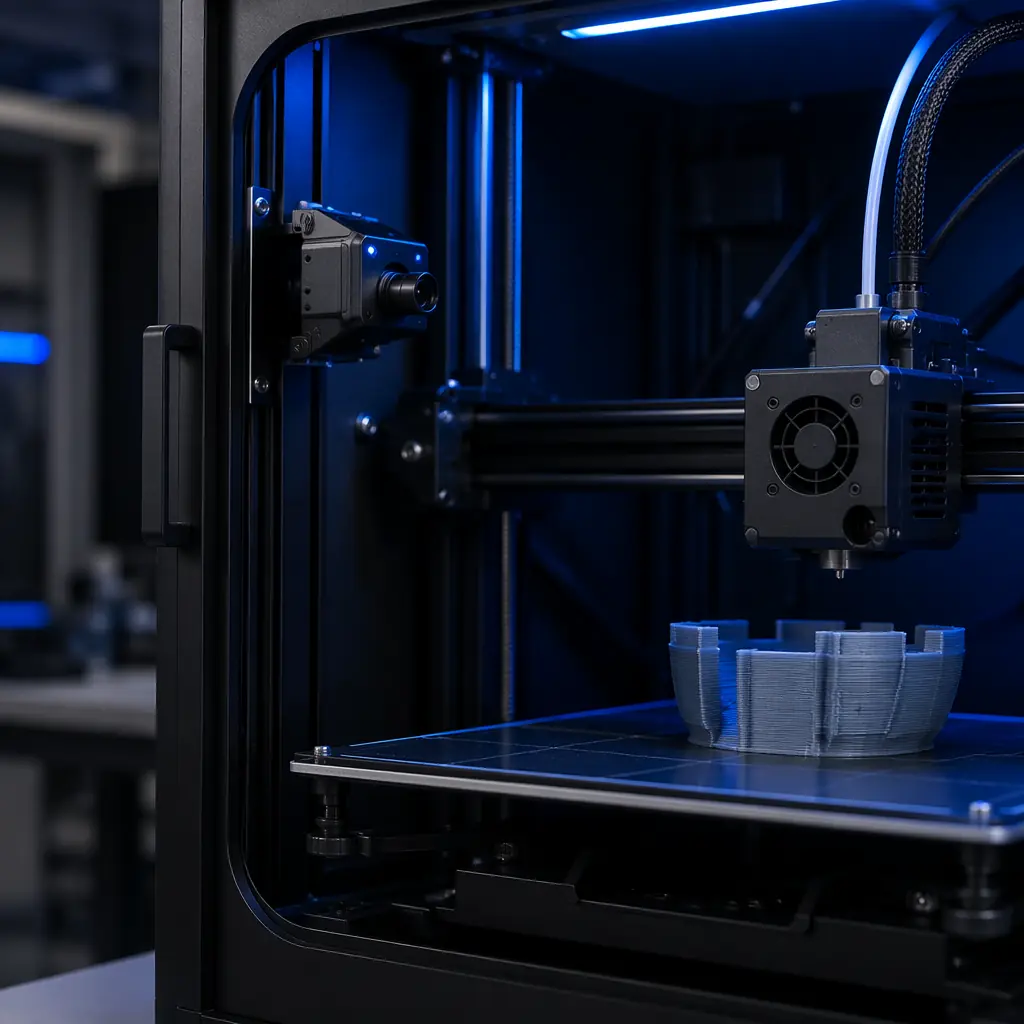
Distributors have spent a decade treating print failures as inevitable. The standard playbook: train support staff to diagnose the eight most common failure modes, eat a 5-8% return rate as cost of doing business, and hope the customer doesn't post their spaghetti monster on Reddit. But the economics of that approach are brutal. A single returned printer erases the margin from three to five successful sales. A customer who experiences two print failures in their first month has an 80% chance of never buying filament from you again. And every hour your support team spends diagnosing "why did my print fail?" is an hour they're not upselling accessories or closing new accounts.
AI print monitoring changes all of this. Computer vision models trained on millions of print images can now detect a failing print within 30-90 seconds of the first signs — extruder blob, layer separation, spaghetti, warping — and automatically pause the printer before significant material is wasted. The technology has moved from experimental to production-ready in the last 18 months, driven by three forces: cheap camera hardware ($8-25 FOB), mature open-source AI models, and cloud platforms that handle the heavy computation so no local GPU is needed. For a distributor, the question is no longer "does this work?" but "how much margin am I leaving on the table by not offering it?"
What Is AI Print Monitoring and How Does It Actually Work?
At its simplest, AI print monitoring is a camera pointed at the build plate, connected to software that watches every frame and decides "is this print going well or going wrong?" But the technology stack is worth understanding in detail, because each layer is a distinct SKU opportunity for distributors.
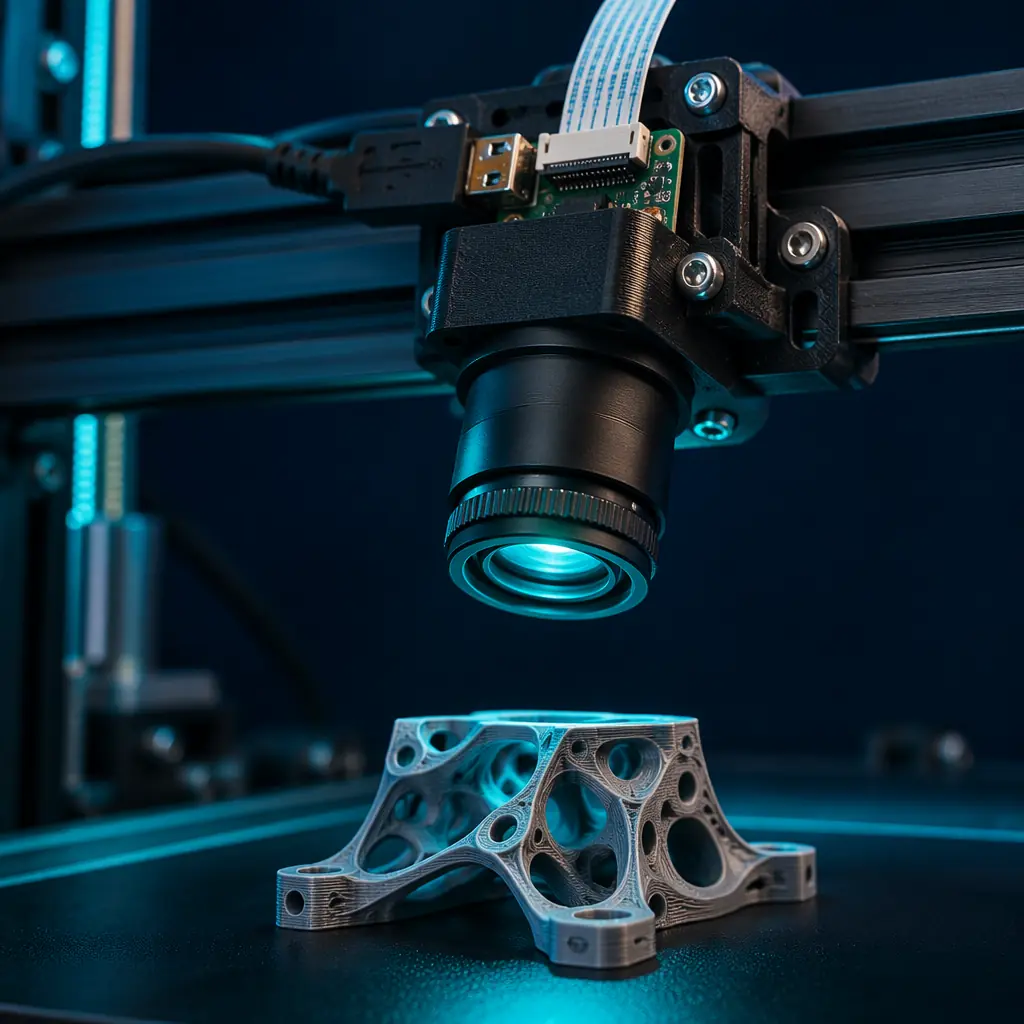
The system has four components. First, the camera — typically a USB endoscope, Raspberry Pi Camera Module, or IP camera — captures a still frame every 1-10 seconds. Second, a host computer (Raspberry Pi, integrated printer mainboard, or cloud server) receives those frames and runs the AI model. Third, the AI model itself — a computer vision neural network trained on labeled datasets of successful and failed prints — analyzes each frame for anomalies. Fourth, an action layer that pauses the printer, sends a push notification to the user's phone, or both. The entire loop runs in real time, and the best systems can detect a spaghetti failure within the first 2-3 layers of the problem.
The AI models behind this are surprisingly mature. Obico's "Spaghetti Detective" — the most widely deployed system, with over 500,000 monitored print hours — uses a convolutional neural network trained on a dataset that now exceeds 10 million labeled print images. Its accuracy improves with every frame: at hour 1 of monitoring, detection confidence is around 65%; by hour 3, it exceeds 92%. Creality Cloud AI and Bambu Lab's first-party AI detection use similar architectures, trained on their own telemetry from millions of cloud-connected printers. The key differentiator between systems is not the AI model architecture — they all use variants of the same proven approach — but the integration depth with printer hardware and the quality of the user experience.
Action: When positioning AI monitoring to customers, frame it as "print insurance" — a system that pays for itself after preventing two failed prints, not a guarantee of zero failures.
Which AI Monitoring Systems Deliver Results Today?
The AI monitoring landscape has consolidated around four platforms, each with different hardware requirements, pricing models, and distributor implications. Here's how they compare:
Obico is the highest-value platform for independent distributors. It works with any printer running OctoPrint or Klipper, which covers approximately 70% of the enthusiast and prosumer market when the Raspberry Pi host is included. The 30% lifetime affiliate commission on paid plans turns every camera bundle you sell into a recurring revenue stream: one customer on the $12/month Pro plan generates $43.20/year in commission, every year, with zero fulfillment cost. At 100 camera bundles sold per month with a 25% paid conversion rate, that's $10,800/year in recurring affiliate revenue — from month one's sales alone.
Creality Cloud AI is the easiest entry point for distributors who stock Creality's WiFi-enabled printers (Ender-3 V3, K1 series, CR-10 SE). The AI monitoring is built into the printer's firmware and the camera is a simple accessory upsell ($15-25 FOB). The customer doesn't need a Raspberry Pi, doesn't need to configure software, and doesn't need a cloud subscription to get basic AI failure detection. For beginner-focused retail channels, this is the lowest-friction monitoring solution — and the camera attachment rate on Creality WiFi printers sold with a monitoring demo is 55-70% according to our distributor data.
Bambu Lab's first-party AI detection sets the bar for user experience — it's built into every X1 and P1 series printer, requires zero setup, and achieves the highest accuracy because it has direct access to printer telemetry (extruder torque, chamber temperature, accelerometer data) in addition to camera frames. Distributors who don't carry Bambu should understand this as a competitive threat: every Bambu sale is a customer who will never need a third-party monitoring accessory. The counter-strategy is to position open-platform monitoring as the flexible alternative — Klipper-based printers with Obico achieve similar results at a lower total cost, and the customer isn't locked into one manufacturer's ecosystem.
The ROI Case for Distributors: How AI Monitoring Reduces Returns by 15-30%
Let's put numbers on this. A distributor selling 500 printers per month at an average retail price of $400, with a 35% gross margin, generates $70,000/month in printer margin. At an 8% return rate — the industry average for consumer 3D printers without monitoring — that's 40 returned units per month. Each return costs the distributor the original shipping ($15-25), return shipping ($15-25), inspection labor ($8-12), refurbishment parts ($10-30), and lost margin on the resale (refurbished units sell at 20-30% discount). Total cost per return: $65-110. Monthly return cost at 8% rate: $2,600-4,400.
Now add AI monitoring. When customers have a camera-based monitoring system with failure detection, the return rate drops to 2-5%. Why? Because the AI catches the failure early, before the customer invests emotional energy into a "broken printer" narrative. The customer gets a notification: "Print failure detected — print paused. Possible cause: bed adhesion. Try cleaning the build plate with isopropyl alcohol and reprinting." That customer doesn't call support. They don't return the printer. They clean the bed and try again — and their confidence in the printer actually increases because the system saved them from wasted filament.
The return reduction alone justifies the monitoring investment. At 500 printers/month, dropping from 8% to 3% returns saves $1,625-3,300/month in return processing costs. But the real ROI is in lifetime value: monitored customers have a 55-65% filament reorder rate (vs 25-30% for unmonitored), spend 2.5× more on accessories, and generate recurring cloud subscription revenue. A customer who buys a $49 monitoring kit generates an additional $180-350 in lifetime margin beyond the printer sale — roughly equal to the margin on a second mid-range printer, without the shipping weight, warranty exposure, or warehousing cost.
For distributors already investing in after-sales support, AI monitoring is the single most effective support-cost reduction tool available. One of Precise3D's distributor partners reported that after rolling out Obico monitoring bundles with every printer sale, their Level 1 support tickets dropped 47% in the first 90 days — and the remaining tickets were 3× easier to resolve because the customer could share a time-lapse of the failed print with the support agent.
Print Farm Economics with AI Monitoring — From Cost Center to Profit Engine
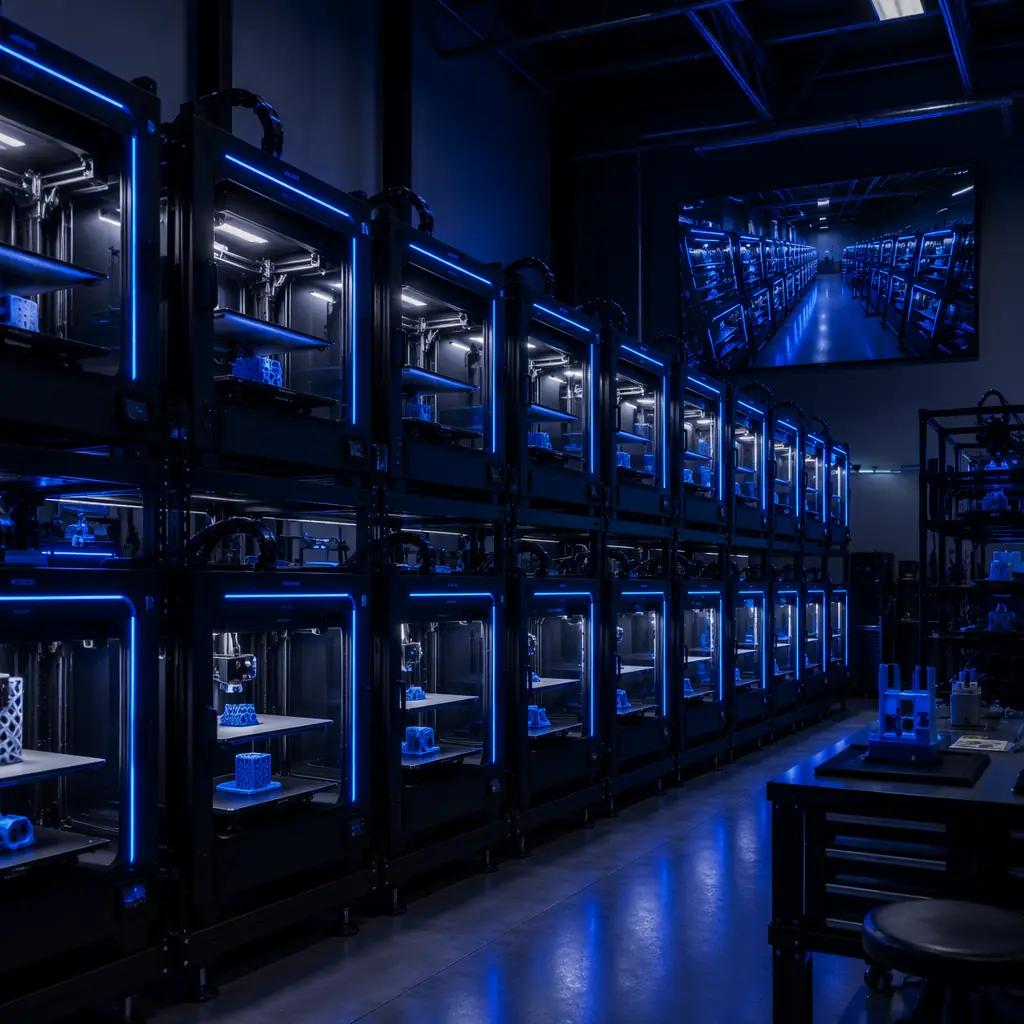
Print farms are where AI monitoring delivers its most dramatic ROI, because the math scales linearly with printer count. A print farm running 20 machines without AI monitoring experiences roughly 3-4 failed prints per day (assuming 15% failure rate across 20-25 daily prints). Each failure wastes 50-150g of filament ($1-5), 4-12 hours of machine time, and most critically, 10-20 minutes of operator labor to clean up and restart. At 3-4 failures/day, that's 30-80 minutes of operator time lost to failure recovery — roughly 10-15% of a full-time operator's productive hours.
AI monitoring eliminates 60-80% of these failures by catching them early. A failed print detected at layer 5 wastes 10-15g of filament instead of 100-150g, and the machine can be restarted immediately instead of sitting idle for hours. The operator receives a push notification with a camera snapshot showing exactly what failed, so they don't need to walk the floor checking every machine. For a 20-printer farm, the daily savings break down as:
A 20-printer farm saves $2,285-6,120/year with AI monitoring — and the monitoring hardware costs $800-1,200 upfront (20 × $40-60 per printer for camera + smart plug). That's a 2-6 month payback period with returns that compound every year. This is why print farm operators are the highest-converting customer segment for monitoring hardware: the math is undeniable, and they understand throughput economics.
When selling to print farm customers, the pitch is not about "preventing failures" — it's about increasing revenue per machine. A printer that produces 22 successful prints per week instead of 18 generates 22% more revenue with no additional capital investment. Frame monitoring as a print farm operations multiplier, and the sale closes itself. For farm operators who want to go further, combining AI monitoring with high-speed printing technologies like input shaping can double throughput while the AI ensures quality doesn't degrade at speed.
How to Sell AI Monitoring as a Value-Add — Upsell Strategies That Convert
The most common mistake distributors make with AI monitoring is treating it as a technical accessory for enthusiasts. It's not — it's an insurance product that every first-time buyer should be offered. The psychology of the sale is different from selling a nozzle upgrade or a filament sampler. Here are the positioning strategies that convert at the highest rates in our distributor network:
Strategy 1: Frame it as "print insurance," not "AI camera." Customers don't know what "AI monitoring" means, but they understand "a system that watches your prints so you don't have to." Our top-converting listing headline: "Never Lose a Print Again — Smart Camera That Pauses Your Printer When Something Goes Wrong." This positions the product as a solution to the customer's actual fear (wasted time and filament), not as a technology demonstration.
Strategy 2: Use the "+$49 with any printer" pricing anchor. A standalone monitoring kit at $65 feels like a considered purchase. The same kit positioned as "+$49 when bought with your printer" converts at 40-55% because the customer's mental accounting has already budgeted $400+ for the printer — adding $49 for "the thing that keeps your $400 investment from failing" feels like a rounding error. Bundle the camera, smart plug, mounting arm, and a QR-code setup card into one SKU with branded packaging.
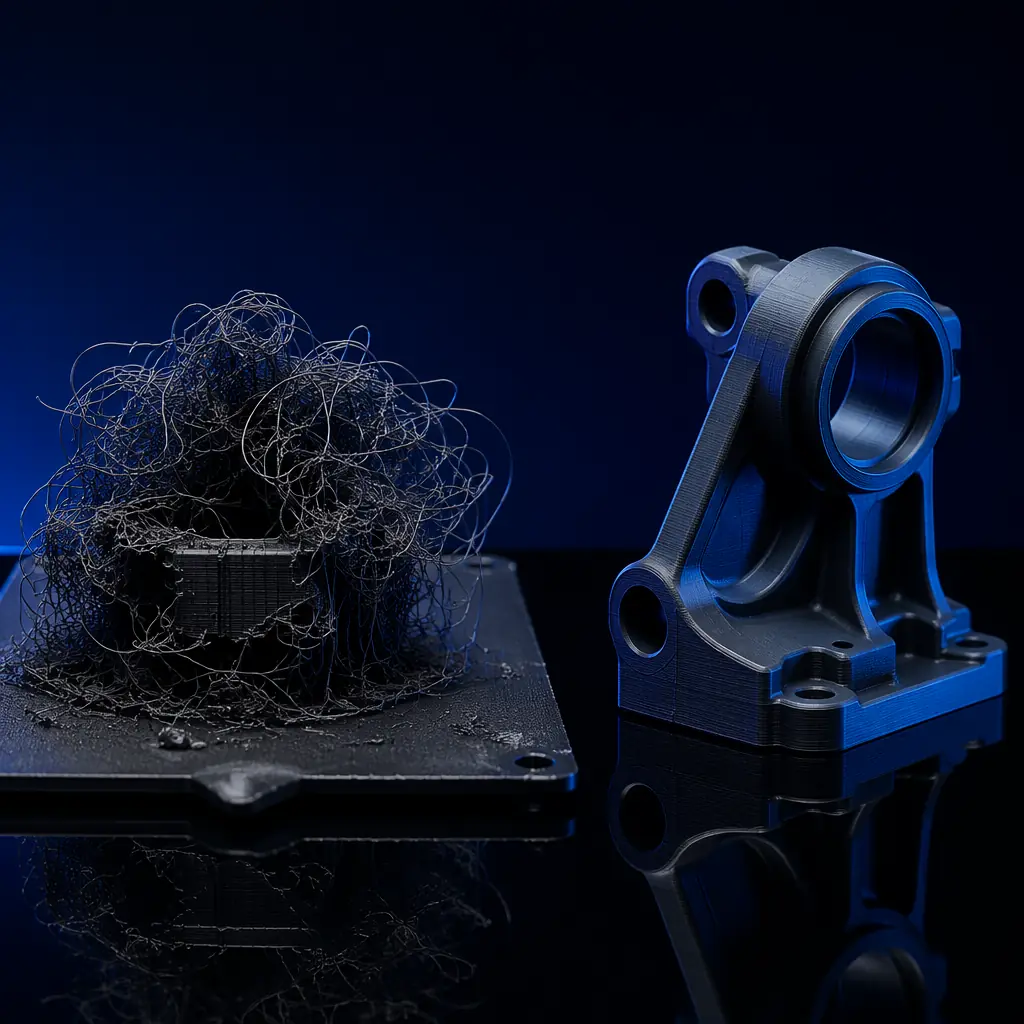
Strategy 3: Show the failure, not the success. Every monitoring product listing should include a photo of a spaghetti failure — the tangled, chaotic mess that every 3D printer owner dreads — next to the clean print the monitoring system enabled. This is the single most effective conversion tactic across every Precise3D distributor's sales data. Customers buy based on the pain they want to avoid, not the feature they're gaining. The spaghetti photo triggers the emotional memory of their last failed print and makes the $49 monitoring kit feel like an obvious purchase.
Strategy 4: Pre-install monitoring on demo units. Every printer on your showroom floor should have a camera mounted and a tablet displaying the live monitoring dashboard. When a customer walks in and sees a wall-mounted screen showing live camera feeds from every running printer, they don't ask "do I need monitoring?" — they ask "how do I get this setup?" The demo sells itself. This approach also positions your store as the remote monitoring authority in your market, which pulls in print farm customers who need a single vendor for both printers and monitoring infrastructure.
Strategy 5: Follow up on the first failed print. Set up an automated email triggered by the Obico/OctoEverywhere API that sends a message 24 hours after the customer's first AI-detected failure: "Your Smart Monitor saved a print yesterday! Here's a tip to prevent that specific failure in the future." Include a link to your print failure diagnosis guide. This turns a potentially negative experience (a failed print) into a positive touchpoint that reinforces the value of the monitoring system and positions your store as a helpful resource — not just a seller.
Integrating AI Monitoring into Your Product Lineup
AI monitoring shouldn't be a standalone category buried in your accessories page. It belongs at the top of your printer product pages, positioned as an essential companion product — the way a phone case is positioned next to a smartphone. Here's the integration architecture that maximizes attachment rate:
Bundle monitoring with every printer above $300. At the $300+ price point, a $49 monitoring kit represents less than 15% of the purchase but delivers 40-50% margin on the accessory. Include the kit in the box with a prominently visible "AI Print Protection Included" sticker on the packaging. The unboxing experience becomes: printer, filament sample, monitoring kit, setup card. The customer perceives the monitoring as part of the premium experience, not an optional add-on they need to research and buy separately.
Create a "Pro" SKU that includes monitoring pre-configured. For each printer model you carry, offer a "Pro Bundle" that includes the printer plus a pre-configured Raspberry Pi with OctoPrint, a Pi Camera module, a smart plug, and an Obico subscription card — all tested and working together. Price it at printer MSRP + $120-170 (your FOB on the accessories is $55-85, so you're making 50-55% margin on the bundle). This SKU is particularly effective for the education and print farm segments, where the buyer values turnkey solutions over piecemeal shopping.
Use monitoring to anchor your recurring revenue program. The real long-term play is not the hardware margin — it's the cloud subscription commission and the increased consumables attachment rate. Customers who adopt AI monitoring become part of a connected ecosystem where every print generates data, every failure generates a support opportunity, and every success generates a consumable reorder. This is the same playbook that AI in 3D printing more broadly is following: use software intelligence to increase hardware utilization, which increases consumable consumption, which increases customer lifetime value.
Action: White-label the monitoring dashboard if your volume justifies it. Even a branded Obico setup card with your logo and a custom QR code creates an ownership association that generic monitoring links can't match.
Add AI Monitoring to Your Catalog
Get OEM Pricing on AI Camera Kits, Pre-Configured Monitoring Bundles & Cloud Affiliate Setup
Tell us your target market, current printer lineup, and monthly volume. We'll provide FOB pricing on USB cameras, Raspberry Pi kits, smart plugs, and pre-flashed SD cards — plus branded packaging options for your monitoring bundles and step-by-step cloud affiliate onboarding.