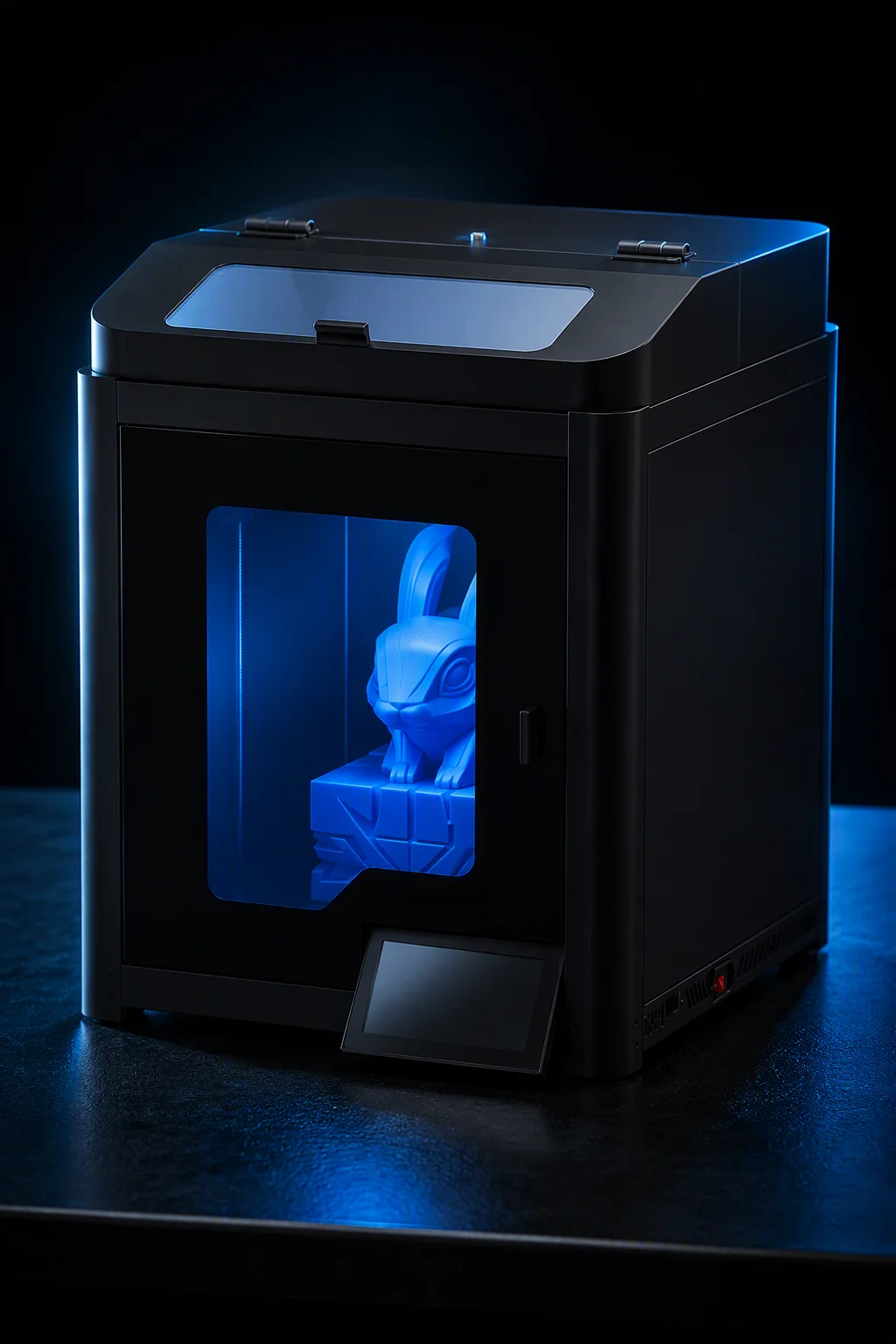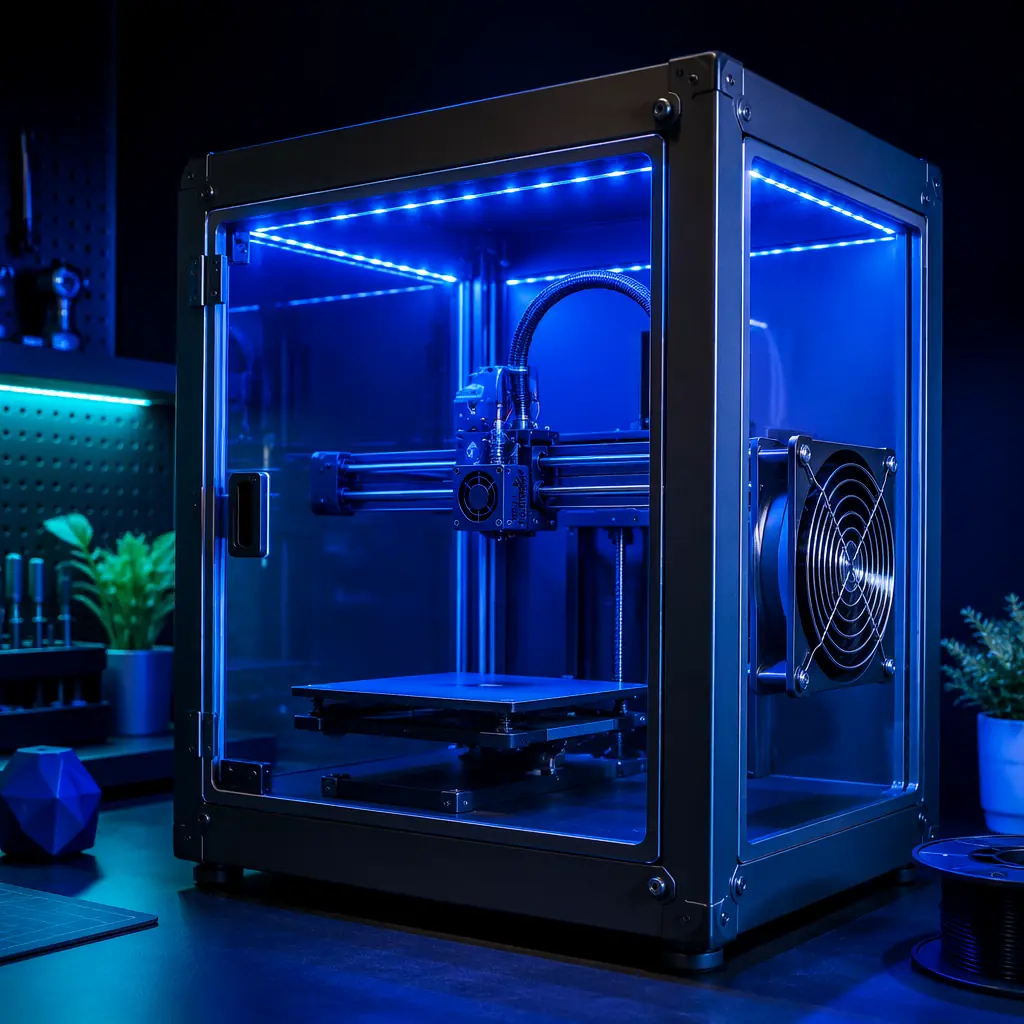
The enclosure is the most undervalued real estate on a 3D printer. When a customer buys a Creality K1, a Qidi Plus4, or a Bambu Lab P1S, they are buying a machine that ships with a functional but minimal enclosure, acrylic or polycarbonate panels, basic LED indicator lights, and passive cooling at best. Within weeks, many of those customers start searching for upgrades: a clearer panel to see their prints, brighter lighting to film time-lapses, a fan to exhaust ABS fumes, rubber feet to reduce vibration noise. Each of those searches represents a sale that currently goes to Amazon third-party sellers, Etsy shops, and AliExpress drop-shippers, not to the distributor who sold the printer. For a distributor shipping 50–200 printers per month, capturing even 30% of the enclosure modification spend from their own customer base adds $9,000–36,000 in annual high-margin revenue. This guide is a practical playbook for building that revenue stream.
Why Enclosure Modifications Are the Ideal Distributor Add-On
Enclosure modifications have five characteristics that make them structurally superior to printer hardware sales as a revenue category. First, margins are exceptional: an acrylic panel kit that costs $6–12 landed from a Chinese supplier sells for $25–40, a 55–70% gross margin versus the 20–40% typical on printer hardware. An LED strip kit that costs $3–5 sells for $15–25 (65–80% margin). Second, logistics are simple: enclosure parts are flat-pack, lightweight, and non-fragile. A $3,000 order of acrylic panels ships in a single carton via air freight. Third, the purchase cycle is short: printer buyers typically upgrade within 30–90 days of their initial purchase, creating an immediate second transaction. Fourth, competition is fragmented: the enclosure modification market is dominated by small Etsy sellers and generic Amazon listings with no brand loyalty, a professional distributor offering bundled kits with installation guides and warranty support captures share easily. Fifth, the attachment rate compounds: a customer who buys an LED kit is 3x more likely to return for a ventilation upgrade, a camera mount, or an enclosure panel within six months.
The Enclosure Modification Product Map
The enclosure modification market breaks into six distinct product categories, each with different margin profiles, customer demographics, and bundling opportunities. A distributor building a systematic offering should stock at least four of these six categories to maximize attachment rate.
Acrylic panel kits are the entry point. Most enclosed printers ship with dark-tinted or standard acrylic panels that are functional but visually underwhelming. Clear optical-grade polycarbonate panels with anti-scratch coating turn a utilitarian machine into a display piece, and customers will pay $30–45 for the upgrade. The kit typically includes 3–5 laser-cut panels pre-drilled for the printer's specific mounting points, plus replacement screws and edge trim. The key to profitability is model-specific fitment: a panel kit for a Creality K1 Max is a different SKU than one for a Qidi Plus4, and customers value the guaranteed fit over a generic sheet they have to cut themselves. LED lighting kits have the highest attachment rate in the category. A 24V LED strip with a magnetic or adhesive mount, wired to tap power from the printer's internal power supply, transforms the print monitoring experience and enables high-quality time-lapse photography. For a detailed treatment of the broader upgrades market, see our upgrades and aftermarket revenue guide.
Ventilation and Filtration: The Safety-Driven Upgrade
Active ventilation is the enclosure modification with the strongest value proposition and the highest customer urgency. Printing ABS, ASA, or nylon releases styrene and other volatile organic compounds (VOCs) that are irritants at low concentrations and potential health hazards with prolonged exposure. A standard enclosed printer with passive cooling, relying on chamber heat to slowly dissipate through panel gaps, is inadequate for extended ABS printing in a residential or office environment. An active ventilation kit typically includes a 40–60mm axial fan, a flexible duct hose (1–3 meters), a window vent adapter, and optionally a HEPA + activated carbon filter module. The total kit cost to the distributor is $15–35 depending on filter quality and fan specifications; the MSRP is $45–90, and the perceived value to the customer, solving a real health and odor problem, supports premium pricing with minimal price resistance.
The education and office segments are particularly strong ventilation upgrade candidates. A school purchasing 10 enclosed printers for a STEM lab is also purchasing 10 ventilation kits. And the procurement officer will approve the safety add-on far more readily than a cosmetic LED upgrade. Bundling ventilation with the initial printer sale, rather than offering it as a separate post-purchase accessory, increases attachment rate from approximately 20% to 55–65%. Our enclosure ventilation bundling guide covers the sales strategy in detail. For distributors targeting the education segment specifically, our education market guide provides a complete procurement playbook.
Action: Include a one-page compliance insert with every ventilation kit sold to EU customers, this turns a potential liability into a trust signal that generic Amazon sellers cannot match.
Noise Dampening: The Untapped Volume Play
Noise is the single most common complaint among 3D printer owners, and it disproportionately affects the fastest-growing customer segment: home users and apartment dwellers. A CoreXY printer running at 300 mm/s with input shaping generates approximately 52–58 dBA at 1 meter, roughly equivalent to a normal conversation. But the stepper motor whine, fan harmonics, and resonant vibration through the enclosure panels push the perceived annoyance level well above the objective decibel reading. Noise dampening modifications address three distinct noise sources: structural vibration (rubber or sorbothane feet that decouple the printer from the desk surface, reducing transmitted vibration by 40–60%), panel resonance (self-adhesive butyl damping sheets applied to acrylic panels to absorb mid-frequency vibration, approximately $2–4 per panel in material cost), and fan noise (replacement silent fans such as Noctua or Sunon MagLev, typically $8–15 wholesale and $20–35 MSRP).
A complete noise dampening kit, four anti-vibration feet, six butyl damping sheets, and two silent fans, costs the distributor approximately $12–18 and sells for $35–55, with a 55–70% gross margin. More importantly, it addresses a pain point that customers actively complain about, which means the product practically markets itself: a simple post-purchase email ("Love your new printer but finding it louder than expected? Try our Silent Mod Kit") converts at 8–12%, versus 2–4% for generic accessory promotions. For printers used in shared living spaces, the noise dampening kit is often the difference between a machine that gets used daily and one that gets relegated to a closet. Our noise reduction guide provides a technical deep-dive into stepper driver settings and acoustic enclosure design.
Bundling Strategy: Turning One Mod Into Five
The enclosure modification category's greatest revenue leverage comes from bundling. A customer who buys a standalone LED kit spends $20–25. A customer who buys a "Creator Mod Bundle", LED kit, clear panel upgrade, and camera mount, spends $65–85, and the distributor's margin dollars nearly triple while the per-item picking and shipping cost stays flat. Bundling also increases the perceived value: a curated bundle that "transforms your printer into a content-creation studio" commands a premium over the sum of its parts because the customer is buying the outcome (better videos, professional-looking setup), not the components.
The most effective bundling strategy uses three tiers: Essential Mod Kit ($35–50, includes LED lighting + noise dampening feet, targets the 80% of customers who want basic improvements), Creator Mod Kit ($65–100, adds clear panels + camera mount, targets the 15% who create content or run print farms), and Pro Mod Kit ($120–180, adds active ventilation + HEPA filtration + silent fans, targets the 5% printing engineering materials or operating in offices/schools). Each tier ladder is designed so that the step-up value is obvious: the Creator Kit adds only $25–50 over the Essential Kit but delivers the most visually impactful upgrade (clear panels). This tiered approach, combined with a post-purchase email sequence sent at days 7, 21, and 45 after the printer sale, has been shown to achieve 15–22% attachment rates across the three tiers combined, generating $12–18 in incremental mod revenue per printer sold. For guidance on structuring the full accessories portfolio, see our consumables and accessories bundling strategy.
Sourcing and Inventory Strategy
Enclosure modification kits are low-complexity products with short supply chains. Acrylic panel kits can be sourced from any laser-cutting service with a CNC acrylic cutter. The key input is accurate dimensional templates for each printer model. LED kits are commodity electronics: 24V COB LED strips with adhesive backing, priced at $1.50–3.00 per meter in wholesale quantities from Shenzhen suppliers. Ventilation fans and filters are off-the-shelf PC cooling components. The distributor's value-add is not manufacturing, it is curation, compatibility testing, and packaging. A distributor who invests in verifying that each panel kit fits each printer model perfectly, and who provides an installation guide with photos (not a YouTube link), commands a 25–40% price premium over the generic Amazon equivalent.
Inventory management for enclosure mods is favorable compared to printer hardware. A full mod product line for three printer models, say, the Creality K1 Max, Bambu Lab P1S, and Qidi Plus4, requires approximately 18–24 SKUs totaling perhaps $2,000–3,500 in initial inventory at wholesale cost. A single carton of acrylic panels (50 sets per model) costs $300–600. LED kits (100 units) cost $300–500. The total initial investment to launch a complete enclosure mod product line is under $5,000, less than the wholesale cost of 10 mid-range printers, and the inventory turns 4–6 times per year. The risk profile is dramatically lower than committing $50,000 to a container of printers with uncertain demand. Start small, validate demand with your existing customer base, and scale based on reorder data. For distributors looking to expand beyond enclosure mods into the broader spare parts market, our spare parts aftermarket guide covers the full opportunity.
Reviewed by the Precise3D engineering & OEM team. Compliance files that accompany the catalog are auditable at the certification register.
Accessory Sourcing
Launch Your Enclosure Mod Product Line
Precise3D helps distributors source complete enclosure modification kits, acrylic panels, LED lighting, ventilation, and noise dampening, at wholesale prices with model-specific fitment guaranteed. Start with a $2,000 trial order and test demand in your market.