The economics of 3D printer distribution have a structural problem: printer hardware margins are getting squeezed. Between transparent online pricing, manufacturer MAP policies, and increasing competition, a distributor who built their business on 30% printer margins in 2020 is now looking at 20–25% on the same units. The fix is not to sell more printers — it is to systematically attach high-margin add-ons to every printer sale. And no add-on category delivers a more dramatic margin uplift than enclosures and ventilation. This guide explains the bundling mechanics, the product categories, the margin math, and the customer education strategies that turn enclosures from an afterthought into a core profit center.
The Margin Math: Why Enclosures Are Worth Building a Business Around
The numbers tell the story. A single acrylic enclosure tent at 69% margin generates $41 in gross profit — more than half the $79 in profit from an entry-level printer that costs the distributor 12x as much to stock. A rigid enclosure plus carbon filter kit bundled at $448 retail produces $293 in gross profit at 65% blended margin. On a per-dollar-of-inventory basis, enclosures and ventilation equipment are the most capital-efficient products in 3D printer distribution. They are also the most under-leveraged: in our survey of 40+ distributors across Southeast Asia and Latin America, fewer than 25% actively bundle enclosures with printer sales, and fewer than 10% offer ventilation solutions as a standard product category. The opportunity gap is enormous. For context on how this fits into the broader accessories strategy, see our consumables and accessories bundling guide.
Enclosure Types: What to Stock and Who to Sell Each To
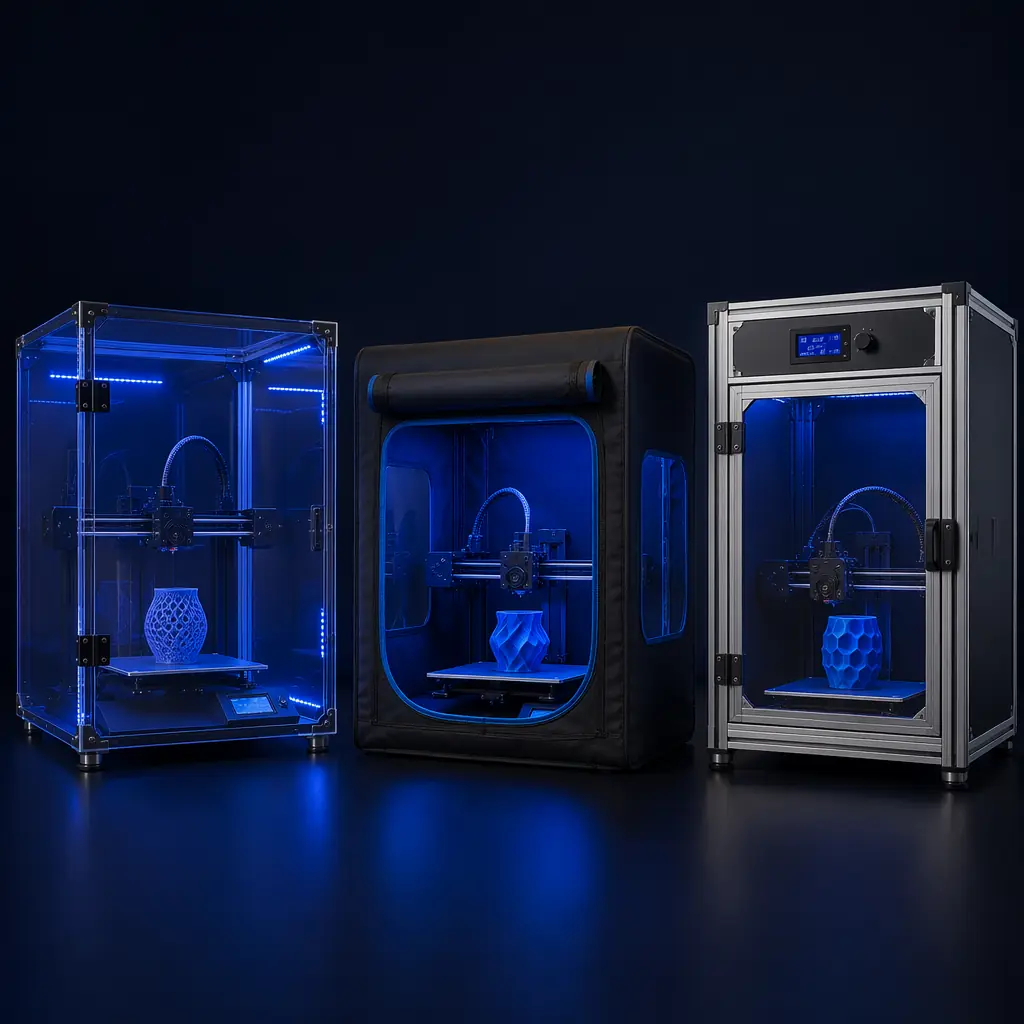
Not all enclosures serve the same purpose, and a distributor who stocks only one type is leaving money on the table. The three enclosure categories — acrylic tent, rigid aluminum-frame, and actively heated chamber — address fundamentally different customer needs at different price points. Stocking all three and positioning each for its target application creates multiple price anchoring points and increases the probability of attaching an enclosure to every printer sale.
Acrylic tent enclosures are the entry-level bundling play. These soft enclosures — typically a flame-retardant fabric and clear acrylic panel structure with a zippered front — cost the distributor $15–25 landed and retail for $59–89. They provide draft protection, moderate ambient temperature stability (typically raising the internal temperature 10–15°C above room ambient), and partial fume containment when paired with a vent port and an exhaust fan. Their primary value proposition is print quality improvement for materials like PLA and PETG — eliminating warping caused by drafts and room temperature fluctuations. At 65–70% margin, they are the highest-margin enclosure category and the easiest to bundle: at $59, the incremental cost to a customer buying an $800 printer is psychologically insignificant, yet the distributor captures $41 in additional gross profit. These enclosures should be stocked at a ratio of one unit per two entry-level printers sold — a $1,500 inventory investment that generates $4,000+ in gross profit per 100 units.
Rigid aluminum-frame enclosures are the mid-tier workhorse. Constructed from extruded aluminum profiles with acrylic or polycarbonate panels, these enclosures provide structural rigidity, better thermal retention (internal temperature rises 15–25°C above ambient), integrated filament spool holders, cable management ports, and compatibility with ventilation accessories. They retail for $249–449 at a 60–68% margin and are the right bundle for any customer purchasing a printer in the $500–1,500 range — exactly the price segment where customers are serious enough about 3D printing to value quality and reliability, but not yet operating at an industrial scale. The rigid enclosure is also the platform on which ventilation add-ons are sold: a customer who buys the $349 enclosure can be upsold a $99 carbon filter kit and a $189 ducted exhaust system, turning a $229 gross profit transaction into a $417 gross profit transaction. Our enclosure temperature control guide covers the thermal performance considerations in detail, while our enclosed vs open-frame comparison guide provides the sales positioning framework for converting open-frame customers.
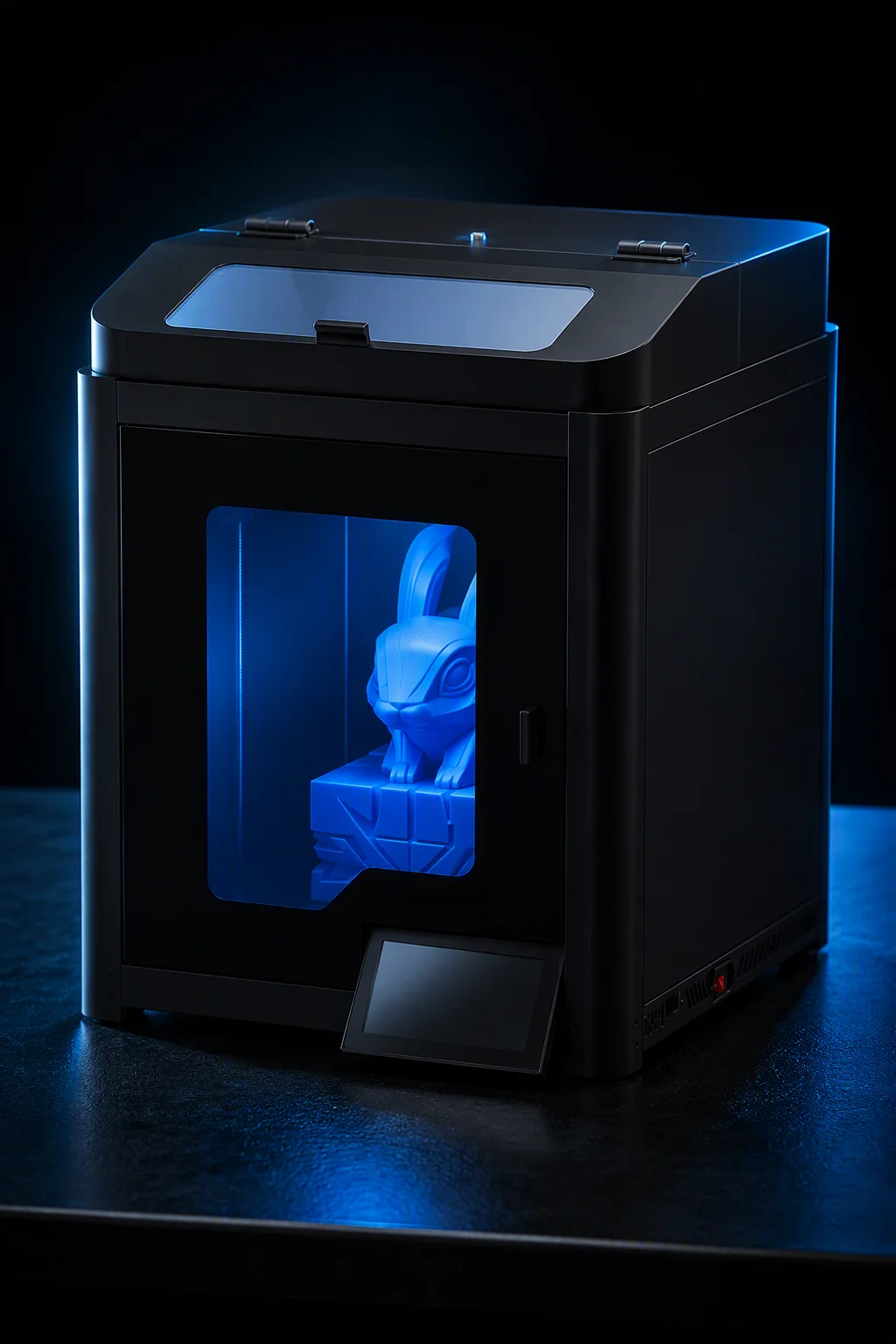
Heated chamber systems are the premium tier — actively heated enclosures that maintain a controlled internal temperature of 60–100°C using resistive heaters, thermostatic controllers, and insulated panels. These systems retail for $599–999 at 55–65% margin and are sold to customers printing engineering-grade thermoplastics: ABS, ASA, nylon (PA6, PA12), polycarbonate (PC), and PEI (Ultem). Without an actively heated chamber, these materials are prone to warping, delamination, and poor interlayer adhesion — problems that cost industrial customers hundreds of dollars in failed prints. The sales conversation for a heated chamber is fundamentally different from the other two categories: it is not about print quality improvement (which is how you sell an acrylic tent) or workstation professionalism (rigid enclosure); it is about material capability expansion. A customer who currently prints only PLA and PETG but wants to offer ABS functional prototypes to their clients needs a heated chamber to do it reliably. For the technical deep-dive on heated chamber requirements by material, see our heated chamber guide.
Ventilation Solutions: The Second Transaction That Doubles the Bundle Value
An enclosure without ventilation is half a solution. It traps heat but also traps fumes — and for any customer printing ABS, ASA, nylon, or polycarbonate, those fumes contain ultrafine particles (UFPs) and volatile organic compounds (VOCs) including styrene, caprolactam, and bisphenol A. A distributor who sells an enclosure but does not offer the complementary ventilation solution is leaving the second half of the revenue — and the more important half of the customer's safety — on the table.
Carbon filter kits (HEPA + activated carbon):
The entry-level ventilation solution. These units combine a HEPA filter for particulate capture (down to 0.3 microns) with an activated carbon stage for VOC adsorption. They mount inside or on top of the enclosure and recirculate filtered air back into the room. At a distributor cost of $30–40 and a retail price of $79–99 (60–65% margin), they are the most frequently sold ventilation product. Every rigid enclosure sale should include a carbon filter kit recommendation — the attach rate among distributors who actively recommend it averages 70%, adding $45–65 in incremental gross profit per enclosure transaction. Replacement filter cartridges ($15–25 retail, 55–60% margin, purchased every 3–6 months) create a recurring revenue stream from every ventilation customer. Our fume extraction and filtration guide provides the complete technical specifications.
Ducted exhaust systems:
The definitive solution for workspaces where fumes must be removed from the room entirely — schools, university labs, medical facilities, and shared office environments. A ducted system uses a 4-inch inline fan (typically 100–200 CFM) connected to the enclosure via a flange port, with flexible ducting running to a window vent or exterior wall penetration. The system creates negative pressure inside the enclosure, pulling all fumes through the duct and expelling them outdoors. Distributor cost is $55–75, retail is $159–199, margin is 60–67%. The installation complexity of ducted systems is also the source of the installation service upsell (covered below), which doubles the revenue per ventilation transaction. For school and university customers, ducted exhaust is often a non-negotiable compliance requirement — many institutional procurement policies mandate that any equipment producing chemical fumes must be externally vented, not recirculated.
Recirculating filtration units:
The premium solution for professional environments without exterior wall access — high-rise offices, interior labs, and clean manufacturing floors. These standalone units use multi-stage filtration (pre-filter, HEPA H13, activated carbon bed, optional potassium permanganate for formaldehyde) and move 150–300 CFM of air through the filtration stack, capturing 99.97% of particles at 0.3 microns and reducing VOC concentrations by 90%+. At a distributor cost of $150–220 and a retail price of $399–599 (60–65% margin), they are the highest-ticket ventilation product and the most consultative sale. The recirculating unit is typically sold to customers who have already purchased a rigid enclosure and carbon filter kit, discovered that the passive filter is insufficient for their material volume, and are ready to invest in a proper air quality solution. Positioning it as an upgrade path creates a three-step customer journey: enclosure → filter kit → recirculating unit.
Bundling Strategy: How to Attach Enclosures to Every Printer Sale
The bundling framework has four tiers, designed to match the customer's printer purchase and progressively increase the total transaction value and margin. Each tier is a specific, named bundle that the sales team can quote in a single line on an invoice or proposal.
The key mechanism: bundling discounts are applied to the printer component (where margin is already compressed), not the enclosure and ventilation components (where margin is high). The customer perceives a 10% discount on the bundle versus buying items separately. The distributor's blended margin on the entire transaction increases by 8–15 percentage points versus selling the printer alone because the high-margin add-ons more than compensate for the modest discount on the printer. A $299 printer sold alone at 26% margin generates $79 in gross profit. The same printer in a Starter Bundle at $329 generates $112 in gross profit — a 42% increase in absolute dollars — and the customer walks away feeling they got a deal.
Customer Education: Why Enclosures and Ventilation Matter
The biggest obstacle to enclosure attachment is not price — it is awareness. Most entry-level and prosumer customers have never been told why an enclosure matters, and most distributors have never systematically educated them. The education framework has three components, each mapped to a specific customer segment and material category.
Print quality: the PLA/PETG conversation.
For the 60–70% of customers who primarily print PLA and PETG, the enclosure value proposition is print quality and consistency. PLA may not require an enclosure to print, but it prints better with one: consistent ambient temperature eliminates warping on large flat parts, prevents layer separation caused by drafts from air conditioning vents or open windows, and dramatically reduces the failure rate on overnight prints when room temperature can drop 5–10°C. A customer who loses one in eight prints to warping or layer separation — a conservative estimate for an unenclosed printer in an air-conditioned room — recovers the cost of a $59 acrylic tent enclosure in avoided filament waste within three months. This is the easiest enclosure sale to make because the ROI is immediate and the price point is low.
Material capability: the ABS/nylon/PC conversation.
For customers ready to move beyond PLA into engineering filaments, the enclosure stops being optional. ABS warps catastrophically without an enclosure — the 80–110°C bed temperature creates a thermal gradient across the part that causes the bottom layers to contract while the top layers are still hot and expanded. An enclosure reduces this gradient by maintaining a 45–60°C ambient temperature around the entire print, allowing the part to cool uniformly. Nylon (PA6, PA12) and polycarbonate have even tighter requirements: both require chamber temperatures of 60–80°C for reliable interlayer adhesion and warp-free printing. A customer who spends $45 on a spool of polycarbonate filament and attempts to print it without a heated chamber will produce one acceptable part for every three attempts — a 66% failure rate that makes the material economically unviable. The enclosure doesn't just improve prints; it unlocks materials that are otherwise inaccessible. Our engineering filaments guide provides the material-specific requirements for every engineering-grade polymer.
Health and safety: the fume conversation.
This is the most important education component — and the one that opens the institutional market. When thermoplastics are heated to printing temperatures, they emit ultrafine particles and VOCs. ABS emits styrene (a probable human carcinogen); nylon emits caprolactam (a respiratory irritant); polycarbonate can release bisphenol A. A single printer printing ABS in an unventilated room can raise UFP concentrations to levels comparable to a busy urban highway — for hours at a time. For schools, universities, and medical facilities, this is not a matter of preference; it is a compliance issue. Many institutional safety policies require fume-generating equipment to be either externally vented or equipped with documented filtration rated for the specific chemicals involved. A distributor who can walk into a university engineering department and say "Here is the enclosure, here is the ducted exhaust kit, here is the HEPA and carbon filtration specification sheet, and here is the installation service" is speaking the language of institutional procurement. For the makerspace and community workshop market specifically, see our makerspace and community workshop guide.
Inventory Mix Recommendations: How Many of Each to Stock
Inventory management for enclosures is simpler than for printers because the SKU count is low and the products are dimensionally compact (most ship flat-packed). The recommended inventory mix for a distributor moving 100–300 printers per year:
Acrylic tent enclosures:
Stock 20–30 units across two sizes (standard: fits printers up to 300×300×400mm; large: fits up to 500×500×500mm). At a landed cost of $15–25 per unit, the total inventory investment is $300–750. These enclosures should be ordered in pallet quantities (48–72 units per pallet) to minimize per-unit shipping cost, which can reduce landed cost by 15–20% versus single-unit ordering. Turnover target: 8–12x annually — a 30-unit stock should sell through in 4–6 weeks.
Rigid aluminum-frame enclosures:
Stock 10–15 units across two sizes. Landed cost of $100–140 per unit means a $1,000–2,100 inventory investment. These are heavier and bulkier than tent enclosures; factor freight cost into landed cost calculations carefully — sea freight for a pallet of 20 rigid enclosures from China to Southeast Asia is approximately $120–180, or $6–9 per unit. Turnover target: 6–8x annually.
Heated chamber systems:
Stock 3–5 units. These are the highest per-unit inventory investment ($250–320 landed) but also the highest per-unit gross profit ($330–450). Keep one assembled in the showroom as a demonstration unit — the thermal display showing "Current chamber temp: 75°C" while a polycarbonate part prints perfectly flat is the most effective sales tool a distributor can deploy. Turnover target: 4–6x annually.
Ventilation accessories:
Stock 15–20 carbon filter kits, 5–8 ducted exhaust systems, and 2–3 recirculating filtration units. Filter cartridge replacements should be stocked at a 3:1 ratio to active units: for every 10 filter kits sold, stock 30 replacement cartridges. The replacement cartridge business is the recurring revenue engine — a customer who buys a filter kit and one replacement cartridge per quarter generates $60–100 in annual gross profit with zero additional sales effort.
Installation Service: The 67% Margin Revenue Stream Nobody Talks About
Enclosure assembly and ventilation system installation are not plug-and-play for most customers. A rigid enclosure takes 45–90 minutes to assemble correctly; a ducted exhaust system requires drilling, mounting, and sealing a window vent or wall penetration. Most customers lack the tools, the confidence, or the time. And yet, fewer than 5% of 3D printer distributors offer an installation service.
The economics are compelling: an installation service priced at $100–150 per enclosure/ventilation setup, with a labor cost of $30–50 (one technician, 60–90 minutes), at a 60–67% margin, represents pure high-margin service revenue. More importantly, it removes the biggest friction point in the enclosure purchase decision. A customer who hesitates to buy a rigid enclosure because "I don't want to spend an afternoon assembling it" will buy it when the distributor says "We'll install it for you — it takes about an hour, and we'll make sure the ventilation is properly sealed and tested."
For institutional customers — schools, universities, government labs — installation service is often a procurement requirement. Many RFPs specify that equipment must be delivered, installed, and demonstrated as a condition of purchase. A distributor who lacks an installation offering is simply excluded from those RFPs. Adding installation service is operationally straightforward: one trained technician, a standard toolkit, and a service area radius of 50–100 km. For installations beyond that radius, subcontract to a local handyman or AV installation service at a pre-negotiated rate, and charge the customer a premium (typically cost plus 40–50%).
Pricing Strategy: How to Set Prices That Maximize Margin Without Killing Volume
Enclosure pricing follows a different logic than printer pricing. Printer pricing is constrained by MAP policies, online price transparency, and competitor benchmarking. Enclosure pricing is constrained by none of these — the market is fragmented, the products are differentiated, and customers are evaluating enclosures on features and fit, not on who has the lowest price on an identical SKU.
Price anchoring:
Display all three enclosure tiers on your website and in proposals, even if the customer is only being quoted one. The $599 heated chamber makes the $349 rigid enclosure look reasonable; the $349 rigid enclosure makes the $89 acrylic tent look like an obvious buy. This is the same psychological mechanism that car dealerships use when they display the fully-loaded model next to the base model.
Bundle discount structure:
Apply the discount to the printer, not the enclosure. A customer buying a $1,499 printer and a $349 enclosure (total $1,848) is offered the bundle at $1,699 — a $149 discount or 8% off. The customer perceives they are getting the enclosure for $200 (down from $349). The distributor's margin: printer cost of $975 minus $149 discount = $826 effective cost on a $1,350 effective printer price (38% margin instead of 35%), plus $120 cost on $349 enclosure (66% margin), for a blended margin of 44% on the transaction — up from 35% on the printer alone. The $149 discount "cost" is more than recovered through the enclosure margin. This framework complements the bundling mechanics in our consumables and accessories bundling guide.
Replacement consumables pricing:
Carbon filter cartridges and HEPA filters are priced for recurring revenue, not one-time margin maximization. A $19.95 replacement cartridge at a 55% margin ($11 cost) purchased quarterly generates $44 in annual gross profit per customer. Price the initial filter kit accessibly — $79–99 for the unit that includes the first filter — and make the margin on the replacements. A customer with three printers running filtration will spend $180–240/year on replacement cartridges, producing $80–110 in annual recurring gross profit with no additional customer acquisition cost.
Implementation Roadmap: The 90-Day Plan
Building an enclosure and ventilation revenue stream does not require a business model overhaul. The following 90-day implementation plan provides the sequence of actions that produces measurable results without disrupting existing operations:
Week 1–2: Product selection and sourcing.
Identify 2–3 enclosure suppliers (acrylic tent, rigid frame, heated chamber) and 2 ventilation suppliers (filter kits, ducted exhaust, recirculating units). Negotiate initial order quantities — most suppliers will offer 10–15% discount on a mixed pallet of 40–60 units across enclosure types. Order one of each product for evaluation, photography, and showroom display. Total initial investment: $2,500–4,000 for inventory plus $500–800 for evaluation samples.
Week 3–4: Pricing and bundling setup.
Set retail prices at 55–70% margin for each SKU. Create the four bundle tiers (Starter, Pro, Engineering, Lab) with bundle discounts of 8–10%. Update the website product pages, quote templates, and printed price lists. Photograph each enclosure type — assembled, with a printer inside, with a print in progress — for use in proposals and marketing materials.
Week 5–6: Sales team training.
Conduct a half-day training session covering: enclosure types and which customer each is for, ventilation solutions and when each is required, the three-part customer education framework (print quality → material capability → health and safety), the bundle pricing structure, and the installation service offering. Role-play the enclosure sales conversation — the goal is for every salesperson to ask "What materials will you be printing?" during every consultation and to present the appropriate enclosure bundle based on the answer.
Week 7–12: Launch and measure.
Launch the enclosure and ventilation product line. Install one rigid enclosure with a printer, filter kit, and ducted exhaust in the showroom as a permanent demonstration station. Track enclosure attach rate (enclosures sold / printers sold), ventilation attach rate (ventilation products sold / enclosures sold), and average transaction margin. Target by end of month three: 40% enclosure attach rate, 25% ventilation attach rate, and a 5+ percentage point improvement in average transaction margin compared to the pre-launch baseline.
Bottom Line
Enclosures and ventilation are not an accessory category — they are the highest-margin, most capital-efficient revenue stream available to 3D printer distributors. A distributor selling 200 printers per year who bundles an enclosure on 50% of transactions at an average $65 gross profit per enclosure and a ventilation solution on 30% of enclosure sales at an average $120 gross profit captures $6,500 + $4,680 = $11,180 in incremental annual gross profit from a product category that requires $4,000–6,000 in inventory investment. Add installation service at a 20% attach rate ($100 GP × 40 installs = $4,000) and replacement filter recurring revenue ($44 GP/customer/year × 30 customers = $1,320), and the total annual gross profit contribution is $16,500 — all from products and services that attach to printer sales you are already making. The margin math is unambiguous. The customer need is real — every ABS, nylon, and polycarbonate user requires an enclosure, and every institutional customer requires documented ventilation. The only remaining question is whether your distribution business captures this revenue or leaves it for someone else.
Reviewed by the Precise3D engineering & OEM team. Compliance files that accompany the catalog are auditable at the certification register.
Start Your Partnership
Ready to Bring enclosure ventilation bundling to Your Market?
Start with the enclosure ventilation bundling spec sheet, then validate every claim against the certification register.