When a makerspace manager contacts a distributor, the conversation starts with floor plans, membership headcounts, grant deadlines, and safety compliance checklists — not "which printer should I buy for my desk." These buyers are equipping a shared production resource used by dozens or hundreds of members, from complete beginners to experienced engineers running multi-day ABS prints. The distributors who understand this segment capture deals worth $15,000–$60,000 per installation — plus five to seven years of recurring consumables revenue.
The Makerspace Buying Pattern: Fleets, Not Units
The defining characteristic of makerspace purchasing is volume. A typical community makerspace or university fabrication lab orders 6 to 20 printers in a single purchase order — enough to create a walk-up-usable print farm keeping wait times under 30 minutes during peak hours. The order is rarely homogeneous: most makerspaces run a mixed fleet with 60–70% workhorse FDM printers for general member use and 20–30% higher-performance machines for advanced users, plus one or two resin printers for high-detail work. This mixed-fleet pattern balances per-unit cost against capability and mirrors the makerspace's tiered membership structure.
The durability expectation is also fundamentally different. A consumer printer might log 200–400 hours per year. A makerspace printer — running 10–14 hours a day with 15–30 different users per week — can accumulate 2,000–4,000 hours annually. Components acceptable in a consumer unit become failure points at this duty cycle: v-wheel motion systems wear out in 6–9 months, cheap thermistors drift, and budget power supplies fail under continuous load. Makerspace buyers increasingly seek distributors who can demonstrate institutional-grade specifications. For motion system durability analysis, see our motion system comparison guide.
Key Requirements: What Makerspaces Actually Need
After reviewing hundreds of institutional RFPs, three requirements surface in virtually every makerspace deal. Distributors who address all three in their initial proposal win at a significantly higher rate than those who lead with price.
Enclosed printers for safety and material versatility:
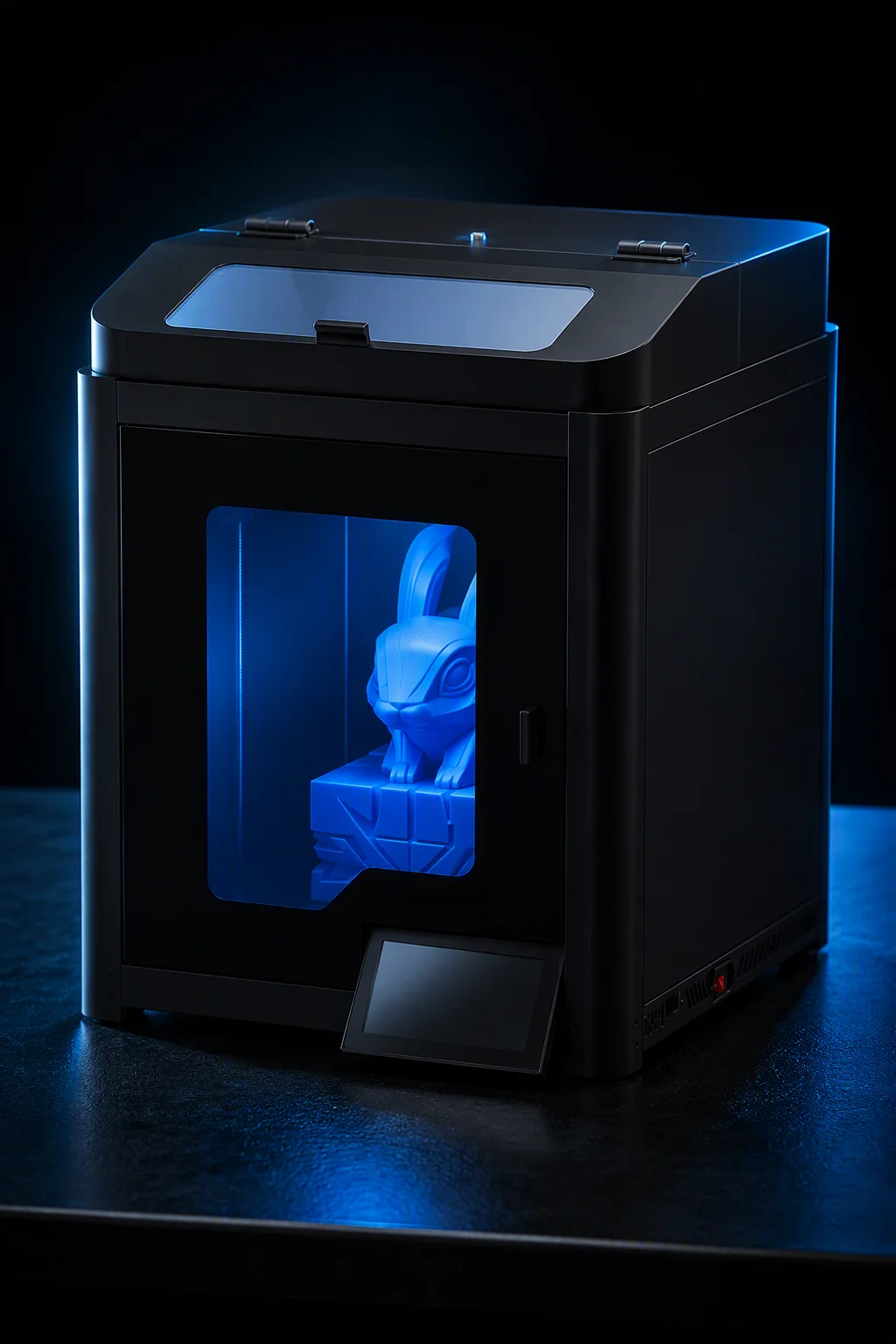
The single most consistent requirement across makerspace RFPs is that every FDM printer must be fully enclosed. Enclosed printers prevent members — especially children and students — from touching hot ends; contain ABS and engineering filament fumes released into shared workspaces; and maintain stable chamber temperatures for print consistency. An open-frame printer in a drafty makerspace produces visibly different results in winter versus summer. For the full case, see our enclosed vs. open frame comparison guide and our fume extraction and filtration safety guide.
Easy maintenance across a fleet:
When a consumer's printer breaks, they troubleshoot one machine. When a makerspace printer breaks, the staff needs to diagnose and repair it in under 30 minutes while members wait. Makerspaces strongly prefer printers with tool-free nozzle changes, magnetic build plates swappable in seconds, belt tensioning knobs, and modular hotend assemblies. The maintenance training needs to cover not just repair procedures but rapid triage: fix it immediately or swap in a spare. Our maintenance guide for distributors covers spare parts inventory and scheduling for institutional accounts.
Standardized consumables across the fleet:
A makerspace does not want to stock six different nozzle types, three build plate surfaces, and four filament diameters. The ideal fleet runs a single nozzle ecosystem, a single build plate standard (magnetic PEI flex plates, identical dimensions), and one filament specification (1.75 mm PLA and PETG from one or two approved vendors). This is an operational necessity. When a member breaks a nozzle on Printer #7 at 8:45 PM, staff needs to grab a replacement and install it by 9:00 PM without checking compatibility charts. Mixed ecosystems create an inventory problem that eats staff hours and member satisfaction.
How Makerspaces Fund Purchases: Grants, Memberships, and Sponsors
Understanding the funding model is critical to winning the institutional deal, because the budget approval process — and the timeline — looks nothing like consumer purchasing. Makerspace printer purchases are funded through three primary channels, and the distributor who can align their proposal with the right channel closes faster.
Grants (40–60% of makerspace printer budgets):
The majority of makerspace printer fleets are partially or fully grant-funded — through federal STEM education grants, municipal economic development programs, state workforce training initiatives, and private foundation grants. Grant-funded purchases have two characteristics: first, the timeline is driven by the grant cycle, meaning 3–6 months between inquiry and purchase order is normal; second, grant applications often require three competing quotes with detailed spec sheets, warranty terms, and training plans. Distributors who provide a grant-ready proposal packet survive the competitive-quote process far more often than those who send a price list and a brochure. For the education segment specifically, see our education and university distributor guide.
Membership fees (25–35%):
Established makerspaces with 150+ paying members often fund purchases from operating revenue. A makerspace charging $50/month with 200 members generates $120,000 annually — enough to allocate $15,000–$30,000 per year to fleet refresh. These purchases are more flexible on timeline but more demanding on ROI justification: the board needs to see that the fleet increases retention, attracts new members, and reduces per-print costs. Distributors who articulate the cost-per-print-hour economics of their recommended fleet win these deals.
Corporate sponsors (10–20%):
A growing number of makerspaces receive equipment donations or subsidized purchases from technology companies, manufacturers, and local businesses. Sponsors typically want naming rights on the printer lab and may request priority access for employees. These deals move faster than grants but often involve non-standard procurement channels and invoicing terms (Net 30 or Net 60) that consumer-focused distributors are not set up to handle.
Why it matters: Grant-funded deals require a 3–6 month timeline and competitive-quote packets. Operating-budget deals can close in 2–4 weeks but require ROI documentation. Sponsor-funded deals need non-standard invoicing. Asking this question in the first conversation signals institutional competence and lets you align your proposal before you write it.
Which Printer Models Sell Best to Makerspaces — and Why
Purchase data from 200+ makerspace installations across North America and Europe reveals a clear pattern: makerspaces gravitate toward three printer tiers mapped to member usage. The table below shows the recommended fleet composition and rationale for each tier.
The workhorse tier dominates fleet composition because it serves 80% of member use cases — and critically, because it is the tier that staff can maintain with the least labor. A fleet of 12 identical workhorse printers sharing the same nozzle type, build plates, and slicer profiles creates a maintenance economy of scale: staff learns one repair procedure, stocks one set of spares, and trains members on one interface. For the operational logic behind homogeneous fleets, see our print farm operations guide.
The advanced tier earns disproportionate revenue for the makerspace — these machines command higher per-hour usage fees (often $3–5/hour vs. $1–2/hour for workhorse machines) and are the primary draw for premium membership tiers. Distributors who help makerspace directors model the premium-tier ROI — showing how 4 advanced printers generating $4/hour at 10 hours/day produce roughly $4,800/month in incremental revenue — win larger deals and earn trust as strategic advisors.
Training and Support: The Institutional Difference
The support expectation for a makerspace account is categorically different from consumer support. A consumer buys one printer and opens 2–4 tickets per year. A makerspace with 15 printers opens 20–40 tickets annually, but they are not "my printer is broken" inquiries — they are "we have three printers down and a weekend workshop with 40 attendees in 48 hours" escalations.
The institutional training package is the most undervalued line item in makerspace deals. A proper package includes three components: train-the-trainer sessions for the 2–4 staff members covering triage, common repairs, and preventive maintenance; member onboarding materials (a simplified one-page guide per printer tier); and a quarterly check-in schedule reviewing fleet health metrics — total print hours, failure rates, parts consumption — with proactive maintenance recommendations.
Distributors who charge $1,500–$3,000 for this training package — positioned as a line item, not a throw-in — report higher close rates than those who offer it for free. A free training package signals that training has no value, and makerspace directors interpret a price tag as a vendor commitment. For the full framework, see our customer training and onboarding guide.
How to Structure Bulk Pricing and Warranty for Institutional Buyers
Makerspace buyers expect institutional pricing — not consumer discounts scaled up. Consumer discounting (e.g., "10% off when you buy 5+") signals a retail transaction. Institutional pricing — a tiered schedule with defined support levels and warranty terms — signals a partnership and helps the buyer justify the purchase to their board or grant committee.
Tiered unit pricing with fleet discount thresholds:
The standard structure uses three tiers: 1–5 units at standard wholesale pricing, 6–12 units at a 12–18% fleet discount, and 13–20+ units at 18–25% with priority support included. The discount should be structured as a line-item fleet discount on the invoice — not baked into the per-unit price — so the grant committee or board can see the value as a tangible line item. This also preserves reference pricing for future add-on orders.
Warranty terms designed for institutional duty cycles:
A standard 12-month consumer warranty is inadequate for a printer accumulating 2,000–4,000 hours per year. The institutional warranty should be structured around print hours, not calendar months. A 2,500-print-hour warranty with a 24-month calendar cap covers the typical duty cycle. Additional provisions that institutional buyers value: advance replacement on critical components so staff can swap a failed part while the RMA processes; dedicated support escalation with a named contact and 4-business-hour SLA; and fleet-wide recall coverage — if a defect is discovered in one printer, the distributor proactively replaces that component across the entire fleet.
A note on price anchoring: makerspace directors almost always have a competitor's quote from a consumer retailer. The winning strategy is to shift the evaluation to total cost of ownership — unit price + 3-year maintenance + consumables + downtime cost. A $50-cheaper-per-unit printer costing $200 more annually in maintenance is a bad deal for a 12-machine fleet. See our TCO and ROI calculator guide for the full methodology.
The Long-Term Consumables Revenue: Why Makerspace Accounts Are the Gift That Keeps Giving
The initial hardware sale is significant — $15,000 to $60,000 — but the recurring consumables revenue is what transforms a makerspace account from a good deal into a great one. A 12-printer fleet running 10 hours per day consumes approximately 15–25 kg of filament per month at 30% utilization, plus nozzles, build plates, PTFE tubing, and hotend assemblies. At distributor margins of 30–45%, a single makerspace account generates $300–$600 per month — $3,600–$7,200 per year, every year, for the life of the account.
The key to capturing this revenue is to make the consumables supply chain invisible to the makerspace staff. The winning model is a consumables subscription tied to the fleet: the distributor monitors filament consumption, automatically ships replenishment before stock runs out, and invoices monthly or quarterly on Net 30 terms. The makerspace never runs out of filament before a weekend workshop, and the distributor locks in recurring revenue with near-zero churn — once the makerspace standardizes on your filament and nozzle ecosystem, switching costs lock them in for years.
Distributors who also bundle maintenance consumables — silicone socks, nozzle cleaning kits, build plate adhesive, PTFE tubing, spare extruder gears — capture an additional $50–$150/month per account. Positioned as a "fleet maintenance kit" delivered quarterly, this becomes an annual budget line item rather than a reactive purchase. For bundling strategies that increase average order value, see our consumables and accessories bundling guide.
Bottom Line
Makerspaces represent the highest-value institutional buyer segment in desktop 3D printing. A 12-printer fleet at $800–$1,200 per unit plus training and initial consumables generates a $15,000–$20,000 initial sale, with $4,000–$8,000 per year in recurring consumables for 5–7 years. Total 5-year account value: $35,000–$60,000. Makerspace directors talk to each other — one well-served account typically generates 2–3 referrals. The distributors who invest in understanding the institutional buying process, structure pricing and warranty for institutional duty cycles, and build training and consumables programs that keep the fleet running are the ones who own this segment.
Reviewed by the Precise3D engineering & OEM team. Compliance files that accompany the catalog are auditable at the certification register.
Start Your Partnership
Ready to Bring makerspace community workshop to Your Market?
Our OEM program supports makerspace community workshop programs end to end - the product line, firmware and compliance files that travel with each shipment.