Filament Is Usually Not Dangerous Goods — Resin Often Is
The single most expensive mistake in 3D printing logistics is treating every consumable as one category. A 25 kg carton of PLA is general cargo. A 1 litre bottle of the same brand's photopolymer resin may be Class 9 environmentally hazardous substance, or may be entirely unregulated, depending on the solvent system the formulator chose. The two arrive on the same purchase order and they cannot travel on the same paperwork.
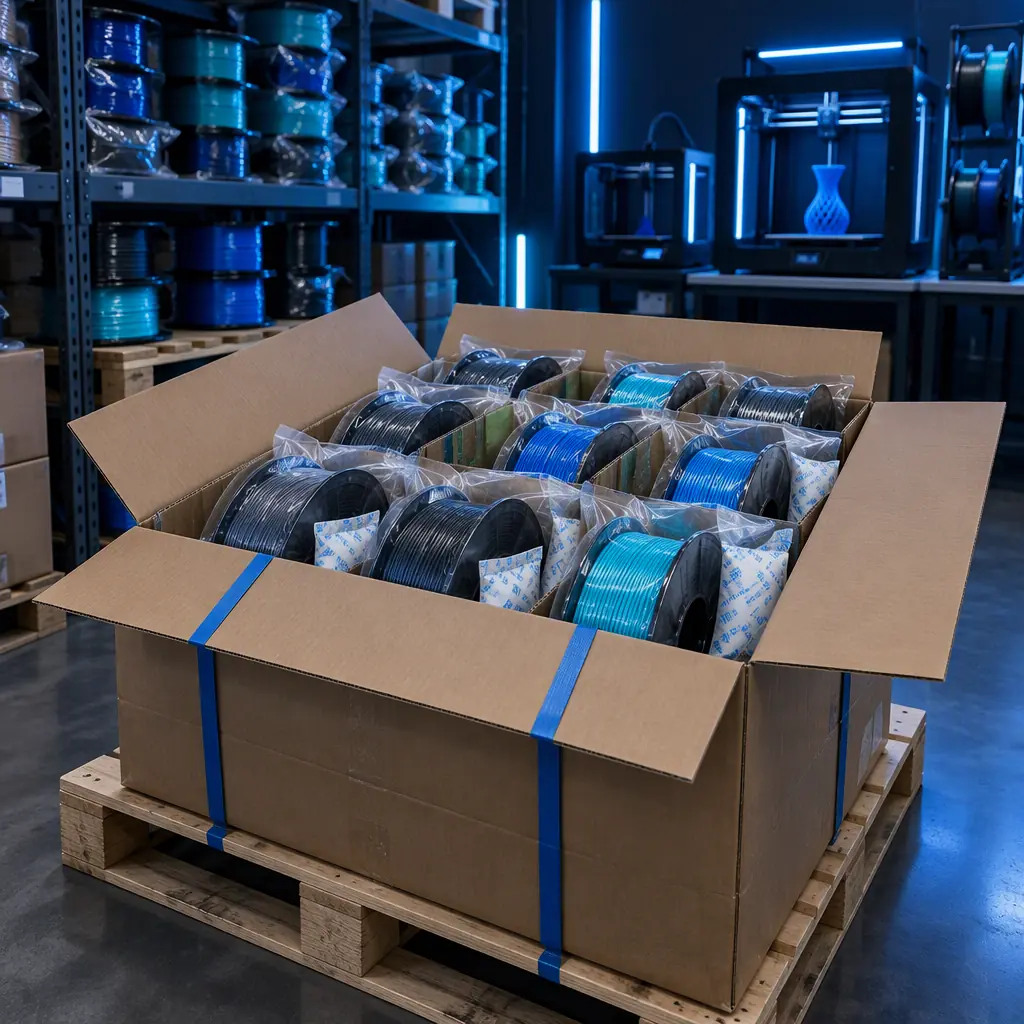
Mass-market filament is genuinely benign. PLA, PETG, ABS, ASA, TPU and unfilled PA are solid polymer in a spool, they have no flash point below 60 degrees Celsius, they do not self-heat, and under the transport regulations they carry no UN number. A distributor shipping 400 spools to a European warehouse is shipping plastic. That is the good news, and it covers perhaps 70 percent of unit volume in a typical consumables catalogue.
The remaining 30 percent is where shipments get held. The categories that need attention are carbon and glass fibre filled grades (the reinforcement itself is inert, but some suppliers ship them with a sizing that is not), photopolymer resin (the largest risk area by far), cleaning solvents and IPA sold alongside resin, and adhesion promoters and release agents in aerosol form. Each has a different answer, and none of them can be resolved by asking the forwarder to "just ship it as samples".
The commercial reason to get this right is not the fine. It is that a held consignment at an air cargo terminal costs the distributor the customer relationship, because the end user's production line stops while the box sits in a bonded area waiting for a declaration that nobody on the supply side can produce. Our certification and compliance guide covers the product-side paperwork; this article covers the transport side.
The UN Numbers That Actually Appear on a 3D Printing Shipment
Four UN entries account for nearly every case a 3D printing distributor will meet. They are worth memorising, because a forwarder's first question is always the UN number and "I will check" costs two days.
UN1866, Resin solution, Class 3, packing group II or III. This is the entry for a photopolymer supplied as a polymer dissolved in a flammable solvent. It is flammable liquid, it has a flash point that may be as low as 23 degrees Celsius, and it cannot travel as passenger air cargo in any meaningful quantity. Many modern 405 nm desktop resins are urethane acrylate with a reactive diluent rather than a solvent carrier, and those do not fall under UN1866 at all, which is exactly why the SDS matters more than the product name.
UN3082, Environmentally hazardous substance, liquid, Class 9, packing group III. A frequent classification for resin and for some wash solutions where the hazard is aquatic toxicity rather than flammability. Class 9 is the least disruptive class to ship, but it is still fully regulated dangerous goods and still requires a declaration.
UN1993, Flammable liquid, Class 3. The entry that catches isopropyl alcohol and general-purpose wash solvents. A distributor bundling a 5 litre IPA container with a resin printer has created a Class 3 shipment out of a product that was otherwise general cargo.
UN3481, Lithium ion batteries contained in equipment, Class 9. The printer itself. This is a separate declaration from the consumables and is covered further down, because a shipment of "one printer and twenty spools" is two regulatory shipments in one carton.
Net Quantity: The Threshold That Keeps You Out of Full Paperwork
Dangerous goods rules are written around quantity per inner package, not per shipment. This is the mechanism that lets a distributor move resin samples and small solvent bottles without a fully regulated consignment, and it is also the mechanism that silently fails when someone packs a bigger bottle into the same carton.
For a Class 3 liquid in packing group II shipped as excepted quantity under the excepted quantity provisions, the limit is 1 litre per inner packaging, with a maximum of 30 kg gross per outer package. For packing group III the inner limit rises to 5 litres. Excepted quantity shipments are marked with the EQ symbol and the UN number, they do not need a full dangerous goods declaration, and they travel on both passenger and cargo aircraft within those limits. That is a materially cheaper and faster route than a fully regulated Class 3 shipment.
The trap is aggregation. One litre of IPA in an outer carton is excepted quantity. Twenty bottles of one litre in the same outer carton is not, because the outer package gross weight limit of 30 kg is breached and the shipment becomes fully regulated. The arithmetic a distributor has to run before every air shipment is therefore not "how much liquid am I sending" but "how is it packed, and what does one outer carton weigh".
The second trap is that the excepted quantity route assumes the liquid is in a packaging rated for it. A 1 litre bottle in a retail blister pack is not a rated inner packaging. A distributor who pours wash solvent into an unrated container has voided the exemption regardless of volume. Buy the solvent in rated packaging or do not ship it as excepted quantity.
What you are looking for: If the answer is 1 litre or less of PG II liquid and the outer is under 30 kg, you are in excepted quantity territory. If either number is exceeded, stop and book it as fully regulated dangerous goods, because the declaration has to be raised by the shipper, not discovered at the terminal.
The 16-Section SDS and What a Distributor Must Supply
Every resin and solvent a distributor sells needs a safety data sheet in the GHS 16-section format, in the language of the destination country, with a current revision date. This is not a nice-to-have document for the website. It is the operational document that the forwarder, the airline and the receiving customer's safety officer will each read for a different reason.
The sections that matter for transport are specific. Section 9 gives flash point, which decides Class 3 versus non-regulated. Section 12 gives aquatic toxicity, which decides whether UN3082 applies. Section 14 is the transport information block itself and should already carry the UN number, proper shipping name, class, packing group and environmental hazard flag. Section 15 carries the regulatory inventory statements that the destination customs authority checks.
A distributor who repacks or relabels a product becomes the responsible party for the SDS in most jurisdictions, because the sheet has to match the container the end user receives. That means an OEM private-label arrangement cannot simply forward the manufacturer's sheet with a new logo unless the manufacturer issues it in the distributor's name. This is covered on the sourcing side in our guide to engineering materials and their documentation.
Two practical rules save enormous time. First, keep the SDS revision date in the product master data, not in a folder, so an expired sheet is visible before a customer asks. Second, keep the SDS in the destination language as well as English, because a Latin American or European customer's safety officer can and will refuse a delivery on a language technicality that has nothing to do with the product.

Shipping the Machine: Lithium Cells and the Printer Itself
A printer is not a consumable, and it brings its own classification. Most desktop and mid-range machines ship with lithium ion cells installed in a controller or an optional UPS module. Under the air regulations those fall under UN3481, Class 9, with the packing instruction determined by cell watt-hour rating and by whether the cells are installed in equipment, packed with equipment, or shipped alone.
For a typical printer with cells under 100 Wh, shipped installed in the machine with the machine protected against accidental activation and packed so that it cannot shift, Section II of the relevant packing instruction applies and the shipment needs a lithium battery mark but no full dangerous goods declaration. Above that rating, or where cells are shipped loose as spares, Section I applies, the shipment is fully regulated, and it is cargo aircraft only. A distributor air-freighting spare batteries as an urgent after-sales favour is committing the single most common DG violation in the industry.
The practical answer is to separate the two problems. Where the customer can accept it, ship printers with cells removed and cells in a properly marked kit, or source the machine in a configuration without an internal battery. Where the machine must arrive ready to run, the shipper needs a current UN38.3 test summary for the cell, the watt-hour rating on the invoice, and a lithium mark on the outer carton. Our customs and HS code guide covers the duty side of the same shipment.
There is also a documentation trap specific to printers: the invoice and packing list must agree with the dangerous goods declaration line by line, including the number of packages containing cells. An airline will reject a consignment where the declaration says two packages and the packing list shows three, and the correction has to be made by the original shipper, which is the factory, which is eight time zones away.
Building the Document Pack
The document pack is what a distributor actually sells when a customer asks whether a product can be shipped to their country. Building it once, per SKU family, converts a recurring two-week delay into a routine shipment.
- Safety data sheet, GHS 16 sections, current revision, destination language plus English.
- UN number and proper shipping name for each regulated component, taken from section 14, never from a web search.
- Dangerous goods declaration where the quantity exceeds excepted limits, raised by the shipper of record.
- UN38.3 test summary for every lithium cell, plus the watt-hour rating declared on the commercial invoice.
- Lithium battery mark on the outer carton where the packing instruction requires it.
- Net quantity per inner packaging and gross weight per outer carton, recorded on the packing list.
- Commercial invoice and packing list that match the DG declaration package count exactly.
- Incoterms stated on the invoice, so responsibility for the DG declaration is unambiguous.
The Incoterms line is the one distributors skip and regret. Under EXW the buyer is the shipper for transport purposes and carries the DG obligation; under DDP the seller does. A distributor who quotes DDP on a resin shipment without realising this has accepted a regulatory role they may not be equipped to perform. Our Incoterms guide sets out which terms move that obligation, and the export documentation guide covers the rest of the paperwork chain.
Is 3D printer filament dangerous goods?
No. PLA, PETG, ABS, ASA, TPU and unfilled nylon filament is solid polymer with no UN number and travels as general cargo. Photopolymer resin, wash solvents and lithium cells are the regulated items in a 3D printing shipment, and each carries its own UN entry and packing instruction. Filament is the safe part of the order.
Where the bundle includes a resin printer and a wash and cure station, the solvent side becomes the constraint, and our wash and cure bundle guide covers how to configure that package so the liquid volume stays shippable. Where the destination imposes its own restrictions on volatile organic compounds or on workplace exposure, the emissions and EHS guide covers the site-level obligations that sit on top of the transport ones.
The rule worth handing to a sales team: never quote a delivery date on a resin or solvent line item until the SDS has been read for section 9 and section 14. Everything else on the order is predictable. Those two sections decide whether the shipment goes as cargo or waits for a declaration, and the difference is measured in days, not hours. A distributor who can answer the UN number question in the first email is treated as a manufacturer rather than a reseller, and that is the whole commercial value of getting this document pack right.

Export Compliance
Ship With the Paperwork Already Done
Precise3D supplies GHS safety data sheets, UN38.3 test summaries and transport classification for every consumable in the catalogue, so a distributor can quote a resin line the same day.