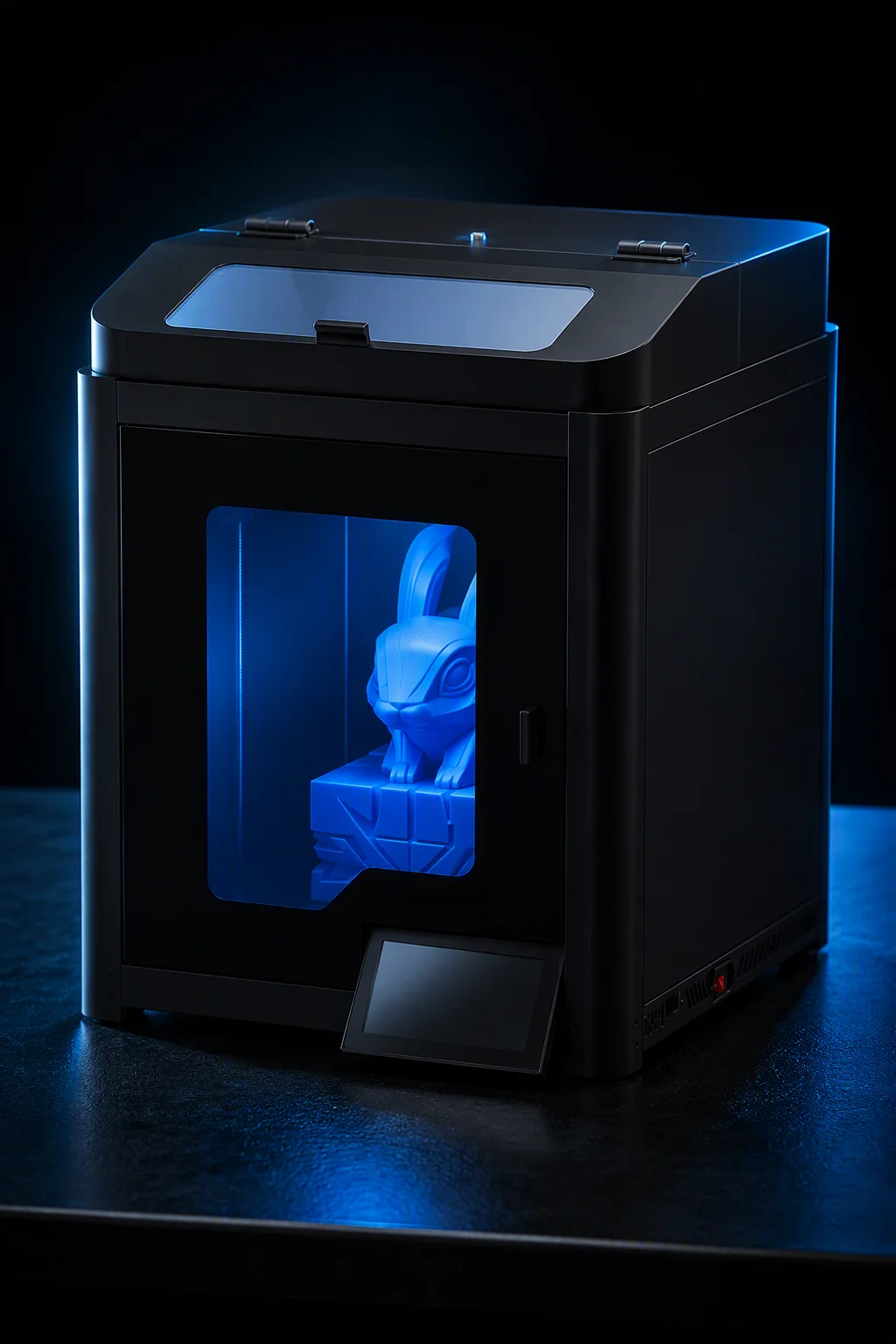
A distributor sells a resin 3D printer for $299. Their landed cost is $224. A 25% margin, or $75. The customer receives the printer, unboxes it, and encounters a problem the listing didn't prepare them for: the print comes off the build plate dripping with uncured resin. They didn't buy isopropyl alcohol. They don't have a wash station. They rinse the print in a plastic tub under the kitchen faucet, contaminating their sink, wasting water, and producing a sticky, partially-cleaned print. They leave it on a windowsill to "cure in the sun." Two hours of patchy sunlight later, the print is tacky, warped, and dimensionally inaccurate. The customer files a return, rating the product one star: "Prints come out sticky and unusable." The distributor loses $75 in margin, $18 in shipping, and a customer who would have spent $400 on consumables over the next 24 months. Total loss: approximately $493.
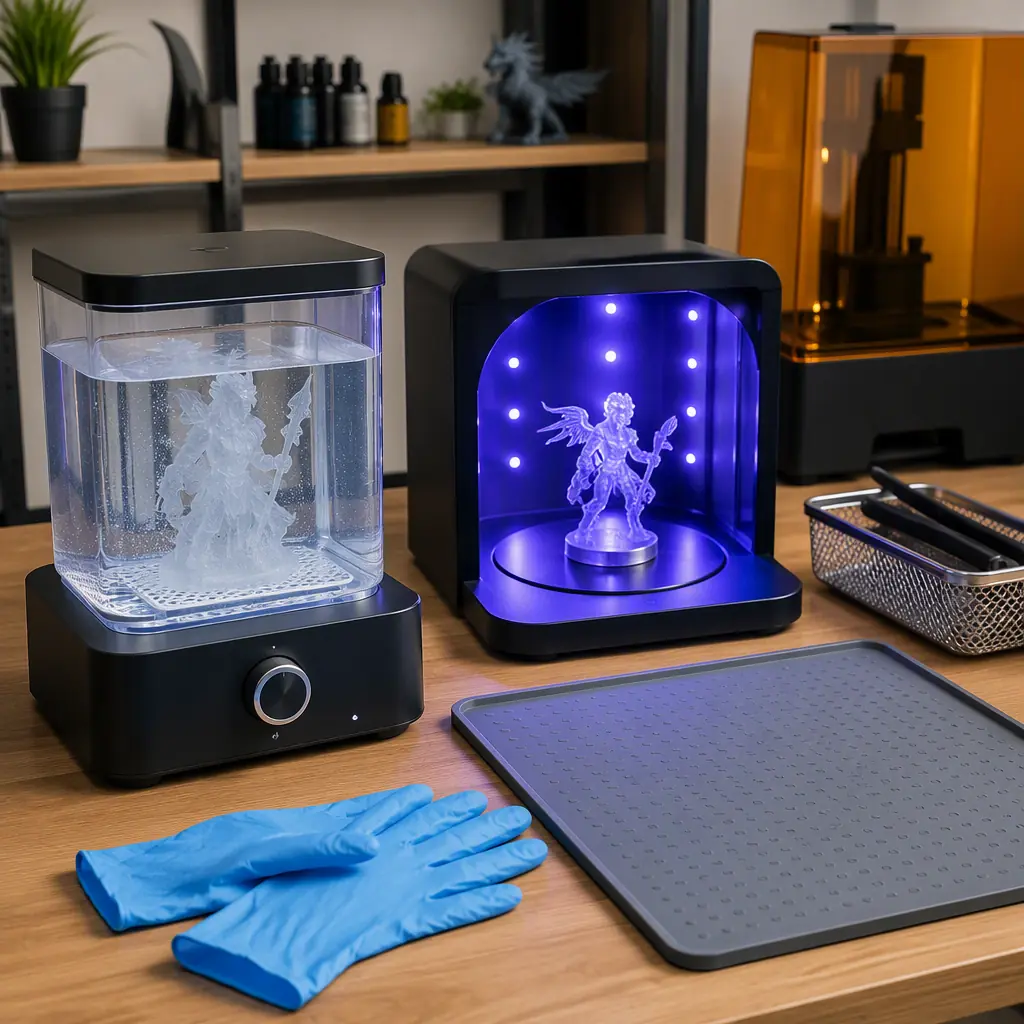
The fix isn't a better printer. It's a complete workflow bundle, printer, wash station, cure station, IPA, and PPE, sold as a single SKU with a single support expectation. The customer who buys the bundle has everything they need to produce a properly washed, fully cured, dimensionally accurate print on their first attempt. The distributor who sells the bundle earns $150+ in margin instead of $75, reduces returns by an estimated 60%, and creates a recurring IPA and consumables revenue stream. This guide covers the economics, the product selection, the bundling mechanics, and the support scripts that make wash & cure bundling the highest-ROI initiative in a resin printer distribution business.
The Wash & Cure Revenue Stack: Breaking Down the Numbers
A standalone resin printer sale at $299 generates approximately $75 in margin. The same printer sold as part of a post-processing bundle: including a wash station, cure station, IPA, gloves, and a silicone mat, generates the following margin profile:
The bundle generates $164 in margin, 2.2× the standalone printer margin, at a higher blended margin percentage (31% vs 25%). More importantly, the customer who buys the bundle has a complete, functional workflow. They are not coming back with "my prints are sticky" support calls because they have a wash station and IPA. They are not returning the printer because it "doesn't work". It works, and they have photographic evidence of their first successful print. The bundle doesn't just increase revenue; it reduces support cost and return rate, a rare combination in distribution economics.
Wash Station Selection: Single-Stage vs Two-Stage Cleaning
The wash station is the first step after printing, and the one most customers try to skip. A customer who washes prints in a plastic tub with a toothbrush will achieve approximately 60–70% resin removal on external surfaces and 0% on internal cavities. A customer using a magnetic stirrer wash station with 99% IPA achieves 95%+ removal on all accessible surfaces. The difference in print quality, and the corresponding difference in return rate, is dramatic.
There are two wash station architectures, and distributors should understand the tradeoffs to match the right product to the right customer:
Single-stage wash stations: the entry point.
A single-stage station uses one tank of IPA with a magnetic impeller that creates a vortex, circulating solvent around the print for a programmed duration (typically 3–10 minutes). The limitation is that the IPA becomes progressively contaminated with dissolved resin over 20–50 prints. By print #30, the "clean" IPA contains enough dissolved resin that prints come out with a slight residue, not enough to cause failure, but enough that detail-oriented customers notice. The fix is an IPA change ($8–12 for 4L of 99% IPA), which the customer should do approximately every 30 prints. Single-stage stations at $89–149 retail are the volume SKU, recommended for first-time resin printer buyers who need a complete workflow without the complexity of two-stage cleaning.
Two-stage wash stations: the upgrade path.
A two-stage station has a "dirty wash" tank (first pass, removes bulk resin) and a "clean wash" tank (second pass, removes residual dissolved resin). The dirty tank IPA lasts 50–80 prints before needing replacement; the clean tank lasts 100+ prints because it only sees pre-washed parts. Two-stage stations at $169–249 retail appeal to customers printing at volume, dental labs, jewelry casting services, print farms, and anyone running their printer more than 40 hours per week. The upsell conversation: "You're already spending 10 minutes per print on washing. A two-stage station cuts that to 5 minutes, and you'll save $40/month on IPA because the clean tank lasts 3× longer." For the full resin printer distribution strategy: including SKU selection across price tiers, see our resin printer distribution guide.
Cure Station Selection: UV Wavelength, Power, and Uniformity
The cure station is the final step in the resin printing workflow, and the one with the most variability in product quality. A properly designed cure station exposes the print to uniform 405 nm UV light from multiple angles for a controlled duration. An improperly designed one, a single strip of UV LEDs in a box, cures the side facing the LEDs to brittleness while leaving the opposite side under-cured. The resulting print has warped dimensions and internal stress that manifests as cracking days later.
Key specifications to evaluate when sourcing cure stations:
(1) UV wavelength: 405 nm ± 5 nm. Consumer MSLA resins are formulated to cure at 405 nm, the same wavelength as the printer's UV LED array. A cure station using 385 nm or 395 nm LEDs will under-cure the resin (wrong absorption peak) and produce prints that remain tacky even after extended exposure. Verify the LED wavelength specification in the OEM's datasheet, not just the marketing copy. A $3 UV wavelength verification card (available from industrial supply distributors) confirms the actual output wavelength in 30 seconds.
(2) Multi-angle UV coverage with turntable. A cure station that illuminates the print from one direction only, e.g., a strip of LEDs on the lid, produces uneven curing that causes differential shrinkage and warping. The minimum acceptable configuration is: UV LEDs on the sides and top of the chamber, plus a motorized turntable that rotates the print at 2–6 RPM. The turntable ensures that all surfaces receive equal cumulative UV dose, eliminating the "one side brittle, one side tacky" problem. Higher-end stations add a reflective interior surface (polished aluminum or mirror-finish stainless steel) that bounces UV light onto the underside of the print. The surface that sits on the turntable and receives the least direct exposure.
(3) Adjustable timer with post-cure recommendations. The cure station should have a programmable timer (1–30 minutes) rather than a fixed 2-minute or 5-minute cycle. Different resins require different post-cure durations: standard grey resin cures fully in 2–3 minutes, clear resin needs 4–6 minutes (UV penetrates deeper but scatters, reducing effective intensity at depth), and engineering resins may need 6–10 minutes. The station's manual should include a table of recommended cure times by resin type and color. Or better yet, the distributor should create and include this table as a laminated card in the box. For a complete analysis of resin types and their post-processing requirements, see our resin types selection guide.
(4) Temperature management. UV LEDs generate heat, and a sealed cure chamber can reach 45–55°C (113–131°F) during a 5-minute cure cycle. At these temperatures, thin-walled prints can soften and deform under their own weight, particularly prints with walls below 1.5 mm. Premium cure stations include active cooling (a small fan that circulates air through the chamber), maintaining internal temperature below 35°C. Budget stations without cooling should be clearly documented with a maximum recommended cure duration before the print must be removed to cool: typically 3 minutes, then a 2-minute cooling pause, then continue. This is a support ticket waiting to happen if not communicated up front.
IPA Management: The Recurring Revenue Stream Nobody Talks About
Isopropyl alcohol is to resin printing what filament is to FDM printing: a consumable that must be continuously replenished. A resin printer user washing 10 prints per week in a single-stage wash station consumes approximately 4 liters of IPA per month, approximately $10–15 at retail. Multiplied by 12 months, that's $120–180 per customer per year in IPA alone. For a distributor with 200 active resin printer customers, IPA represents $24,000–$36,000 in annual recurring revenue at 60–70% gross margin.
IPA grade matters.
The minimum acceptable grade for resin print washing is 99% isopropyl alcohol, not 91%, not 70%, and definitely not denatured ethanol (which contains additives that leave residue on prints). Lower concentrations contain water that reduces the solvent's effectiveness and leaves water spots on prints that interfere with painting and finishing. Distributors should source 99% IPA in bulk (200L drums) and repackage into 1L and 4L containers with their own branding. The branding serves a dual purpose: it builds brand recognition and prevents the customer from discovering that the same IPA is available at the hardware store for $2 less, because the distributor's branded bottle includes a QR code linking to the wash station maintenance guide and the optimal IPA change schedule, adding value that the generic hardware store bottle doesn't provide.
IPA disposal as a value-add.
Used IPA containing dissolved resin cannot be poured down the drain, it's hazardous waste in most jurisdictions. Distributors who offer an IPA take-back program (customer ships back used IPA in the original container, distributor arranges industrial disposal) create a switching cost that competitors cannot easily replicate. The disposal cost to the distributor is approximately $2–3 per 4L container at industrial scale, easily absorbed by the margin on the replacement IPA sale. The customer benefit: they don't have to figure out hazardous waste disposal on their own. This is a retention mechanism disguised as a service. For environmental and regulatory compliance in broader 3D printing operations, see our sustainable 3D printing guide.
PPE and Workspace: The Safety Bundle That Prevents Liability
Uncured photopolymer resin is a skin irritant and respiratory sensitizer. A customer who handles uncured prints with bare hands for the first time, because nobody told them to wear gloves, will develop contact dermatitis within days to weeks. By the time the rash appears, the sensitization is permanent: they will react to resin exposure for life. This is not a support issue; it's a liability issue. Distributors who sell resin printers without including PPE in the bundle are exposed to product liability claims that PPE bundling eliminates.
The minimum PPE bundle ($25 retail) should include:
Nitrile gloves (100-count box):
Not latex (resin penetrates latex), not vinyl (tears too easily). Nitrile with a minimum thickness of 4 mil provides adequate protection for handling uncured prints. Cost to distributor: $4–6 per box in bulk. This is a recurring consumable. A customer printing daily goes through a box every 2–3 weeks.
Silicone work mat (40×50 cm):
Resin spills are inevitable, a drip from the build plate, a splash during vat draining, an overfilled vat. Uncured resin bonds to wood, laminate, and painted surfaces, causing permanent damage. A $5 silicone mat with a raised edge (to contain spills) protects the customer's workspace and prevents the angry spouse/parent/landlord call that says "your product ruined my desk." The mat should be explicitly labeled "Not for use as a cutting mat, resin chemical resistance only" to prevent misuse.
Safety glasses (indirect-vent, splash-resistant):
A drop of IPA containing dissolved resin that splashes into an eye causes immediate irritation and potential corneal damage. Indirect-vent goggles ($3–5 at bulk pricing) are adequate for splash protection. The glasses should meet ANSI Z87.1 or EN 166 standards. This is printed on the frame and provides legal documentation that appropriate PPE was supplied.
Funnel with fine mesh filter (for IPA recovery):
When the customer changes their wash station IPA, pouring 4 liters of used solvent through a funnel with a 190-micron mesh filter catches partially cured resin particles that would otherwise clog drains or contaminate the fresh IPA batch. The funnel is a $2 item that prevents a $50 plumber call, include it in every bundle.
Optional upgrade: respirator with organic vapor cartridges.
For customers printing in enclosed spaces without dedicated ventilation, IPA vapor concentrations can exceed occupational exposure limits (400 ppm TWA per OSHA) during extended post-processing sessions. A half-face respirator with organic vapor cartridges ($25–35 retail) is appropriate for high-volume users. Distributors should not make this optional in the bundle for customers ordering more than 3 resin printers. At that scale, the customer is running a production operation that requires respiratory protection. For fume management strategies across 3D printing technologies, see our fume extraction guide.
Bundling Mechanics: How to Sell the Workflow, Not the Printer
The most common mistake distributors make when introducing wash & cure bundling is listing the bundle as an optional accessory at checkout. The customer sees the $299 printer and the $289 post-processing bundle and thinks "I'll start with the printer and add the accessories later if I need them." They need them, immediately, but they don't know that yet. By the time they discover the need, they've had a failed print experience, and the return clock is ticking.
The solution: make the bundle the default.
List the resin printer at $299 standalone and the complete workflow bundle at $528 ($587 without discount). The bundle should be the default selection on the product page, with a radio button to "downgrade" to printer-only. The psychology: customers value what they have to opt out of more than what they have to opt into. A/B testing across consumer electronics categories shows that default-bundle presentations achieve 68–75% bundle attachment rates vs 12–18% for optional-add-on presentations. The revenue difference for a distributor selling 20 resin printers per month: approximately $3,300 vs $13,200.
Bundle naming matters.
Don't call it "Resin Printer + Accessories Bundle." Call it "Complete Resin Printing Workflow" or "Start Printing in 30 Minutes Bundle." The name should communicate that the bundle is the product, the standalone printer is the incomplete version. Every product photo should show the printer next to the wash and cure stations, with the PPE and IPA visible in the frame. The visual message: this is what a resin printing setup looks like. If your product photo only shows the printer, you are marketing an incomplete product.
Financing the bundle.
A $528 bundle feels expensive compared to a $299 printer. But a customer using Affirm, Klarna, or in-house financing at $44/month for 12 months sees $44/month vs $25/month, a $19 difference. Position the financing comparison: "For $19 more per month, you get a complete workflow instead of a printer that can't finish a print." The monthly payment framing makes the bundle nearly a no-brainer for the customer and 3× more margin for the distributor. For financing and leasing strategy across product categories, see our leasing and financing guide.
Support Impact: Why Bundles Reduce Returns
The financial case for bundling extends beyond the initial margin uplift. Bundled customers generate significantly fewer support tickets and returns than standalone printer customers, and the difference is measurable:
The "prints are sticky" ticket elimination alone justifies the bundling strategy. A standalone printer customer who washes prints in a plastic tub under running water, the most common improvisation, will almost certainly produce sticky, under-washed prints. That customer files a support ticket, and the support agent must explain that the $299 printer they bought requires a $129 wash station, $99 cure station, and $35 of IPA to function properly. Information that should have been communicated before the purchase, not after a failed print. The conversation damages trust and frequently ends in a return. The bundle customer never has this experience because they started with the complete workflow. Their first print is washed in a magnetic stirrer with 99% IPA and cured under controlled 405 nm UV, producing a clean, hard, dimensionally accurate part that matches their expectations. For a complete post-processing strategy covering both resin and FDM finishing techniques, see our post-processing and finishing guide.
The bundle also improves the customer's first-print experience in ways that compound over time. A customer whose first print succeeds becomes confident and explores more complex models. They tell friends, post on social media, leave positive reviews. A customer whose first print fails becomes frustrated and either returns the product or abandons it in a closet. The difference in lifetime value between these two outcomes, approximately $890 vs $0, is entirely determined by the completeness of the initial purchase. The $164 in bundle margin is not the full story; the $890 in customer lifetime value is.
Implementation: The Wash & Cure Bundle Launch Checklist
Week 1–2: Product sourcing.
Identify 2–3 Chinese OEMs for wash stations and cure stations. Evaluate based on: UV wavelength accuracy (must be 405 nm ± 5 nm), turntable motor quality (brushless > brushed for longevity), build quality (metal housing > injection-molded plastic), and certification status (CE, FCC, RoHS minimum). Order samples and run a 100-print torture test on each, 100 prints, 100 washes, 100 cures, measuring cure station LED output before and after to detect degradation. For OEM evaluation methodology, see our factory audit QC checklist.
Week 3: Documentation and training.
Create a one-page quick-start guide covering: wash station setup (fill to line with IPA, set timer to 5 minutes, clean basket after each use), cure station setup (place print on turntable, set timer per included resin chart, allow print to cool before handling), IPA maintenance (when to change. "when you can't see the magnetic impeller through the IPA"), and safety (gloves always, ventilation recommended, uncured resin ≠ trash). Train support agents on the top 5 wash & cure support tickets: IPA too dirty (change it), prints still sticky after wash (IPA concentration too low, use 99% only), prints warping during cure (turntable not rotating or cure time too long for thin walls), wash station impeller not spinning (magnet disengaged, re-seat the impeller), and cure station LEDs not turning on (timer not set, the most common "defect" that isn't a defect).
Week 4: Launch with bundle-as-default.
Update the product page to default to the bundle. Send an email to existing resin printer customers (standalone buyers) offering the wash & cure bundle at 20% off for 7 days. These customers are already experiencing the pain of manual post-processing and are the highest-converting audience for the bundle upsell. Simultaneously, launch the IPA subscription program for bundle customers: $12/month, auto-shipped, cancel anytime. Position it as "never run out of IPA mid-print" rather than "cheap IPA delivery", the convenience pitch works better than the price pitch for consumables.
The distributors who implement wash & cure bundling in 2026 will look back in 2028 and see it as the decision that transformed resin printing from a low-margin commodity product line into a high-margin recurring revenue engine. The bundle is not a tactic, it's the business model. The printer is the entry point. The post-processing workflow is the product.
Reviewed by the Precise3D engineering & OEM team. Compliance files that accompany the catalog are auditable at the certification register.
Build Your Post-Processing Revenue Stream
Source Wash & Cure Stations With Distributor-Ready Bundle Packaging
Precise3D provides wash stations, cure stations, and complete PPE kits, with co-branded documentation, quick-start guides, and IPA subscription logistics. Turn a commodity printer margin into a premium workflow sale.