Sustainability in 3D printing is no longer a marketing checkbox. It is a purchasing criterion for government and education buyers, a cost line item for print farms, and an increasingly common question from consumers who see their trash bin filling with PLA scraps. A 2025 survey of 1,200 3D printer users by All3DP found that 68% were "concerned about plastic waste" and 41% had actively searched for recycling solutions. Yet the distributor channel has been slow to respond: most filament catalogs still treat "eco-friendly" as a niche category with 2–3 SKUs, and recycling equipment is almost never bundled with printer sales. This guide provides the numbers, the product categories, and the sales positioning to make waste reduction a profit center, not an afterthought.
Quantifying the Waste: Where the Plastic Actually Goes
Before selling a solution, distributors need to quantify the problem for their customers. Filament waste in 3D printing breaks down into four categories, each with a different root cause and a different mitigation strategy.
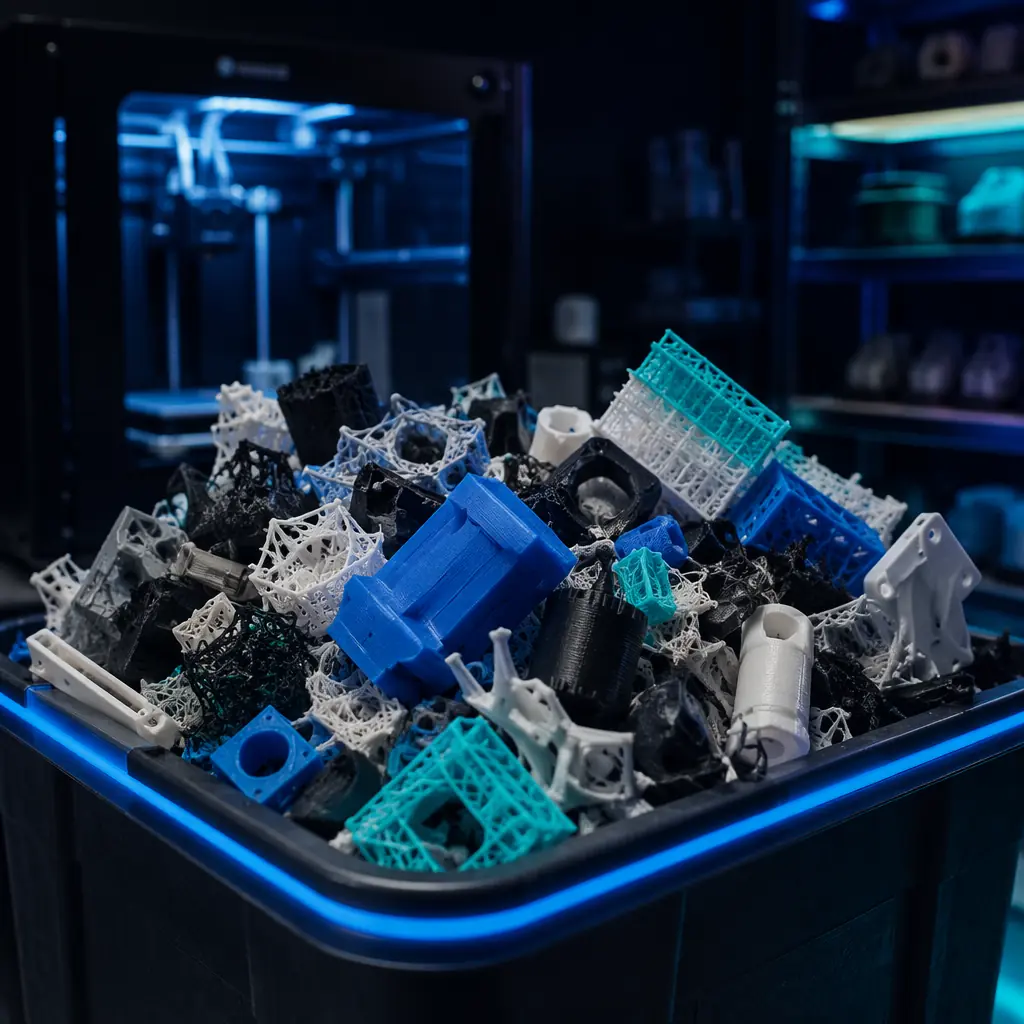
The total of 2.5–4.0 kg per year per printer is based on an active hobbyist printing 15–20 hours per week. A print farm operating 10 machines at 80% duty cycle generates approximately 40–70 kg of waste annually, roughly a full garbage bin of dense PLA parts. At the industrial scale, the numbers become material: a 50-machine print farm discarding 3 kg per machine per year loses 150 kg of filament at a replacement cost of $3,000–4,500. This is not an environmental argument, it is a procurement argument. Every kilogram of waste eliminated is a kilogram of filament the customer does not need to reorder. Our print farm economics guide covers the broader operational math.
Recycling Equipment: Desktop Filament Extruders and Grinders
The core of any waste reduction strategy is the filament recycling workstation, a grinder to break down waste prints into granulate, and an extruder to re-form the granulate into usable filament. This equipment category has matured significantly since 2023, with sub-$1,000 options now delivering ±0.05 mm diameter consistency, which is within the tolerance range that most direct-drive extruders can handle without adjustment.
Desktop recycling economics:
A complete recycling workstation (grinder + extruder) costs $600–1,200. At a filament replacement cost of $22/kg for standard PLA, a user recycling 3 kg per year recovers $66 in material value annually, a simple payback period of 9–18 years at hobbyist volumes. This is why selling recycling equipment purely on material cost recovery does not work for individual users. The value proposition must include avoided disposal costs, educational value (schools), regulatory compliance (EU packaging waste directives), and brand positioning. For print farms, the math changes: 150 kg/year × $22/kg = $3,300 in recovered material value, with a payback period of 4–6 months, a straightforward capital equipment sale.
Quality degradation and the "virgin mix" requirement:
Recycled filament is not a closed loop. Each heat cycle through the extruder degrades the polymer chains, reducing molecular weight and mechanical properties. After one recycle cycle, PLA loses approximately 5–10% of its tensile strength; after three cycles, 20–30%. The industry standard is to mix recycled granulate with virgin pellets at a ratio of 30:70 (recycled:virgin) for non-structural parts, or 10:90 for parts requiring full mechanical properties. This means recycling does not eliminate virgin filament purchases. It reduces them by 10–30%. For distributors, the recurring revenue opportunity is in the virgin pellets and the consumable filters/screens for the extruder, not in the one-time equipment sale. Our engineering filaments guide covers material properties across polymer families, including how recycled content affects specifications.
Bio-Based and Recycled Filament: The SKUs Your Catalog Is Missing
The filament market has evolved beyond "PLA vs PETG." Three emerging categories create upsell opportunities for distributors who stock them before competitors do.
rPLA (Recycled PLA):
Filament manufactured from post-industrial PLA waste. Sprues, reject parts, and production offcuts from injection molding. rPLA has 90–95% of the tensile strength of virgin PLA and prints at identical temperatures (190–220°C). The cost premium is $2–4/kg over virgin PLA, but the sustainability marketing value for education and government buyers justifies the margin. Key suppliers: Filamentive (UK), Reflow (Netherlands), 3D-Fuel (US).
PHA-Blend Filaments:
Polyhydroxyalkanoate (PHA) is a bacterially-produced polyester that biodegrades in marine environments. Unlike PLA, which requires industrial composting at 58°C. PHA blends (typically 70% PLA + 30% PHA) print at 180–210°C with bed adhesion comparable to standard PLA, but offer genuine home-compostable end-of-life. The price premium is $8–12/kg, targeting the premium education and eco-conscious consumer segments. ColorFabb and Beyond Plastic are the leading brands.
Recycled PETG (rPETG):
Made from post-consumer PET bottles, rPETG prints at 230–250°C with mechanical properties within 5% of virgin PETG. The cost is typically 10–15% lower than virgin PETG because the feedstock (discarded bottles) is cheaper than virgin resin. This is the rare sustainability product that is both cheaper and functionally equivalent, an easy upsell for any distributor selling PETG. For a complete overview of filament types and stocking strategy, see our basic filament stocking guide.
Support Material Optimization: The Largest Waste Category
Support structures account for 25–35% of all filament waste, the single largest category. Reducing support waste has three approaches, each with different equipment requirements and distributor margin opportunities.
Soluble supports (PVA, BVOH, HIPS):
The gold standard for complex geometries. PVA dissolves in water, leaving zero witness marks on the supported surface. The tradeoff is cost: PVA is $40–60/kg versus $20/kg for PLA, and it absorbs moisture aggressively, requiring sealed storage with desiccant. For distributors, PVA is a high-margin consumable ($15–25/kg margin) that drives recurring purchases, most users consume 0.5–1 kg of PVA for every 5 kg of model material. The equipment requirement is a dual-extrusion printer or an IDEX (independent dual extruder) system. Our IDEX printer guide covers the hardware options.
Breakaway supports:
Dedicated breakaway support materials (Polymaker PolySupport, Bambu Lab Support for PLA) are printed as an interface layer between the model and the support structure. They bond weakly to the model material, allowing the support to be snapped off cleanly without tools. The material cost is $30–40/kg, but the labor savings versus manually cutting away standard supports: often 10–20 minutes per print. Justifies the premium for any operation where labor is the bottleneck. For distributors, breakaway support material is positioned as a productivity tool, not an environmental one.
Supportless design training:
The most cost-effective waste reduction requires no equipment at all, just knowledge. Teaching customers to orient parts for minimal overhangs, design self-supporting geometries (the 45-degree rule), and use tree supports instead of grid supports can reduce support material consumption by 40–60% with zero investment. Distributors who offer a 1-page "support optimization cheat sheet" with every printer sale differentiate themselves from box-shifting competitors and reduce the support-related support tickets that consume after-sales bandwidth. Our after-sales support strategy guide covers how proactive customer education reduces ticket volume.
Building a Waste Reduction Product Bundle
For distributors, the waste reduction opportunity is not a single product. It is a product category that spans equipment, consumables, and services. The three-tier bundle structure below is proven to increase average order value by 25–40% when presented as an optional add-on at the point of printer sale.
The key to converting bundle sales is presenting waste reduction as a margin opportunity for the customer, not a charity donation to the environment. A print farm that reduces filament consumption by 20% through support optimization and recycled material saves $660 per year on a $3,300 annual filament budget. Which means a $350 Pro bundle paid for itself in 6 months. For education buyers, the pitch is different: sustainability aligns with institutional procurement criteria, and a "Zero Waste Lab" is a differentiator for grant applications. For how to bundle consumables with printer sales, see our consumables bundling guide.
Reviewed by the Precise3D engineering & OEM team. Compliance files that accompany the catalog are auditable at the certification register.
Consumables Program
Stock eco-friendly filaments and recycling equipment for your market
We offer wholesale pricing on rPLA, PHA-blend, and rPETG filaments, plus desktop recycling workstations for print farm customers. Minimum order quantities start at 50 kg for custom filament formulations.