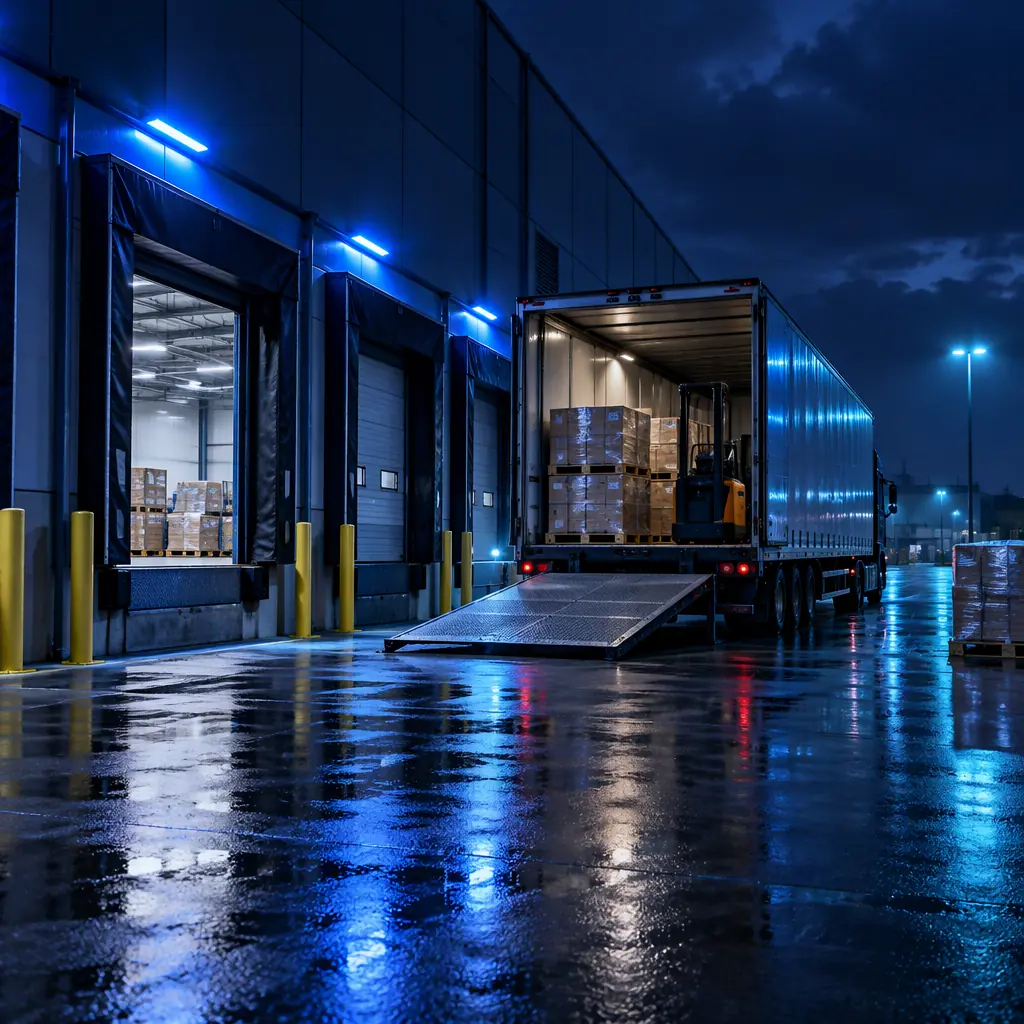
What Are LTL Accessorials?
LTL accessorials are the charges a carrier adds on top of the base linehaul rate for services outside a standard dock-to-dock delivery: liftgate, inside delivery, limited access, appointment scheduling, residential or trade-show delivery, reweigh and reclassification, and detention when the truck waits. On a 3D printer shipment they routinely add 15 to 40 percent to the quoted freight cost, and they are the single largest source of gap between a distributor's freight budget and their freight invoice.
The reason printers attract them is geometric. A desktop enclosed printer in its crate weighs 25 to 45 kilograms but occupies 0.6 to 0.9 cubic metres, so freight class comes out at 100 to 150 rather than the 70 to 85 range a dense pallet would earn. Light and bulky is the worst combination in LTL pricing, and it is unavoidable for this product category. The only controllable variables are how the freight is tendered and how the receiving site is described.
LTL Versus Full Truckload: Where the Break-Even Sits
Below a certain machine count, LTL is obviously cheaper. Above it, the accessorial exposure and the damage risk on a multi-stop trailer make full truckload or a dedicated container leg the better buy even when the base rate looks higher. The break-even for crated desktop printers usually lands between 14 and 22 machines, depending on crate density and destination.

| Machines per shipment | Typical mode | What drives the decision |
|---|---|---|
| 1 to 4 | Parcel or small LTL | Parcel weight and dimension limits; damage risk per unit is highest here because of handling frequency |
| 5 to 14 | Consolidated LTL | Accessorial exposure grows faster than linehaul; palletise and ship as one handling unit |
| 15 to 22 | LTL or partial truckload, price both | Volume discount on LTL starts to disappear; partial truckload becomes competitive |
| 22+ | Full truckload or 20ft container | Single handling, single delivery appointment, damage claims drop sharply |
The count alone does not decide it. Two other factors move the break-even by several machines in either direction. First, destination type: a delivery to a dealer's own dock with a forklift and a receiving window costs almost nothing in accessorials, while the same shipment to an end customer's office building with a liftgate and a two-hour appointment window can add a third to the total. Second, cube utilisation: if the crates stack poorly and the trailer runs at 60 percent cube, the per-unit cost of a full truckload rises enough that LTL stays competitive longer.
The practical rule is to quote both modes on every order above twelve machines and to record which one won. Over a few quarters that record tells you exactly where your own break-even sits, which is more reliable than any published rate table because it reflects your crate dimensions and your customer mix.
The Accessorials That Actually Appear on a Printer Shipment
Carrier accessorial schedules run to dozens of line items, but on this product category a small set accounts for almost all of the surprise cost. Knowing the names matters because a charge you cannot name is a charge you cannot dispute.
- Liftgate at origin or destination. Charged when either site has no dock. A dealer with a loading dock should say so explicitly on the bill of lading, because the carrier defaults to liftgate when the site description is ambiguous.
- Limited access. Applies to schools, hospitals, government buildings, trade show venues, and any site without a commercial receiving area. The definition is carrier-specific and inconsistently applied, which is why it produces disputes.
- Appointment or notify-before-delivery. Charged when the consignee requires a scheduled window. On industrial installations this is normal and should be priced in, not fought.
- Reweigh and reclassification. The carrier re-measures or re-weighs the shipment after pickup and applies a corrected class. This is legal under most carrier tariffs and is the single most common source of invoice surprise.
- Detention and dwell. Charges for time the trailer is held beyond the free period, at origin or destination.
- Inside delivery and debris removal. Moving crates past the threshold and taking packaging away. Often requested by dealers installing for end customers.
Each of these is negotiable at the contract level even when it is not negotiable per shipment. Carriers routinely waive liftgate and notify charges for accounts with predictable volume, and a distributor who has never asked is paying list price on every one of them.
Dwell, Detention and Demurrage: Three Different Clocks
These three terms get used interchangeably and they are not the same charge. Getting them confused is how distributors end up disputing the wrong invoice.
| Charge | What is being billed | Clock starts | Typical free time |
|---|---|---|---|
| Detention | The trailer or container is held outside the terminal after the delivery or pickup is completed | When the equipment leaves the terminal | 2 to 4 hours at destination for LTL |
| Demurrage | The container sits inside the port or terminal beyond free time | When the container is discharged and available | 3 to 7 days at most ports, varies by carrier and terminal |
| Dwell | Generic term for time-based charges, often used for warehouse dock hold time | Depends on the contract — usually arrival at the dock | Set by the warehouse, not the carrier |
The distinction that costs distributors money is where the demurrage clock actually starts. It is not when the vessel berths, and it is not when the container is available for pickup in practice. It is the timestamp the terminal records when the container becomes available in its system, which can be a day or more after the vessel is worked. A distributor who books a truck based on the vessel arrival date rather than the availability notice can burn two days of free time before the container is even collectable.
At destination, detention on LTL is usually billed in 15-minute increments after a two to four hour free window, and the increments are not cheap. The controllable variable is not the trucking company, it is the receiving site: a dealer who cannot unload a pallet within the free window because the forklift operator is at lunch will generate a detention charge that no amount of carrier negotiation will remove.
The preventive measure is a receiving instruction issued with every shipment, stating dock hours, equipment available, the named person who will sign, and a fallback contact. This sounds like administration. In practice it is the difference between a 40 currency unit delivery and a 180 currency unit delivery on the same lane.
The Reweigh and Reclassification Dispute
Freight class in the density-based system is a function of pounds per cubic foot, and printers sit in an awkward band. A crated desktop unit at 30 kilograms in 0.7 cubic metres works out to roughly 43 kilograms per cubic metre, which lands in a light-density class. If the carrier's dimensioner reads the crate slightly differently, or if a pallet is measured including overhang, the class can move several steps and the invoice can arrive 25 to 60 percent above the quote, three to six weeks after delivery.
The dispute path has three components and all three need to be prepared before the shipment, not after.
- Photograph the palletised shipment on the dock, with the tape measure visible. Height, width and length in one frame. This is the single most effective piece of evidence in a reclassification dispute.
- Record the actual weight on a calibrated scale and keep the ticket. Carrier reweighs are not infallible and a certified origin weight wins most disputes.
- File the dispute within the carrier's window, which is often 30 to 180 days depending on jurisdiction and contract. A dispute filed after the window is a donation.
There is also a structural fix: consolidate to fewer, denser handling units. Two machines strapped to a single pallet with the crates oriented to minimise cube occupy less trailer space than two separate pallets, which raises density and can move the shipment into a cheaper class. On a fifteen-machine order this alone can reduce freight cost by 8 to 15 percent before any rate negotiation.
Building a Landed Cost That Includes Freight Reality
The landed cost model most distributors use has a freight line that was accurate for the first container and has been carried forward unchanged ever since. The corrective is to build the freight line from four components rather than one quoted rate: linehaul, accessorials by destination type, duty and clearance, and an allowance for reclassification and detention based on the last twelve months of actual invoice variance.
That allowance is not padding. If the historical variance between quoted and invoiced freight is 18 percent, then a cost model using the quote is understating landed cost by 18 percent on every unit, and the pricing that follows from it is wrong. Distributors who track this usually find the variance concentrated in a small number of destination types, which makes it addressable: fix the receiving instructions for those sites and the variance drops.
The adjacent disciplines matter here too. Incoterms determine who pays which leg and where risk transfers, and a distributor who has agreed to DAP terms has accepted responsibility for the destination accessorials without necessarily pricing them. Crate design directly determines both damage rate and cube density, so it is a freight cost lever as much as a protection measure. And the documentation package is what determines whether a reclassification dispute is winnable at all.
Multi-Site Deployments and the Installation Timing Problem
When a single order goes to fifteen different end-customer sites rather than one dealer dock, LTL economics change completely. Each leg attracts its own destination accessorials, each site has its own receiving constraints, and the probability that at least one delivery fails on the first attempt approaches certainty. On a fifteen-site roll-out, distributors typically see two to four failed first attempts, each costing a redelivery fee plus a day of schedule slippage.
The mitigation is sequencing rather than rate negotiation: ship to a staging location in-country, then run a local delivery schedule from there with a single carrier who has the whole route. This raises the intermediate handling cost and lowers the total, because it concentrates the accessorial exposure into one relationship with predictable volume and it lets the installer and the delivery arrive together. Spare parts logistics for multi-site deployments covers the same structural problem on the service side.
Timing also connects to the site preparation question. A machine that arrives before the site has power, ventilation or a level floor sits in its crate, in the way, generating either storage cost or an urgent request to install early. A pre-installation site survey should be completed before the delivery date is booked, not after.
For distributors still working out the total in-country cost model, the China logistics guide sets out the container and clearance leg that this inbound piece sits on top of, and the freight figures there are the starting point rather than the whole answer.
The practical sequence is: quote both LTL and full truckload above twelve machines, standardise the crate to one density class, issue receiving instructions with every shipment, photograph and weigh every outbound pallet, and keep a twelve-month variance record to price the allowance. Four of those five cost nothing but discipline.
Reviewed by the Precise3D logistics team. Accessorial schedules, free time allowances and dispute windows are set by individual carriers, terminals and jurisdictions and change periodically; confirm the current tariff with your carrier before relying on any figure here. Nothing here is legal advice on freight claims.
Logistics Support
Want the Crate Density and Receiving Instruction Templates?
We can send our crate cube and weight data per model, the palletisation sheet we use to keep shipments in one density class, and the receiving instruction template that goes out with every consignment. Landed cost schedules to your destination port on request.