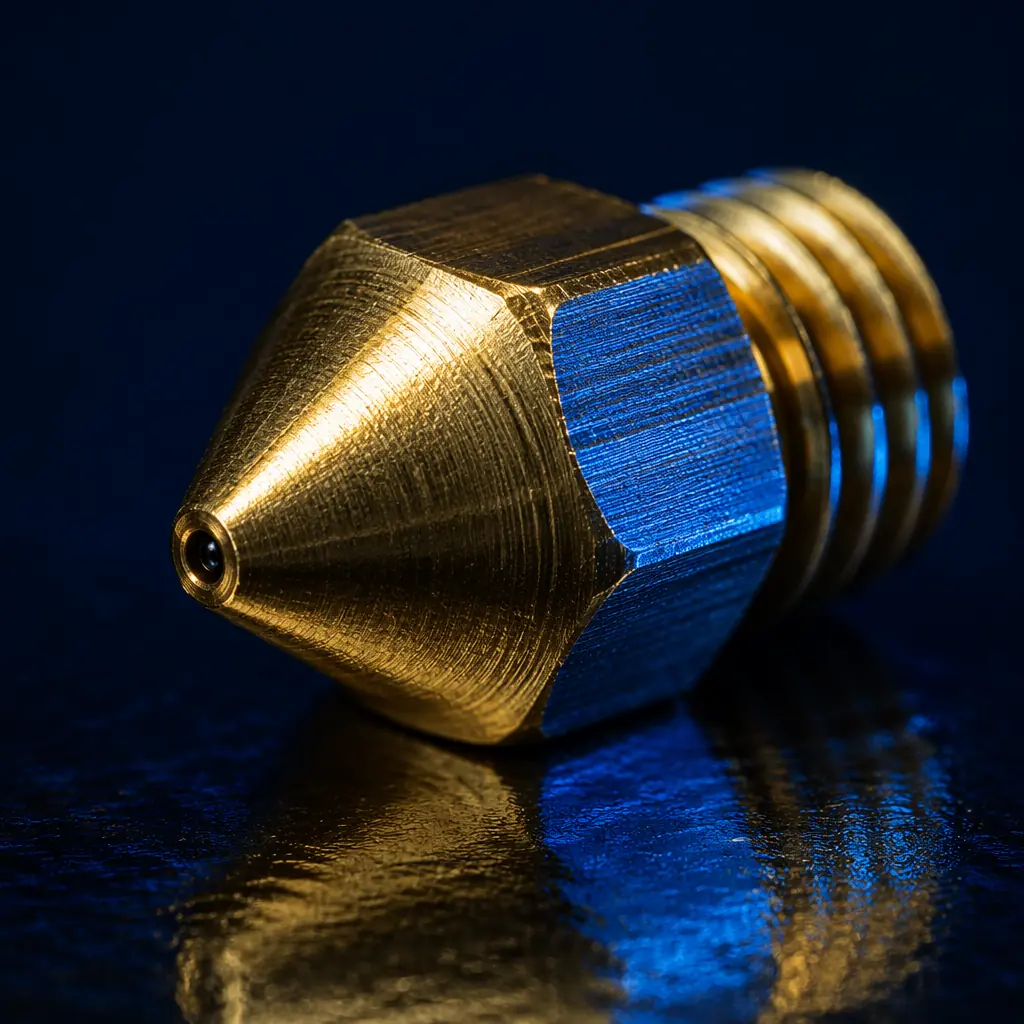
The 3D printer nozzle is the most replaced consumable in FDM printing — more frequently replaced than build plates, more frequently than PTFE tubing, more frequently than any component except filament itself. A typical hobbyist printing PLA 8 hours per week will wear a brass nozzle to the point of visible diameter increase within 6–12 months. A print farm running abrasive materials will destroy a brass nozzle in a single weekend. And yet most distributors treat nozzles as an afterthought — a few SKUs of 0.4 mm brass thrown into the accessories section. This is leaving money on the table. A well-structured nozzle SKU matrix generates recurring revenue of $15–60 per printer per year — and the margins on premium nozzle materials (ruby, tungsten carbide) are 40–60%, among the highest in the 3D printing consumables category. This guide covers the nozzle material landscape, diameter selection, wear mechanisms, and the product matrix that maximizes both customer satisfaction and distributor margin. For the broader consumables strategy, see our consumables bundling guide.
The Five Nozzle Materials: A Wear-Resistance Hierarchy
Nozzle materials differ along three dimensions: hardness (directly determines wear resistance), thermal conductivity (determines how efficiently heat transfers from the heater block to the filament), and cost. The tradeoff is almost always hardness versus thermal conductivity — the harder the material, the worse it conducts heat, requiring higher hotend temperatures to maintain the same melt flow rate. Here is the full material hierarchy, ranked by wear resistance.
Brass:
The default. Brass nozzles have the best thermal conductivity of any nozzle material — 109 W/m·K — meaning the filament reaches target temperature faster and more evenly through the melt zone. For PLA, PETG, ABS, and ASA printing without abrasive additives, brass is the optimal material. The wear mechanism on brass is primarily abrasive erosion: microscopic hard particles in even "non-abrasive" filaments (trace minerals, pigment particles) gradually enlarge the nozzle orifice. After 3–6 months of regular use, a 0.4 mm brass nozzle typically measures 0.42–0.45 mm — a 5–12% diameter increase that produces visible over-extrusion and dimensional inaccuracy. Replacement cost is negligible, making brass the consumable that generates repeat purchases without customer resistance. Our nozzle and hotend technology guide covers the full hotend assembly in more detail.
Hardened steel:
The entry-level abrasive-resistant nozzle. At 55 HRC, hardened steel resists the carbon fibers, glass fibers, glow-in-the-dark pigments, and metal-filled filaments that destroy brass in hours. The penalty: thermal conductivity drops to 22 W/m·K — roughly one-fifth of brass. Practically, this means you need to increase hotend temperature by 5–15°C compared to brass for the same filament to achieve equivalent melt flow, because heat is not reaching the filament core as efficiently. Some slicer profiles compensate automatically; many do not. Distributors should include a temperature adjustment card with every hardened steel nozzle sold: "+5°C for PLA, +10°C for PETG, +15°C for ABS." For customers printing occasional abrasive materials, hardened steel is the right recommendation. For customers who print abrasives daily, tungsten carbide's better thermal conductivity justifies the higher price.
Tungsten carbide:
The material that is changing the nozzle market. Tungsten carbide combines hardness of 78 HRC (approaching ruby) with thermal conductivity of 80 W/m·K (approaching brass). It is the only nozzle material that does not force a tradeoff between wear resistance and thermal performance. A tungsten carbide nozzle installed at the factory and never removed can survive five years of daily printing across all materials — including carbon-fiber-filled nylon, which destroys brass nozzles in hours and hardened steel nozzles in months. At $40–60 per nozzle, the sticker price is 10–15 times a brass nozzle. But the total cost of ownership argument is compelling: one tungsten carbide nozzle replacing 20 brass nozzles over five years at $5 each = break-even. Add the labor cost of changing nozzles (5–10 minutes each, 20 times = 100–200 minutes) and the avoided print failures from worn nozzles, and the ROI is clearly positive for any printer running more than 10 hours per week. For print farm operators, tungsten carbide is not an upgrade — it is an operational necessity. See our print farm economics guide for the throughput math.
Ruby-tipped and diamond-tipped:
The premium tier. Ruby-tipped nozzles (like the Olsson Ruby) bond a synthetic ruby gemstone to a brass body. The ruby tip is essentially immune to abrasive wear — hardness of 9 on the Mohs scale — and the brass body provides reasonable thermal conductivity through the heat break. The failure mode on ruby nozzles is not wear but tip detachment: the ruby-to-brass bond can fail under thermal cycling, especially if the nozzle is overtightened during installation. Diamond-tipped nozzles solve this with a CVD diamond coating that cannot detach, but at $90–150 per nozzle the market is limited to industrial users who genuinely need the last 1% of wear resistance. For most distributors, ruby and diamond nozzles are not volume products — they are halo SKUs that signal premium positioning and technical credibility to customers who do eventually buy hardened steel and tungsten carbide.
Nozzle Diameter: The Tradeoff Most Customers Don't Understand
Nozzle diameter determines two things that are inversely related: detail resolution and volumetric flow rate. A 0.2 mm nozzle can print 0.1 mm layer lines with exceptional surface detail — but it takes 4 times as long to print the same part as a 0.4 mm nozzle because the volumetric flow rate (mm³/s) scales with the square of the nozzle diameter. A 0.8 mm nozzle prints 4 times faster than a 0.4 mm nozzle but cannot produce wall thicknesses below approximately 0.9 mm and loses fine feature resolution. The relationship is nonlinear: the sweet spot for most consumer printing is 0.4 mm, but the right nozzle for a given application is not necessarily 0.4 mm — and a distributor who stocks only 0.4 mm brass is leaving nozzle revenue from every other diameter on the table.
The 0.6 mm nozzle deserves special attention because it is the fastest-growing diameter segment. A 0.6 mm nozzle prints approximately 2.3 times faster than a 0.4 mm nozzle at the same layer height, with only a modest loss of fine detail that is invisible on functional parts and barely noticeable on decorative surfaces viewed from more than 30 cm away. For print farm operators who sell functional parts — brackets, mounts, enclosures, jigs — the 0.6 mm nozzle is the optimal diameter. It also handles filled filaments better than 0.4 mm because the larger orifice is less prone to clogging from fiber aggregates. Distributors should stock 0.6 mm in at least brass and hardened steel — and ideally in tungsten carbide as an upsell for print farm customers. See our build volume guide for the complementary dimension of throughput optimization.
Building the Distributor Nozzle SKU Matrix
A distributor's nozzle inventory should cover three customer types: the casual hobbyist who needs replacement brass, the enthusiast who experiments with materials and diameters, and the professional or print farm operator who buys premium materials for reliability. The minimum viable SKU count is 12; the recommended count is 20. Below is the recommended matrix.
The logic behind this matrix: brass at 0.25/0.4/0.6 mm covers 90% of replacement purchases. Hardened steel at 0.4/0.6 mm covers the two most common diameters for abrasive materials. Tungsten carbide at 0.4/0.6 mm addresses the print farm and prosumer segment, where a single $45–55 nozzle eliminates a recurring failure point. The 0.8 mm tier is for customers printing large functional parts — a growing segment in the prototyping and manufacturing space. The 1.0 mm and ruby SKUs are optional: order them when a customer asks, but do not tie up inventory capital in diameters and materials that turn over slowly. For more on how to price and bundle these, see our pricing and margin strategy guide.
Wear Detection: How to Know When a Customer Needs a New Nozzle
The most common support ticket that should be a consumable sale: "My prints suddenly look over-extruded and the dimensions are off." The customer has not changed any slicer settings. The filament is the same brand and batch. The printer is mechanically sound. The nozzle has simply worn to a larger diameter — and because the slicer assumes a 0.4 mm orifice, every extrusion is now 5–15% wider than intended. The visible symptom is usually top-surface over-extrusion: the final solid layers look rough, blobby, or "ridged" because the extra material has nowhere to go but up. A distributor who can diagnose this from a single support photo converts a support cost into a nozzle sale — and a customer who learns the "worn nozzle" failure mode becomes a repeat nozzle buyer forever.
The objective test: extrude 100 mm of filament at the standard temperature, measure the actual extruded diameter with calipers, and compare to the nominal nozzle diameter. If a 0.4 mm nozzle is extruding filament wider than 0.48 mm (20% oversize), it is worn and should be replaced. A simpler test: hold the nozzle up to a light source and look through the orifice. A new 0.4 mm nozzle produces a clean, round point of light. A worn nozzle produces an irregular, enlarged, or oval opening. This takes 10 seconds and requires no tools — every distributor support technician should know this check. For the full troubleshooting framework, see our print failure diagnosis guide.
What you're looking for: Consistent over-extrusion everywhere = worn nozzle (diameter uniformly enlarged). Over-extrusion only on top surfaces or specific regions = slicer flow rate or extrusion multiplier issue, not nozzle wear. This single question correctly routes roughly 70% of "over-extrusion" support tickets to either a nozzle replacement sale or a slicer settings adjustment — without any physical inspection.
Reviewed by the Precise3D engineering & OEM team. Compliance files that accompany the catalog are auditable at the certification register.
Nozzle Consumables
Build Your Nozzle Inventory with Distributor Pricing
Get brass, hardened steel, and tungsten carbide nozzles across all diameters at wholesale pricing with volume discounts. We'll help you build the right SKU matrix for your market.