
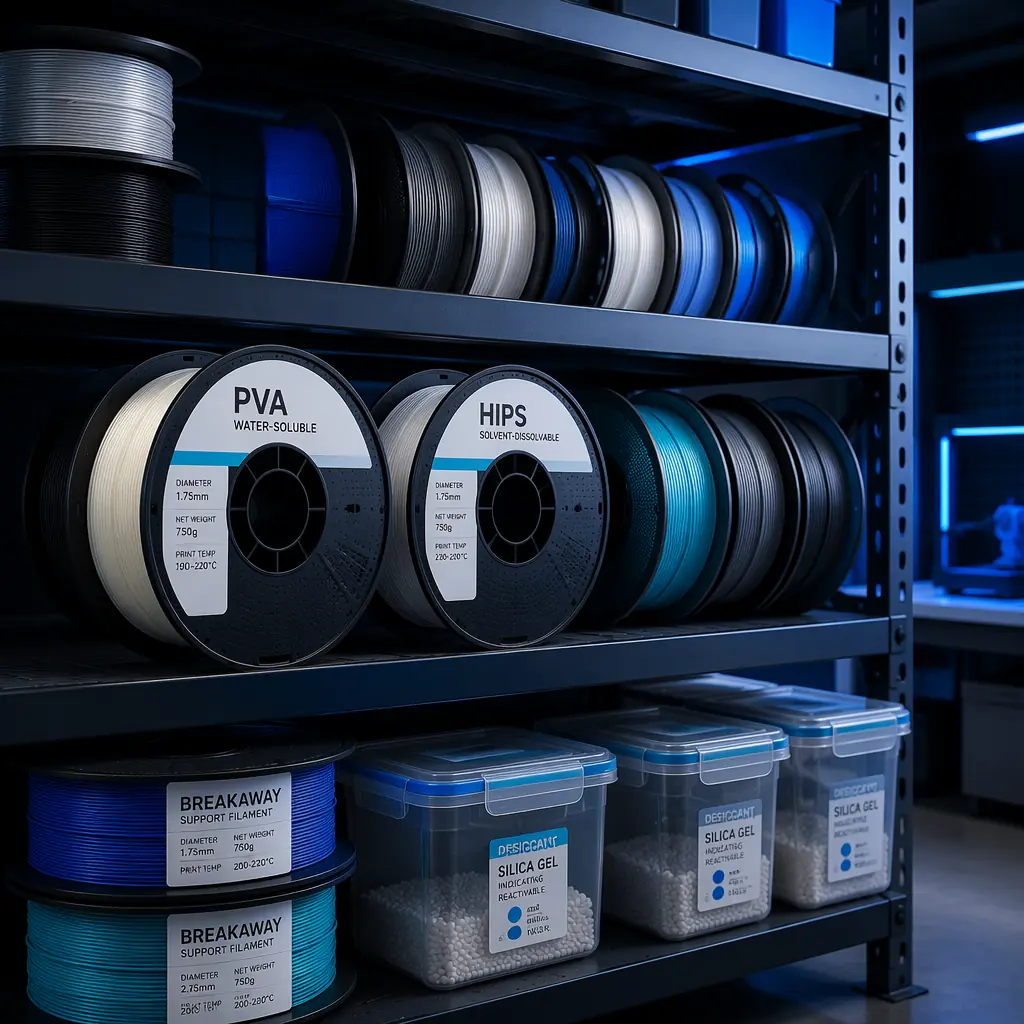
The economics of 3D printer distribution follow a well-known pattern: printers are the low-margin entry point. Filament, spare parts, and accessories are where the sustainable business lives. A standard spool of PLA generates roughly $8–12 in gross margin per sale and is reordered every 6–12 weeks depending on print volume. Support materials — PVA, HIPS, and breakaway filaments — follow a fundamentally different consumption curve: they are used at roughly 20–35% the volume rate of the primary material on every print that requires supports, and they are consumed regardless of what the primary material is. A customer who prints 2 kg of PLA per month with supports on 60% of prints will burn through roughly 360–630g of support material per month — approximately one 500g spool every 4–6 weeks. And unlike PLA, where the customer has 50+ color and brand options, the support material market is concentrated: PVA, HIPS, and breakaway account for over 90% of all support material consumption. If you stock the right three SKUs, you capture the revenue. If you don't, the customer buys from Amazon and you lose the recurring touchpoint that drives filament, nozzle, and build plate reorders.
The Three Support Material Categories: What They Are and When to Use Each
Support materials fall into three categories based on how they are removed from the finished print: dissolvable in water (PVA), dissolvable in solvent (HIPS), and mechanically removable (breakaway). Each has specific compatibility requirements with primary materials, storage constraints, and cost profiles. A distributor who understands the compatibility matrix can bundle the right support material with every dual-extrusion printer sale and capture the consumable revenue from day one.
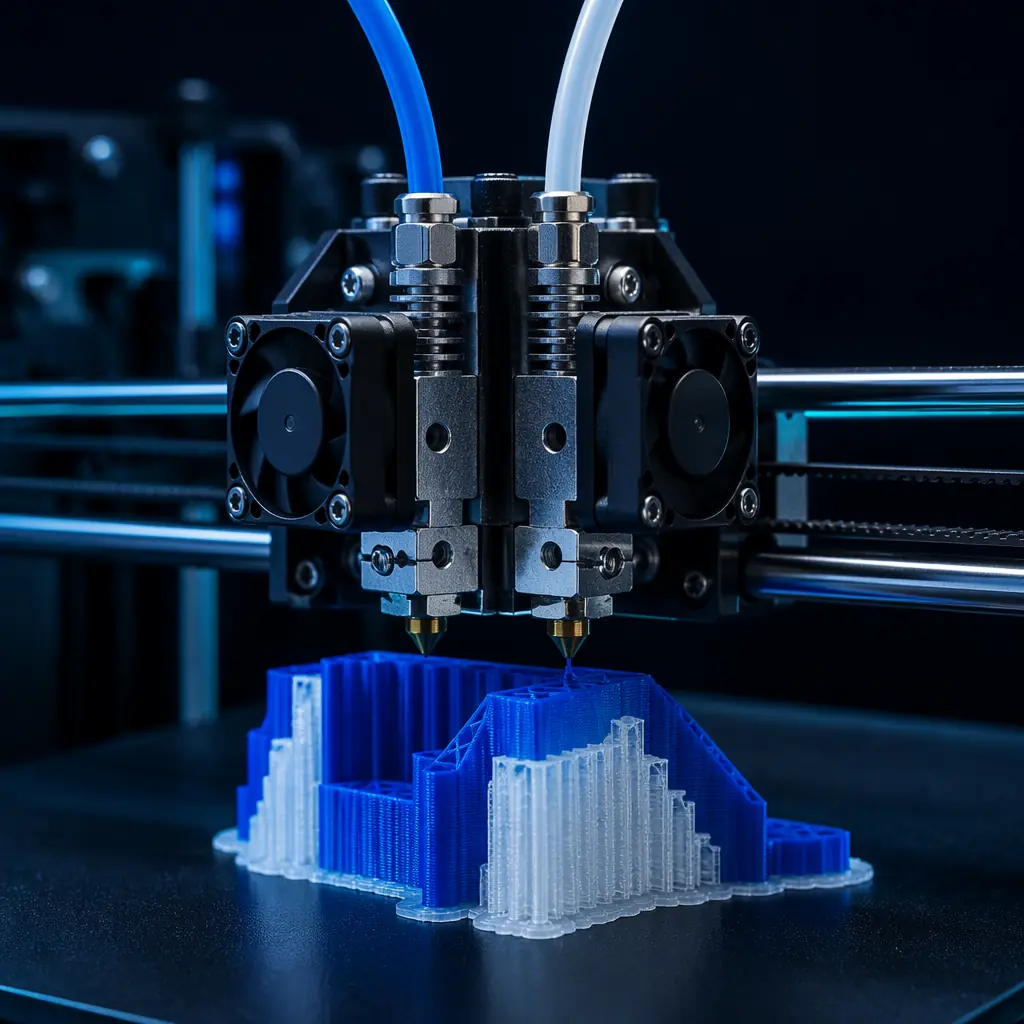
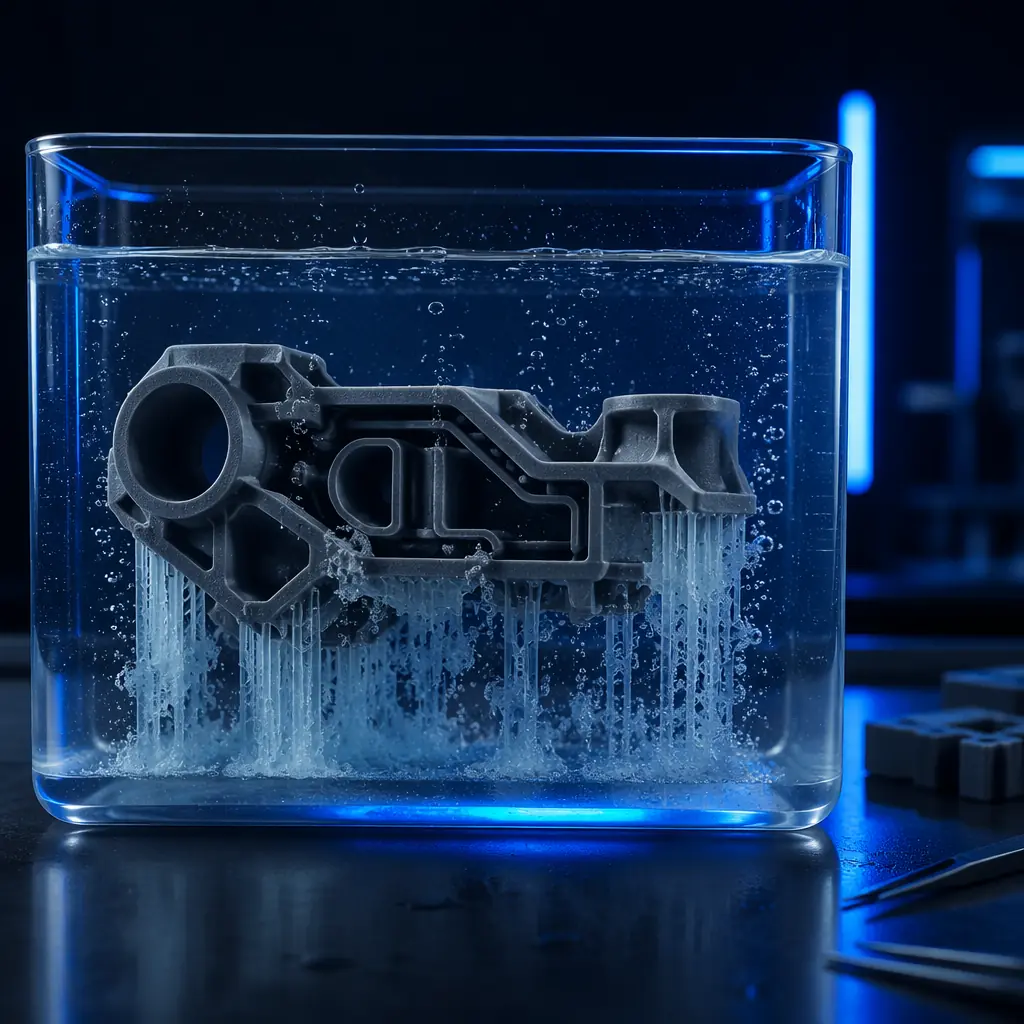
PVA (Polyvinyl Alcohol) — the gold standard for PLA and PETG: PVA is water-soluble, non-toxic, and prints at temperatures compatible with PLA (190–220°C) and PETG (220–240°C). It is the most widely used support material because PLA is the most widely used primary filament. When a dual-extrusion printer prints a complex part — a mechanical assembly with internal channels, an architectural model with overhangs, a jig with captive nuts — one extruder lays down PLA for the part and the other lays down PVA for the supports. After printing, the part is submerged in water (warm water at 30–40°C accelerates dissolution to 2–6 hours; cold water takes 12–24 hours) and the PVA dissolves completely, leaving a clean surface with zero support marks. No post-processing. No sanding. No scarring. The part emerges exactly as designed.
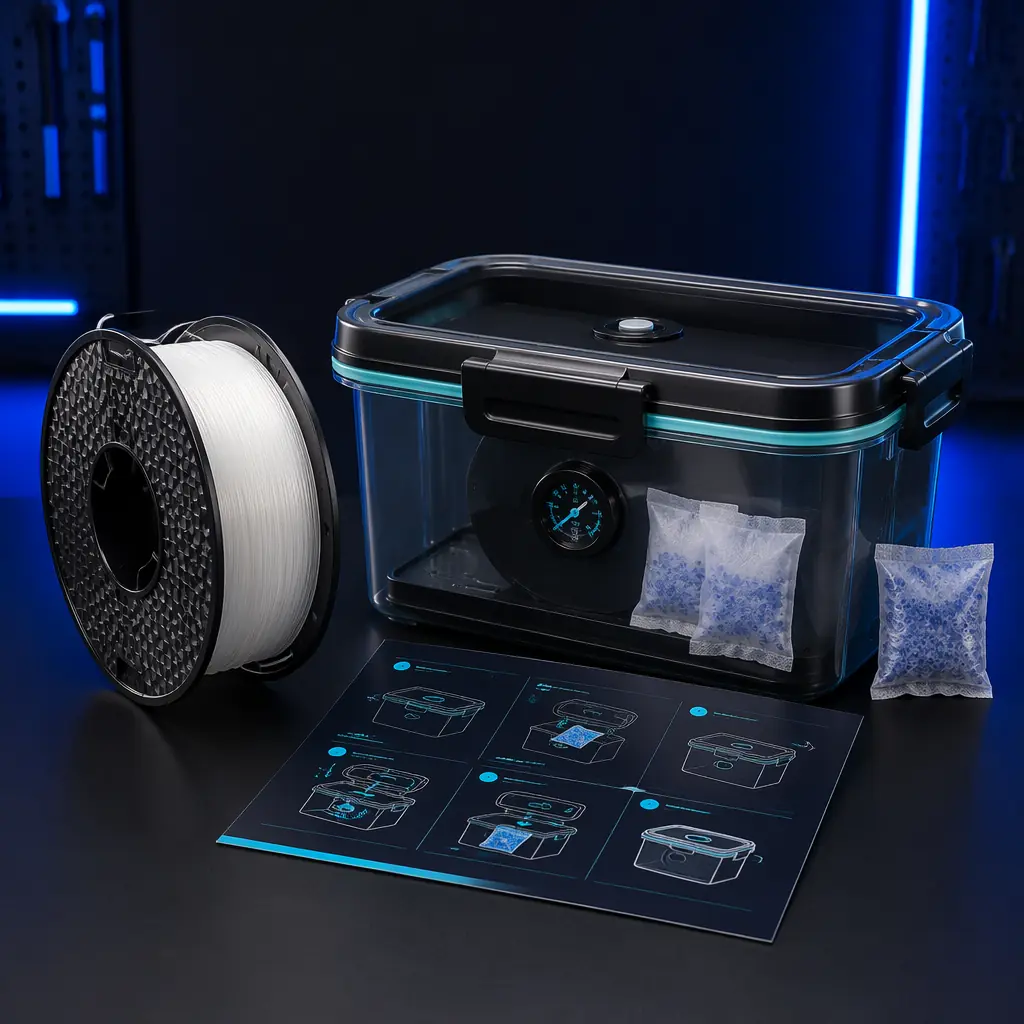
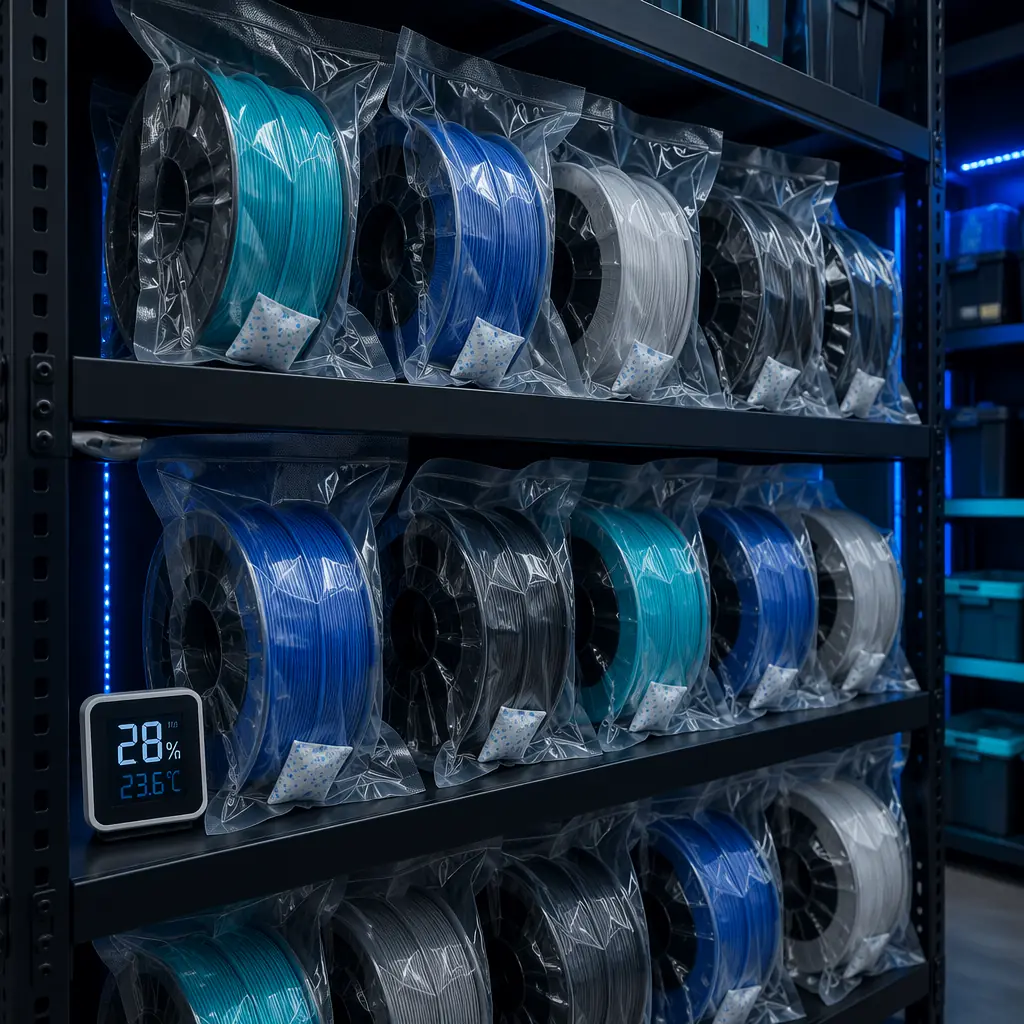
The critical constraint with PVA is moisture sensitivity. PVA absorbs atmospheric moisture roughly 5x faster than PLA. An open spool of PVA left in ambient humidity (50–60% RH) will become unprintable within 24–48 hours — it will bubble, pop, and produce weak, inconsistent extrusion. This moisture sensitivity is both a challenge and a revenue opportunity: it means customers must store PVA properly (vacuum-sealed with desiccant between uses) and will periodically ruin spools by leaving them exposed, driving reorders faster than any other filament type. Distributors who bundle a vacuum-sealable storage container with every first PVA purchase see 30–40% higher repeat purchase rates than those who sell PVA alone, because the container solves the storage problem and the customer attributes their good experience to the distributor's guidance. For the full storage infrastructure picture, see our filament drying and storage guide.
HIPS (High Impact Polystyrene) — the ABS/ASA companion: HIPS dissolves in d-limonene, a citrus-derived solvent that does not affect ABS or ASA. This makes HIPS the default support material for the engineering-grade filament ecosystem: ABS for functional parts, ASA for outdoor applications, and HIPS for the supports that make complex ABS/ASA geometries possible. HIPS prints at 230–245°C — right in the ABS/ASA temperature window — and adheres well to ABS during printing while releasing cleanly during the limonene bath. The dissolution process takes 8–24 hours depending on part geometry and agitation. Limonene is reusable: a single liter can dissolve 150–200g of HIPS before saturation, making the per-print solvent cost roughly $0.50–1.00 for typical parts.
The HIPS opportunity is more specialized than PVA but carries higher margins per unit because the customer base — ABS/ASA users — is typically professional, less price-sensitive, and buys in higher volumes per order. A small manufacturer running a print farm of 10 ABS printers for functional parts will go through 3–5 kg of HIPS per month. That's $150–275 in monthly recurring revenue from a single customer, at 35–45% gross margin. The distributor who stocks HIPS and limonene together captures that revenue; the distributor who only stocks PLA lets it walk to a specialty supplier. For a deeper look at the engineering materials market, see our engineering filaments guide.
Breakaway support materials — the universal option: Breakaway filaments are formulated to adhere just enough to the primary material to provide structural support during printing, but peel away cleanly with moderate hand force after printing. They do not require water, solvent, or any post-processing equipment. The trade-off is surface quality: breakaway removal leaves a slightly rougher interface surface than dissolvable supports, and it cannot reach internal channels or enclosed cavities that a solvent can access. Breakaway is ideal for external overhangs, bridging, and geometries where the support interface is accessible. It is also the only support material option for single-extruder printers using manual filament changes — a niche but real use case for hobbyists who want to try soluble supports without investing in a dual-extrusion machine.
Breakaway's universal compatibility — it works with PLA, PETG, ABS, ASA, and TPU — makes it the safest "starter" support material for distributors building their first support material SKU. It requires no special storage beyond standard dry conditions, generates fewer support tickets than PVA (no "my PVA won't dissolve" calls), and carries a lower per-spool price point that reduces customer hesitation on first purchase. The margin per unit is lower than PVA or HIPS ($6–10 vs $12–20), but the higher adoption rate and lower support burden often make it the most profitable support material SKU on a net basis. For the broader consumables revenue strategy, see our consumables bundling guide.
The Support Material Revenue Model: What the Numbers Actually Look Like
To make this concrete, here is the support material revenue projection for a mid-size distributor with 100 active dual-extrusion printer customers. The assumptions are conservative: average of 1.5 kg of primary filament consumed per customer per month, supports needed on 50% of prints, support material consumption at 30% of primary material rate on supported prints.
At 200 active customers, the annual contribution doubles to roughly $20,000–25,000. At 500 customers — a realistic number for a regional distributor covering a mid-size country — support materials become a $50,000–60,000 annual revenue line with minimal incremental overhead. The warehouse space required for 500g spools is negligible (a single pallet holds approximately 800 spools), the picking and packing labor is identical to standard filament, and the customer acquisition cost is effectively zero because the customer already owns a compatible printer. This is not a speculative business — it is the consumable tail of the printer sale that most distributors fail to capture because they never stock the right three SKUs. For a comprehensive approach to building recurring revenue streams, see our consumables subscription program guide.
Bundling Strategy: How to Attach Support Materials to Every Dual-Extrusion Printer Sale
The highest-ROI moment to sell support materials is at the point of printer purchase. The customer has just committed $400–1,200 to a dual-extrusion or multi-material printer. Adding a $35–55 support material starter pack to the order is roughly a 5% upsell on a mid-range printer — well within the psychological threshold where the customer says yes without hesitation. The bundle also solves the "cold start" problem: a customer who buys a dual-extrusion printer and no support material will either never use the second extruder, or will try to use PLA as support material (which welds to PLA primary material and ruins the part), or will buy support material from whoever is fastest to deliver — usually Amazon. None of those outcomes benefit the distributor.
The starter pack bundle: One 500g spool of PVA (if the printer is PLA/PETG-focused) or HIPS (if ABS/ASA-focused), one vacuum-sealable storage container with desiccant pack, and a single-page "Getting Started with Soluble Supports" guide. Bundle price: $45–65, representing a 15–20% discount vs individual pricing. Gross margin on the bundle: 30–35%. The bundle achieves three things: it captures the first support material sale, it solves the storage problem that would otherwise generate a support ticket when the customer's PVA goes bad, and it establishes your brand as the source for support materials going forward. The customer reorders from the brand that got them started successfully. For guidance on building effective product bundles, see our accessories bundling strategy.
The subscription upsell: For customers who buy the starter pack, offer a support material subscription: one 500g spool delivered every 6 weeks, auto-billed, with a 10% discount vs single-purchase pricing. The subscription model converts a sporadic reorder pattern into predictable monthly revenue, reduces churn (the customer is less likely to switch suppliers when they have an active subscription), and provides inventory forecasting data that helps the distributor maintain optimal stock levels. A distributor with 50 active subscriptions at $31.50/month (discounted from $35) generates $1,575/month in contracted recurring revenue — $18,900/year — with zero additional sales effort after the initial subscription setup.
Storage and Shelf Life: The Operational Details That Determine Profitability
Support materials are more sensitive to storage conditions than standard filaments, and poor storage management can turn a profitable product line into a loss leader through spoilage. The operational details matter.
PVA shelf life: Factory-sealed PVA in vacuum packaging with desiccant has a shelf life of 12–18 months from manufacture date. Once opened, the usable life in ambient humidity (50–60% RH) is 24–48 hours before print quality degrades. In a sealed container with fresh desiccant (target <15% RH), opened PVA remains usable for 3–4 weeks. In a actively heated dry box at 45–55°C, opened PVA can last 2–3 months. Distributors should store all PVA inventory in factory-sealed packaging until the moment of shipment. PVA spools that have been opened for demo or QC purposes should be labeled with the opening date and sold at a 20–30% discount within 2 weeks, or relegated to internal use. Spoiled PVA cannot be recovered by drying — the hydrolysis reaction that degrades PVA in the presence of moisture is irreversible. For the complete filament quality management framework, see our filament quality evaluation guide.
HIPS storage: HIPS is moderately hygroscopic — less sensitive than PVA but more sensitive than PLA. Factory-sealed HIPS lasts 18–24 months. Opened HIPS in ambient conditions remains usable for 1–2 weeks before stringing and surface quality issues appear. Drying at 65–70°C for 4–6 hours restores opened HIPS to printable condition, but repeated moisture absorption and re-drying cycles degrade the polymer over 5–8 cycles. The operational guidance for distributors: store HIPS in sealed containers with desiccant, ship in factory-sealed packaging, and include a "dry before use" instruction card with every spool. A customer who dries HIPS before their first print will have a good experience; a customer who prints straight from a humid spool will blame the material — and the distributor who sold it.
Breakaway storage: Most breakaway formulations are based on modified PLA or PETG blends with controlled adhesion properties, and their storage requirements mirror their base polymer. PLA-based breakaway filaments are minimally hygroscopic and can be stored in standard conditions. PETG-based breakaway filaments benefit from dry storage but are not nearly as sensitive as PVA. The operational simplicity of breakaway — no special storage, no solvent, no drying equipment — is one of its strongest selling points, particularly for distributors whose customer base skews toward hobbyists and educational users who may not invest in filament storage infrastructure.
Common Support Material Problems and How to Prevent Them
Most support material support tickets fall into three categories. Addressing them proactively in your customer documentation eliminates the majority of support calls before they happen.
Getting Started: The Minimum Viable Support Material Product Line
For a distributor adding support materials to their catalog for the first time, the minimum viable product line is three SKUs: one spool of PVA (500g), one spool of breakaway (500g), and one vacuum-sealable storage container with desiccant. Total wholesale investment: approximately $120–180 at distributor pricing for initial inventory of 5 units each. At a retail price of $35–55 per PVA spool, $20–30 per breakaway spool, and $15–25 per storage container, the initial inventory generates $350–550 in revenue at roughly 35–45% gross margin. The inventory turns every 4–6 weeks at 100 active dual-extrusion customers.
Add HIPS and limonene as a second-phase expansion once PVA and breakaway sales data confirms demand. HIPS requires a different customer profile (ABS/ASA users) and introduces the complexity of stocking a solvent (limonene) alongside the filament. The per-unit margin on HIPS is higher than PVA or breakaway, but the addressable customer base is smaller. For most distributors, PVA + breakaway captures 70–80% of the support material opportunity; HIPS captures the remaining 20–30% from professional and industrial ABS users. For the full strategic picture on building a filament product line from scratch, see our filament stocking guide.
The support material opportunity exists because of a simple structural fact: dual-extrusion and multi-material printers are growing at roughly 15–20% annually in unit sales, but the support material supply chain has not kept pace. Most distributors stock 20–50 filament SKUs and zero support material SKUs. The customer who buys a dual-extrusion printer from you and support material from Amazon is a customer you are training to look elsewhere for consumables. The customer who buys both from you is a customer who reorders both from you. The difference is one inventory decision, made once, that generates recurring revenue for the life of every dual-extrusion printer you sell.
Start Your Partnership
Ready to Bring Precision Printing to Your Market?
Join our network of 200+ global distributors. Competitive pricing, dedicated support, and fast fulfillment.