Why a Single Breakeven Number Fails
The standard advice says additive manufacturing wins below a few hundred parts and injection molding wins above it. That advice quietly assumes every part needs the same tool. It does not. A tool is priced from four things: the number of faces it has to form, whether any of those faces sit behind another and need a side action, how smooth the visible surface has to be, and how many parts the tool has to survive before it is rebuilt. Those four items move the tool price from roughly $2,400 to roughly $58,000 on the same envelope, and the breakeven volume moves with it.
The way to make the decision defensible is to compute the crossover per part family rather than per company. That means five or six short calculations, each of which takes under ten minutes once the vendor rates are in hand. The rest of this guide supplies the rates, the arithmetic, and the feature triggers that shift the answer.
The Two Cost Stacks, Built From Components
Both routes are compared on fully loaded cost per good part. Loading matters: a printed part that needs 22 minutes of manual support removal on a $38/hour labour rate carries $13.90 of labour that a per-gram price never shows, and a molded part carries the machine hour whether or not that hour is full.
Printed stack
The single number that separates a credible printed quote from an optimistic one is chamber packing. A part that leaves 60% of the build chamber empty has paid for that empty space. Quoted per-part prices that assume near-perfect nesting are the most common reason a printed part is awarded in January and moved to tooling in June.
Molded stack
Both stacks need the same downstream items, which is why they are excluded from the comparison: incoming inspection, packaging, freight and payment terms apply equally and only blur the crossover. What differs is where the money sits. Printing front-loads labour and packing efficiency. Tooling front-loads capital and then amortises it.
Worked Case One: A Plain Bracket, 60 mm
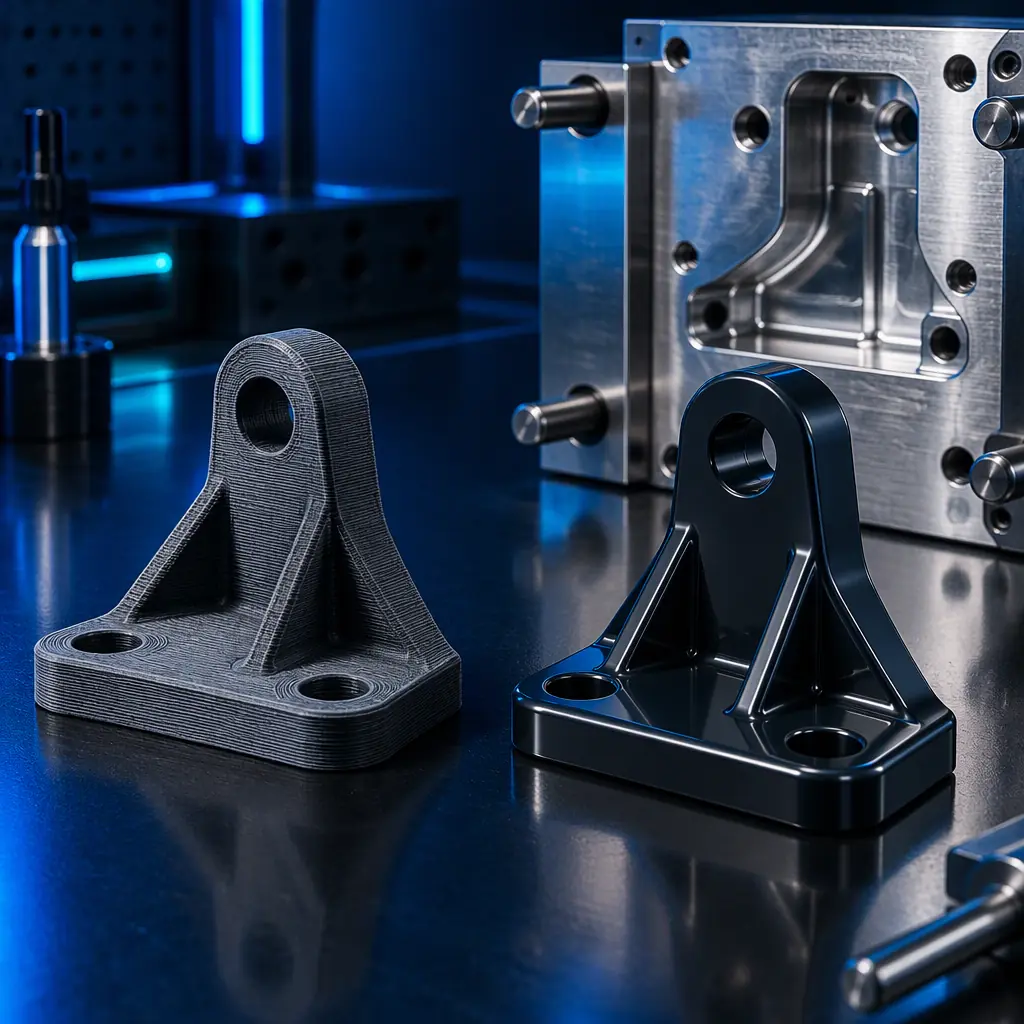
The bracket is a PA12-GF part, 38 g, one visible face, no undercuts, ±0.35 mm on two holes only.
| Cost item | Printed route | Molded route |
|---|---|---|
| Setup or tool | $0 | $3,900 (single cavity aluminium) |
| Variable cost per part | $6.10 | $0.62 material + $0.31 machine = $0.93 |
| First-article and approval | $180 | $1,900 |
| Nominal aperture | — | — |
Breakeven is the tool-plus-approval premium divided by the variable cost gap: ($3,900 + $1,900 - $180) / ($6.10 - $0.93) = 11 parts. That is the entire basis for the “printing wins under a few hundred” rule of thumb, and it is correct for exactly this kind of part: one face, no undercut, loose tolerance.
Eleven parts is also short enough that almost nobody prefers tooling there, because a tool adds a lead time the schedule cannot absorb. The bracket decision is usually already made by the calendar, not the spreadsheet.
Worked Case Two: A Glass-Filled Housing With a Side Action
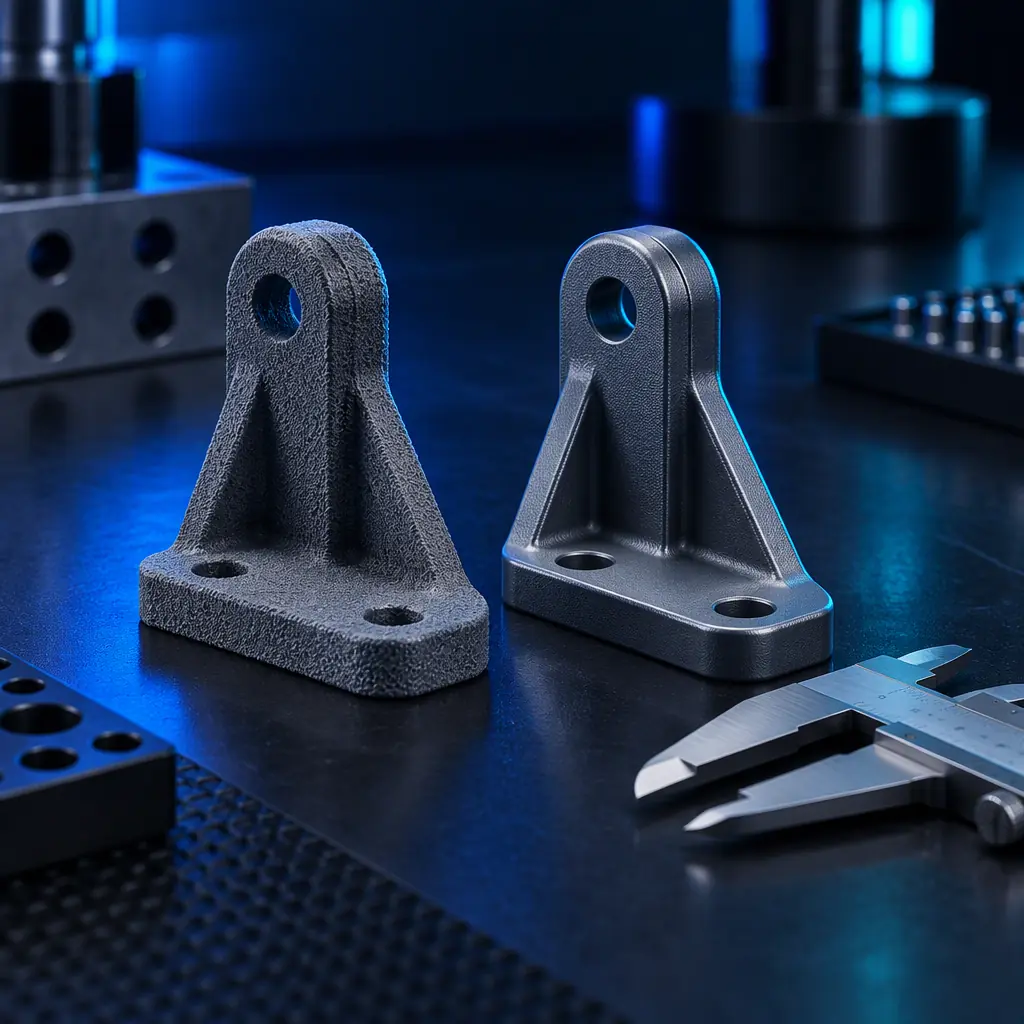
Same envelope, different part. A 112 g PA66-GF30 electronics housing, class A visible front, two internal clips that sit behind the front face, and a mould-texture callout on the front.
| Cost item | Printed route | Molded route |
|---|---|---|
| Tool | $0 | $18,400 (steel core, side action, texture) |
| Variable cost per part | $16.40 | $2.71 |
| First-article, PPAP, dimensional report | $340 | $4,200 |
| Class A surface achieved by | Vapour or bead-blast, +$4.20 / part | In tool texture, included |
Breakeven: ($18,400 + $4,200 - $340) / ($16.40 - $2.71) = 1,630 parts. The part did not change size, mass, or expected life. It gained a second tooling face, a texture callout and a hard moulding resin, and the breakeven moved from 11 to 1,630 - a factor of 148.
This is the case that breaks annual blanket policies. A buyer who set “tool anything above 500 units” last year will tool a 600-unit run of this housing and pay $18,400 to recover $8,200 of variable cost, with a tool sitting idle after month three. The reverse error is as common: printing 1,800 units of a part that should have been tooled in the first month.
Worked Case Three: Two Small Parts, One Tool or Two
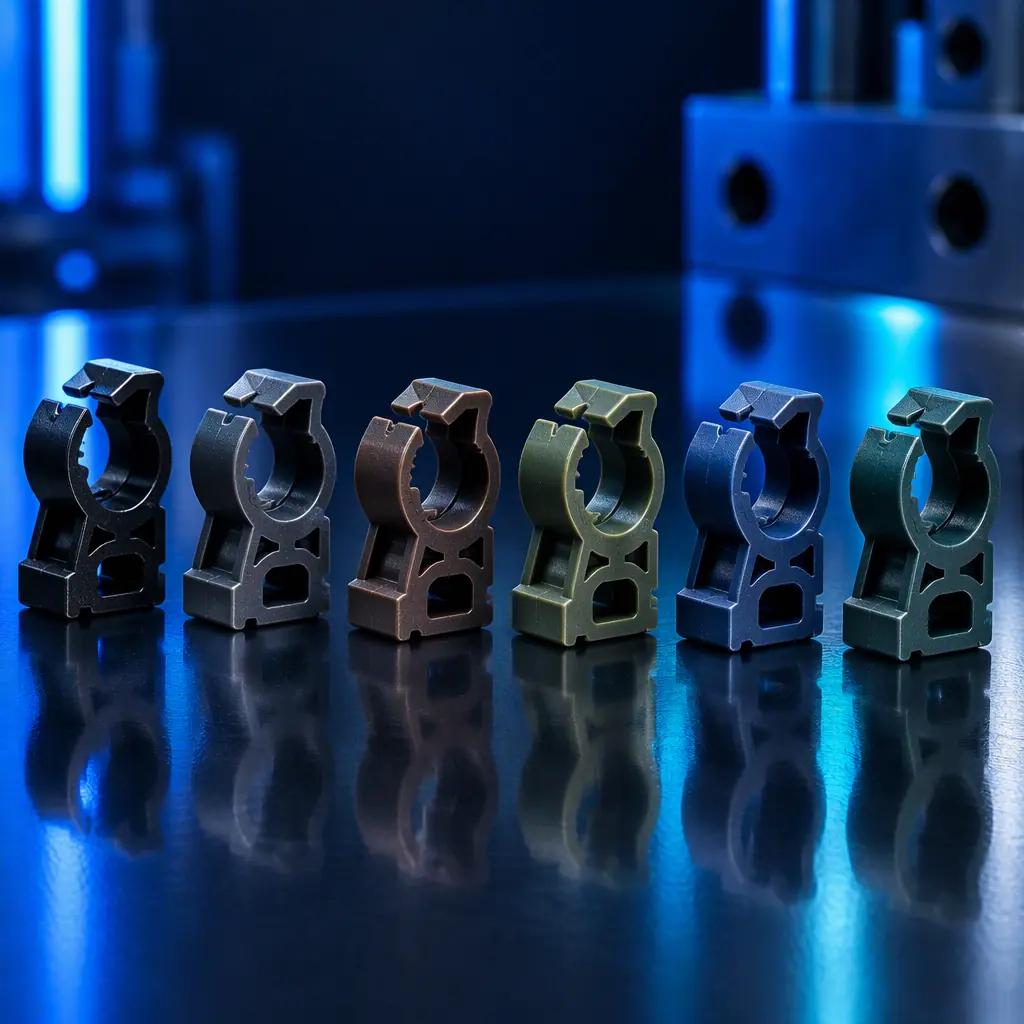
Two sub-40 mm clips are held to the same material and colour. Tooled together in a two-cavity family tool, the tool is $14,200 with no hot runner; tooled separately in two single-cavity tools it is $9,800 total but each machine run carries its own setup and its own first article.
At 900 parts each, the family tool saves $4,400 of tooling but forces one material, one colour and one shot weight on both parts for the life of the tool - a constraint that usually costs more than $4,400 when the clips diverge in revision. The arithmetic says family tool; the revision risk says two tools. Both answers are defensible here, and the deciding factor is the release history rather than the price.
For a version-controlled pair, print both until the design is frozen, then tool the one with the stable drawing and keep the other printed. Hybrid decisions of this kind are the norm in real programmes and are invisible to breakeven-calculator thinking.
Five Part Families and Their Breakeven Volumes
The table below is what a buyer should actually hold: breakeven per family, with the driver that sets it. Values assume the mid-range of the rate stacks above and a 1-year demand window.
| Part family | Tooling cost | Variable gap | Breakeven volume | What sets the tool cost |
|---|---|---|---|---|
| Plain bracket, 1 face, no undercut | $3,900 | $5.17 | 11 parts | Envelope only |
| Clip with one undercut | $8,700 | $6.40 | 160 parts | One side action |
| Housing, 2 faces, texture, GF resin | $18,400 | $13.69 | 1,630 parts | Side action + polish + resin |
| Fluid plate with 6 bores | $12,600 | $9.10 | 1,600 parts | Core pull + tight bores |
| Cosmetic fascia, class A all round | $41,000 | $17.80 | 2,410 parts | Polish on every face |
| Sealed gasket, TPE overmould | $52,000 | $14.20 | 3,800 parts | Two-shot tool + overmould |
The pattern is not “big parts tool later.” The fascia is smaller than the housing and tools two tiers later. The driver is the number of faces that must be formed, corrected or polished, which is exactly the cost that additive does not charge for.
Two caveats keep this table honest. First, the variable gap shrinks as print speed rises, which pushes every breakeven up, not down; a 30% faster printer raises the bracket breakeven from 11 to roughly 16 and the housing from 1,630 to about 2,300. Second, one-year demand is assumed. For a two-year programme with flat demand, multiply the molded variable cost by two before comparing, and every breakeven roughly halves in effective urgency.
What the answer tells you: every undercut, side action and second face adds $3,200 to $7,500 of tool capex, which is 500 to 1,400 parts of variable-cost gap at these rates. A part with three such features almost never tool economically below 3,000 units.
The Triggers That Move the Crossover
Six feature additions each move the breakeven by a predictable amount. A buyer can price them before asking for quotations.
Hot runner deserves a note because it is routinely mispositioned. It removes runner scrap and shortens cycle, which reduces variable cost and therefore raises breakeven. On a 2,000-unit programme it rarely pays; on a 20,000-unit programme it usually does. The mistake is including it in a first tool for a demand band that does not exist yet, which converts a $12,000 decision into a $24,000 one for a saving that arrives in year three.
Hidden parts are the mirror case. A bracket that never gets seen does not need polish or texture, and dropping those callouts takes $2,000 off the tool and pushes breakeven down. Buyers who forward the sales drawing to the toolmaker without stripping cosmetic requirements pay for surfaces nobody inspects.
What the Printed Route Should Include in the Quote
Most printed-versus-tooled comparisons fail on the printed side, not the molded side, because printed quotes omit four cost lines that appear later.
- Packing efficiency at the actual quantity. A 1,200-part order may fill nine chambers on the last build and three on the first. Averaging across builds hides the partial chamber.
- Support removal and surface treatment. Cosmetic parts that need vapour smoothing or bead blasting carry $2.80 to $4.60 per part at these sizes, which can exceed the printing cost itself on small parts.
- Reject handling after post-processing. A part that fails after four manual operations has consumed all four. Reject rate on the printed stack should be applied to post-processing labour as well as to print time.
- Design revision cost. Printing allows change, and programmes use that allowance. One or two design iterations should be budgeted at the engineering hour rate, not assumed free.
A printed quote that already includes these four lines is usually 20% to 35% higher than a per-gram estimate, and it is the only version that survives comparison with a tooled quote. Buyers who compare a complete molded quote against an incomplete printed quote tool parts they should print, and then discover the difference in month two.
What the answer tells you: if the answer is per-gram pricing with no labour line, the printed side of the comparison is understated by $3 to $14 per part on cosmetic work, which can move the breakeven by more than 1,000 parts on the housing family.
Making the Decision Repeatable
Three practices turn this from a one-off analysis into a habit that survives staff changes.
Keep a parts register with the family assignment. Each part gets a family, a current route, a quantity band and the date the band was last checked. Routing decisions expire; a part tooled at 400 units a year ago and now running at 2,600 should be revisited, and a register is the only reliable way to notice.
Re-check at every quantity step change. A tool purchased for a 1,500-unit band is usually still right at 2,000 and usually wrong at 6,000. The re-check is fifteen minutes of arithmetic, and it is the cheapest form of cost reduction available to a hardware programme.
Keep the reverse check. For every part routed to tooling, ask what quantity would have justified printing it instead; for every part printed, ask what quantity would trigger tooling. Programmes that only run the second question accumulate parts that should have been tooled two quarters ago.
The broader arithmetic for printed unit economics, including machine hour build-up and the effect of chamber utilisation, is set out in the cost-per-part model. Where the question is whether to print in-house at all rather than which route to use, the make-or-buy arithmetic covers the loaded internal rate and bureau price curve. For the printed route at higher volumes, the volume transition guide covers capacity and process control, and the MRB disposition guide covers what happens to the rejects either route produces.
Tooling Decision Support
Want the Breakeven for Your Own Part Family, Not a Rule of Thumb?
Send the drawing and the annual quantity band. You will get the loaded printed cost stack, the tooling scope the part actually requires, and the crossover volume for your specific features.