The Make-or-Buy Question as It Actually Arrives
Almost nobody decides to outsource 3D printing as a strategic policy. The decision arrives as a specific part with a specific deadline, at a moment when the in-house machine is busy, and the purchasing team sends it out because that is the fastest way to close the gap. Three years later the company has a mix of in-house and outsourced work that nobody has ever deliberately designed.
That drift has a cost. Parts migrate outward for reasons of convenience and stay outward for reasons of inertia, and the company ends up paying a bureau margin on work it owns the capacity to do. The reverse also happens: a shop keeps printing a part in-house that a bureau could produce for less, because the internal cost is never compared against the external price.
This article sets out the arithmetic for deciding deliberately. It is written for the buyer who controls both a budget and a machine, and who has to justify the split to someone who will ask why the same part is sometimes bought and sometimes made.
What In-House Printing Really Costs Per Hour
The most common error in the make-or-buy calculation is using a machine rate that counts capital and material but forgets everything else. The loaded internal rate has more line items than most shops track.
The width of that final band is the point. Two companies with the same machine produce internal rates that differ by a factor of three, because the rate is dominated by how much skilled labour the part needs and how often prints fail. A shop that prints simple fixtures with a mature profile sits near the bottom of the band. A shop printing complex engineering parts with a profile that is still being tuned sits near the top, and at the top of the band a bureau's quoted price is frequently cheaper than the internal cost.
The second thing to notice is that material is a small share of the internal rate for most parts, yet it is often the only number a shop compares against a quotation. A bureau quote of $45 for a part that consumes $6 of filament feels expensive until the internal rate is applied to the 5 hours the part actually occupies across printing and finishing. That is $19 to $57 of internal cost depending on where in the band the shop sits, and the comparison is not obvious in either direction.
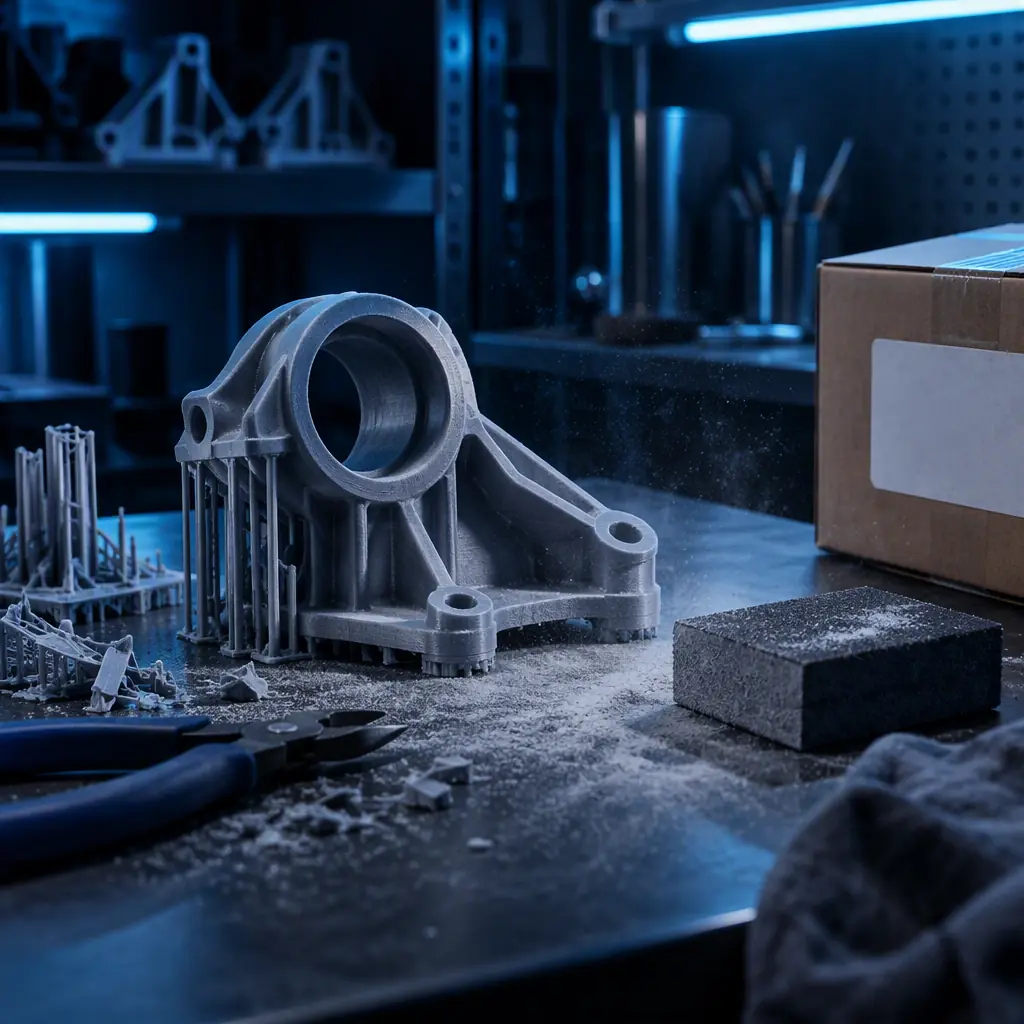
Post-processing is the most under-counted line. Support removal, sanding, vapour smoothing, dyeing and inspection are frequently performed by a technician who is not tracking their time against the part, and that labour is real. Our guide to post-processing and finishing breaks down which finishing operations should be bought rather than done in-house, because several of them are economically better outsourced even when printing is kept internal.
The Break-Even Volume, Derived Rather Than Guessed
With an internal rate and an external price, the break-even is direct arithmetic. The complication is that the external price is not linear in volume, and until you know its shape the break-even is a moving target.
Those ranges are illustrative for a moderately complex part of roughly 100 grams, and they show the shape clearly: bureau pricing falls steeply from one-off to small batch, then flattens. The flattening is not arbitrary. A bureau's cost structure includes setup, machine scheduling and QC that does not shrink with volume, so the price floor is set by process overhead rather than by material or machine time.
For that part, in-house printing becomes cheaper than a bureau at somewhere around 80 to 150 units if the internal rate is in the middle of its band and the profile is mature. Below that, the bureau wins on price as well as on lead time, because it is amortising setup across its whole order book rather than across your one part.
Two corrections make the break-even honest. The first is the urgency premium: a bureau that can deliver in three days when the alternative is waiting six days for internal machine availability is delivering schedule value, not just parts. That is worth paying for, and it should be recorded as a schedule decision rather than treated as a price failure. Our guide to RFQ and proposal playbooks covers how to structure the comparison so the schedule value is visible.
The second correction is the learning cost of a new part. If the part is a new geometry that will need profile development, printing the first batch internally means paying for that development in machine time and scrap. A bureau has already paid it. Outsourcing the first batch and bringing the part in-house once the profile is stable is frequently the cheapest sequence, and it is the opposite of what most shops do.
What Belongs In-House and What Belongs Out
The volume break-even is necessary but not sufficient. Several categories of work should stay in-house regardless of the volume arithmetic, and several should go out even when the internal rate looks favourable.
Keep in-house
- Iterative design work. A part in its fifth revision benefits from a same-day turnaround loop. The value of the iteration speed exceeds the price difference, and every design cycle spent waiting on a bureau is a cycle not spent finding the problem.
- Confidential geometries. Parts that reveal a product's internal architecture should not leave the building. This is a business decision that overrides the cost comparison, and it should be documented as such so it is not relitigated per order.
- Fixtures, jigs and internal tooling. These consume machine time that has no external opportunity cost and they never leave the company. See our guide to printed jigs and fixture libraries for how to run this category as a managed library rather than as ad hoc printing.
- Material-qualified production. If a part is qualified on your machine with your profile and your material lot, moving it to a bureau invalidates the qualification and requires requalification. The cost of requalification usually exceeds the savings.
Send out
- Volume runs above the break-even on a part you cannot schedule. A part that will consume two weeks of machine time has an opportunity cost equal to everything else that machine would have produced.
- Materials and processes you do not own. SLS nylon, metal, or high-temperature polymers require a different machine class. Buying the capability for a single part is rarely justified.
- Spike demand. A short-notice order for 400 units should be bought, not used as the argument for buying another machine that then sits idle. This is the same capacity reasoning that governs print farm sizing.
- Qualification and inspection services. CT scanning, mechanical testing and full dimensional reporting are better bought from a specialist than built in-house for occasional use. Our guide to part metrology and dimensional inspection covers what to specify when you buy inspection rather than perform it.
The list is not symmetric, and that asymmetry is worth stating plainly: in-house printing is defensible for speed, control and confidentiality, and it is rarely defensible on per-part cost at low volume. Companies that treat the decision as purely financial almost always end up outsourcing more than they intended, and then losing the design iteration speed that justified owning the machine in the first place.
The Bureau Relationship as a Managed Asset
Outsourced printing is often treated as a transactional fallback, which is why it underperforms. A bureau that knows your parts, your tolerances and your material preferences delivers far better results than one receiving a fresh CAD file and a deadline each time.
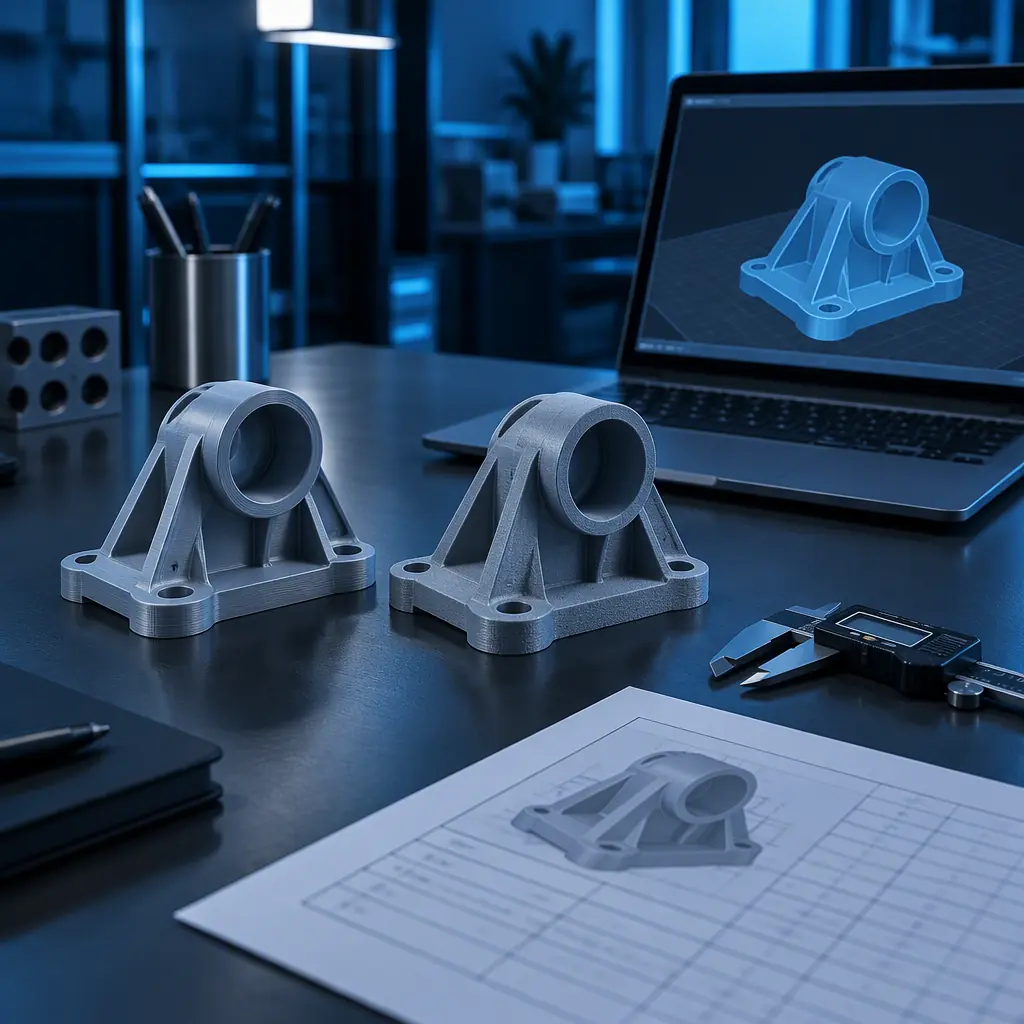
The practices that make the relationship productive are unglamorous. Send the same file format every time, with the part's functional surfaces identified. State the tolerance that matters rather than an overall tolerance band. Name the material by grade and supplier rather than by family. Report what went wrong on the last batch, including your own profile mistakes, because a bureau that understands your failure history will flag the risk before running the job.
It is also worth establishing a price agreement with volume tiers in advance, so the make-or-buy calculation has a stable external number to compare against. Without that, each decision renegotiates the external side and the comparison drifts. Our guide to RFQ and proposal playbooks covers how to structure the tier schedule so it can be used as a decision input rather than as a negotiation position.
What you're looking for: If the rate predates the current labour cost and the current failure rate, every make-or-buy decision since then has been made on a stale number. A shop that recalculates quarterly is making decisions deliberately; one that has never calculated it is making them by default.
Reporting the Split So It Survives Scrutiny
The decision has to be defensible to a controller who will look at the external spend line and ask why it is not zero. The defence is a per-part register that records, for each part: internal rate applied, external quote obtained, volume, and the reason the chosen route was chosen. Schedule, confidentiality, capability and material qualification are all legitimate reasons, and they read very differently in a register than they do as an explanation offered after the fact.
That register also surfaces the drift. Parts that were outsourced during a busy period and never reconsidered will show up as entries whose reason no longer applies, and those are the easy savings. The reverse entries, parts kept in-house well past their break-even volume, show up the same way.
None of this requires new systems. It requires a spreadsheet with one row per part and a discipline of filling in the reason, which is exactly the discipline that makes the make-or-buy question stop being an accident and start being a policy.
If you are trying to establish where your own break-even sits for a specific part, send us the geometry, the material, the annual volume and your shift pattern. We build engineering-grade machines for exactly this duty, and we are equally willing to tell you when the arithmetic says to keep buying the part.