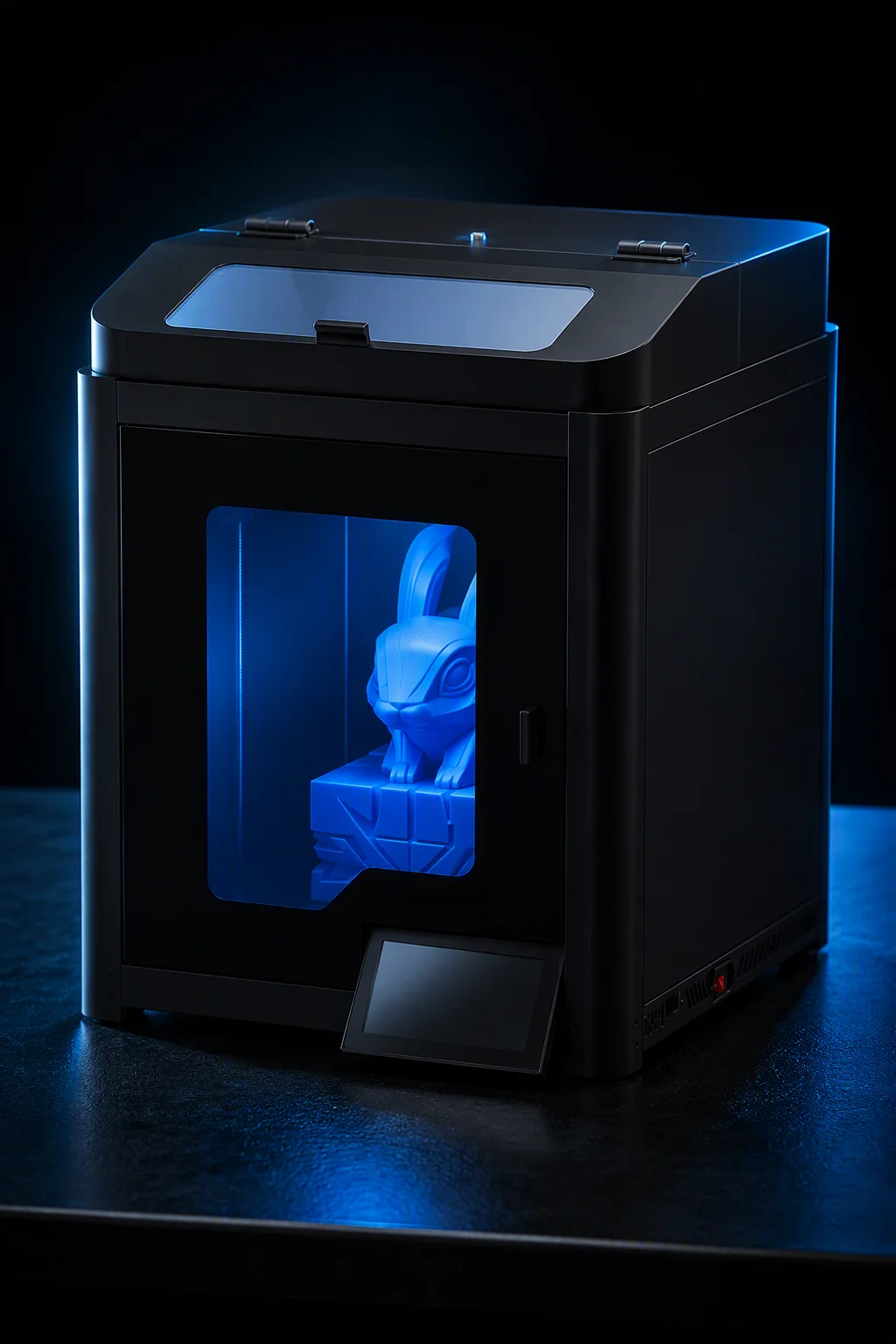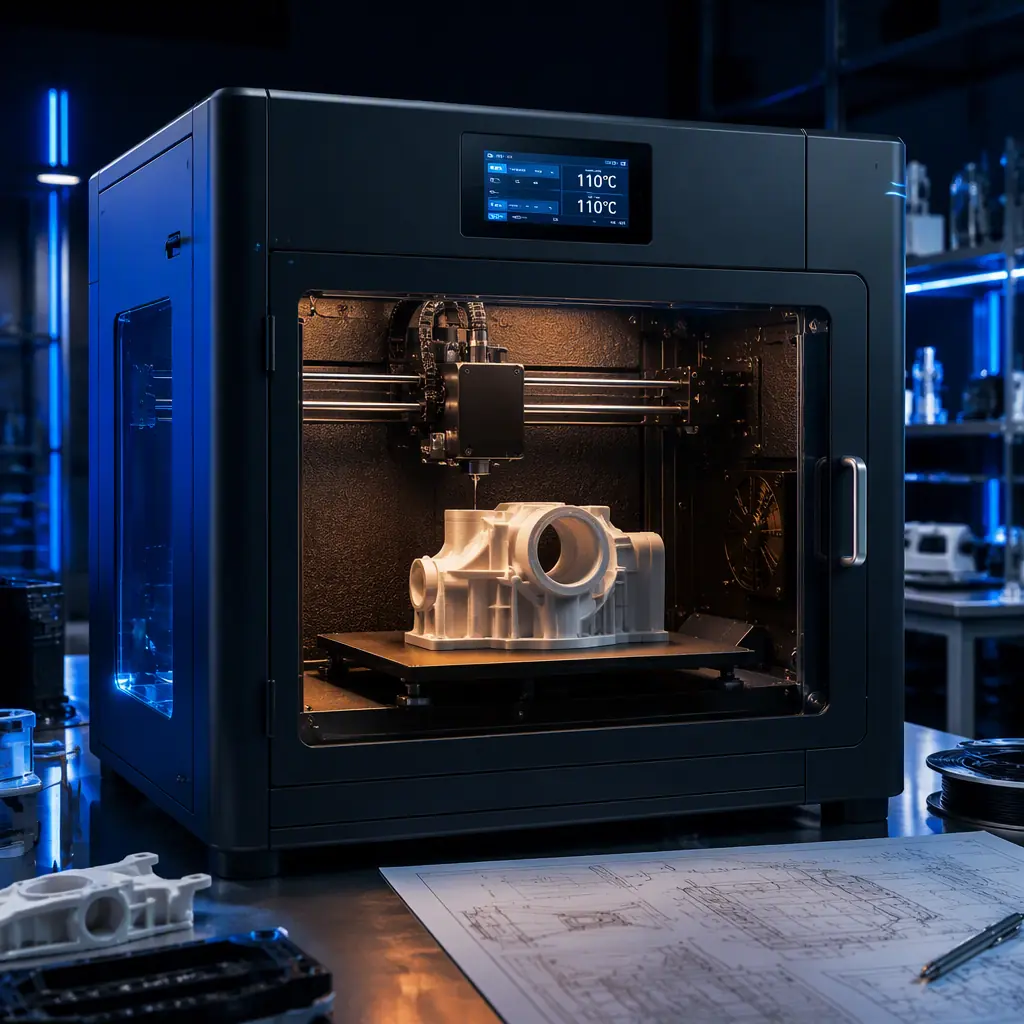
Every engineering team eventually asks the same question: which 3D printer do we buy? The market makes the answer deliberately confusing, consumer machines advertise specs that look identical to industrial ones, and industrial machines price themselves at 5-10x with features nobody explained. This guide defines the buying criteria that actually separate engineering-grade machines from hobby hardware: heated chamber capability, hotend and material compatibility, dimensional repeatability, software and workflow, safety certification, and total cost of ownership. It is the technical companion to our R&D rapid prototyping guide, which covers the sales conversation for selling into engineering accounts, and it builds on the portfolio strategy that positions which machines belong in which segment.
What "Engineering-Grade" Actually Means
Three capabilities define an engineering-grade FDM machine, and none of them appear on a consumer spec sheet in a comparable way. Material breadth: the machine must print the engineering material family, PC, nylon, PA-CF, PETG, ASA, and in the top tier PEEK/PEI, not just PLA and PETG. Environmental control: an actively heated, temperature-stable chamber is required for low-warpage prints in PC, nylon and ASA; without it, large parts in these materials curl off the build plate regardless of bed temperature. Reliability and repeatability: the machine must reproduce the same result print after print, same dimensions, same surface, same mechanical properties, because engineering prototypes are decision inputs, not decorations. The material science behind these requirements is covered in our engineering filaments guide and the PEEK/PEI/PPSU materials guide, and the accuracy expectations are quantified in our tolerances guide.
The one-line test that separates the tiers: can the machine print a 150 mm PC part with sharp corners and hold dimensional accuracy overnight in a changing room temperature? A consumer machine with a partially enclosed chamber cannot; an engineering machine with an active chamber holds the environment, and the part holds its geometry. This test is worth running before any budget discussion, the demo structure is in our B2B sales demo playbook.
Heated Chamber & Hotend: The Hardware That Sets the Tier
Two hardware systems determine what a machine can print. The hotend must reach and hold the melt temperature of the target material family, with an all-metal throat (no PTFE tube at the melt zone) so the material does not degrade or clog:
The chamber is the bigger differentiator. An "enclosure" is a box; a heated chamber actively maintains a set temperature (usually 45-70°C for engineering materials) so the part cools uniformly and does not warp. The difference matters most for large flat parts in PC, nylon and ASA, the exact failure mode that sends parts back to the drawing board. The chamber design physics and upgrade paths are detailed in our heated chamber guide, and the enclosure temperature control conversation is in our enclosure temperature control guide.
Two more hardware systems deserve scrutiny. Motion system: linear rails or high-quality v-wheels with closed-loop or high-resolution steppers determine long-term accuracy; the comparison is in our motion system guide, and the stepper driver options are in our stepper & motherboard guide. Build volume: engineering teams need at least 250×250×250 mm to print real prototypes; the sizing logic is in our build volume guide.
Dimensional Repeatability: The Spec That Predicts Trust
Engineers do not ask "is it accurate?". They ask "will part 47 match part 3?" Repeatability, not absolute accuracy, is the trust metric. When evaluating a machine, demand three numbers:
- Dimensional repeatability: the spread of a calibrated test cube across 10 consecutive prints. Engineering machines hold ±0.05-0.10 mm; consumer machines drift ±0.15-0.30 mm as chamber temperature and ambient conditions change.
- First-layer consistency: the single biggest source of failed parts; automatic bed leveling with a load cell or inductive sensor matters more than marketing claims, the technology comparison is in our auto bed leveling guide.
- Calibration stability: how long the machine holds its calibration between maintenance cycles. A machine that needs re-leveling every 20 prints is not an engineering tool, whatever its spec sheet says; the calibration disciplines are in our advanced calibration guide.
The honest way to test repeatability in a demo: print the same 50 mm calibration cube three times with the same g-code, and measure all three with calipers in front of the customer. If the spread exceeds 0.1 mm, the machine is not engineering-grade for their workflow. This is the demo that closes accounts, the full framework is in our sales demo playbook, and the QC framework that engineers expect is in our factory audit & QC checklist guide.
Software & Workflow: What R&D Teams Cannot Compromise
The printer is only half of the engineering tool; the workflow around it decides adoption. Four software capabilities separate engineering platforms:
- Material profiles, not generic presets. An engineering machine ships with validated print profiles for each material it claims to support (temperature, cooling, retraction per material), so the engineer prints nylon correctly on day one instead of tuning for a week. The profile-dependent quality gap is covered in our slicer software guide.
- Network monitoring and queuing. R&D teams need to launch, monitor and queue prints from their desks, the remote monitoring ecosystem is in our remote monitoring & cloud guide.
- Firmware openness or fleet management. Depending on the team, either open-source firmware (Klipper/Marlin, covered in our Klipper guide) or centralized fleet management for multi-machine labs; the ecosystem choice is in our software ecosystem guide.
- Print failure detection. AI-based failure detection and paused-print alerts protect overnight unattended runs, the technology is in our AI print monitoring guide.
The workflow question to ask in a demo: "Can your team go from CAD to a validated print with material-appropriate settings in under 15 minutes, without a printed reference card?" If the answer requires manual tuning per material, the machine slows the engineering loop it is meant to accelerate.
Safety & Certification in Engineering Environments
Engineering and lab environments have safety requirements that hobby machines ignore. Four items are non-negotiable for an engineering purchase:
- Electrical safety certification: CE (IEC 60950/62368), UL or equivalent, required for any machine placed in a corporate or university environment, and a hard procurement gate in the EU and many enterprise buying policies. The certification landscape is mapped in our certification & compliance guide.
- Thermal runaway protection: redundant temperature sensing that shuts the heater down if the thermistor reads implausible values, the safety feature set is detailed in our safety features guide.
- Enclosed, filtered operation: engineering materials (ABS, nylon, PC) emit particulates and VOCs; an enclosed machine with a HEPA/carbon filter is the difference between a lab-compliant install and a facilities objection. The filtration options are in our fume extraction & filtration guide.
- Power supply quality: engineering machines run long unattended prints, so a certified PSU with overload protection matters, the PSU selection criteria are in our PSU selection guide.
The certification question is also a margin question for distributors: certified machines command 30-60% higher prices in enterprise procurement, and the paperwork (declaration of conformity, test reports) is often the deciding factor against a cheaper competitor, the selling framework is in our certification guide.
Total Cost of Engineering Ownership
The final criterion is the one procurement signs: total cost of ownership, not sticker price. The honest comparison for an engineering team printing 40 hours/week:
The counterintuitive result is real: at engineering workloads, the cheaper machine costs more in the first year because engineer time and material waste dominate the equation. The full TCO model, with the spreadsheet math that procurement understands, is in our TCO & ROI calculator guide, and the financing options that make the engineering platform affordable are in our leasing & financing guide.
The Distributor Angle: Selling the Engineering Tier
For distributors, the engineering tier is the highest-margin, lowest-return-rate segment of the market, but it sells differently than consumer hardware. Five rules govern the conversation:
1. Sell the workflow, not the machine. Engineering buyers purchase outcomes (validated parts on a repeatable schedule), so the demo must show the workflow: CAD → material profile → print → measured result. The demo structure is in our sales demo playbook.
2. Bring the material story. The R&D team's pain is usually a specific material (PC enclosures, PA-CF jigs); match the machine to the material matrix and prove it with a print of their own part. The material-to-machine mapping is in our engineering filaments guide.
3. Lead with certification. CE/UL documentation is what procurement checks; have the declarations ready before the meeting. The paperwork play is in our certification guide.
4. Quantify the TCO. Bring the 12-month total cost table for their workload; it neutralizes the sticker-price objection before it lands. The model is in our TCO calculator guide.
5. Attach the consumables loop. Engineering material (PC, nylon, PA-CF) is 2-4x the price of PLA and consumed faster; the recurring revenue is in our consumables bundling guide.
The bottom line: "engineering-grade" is a capability, not a price point. The machine that holds a heated chamber, prints the engineering material family, repeats within 0.1 mm and carries the certifications is the one R&D teams keep. And the distributor who can prove those four capabilities owns the most profitable tier of the printer market.
Reviewed by the Precise3D engineering & OEM team. Compliance files that accompany the catalog are auditable at the certification register.
Partner With Precise3D
Ready to Sell the Engineering Tier?
Get wholesale pricing on engineering-grade platforms, active heated chamber, 300°C all-metal hotend, material profile library, CE certification, plus the TCO sales kit that wins R&D accounts.