Marginal Cost vs Fully Absorbed Cost
Before any arithmetic, separate two numbers that are both called "cost per part" and are not the same number. Confusing them is the most expensive error in print shop pricing.
Marginal cost is what one additional part costs when the machine is already bought, the operator is already paid, and the shop is already open. It contains material, a share of consumables, and the machine time that could have been sold to someone else. It does not contain the machine itself, the rent, or the salaries, because those are spent whether this part is made or not.
Fully absorbed cost is what a part costs when it carries its fair share of everything: a slice of machine capex, of the building, of the salaries, of software and insurance. This is the number that tells you whether the business is viable. Marginal cost tells you the lowest price at which accepting a job is better than idling. Absorbed cost tells you the lowest price at which the business survives.
The practical rule: quote against absorbed cost, and accept against marginal cost. A shop that prices against marginal cost will win every job and slowly go bankrupt. A shop that refuses anything below absorbed cost will turn away work that could have contributed. Knowing both numbers and which one applies to the decision in front of you is the entire skill. The same logic appears in service bureau economics, where utilisation is the variable that decides which regime you are in.
Building the Machine-Hour Rate Line by Line
The machine-hour rate is the foundation of every number that follows, and it is the line most often asserted rather than computed. Building it takes one pass. Worked for a mid-size professional machine:
Two variables in that build deserve attention because they move the result more than anything else. The first is utilisation. At 45 percent the capex line is $1.14 per productive hour; at 20 percent it becomes $2.57, and at 80 percent it falls to $0.64. Nothing about the machine changed, only how much of the time it is actually making sellable parts. This is why a busy shop can undercut an idle one and still make more money, and why print farm economics is mostly a utilisation discussion.
The second is service life. Assuming four years of calendar life is generous for a machine in continuous production; assuming 35,040 hours of running life is not. Which limit binds first depends on duty cycle, and for a machine running three shifts it is the running hours, not the calendar. Using calendar life for a heavily loaded machine understates the rate, sometimes by a factor of two.
Note what is deliberately excluded: operator time. Labour is treated as its own line because it scales with parts rather than with hours, and mixing it into the machine rate hides the largest cost lever in the whole model.
Material Cost: Filament, Resin and the Waste Factor
Material cost looks like the easiest line and is routinely understated by 15 to 30 percent because the quoted price is for material that ends up in the part, and not all of it does.
For filament, the nominal cost is part mass multiplied by price per kilogram. The waste factor then adds: purge and prime lines, the skirt or brim, supports, failed prints, end-of-spool remnants that are too short to use, and the tangled or wet spool that gets discarded. In a well-run shop these add 8 to 15 percent. In a shop with unreliable material storage they add considerably more, because moisture-degraded filament turns into failed prints rather than slightly worse ones. Our guide to filament drying and storage exists because that waste is avoidable.
For resin, the calculation differs in an important way: the part is not the only thing the resin is used in, and the build plate is not the only place resin ends up. Waste comes from supports, failed builds, wash-solvent losses, resin left in the vat past its useful life, and the resin that never leaves the bottle because it has separated. A waste factor of 10 to 20 percent is realistic for resin, higher than filament, because vat losses do not depend on whether the build succeeded.
An engineering material changes the picture out of proportion to its price. A $180/kg high-performance filament printing a 40 g part costs $7.20 in material before waste, and a 12 percent waste factor takes it to $8.06. That single line can exceed the machine time cost of the part, which is why material selection is a commercial decision and not only a technical one. Compare that with total cost of ownership, where material is often the largest recurring line over a machine's life.
What you're looking for: A number under 80 percent almost always means there is recoverable loss — wet material, avoidable support volume, over-large purge, or failed builds being written off silently. A shop that cannot answer is not measuring, which means the waste is in the price but not in the model.
Post-Processing Labour Is Usually the Largest Line
On any part that ships to a customer rather than coming off the plate and into a box, post-processing labour exceeds material and machine time combined. It is also the line estimated most casually, usually as "a few minutes". Measure it once and the estimate rarely survives.
Multiply those minutes by a fully loaded labour rate — wage plus employer costs plus the fact that an operator cannot be productive on something else while sanding — and the result is frequently $8 to $25 per part. For a part whose material cost is $3 and whose machine time is $2, post-processing is 60 percent of the total. Yet it is the line most often left out of a published cost model, because it is invisible in a slicer.
Two consequences follow. First, quoting from a slicer's estimated print time and mass alone systematically under-prices finishing-heavy work, and the shop discovers this when it loses money on a job it thought was profitable. Second, the strongest cost-reduction lever is usually design for finishing rather than a cheaper material: orienting the part to put supports on a non-cosmetic face, splitting an assembly so no part needs blasting, or specifying a surface finish the process achieves natively. That is the commercial reason post-processing strategy belongs in the quoting conversation rather than after it.
Failure Rate and Rework: The Line Everyone Omits
No published cost calculator includes a failure line, and in real production it is one of the largest. The reason for the omission is that failure rate is a property of your shop, not of the part, so a generic calculator has nothing to put there. That is exactly why the model has to be yours.
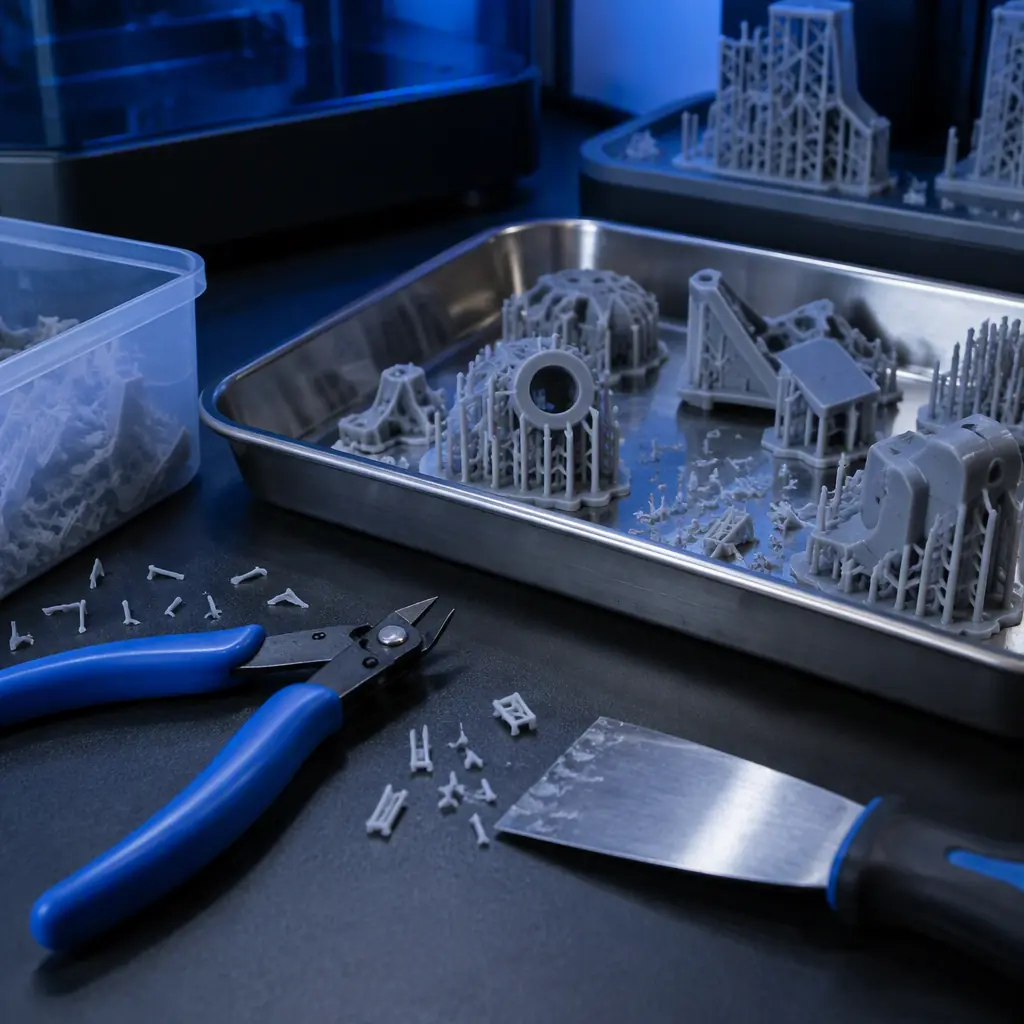
The arithmetic is simple and its effect is larger than expected. If five percent of builds fail, then to ship 100 good parts you must start 105, and you consume the material, machine time and operator attention for all 105. The failed five also consume the post-processing and inspection time up to the point of detection, and if the failure is found late, they consume a production slot that could have made a sellable part.
The effective cost multiplier is the reciprocal of the yield. At 95 percent yield each shipped part carries 1.053 times its nominal cost; at 85 percent, 1.176; at 75 percent, 1.333. A shop with a 25 percent failure rate is pricing every part a third too low if the failure line is missing, and that is the size of the error being made quietly in a great many small operations.
Where the failure is caught matters as much as whether it happens. A first-layer failure detected within ten minutes wastes ten minutes. The same failure detected at hour twelve wastes twelve hours of a machine that could have been making revenue. This is the mechanism that makes in-process monitoring pay, and our guide to vision inspection on a printing line covers how to size that investment. The cost of failures that reach the customer is a different and much larger number, treated properly in our guide to cost of poor quality and root cause analysis.
What you're looking for: The ratio is the yield, and it belongs in the cost model as a divisor, not as a note. If the answer requires checking records that do not exist, that is the first thing to fix, because a shop cannot improve a number it does not measure.
Overhead: Floor Space, Power, Software, Consumables
Overhead is the line where small shops either double-count or ignore entirely. The goal is not to be exhaustive but to be consistent and to avoid charging the same thing twice.
- Floor space. Rent or mortgage divided by usable area, multiplied by the footprint of the machine including the access and staging space it needs. Charged per machine-hour it is usually a modest figure; charged per part it is negligible. Include it anyway, because a shop that ignores it cannot compare a machine that needs 2 m² with one that needs 6 m².
- Power. Machine draw plus the ancillaries, which buyers routinely forget: the drying cabinet, the wash station, the curing unit, extraction, and the air conditioning that offsets the heat the machines produce. Total draw is often 40 to 70 percent above the machine's rated figure. Our guide to energy and operating cost covers how to measure it rather than estimate it.
- Software and licences. Slicers, farm management, CAD seats, and any quality or ERP modules. Divide by productive machine hours.
- Consumables that are not material. Nozzles, build plates and their replacement sheets, resin vats and films, filters, gloves, IPA or solvent, paper towels, build plate adhesive. Individually trivial, collectively a persistent per-hour cost. This is the line that gets paid for out of pocket and never charged to a job.
The consistency rule is that each cost appears exactly once, either as a per-hour overhead or inside the machine-hour rate. Charging maintenance both as a rate component and again as a per-job consumable line double-counts it, and the resulting price looks uncompetitive for reasons nobody can explain.
Worked Example, Two Parts, Two Machines
Two parts priced on the same machine at the same $1.95 per machine-hour, to show how differently the lines behave.
Three things are visible in that comparison. The first is that post-processing is 25 percent of the small part's cost and 23 percent of the large one's, which is roughly constant because finishing effort tracks part complexity rather than part size. The second is that machine time dominates the large part, which means improving the large part's cost is a machine and nesting problem, while improving the small part's cost is a finishing and batch-size problem. The third is that failure at 95 percent yield adds only five percent, which is why a shop with a high failure rate cannot see its problem in a single part's quote and has to look at monthly totals instead.
Nesting changes the large part's arithmetic significantly and is the reason build volume matters commercially: filling a plate with several enclosures spreads the machine time across more parts without increasing it proportionally, provided the parts finish at the same time. That is the practical argument for the build volumes in our range of engineering-grade machines, and the scheduling discipline that goes with it is covered in line balancing and bottleneck analysis.
Pricing From Cost: Margin, Volume Bands and MOQ
Cost determines the floor, not the price. Turning cost into a quotation involves three decisions that the cost model should inform but cannot make.
Margin structure. A flat percentage applied to every part treats equal effort as equal risk, which is not true. A one-off prototype carries quoting risk, setup risk and the possibility of a design change mid-run; a repeat part carries almost none. Charging the same percentage for both means the repeat customer subsidises the prototyping customer, or the reverse. Many shops handle this with a modest setup fee that covers the first-article process and then a lower per-part margin on repeats, and it is more honest than inflating the per-part price to hide the same thing.
Volume bands. Because setup is amortised over the run while material and finishing scale with it, cost per part falls with quantity but not continuously. Quoting discrete bands — 1 to 9, 10 to 49, 50 to 199, 200 plus — reflects the underlying step changes in how the work is organised, and it is more defensible to a buyer than a smooth curve nobody can explain. It also stops the shop from quoting a thousand-unit price on a hundred-unit job because a calculator interpolated.
Minimum order quantity. Below a certain value a job cannot cover its own quoting and administrative overhead regardless of margin, and the MOQ exists to stop the shop from accepting work that loses money invisibly. Setting it from the cost model rather than from habit is what makes it defensible when a customer pushes back. Our guide to distributor pricing strategy and margin covers the channel-side version of the same problem, where the MOQ also has to satisfy a distribution agreement.
Building Your Own Sheet in Ten Numbers
The whole model reduces to ten inputs. Put these in a spreadsheet and every part you quote becomes arithmetic rather than judgement.
- Machine capex, installed, in your currency.
- Service life in hours, whichever binds first — running hours or calendar.
- Practical utilisation as a percentage, measured from records rather than hoped for.
- Maintenance and spares spend per year, divided by productive hours.
- Power draw in kW including ancillaries, times your tariff.
- Floor area occupied, times rent per square metre per year, divided by productive hours.
- Material price per kilogram or litre, by material.
- Waste factor as a percentage, measured from purchases versus shipped mass.
- Loaded labour rate per minute, for finishing and inspection.
- Yield as a percentage, from builds started versus parts shipped.
Those ten produce a cost per part that reflects your operation rather than an average, and they make the sensitivity visible: change utilisation from 45 to 30 percent and watch the cost move, change waste from 12 to 20 percent and watch it move again. That visibility is the real deliverable, because it tells you which improvement is worth pursuing. A shop that knows its numbers can decide whether to buy a faster machine, a bigger plate, or a better drying cabinet — and the answer is usually not the machine.
If you are building a business case for capacity and want the machine side of the arithmetic checked, send us the parts you intend to run and the volumes, and we will work the machine-hour rate and the yield assumptions through with you.