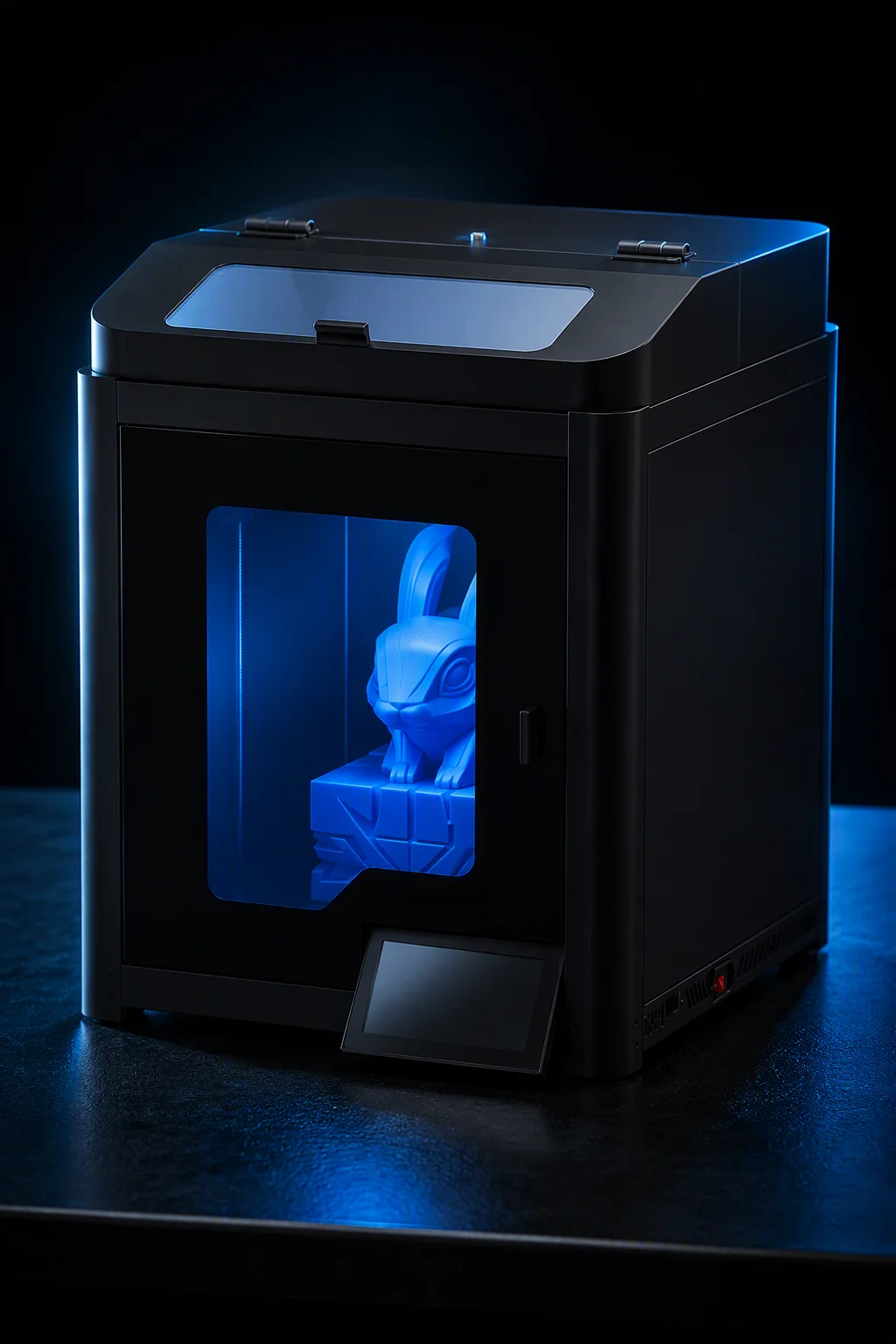
In the 18 months since Bambu Lab's X1 Carbon began appearing on retail shelves outside China, no single company has reshaped the distributor economics of consumer 3D printing more dramatically. Before Bambu, the market ran on a well-understood model: manufacturers competed on hardware specs and wholesale price, distributors differentiated on service, and the aftermarket, nozzles, build plates, hotends, was largely commoditized and cross-compatible. Bambu broke that model. Their printers are genuinely excellent, the X1C and P1S consistently rank at the top of independent print quality benchmarks, but the business model underneath is a closed loop designed to capture value at every layer: the printer sale, the filament reorder, the replacement part, and increasingly, the direct customer relationship. For an independent distributor, the question is not whether Bambu printers sell. They do. The question is whether selling them strengthens or weakens your business over a 3-year horizon.
The Economics of Closed Ecosystems: What Distributors Actually Keep
To understand the strategic choice, start with the numbers. An open-source printer, say a Creality K1 Max or a Qidi Plus4: typically offers a wholesale price of $350–550 with a distributor margin of 35–45% on the hardware sale. The aftermarket parts (nozzles, build plates, hotends) are commoditized and cross-compatible, meaning the distributor can source from multiple suppliers, stock third-party alternatives, and maintain 50–70% margins on consumables. A Bambu Lab P1S, by contrast, has a wholesale price of approximately $480–550 with a distributor margin closer to 20–28%, roughly 12 points lower. But the real margin compression comes from the consumables: Bambu's proprietary hotend assembly ($35 MSRP, approximately $22 wholesale) leaves the distributor with a 35% margin versus the 60%+ achievable on a standard Creality-compatible hotend sourced at $8 and sold at $20. Multiply that across 100 printer sales per month, each consuming 2–3 hotends and 12–15 spools of filament per year, and the annual margin differential is approximately $18,000–25,000 per 100-printer installed base.
The margin gap is real and significant. But it is not the whole story. Bambu printers sell faster, independent distributor surveys indicate 1.7–2.3x faster inventory turnover versus similarly priced open-source models, and they attract a different customer: higher disposable income, less technical, willing to pay for convenience. The strategic calculation is not "Bambu vs. open-source" in isolation. It is whether the velocity and customer acquisition value of stocking Bambu offsets the structural margin disadvantage. For a detailed breakdown of open-source printer portfolio economics, see our open-source vs proprietary portfolio strategy.
The AMS Lock-In: Why Filament Becomes the Real Revenue Battle
Bambu Lab's Automatic Material System (AMS) is the most effective customer retention mechanism in consumer 3D printing. An AMS unit holds four spools and uses RFID tags embedded in Bambu-branded filament spools to automatically detect material type, color, and remaining quantity. The user experience is genuinely seamless, tap print, and the AMS handles material switching, runout detection, and spool tracking without any manual intervention. But the RFID system also creates a soft lock-in: third-party spools require a printable adapter ring and manual configuration, and multi-color prints with off-brand filament produce inconsistent results because Bambu's slicing profiles are tuned to their own material specifications. The result is that Bambu AMS owners purchase an estimated 75–85% of their filament from Bambu directly or through authorized channels, compared to 30–40% brand loyalty for open-source printer owners.
For a distributor, this changes the consumables math entirely. An open-source printer owner buying 12 spools per year at an average of $18/spool generates approximately $216 in annual filament revenue, of which the distributor might capture $90–130 depending on sourcing. A Bambu AMS owner buying 15 spools per year (multi-color printing increases consumption by approximately 25%) at Bambu's $25–30/spool pricing generates $375–450, but the distributor only captures margin on their wholesale allocation, roughly $60–90, because Bambu's direct online store competes for the same customer. The AMS user spends more on filament, but more of that spend flows directly to Bambu Lab, not through the distribution channel. For a deeper analysis of multi-material printing economics, see our multi-material systems guide.
Data Point: Bambu Lab's direct-to-consumer filament revenue grew an estimated 140% YoY in 2025, reaching approximately $180M globally. Third-party distributors selling Bambu printers captured less than 15% of the associated filament spend.
Three Strategic Responses: A Decision Framework for Distributors
There is no single right answer for every distributor. The optimal strategy depends on your market position, customer base, and growth objectives. The following framework maps three viable approaches, each with distinct economics and operational requirements.
Strategy 1, Stock & Bundle:
Carry Bambu printers as your entry-level premium offering, but bundle them with high-margin open-source consumables (generic filament, aftermarket build plates, third-party nozzles) and service plans. The Bambu printer sale becomes a customer acquisition cost; the profit comes from everything the customer buys after. This works best for high-volume consumer-focused distributors in markets where Bambu has not yet established direct retail presence. Strategy 2, Compete & Differentiate: Do not stock Bambu. Instead, build your portfolio around the strongest open-source competitors, Qidi Plus4, Creality K2 Plus, Sovol SV08, Prusa Core One, and differentiate on local service, training, and full-lifecycle support that Bambu's direct channel cannot match. This is the highest-margin path but requires active marketing to overcome Bambu's brand recognition advantage. Our competitive brand landscape analysis maps the strengths of each alternative. Strategy 3, Hybrid Funnel: Stock a limited Bambu selection (P1S combo, A1 Mini) as your top-of-funnel products, then use the customer relationship to upsell higher-margin open-source printers, consumables, and service contracts over the first 12–18 months. This captures the Bambu demand without becoming dependent on it. The Bambu sale is the entry point, not the endgame.
Firmware Lock-In and the Right-to-Repair Movement
In early 2026, Bambu Lab introduced an authorization chip requirement for replacement hotends on the X1 and P1 series. The printer firmware checks for a cryptographic signature before heating, and third-party hotends without the chip trigger an error and refuse to operate. From an engineering perspective, the rationale is defensible: the system prevents thermal runaway from incorrectly installed heating elements. From a distributor perspective, it eliminates the third-party parts aftermarket for one of the highest-volume consumable categories. A standard Bambu-compatible hotend costs the distributor approximately $5–8 to source from a third-party manufacturer and sells for $15–20. The authorized Bambu hotend costs $22 wholesale and sells for $35 MSRP. The distributor's margin per hotend drops from $10–12 to $13, superficially similar in absolute dollars, but the MSRP to the end customer rises by 75%, reducing the total addressable consumables market as price-sensitive customers delay replacements or seek workarounds.
The right-to-repair movement is beginning to engage with 3D printer firmware locks. In the EU, the Ecodesign for Sustainable Products Regulation (ESPR), effective 2026, requires manufacturers of consumer electronics to make spare parts available for 7–10 years after the last unit is placed on the market. While ESPR has not yet been tested against firmware-level parts authentication, legal scholars and consumer advocacy groups have flagged Bambu's approach as a potential test case. A ruling against firmware-locked parts would instantly reopen the third-party consumables market, and distributors positioned with open-source alternatives would capture the shift. The legal timeline is uncertain (1–3 years for a test case to reach resolution), but the strategic signal is clear: closed ecosystems face regulatory headwinds that open ecosystems do not. For distributors evaluating a 3–5 year business plan, the regulatory risk to the closed model should factor into the portfolio decision. Our certification and compliance guide covers the regulatory landscape in detail for each major market.
Building a Defensible Distribution Business in the Bambu Era
Regardless of which strategy you choose, the core insight is this: Bambu Lab's closed ecosystem raises the floor on what it means to be a competitive 3D printer distributor. When the printer itself is increasingly commoditized, whether proprietary or open-source, the distributor's value shifts to everything around the printer: local service, technical training, consumables supply chain, financing, and industry-specific application expertise. Five specific capabilities separate distributors who are growing in the Bambu era from those losing share:
1. In-house repair and service center. Bambu's warranty process requires shipping the printer to a central facility. A 2–4 week turnaround that is unacceptable for business and education customers. A distributor offering 48-hour local repair captures customers who would otherwise buy direct. See our guide on building a repair and service center. 2. Consumables subscription program. If you stock Bambu, build a filament and parts subscription that locks the customer to your distribution, not Bambu's online store. Even a 10% discount on subscription pricing yields higher lifetime value than one-off retail sales. 3. Vertical market specialization. Bambu sells to everyone. A distributor who specializes in dental labs, education procurement, or manufacturing tooling can offer application-specific bundles, validated material profiles, training curricula, compliance documentation, that a direct-to-consumer brand cannot match. Our portfolio strategy by market segment provides a segmentation framework. 4. Multi-brand solution selling. Position yourself as the trusted advisor who recommends the right printer for each use case, sometimes a Bambu, often an open-source alternative, occasionally a resin printer for dental applications. The customer relationship belongs to the advisor, not the manufacturer. 5. Aftermarket parts and upgrades revenue. Even if Bambu locks core consumables, the upgrade market, build plates, enclosures, lighting, ventilation, camera systems, remains open and offers 40–60% margins. Our upgrades and aftermarket revenue guide details the opportunity.
The 2026-2028 Outlook: Where This Is Heading
The closed ecosystem trend is not limited to Bambu. Anycubic's upcoming Kobra S1 includes proprietary nozzle cartridges with RFID. Creality's next-generation platform (codenamed "Ender-5 Max") is rumored to include an optional proprietary multi-material system with filament DRM. The industry is bifurcating into two tracks: a closed, appliance-like track where the manufacturer controls the full value chain, and an open, modular track where the distributor builds value through integration, service, and specialization. The distributors who thrive in 2028 will be those who made a conscious strategic choice in 2026. Not those who drifted into stocking whatever was popular and woke up to find their margins had evaporated. The decision framework in this article provides the starting point. The execution, building service capability, developing vertical expertise, and controlling the customer relationship, determines the outcome.
Reviewed by the Precise3D engineering & OEM team. Compliance files that accompany the catalog are auditable at the certification register.
Strategic Sourcing
Build a Portfolio That Protects Your Margins
Whether you stock Bambu, compete with open-source alternatives, or build a hybrid strategy, Precise3D helps distributors source the right mix of printers and consumables for your market. Contact us for a portfolio consultation.