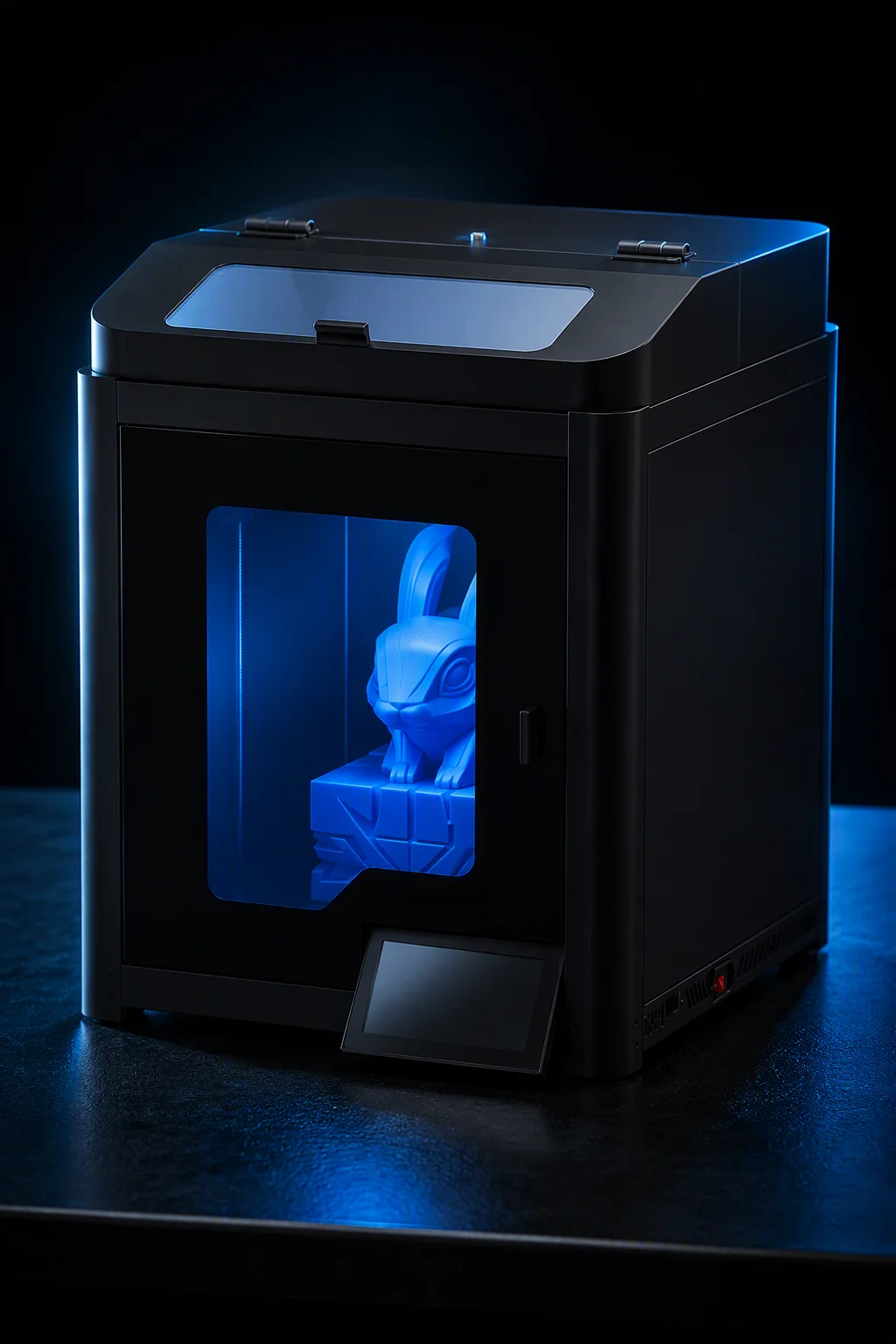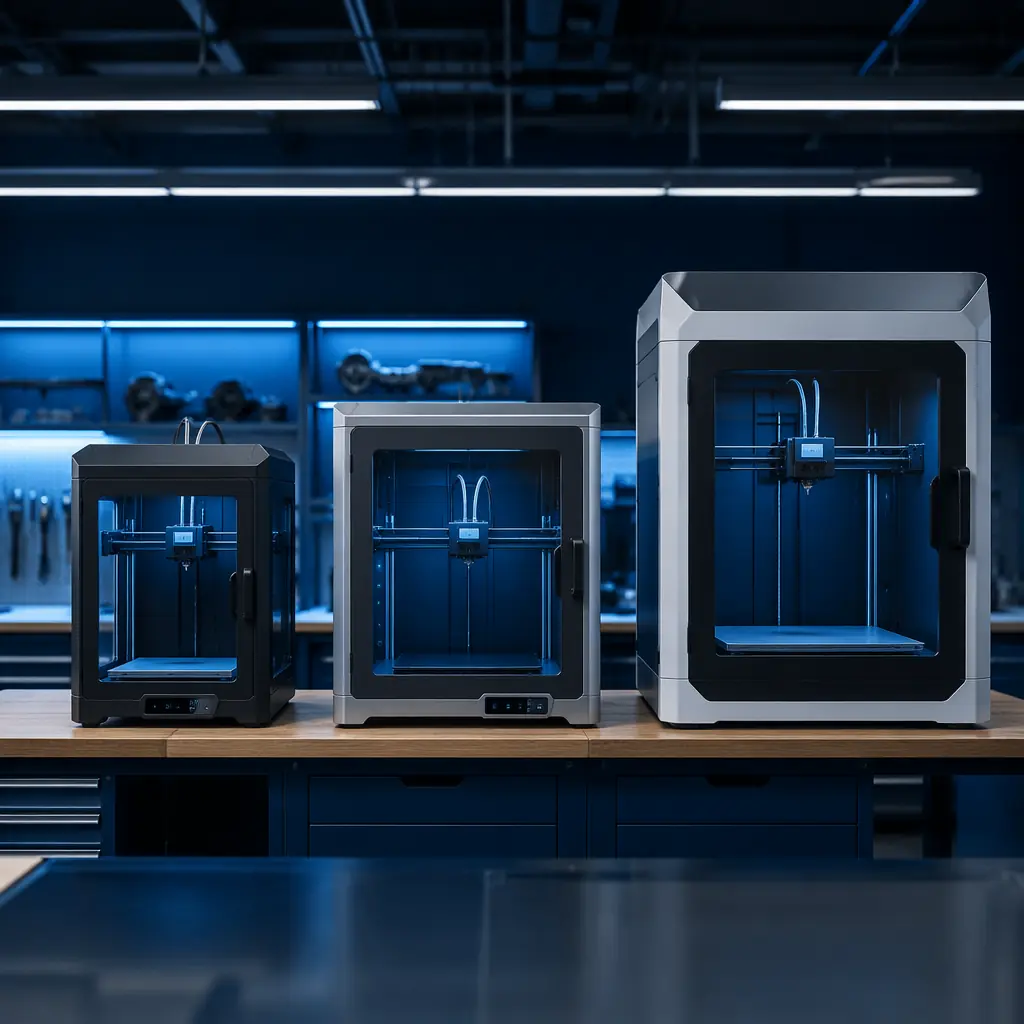
The $599–1,199 enclosed CoreXY segment is the most competitive category in consumer 3D printing in 2026. Three printers dominate the conversation among distributors planning their mid-tier lineup: the Bambu Lab P1S (launched 2023, still the benchmark for out-of-box reliability), the Creality K2 Plus (launched late 2024, Creality's most ambitious CoreXY platform to date), and the Qidi Plus4 (launched late 2024, Qidi's fourth-generation enclosed printer with the highest spec-to-price ratio in the segment). Each represents a different philosophy about what a $600–900 enclosed CoreXY printer should be — and each appeals to a different distributor strategy. This comparison covers what spec sheets don't: actual reliability data, the economics of stocking each model, and which segments each printer wins.
Before diving into the comparison, it's worth understanding why this segment matters. The enclosed CoreXY category is the fastest-growing slice of the consumer 3D printer market — growing at roughly 35% year-over-year — because it sits at the intersection of three trends: consumers upgrading from open-frame bedslingers, small businesses buying their first in-house prototyping capability, and educational institutions replacing aging printer fleets with reliable, enclosed machines. A distributor who nails the enclosed CoreXY product line captures the highest-value customers in the market. A distributor who stocks the wrong mix watches those customers buy direct from the manufacturer. For broader context on how brand positioning affects portfolio strategy, see our brand landscape guide.
The Spec Sheet Comparison: What the Numbers Say
Build Volume Showdown: The K2 Plus's 1.9x Advantage and When It Matters
The single biggest differentiator in this comparison is build volume. The K2 Plus's 350mm³ cube is 87% larger by volume than the P1S's 256mm³ — 42.9 liters vs 16.8 liters. That's not an incremental difference; it's a category difference. A printer with a 350mm build plate can print a full-sized cosplay helmet in one piece, a functional drone frame without splitting, or four copies of a standard-sized part simultaneously. A 256mm printer can't do any of those things without splitting models — which adds assembly time, weakens structural parts, and introduces dimensional tolerance stacking from glue joints.
However, larger build volume comes with physics tradeoffs. The K2 Plus's 350mm bed requires 3.6x more heating power than the P1S's 256mm bed (power scales with area, and the K2 Plus's bed area is 1.87x larger, but the bed is also thicker and heavier, increasing total thermal mass). The K2 Plus ships with a 1,000W AC heated bed — the highest-powered bed in any consumer 3D printer — which heats from room temperature to 100°C in approximately 3 minutes. The P1S heats to 100°C in approximately 5 minutes. Neither is slow by historical standards, but the K2 Plus's AC bed represents a fundamentally different engineering approach: mains-powered AC heating with an SSR (solid state relay) instead of the P1S's DC-powered bed through the mainboard MOSFET. This is the same approach used by industrial printers and is inherently more reliable for sustained high-temperature operation — one fewer high-current component on the mainboard that can fail. Our safety features guide covers why AC heated beds with dedicated SSRs are the gold standard for fire prevention.
Segment recommendation:
The P1S's 256mm³ volume is sufficient for 85% of prints that consumers and prosumers actually run. The K2 Plus's 350mm³ volume matters for three specific segments: cosplay/prop makers who print wearable items in one piece, engineering firms printing functional prototypes at full scale, and print farms that batch-produce standardized parts and benefit from fitting more units per plate. A distributor serving the education market should stock the P1S (256mm is more than students need, and the lower price point matters for bulk purchasing). A distributor serving small manufacturing businesses should stock the K2 Plus (the build volume is the #1 spec those buyers filter on). A distributor serving both should stock both — they don't cannibalize each other because they serve different use cases.
Heated Chamber: The Engineering Filament Decider
The P1S has an enclosure — it traps heat from the heated bed, raising the internal chamber temperature to roughly 40–45°C during an ABS print. This is sufficient to prevent warping on small to medium-sized ABS and ASA parts (under 150mm in any dimension), but parts larger than that will see corner lifting on the P1S unless printed with a brim and glue stick. The P1S's enclosure is a draft shield, not a heated chamber — it prevents ambient air currents from causing uneven cooling but does not actively raise the chamber temperature above what the bed radiates.
The K2 Plus and Qidi Plus4 both have active chamber heaters — dedicated heating elements that raise the chamber air temperature independently of the bed. The K2 Plus targets 60°C chamber temperature; the Qidi Plus4 targets 65°C. At 60°C chamber + 100°C bed, ABS prints with less than 0.2% linear shrinkage (vs 0.4–0.7% at 45°C chamber). At 65°C chamber + 110°C bed, ASA and PC (polycarbonate) become routinely printable without warp — materials that are marginal at best on the P1S's passive enclosure. Our engineering filaments guide covers the full material temperature requirements in detail.
However, the Qidi Plus4's 65°C chamber heater has a known reliability issue that has been documented across user forums: the chamber heater's SSR can fail after approximately 500–800 hours of sustained high-temperature operation, causing the heater to stay on continuously. Qidi addressed this in a firmware update that added a redundant thermal cutoff, but the underlying component quality is below what the K2 Plus uses (Mean Well power supply and name-brand SSR vs unbranded components). Distributors stocking the Qidi Plus4 should budget for approximately 3–5% warranty claims related to chamber heater issues in the first 12 months — comparable to the P1S's AMS feeder wear rate (3–4% in 12 months) and higher than the K2 Plus's reported chamber heater failure rate (under 1% in the first batch of community-tracked units).
Multi-Material Ecosystems: The Real Profit Driver
Multi-material compatibility is where these three printers diverge most dramatically — and where distributor margin strategy should focus. The P1S + AMS bundle at $1,048 is the most mature multi-material system in consumer 3D printing: the AMS has been shipping since 2023, the firmware is on its third major revision, and the RFID spool ecosystem is well-established. A distributor who stocks P1S units without stocking the AMS is leaving roughly 60% of potential consumables revenue on the table. The P1S + AMS bundle customer consumes 3–4x more filament than a P1S-only customer over 12 months, primarily due to purge waste, support interface materials, and color-matched multi-spool purchasing behavior.
The K2 Plus + CFS bundle at $1,148 is newer (shipping since early 2025) and has a smaller but rapidly growing installed base. The CFS's lack of RFID lock-in is a strategic advantage for distributors who sell their own filament brand — the K2 Plus + CFS customer is the ideal target for a distributor's private-label filament program because there's no ecosystem friction pushing them toward a manufacturer-branded consumable. Creality has committed to making the CFS compatible with future K-series printers, creating a multi-generational accessory revenue stream that benefits distributors who establish the K2 Plus + CFS as their flagship bundle.
The Qidi Plus4 has no native multi-material solution as of mid-2026. Qidi has publicly announced a "Qidi Box" in development but has not shipped it. This is the Plus4's single biggest competitive weakness from a distributor's perspective: it's the best printer in the comparison for pure single-material engineering printing (highest nozzle temperature, highest chamber temperature, largest build volume per dollar), but it misses the multi-material consumables multiplier entirely. A distributor who stocks the Plus4 should position it specifically for engineering filament customers — those printing PPSU, PEI, and PC blends that require 350°C+ nozzle temperatures and active chamber heating — and accept that these customers will have lower consumables reorder frequency than multi-material users. For the full multi-material business case, see our multi-material systems guide.
Reliability and Return Rate Benchmarks
The following table represents aggregate reliability data drawn from community-maintained failure trackers, distributor warranty claim databases, and manufacturer-reported quality metrics. These are directional numbers — not audited statistics — but they capture the relative reliability differences that matter for warranty reserve planning.
The spare parts availability difference is the most operationally significant number in this table. A P1S with a failed AMS feeder can be repaired by the end customer in 5 minutes with a $35 part that ships in 24 hours. A K2 Plus with a failed CFS sensor requires a more involved repair (60–90 minutes for a first-time user) with a part that ships in 3–5 days. A Qidi Plus4 with a failed chamber heater SSR is a mainboard-level repair that requires opening the electronics enclosure — a 2–3 hour job for a technically inclined user, with a part that may take 5–10 days to arrive from Qidi's China-based support operation. These differences matter for distributor support costs: a distributor who provides first-line technical support will spend 3–5x more support hours per Qidi Plus4 unit than per P1S unit over a 12-month period. For guidance on building a distributor repair and support operation, see our repair service center guide.
Per-Segment Winner: Which Printer for Which Customer
The right printer depends entirely on the customer segment. Here's the segmentation that maximizes margin and minimizes returns for each model.
Education (Schools, Universities, Libraries):
Winner: Bambu Lab P1S. The P1S wins the education segment on three dimensions that matter more than spec sheets: out-of-box reliability (a printer that fails during the first week of a semester creates a semester-long problem), spare parts availability (school IT departments need next-day parts, not 10-day parts), and the AMS ecosystem (multi-color printing is the #1 feature that gets students excited about 3D printing, and the AMS is the only multi-material system with a proven education track record). The P1S's 256mm build volume is sufficient for 95% of educational prints; the rare student project that needs 300mm+ can be printed on the school's single large-format machine (budget $1,500–2,500 for a dedicated large-format printer like the K2 Plus, purchased at a ratio of 1:8 vs P1S units).
Small Manufacturing (Job Shops, Prototyping Services, In-House R&D):
Winner: Creality K2 Plus. The K2 Plus's 350mm build volume and active chamber heating are the two features that manufacturing buyers filter on first. A machine shop buying a 3D printer for in-house fixture and jig production needs to print parts that are 200–300mm in at least one dimension — a requirement that eliminates the P1S immediately. The K2 Plus's CFS adds engineering support material capability (PVA/BVOH for complex internal geometries) that the Qidi Plus4 can't match without a multi-material system. And the K2 Plus's AC heated bed is the right architecture for 8–16 hour continuous prints at 100°C bed temperature — the exact use case for manufacturing. For distributors selling into this segment, bundling the K2 Plus with 2 spools of engineering filament (ABS/ASA + a support material) and a spare parts kit (nozzles, PTFE tube, build plate) creates a $1,300–1,500 average order value. Our small manufacturers sales guide covers the full pitch.
High-Temperature Engineering (PPSU, PEI, PC Blends):
Winner: Qidi Plus4. The Plus4's 370°C nozzle and 65°C active chamber are the highest thermal specs in the sub-$1,000 segment. For customers printing PPSU (extrusion temperature 360–390°C, chamber requirement 70–90°C), PEI/ULTEM (extrusion 350–380°C, chamber 80–120°C), or high-temperature PC blends, the P1S is physically incapable (300°C ceiling) and the K2 Plus is marginally capable at best (350°C nozzle, but the chamber heater targets 60°C, not the 70–90°C that PPSU ideally needs). The Plus4 is the only printer in this comparison that can credibly print PPSU — and while it's at the bottom edge of PPSU's chamber temperature requirement, it's the only sub-$1,000 option that's even in the game. For distributors serving aerospace, medical device, or oil & gas prototyping customers, the Plus4 opens a segment that the P1S and K2 Plus can't touch — and those customers buy $80–120/kg engineering filament at 2–3x the margin of consumer PLA.
Reviewed by the Precise3D engineering & OEM team. Compliance files that accompany the catalog are auditable at the certification register.
Build Your Enclosed CoreXY Lineup
Source the Right Enclosed CoreXY Printers for Your Market
Precise3D provides OEM access to all three platforms — P1S-competitive, K2 Plus-class, and Plus4-tier enclosed CoreXY printers — with factory-direct pricing, private-label options, and segment-specific bundling strategies. Don't pick one. Stock the mix that matches your customer segments.