The Four Variables That Actually Decide It
Most of the comparison criteria that get published — surface finish, speed, material choice, tooling cost — are symptoms of four underlying variables. Reduce a job to those four and the process choice usually makes itself.
- Batch size. How many identical parts. This is the strongest single predictor, because the two processes amortise cost completely differently.
- Geometry. Specifically whether the part has internal features that a rotating cutter cannot reach: internal channels, undercuts, cavities, lattices.
- Tolerance and finish. The tightest dimension that actually matters and the surface the part must present.
- Material. Whether the required material is available in each process at all, which is a binary question that overrides the other three.
The reason a criteria list is less useful than these four variables is that they interact. A one-off part with a 0.02 mm tolerance and internal channels is a machining job with a printed prototype, not a printed part, and no single-variable comparison would predict that. Work through all four in order, treating material as a gate and batch size as the strongest tiebreaker.
Batch Size and the Cost Crossover
The economics differ in structure, not degree. CNC has a large fixed cost, which is the setup, programming and fixturing of the machine, and a moderate per-part cost that falls slowly. Additive has a small fixed cost, essentially file preparation, and a per-part cost that is dominated by machine time and does not fall much with quantity, because each part is built sequentially.
That structure produces a predictable crossover. The table below shows a representative aluminium bracket and a representative printed bracket, priced as an in-house job with the setup amortised. Treat the absolute values as illustrative and the shape as the useful output.
Two conclusions are worth stating plainly. First, at quantity one the gap is large enough that additive wins on cost alone for any part it can physically make, often by an order of magnitude, because the machining setup is paid once for a single part. Second, the crossover in the general case sits somewhere in the tens to low hundreds of parts, and it moves with part complexity: a simple prismatic part with a short setup crosses over at low quantities, whereas a complex part with multi-face fixturing may never economically machine at all at low volume.
There is a third conclusion that matters more than either. Additive's per-part cost barely falls with quantity, which means a printed part priced acceptably at ten units stays priced acceptably at a hundred. That makes printing a viable bridge to volume rather than only a prototyping step, and it removes the pressure to commit to hard tooling before the design is settled.
Geometry — Where Each Process Wins and Loses
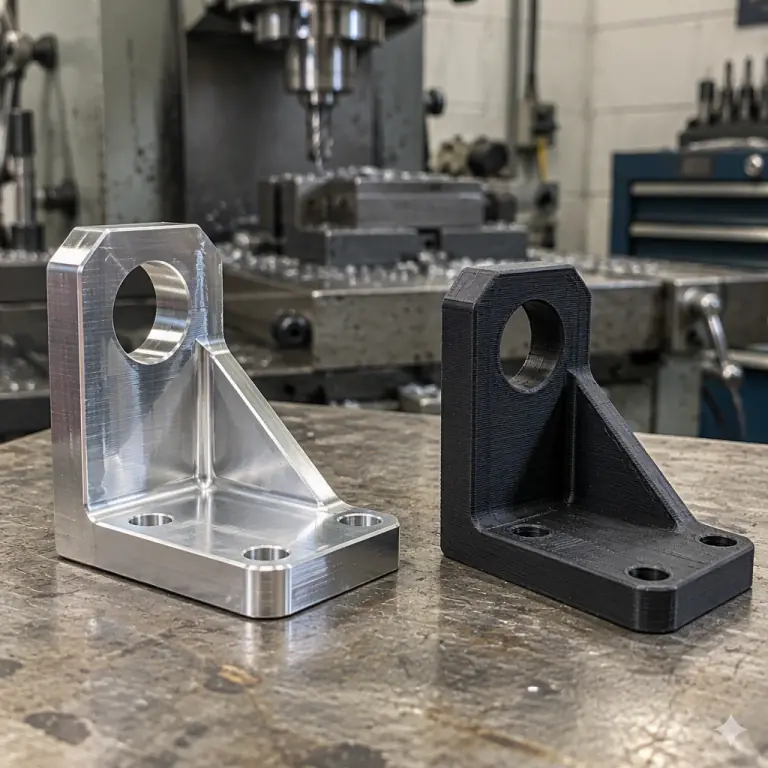
Geometry is the variable most often decided by intuition, and intuition is usually about complexity rather than about reach. The real question is whether a tool can physically get to the feature.
Where additive wins
Internal channels and conformal cooling paths are the clearest case: a curved channel inside a mould or manifold cannot be machined at all, because no cutter can follow a curve it cannot reach. A printed part has no such constraint, since the channel is simply absent material. The same logic covers lattices and internal porosity, used for weight reduction and for energy absorption, and consolidated assemblies, where a printed part replaces several machined components and their fasteners, removing the assembly step and the leak paths between them.
Where subtractive wins
Precision bores and bearing seats are almost always machined. A printed bore is a near-net shape at best; a bearing that must sit at a controlled interference needs a machined or reamed surface, and printing it and then reaming it is a legitimate combination rather than a compromise. Threads are analogous: printed threads work for occasional assembly, but any thread that will be cycled or loaded should be machined or replaced with a threaded insert. And sharp internal corners are a subtractive advantage, because a printed corner carries a radius set by the nozzle while a machined corner carries a radius set by the tool, which is generally smaller.
The practical rule that follows is that geometry rarely makes a part all-or-nothing. A part with internal cooling channels and two bearing bores should be printed oversize on the bores and machined afterwards, which is exactly the hybrid pattern described below.
Tolerance and Surface Finish
The tolerance question is usually framed as a single number per process, which is misleading because achievable tolerance depends heavily on which dimension and which feature. As a working guide, FDM holds roughly ±0.2 to ±0.5 mm on general dimensions, resin processes reach around ±0.1 to ±0.2 mm, and CNC machining routinely holds ±0.05 mm with ±0.01–0.02 mm achievable on critical features with the right machine and fixturing.
Surface finish shows a similar pattern. Printed surfaces carry layer texture measured in tens of microns unless post-processed, whereas machined surfaces are characterised by cutter marks that are either acceptable as-machined or easily refined. Where a part must present a sealing face, a bearing interface or a sliding surface, that requirement alone tends to select machining.
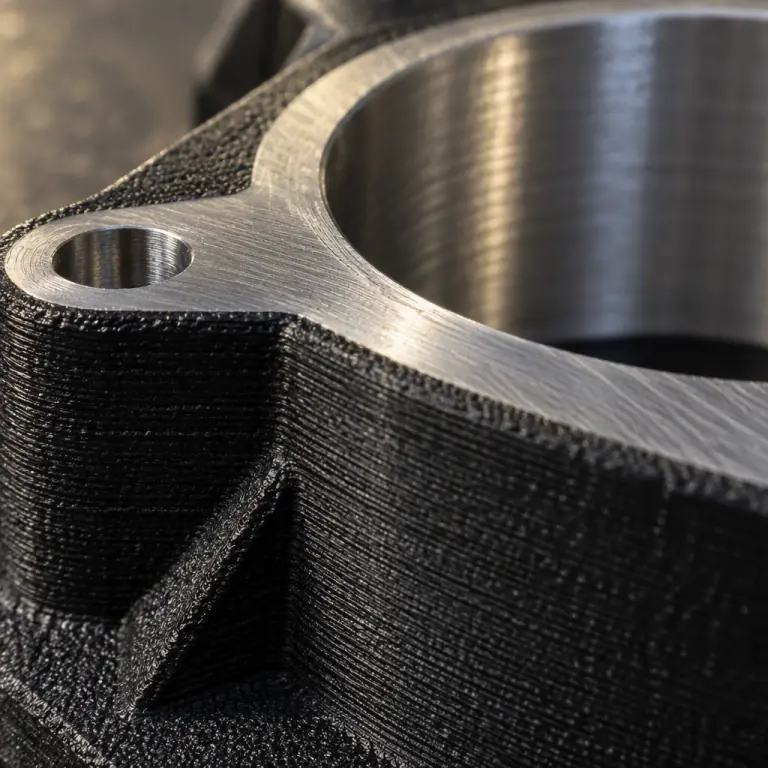
The important qualification is that tolerance and finish are often local rather than global. A part may need ±0.5 mm almost everywhere and ±0.05 mm on two features. That is not a reason to machine the whole part; it is a reason to print it and finish two features. The dimensional budgeting for that approach, including where to leave material and how much, is the same discipline described in our dimensional accuracy and tolerance compensation guide.
Material Reality
Material availability is a gate rather than a scoring criterion. If the required material does not exist in a given process, the comparison ends there regardless of geometry or quantity.
- Metals. Machining covers aluminium, stainless, titanium, brass and tool steels as a matter of course. Metal printing exists and is genuinely useful for complex internal geometry, but it is a different cost and equipment class, and it does not replace a machining centre for general work.
- Engineering polymers. Printing covers a wide and growing range including PEEK, PEI and PPSU-class materials, which changes the picture for high-temperature and chemically exposed parts substantially. Machining covers these as stock shapes, often with better mechanical properties than a printed equivalent because the material has no interlayer interface.
- Anisotropy is the honest limitation of printed parts. A printed part is weaker across the layer interface than within a layer, typically by a meaningful margin, and a machined part from stock has no such directionality. Where a part is loaded in tension across what would be the layer plane, orientation may solve it and it may not; where it cannot, the part is a machining job or a design change.
- Composites. Machining handles fibre-filled and laminated stock well. Printing with short-fibre filled materials is possible and useful for stiffness, but it does not produce a continuous-fibre laminate, and the distinction matters in anything structurally critical.
One further material consideration decides many real jobs: availability in the needed form at the needed time. A printed part can be made from filament on the shelf today, whereas a machined part may wait for plate stock in the right alloy and thickness. When schedule dominates, that is often the deciding factor.
The Hybrid Route
Framing this as a choice between two processes discards the most useful option available to a shop that owns both. The hybrid route is not a compromise; in several configurations it is technically the best answer.
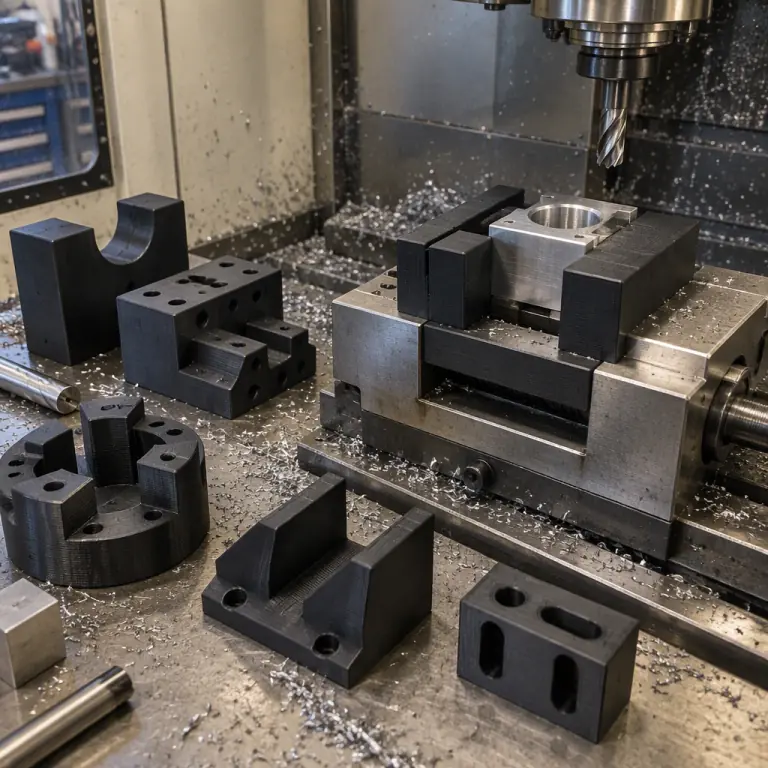
Printed fixtures and soft jaws for machining are the highest-value application. A printed soft jaw or work-holding fixture lets a machinist hold an awkward part without a bespoke fixture build, and it can be designed, printed and in service in an afternoon. Because the fixture does not need to be durable in the way a production tool does, the printed version's limitations are irrelevant. This is also the most common route by which a machine shop justifies a printer, and it is covered in more depth in our guide to printed jigs, fixtures and tooling libraries.
Printed near-net parts finished by machining suit complex geometry with a few critical features. Print the internal channels, the organic external form and the weight-reducing pockets, then machine only the bores, faces and threads that require it. The printed part acts as its own preform and the machining is a short second operation, which is economically different from machining the whole part.
Machined inserts in printed assemblies solve the fastener problem. Heat-set or machined threaded inserts give a printed assembly load-bearing threads without printing them, and the insert is the part that wears. This is standard practice in functional printed assemblies and removes the most common failure mode of printed mechanical parts.
Shops that run both processes side by side also find that printed work changes the machining workload rather than replacing it: the small fixtures, spacers, covers and prototypes leave the machining centres, and the machining centres spend their time on parts that genuinely need them. That rebalancing is worth more than the individual part decisions, and it is the subject of our guide to 3D printing in a machine shop production cell.
A Per-Job Routing Rule
Six questions, applied in order, resolve the majority of part decisions in a couple of minutes.
- Is the required material available in the chosen process? If the material is metal and the geometry is simple, the answer is machining and the remaining questions are about cost. If it cannot be printed and must be machined, stop here.
- Does the part have internal features a cutter cannot reach? Internal channels, cavities or lattices point to printing, or to printing plus local machining. If not, continue.
- What is the quantity? Under roughly ten, printing usually wins on cost for any part it can make. In the tens to low hundreds, compare the two columns in the crossover table. Above that, machining's falling per-part cost usually takes over for simple geometry.
- What is the tightest tolerance that actually matters, and how much of the part does it apply to? If it applies to two features, print and finish those two features. If it applies to the whole part, machine.
- Will the part be loaded across the layer plane? If a printed orientation cannot resolve the stress direction, machine the part or redesign the load path.
- What is the deadline? A printed part can usually be made from stock filament today; a machined part may wait on material, fixturing or machine availability. When the schedule is fixed and the tolerance allows it, printing is often the answer regardless of the other five questions.
Running those six questions consistently is what turns a shop's process mix from an accumulation of habits into a decision. It also produces a useful side effect: the questions expose parts that are being machined out of habit when they are geometrically and economically printed parts, which is exactly the rebalancing that pays for the printer.
What to Buy First
For a shop or engineering team adding capability rather than replacing it, the investment order follows from the job mix.
- If the job mix is dominated by one-offs, prototypes and fixtures, a printer is the higher-return addition, because it addresses the work the machining centres are least efficient at and frees them for the work they are best at.
- If the job mix is dominated by tight-tolerance production parts, more or better machining capacity is the answer, and a printer serves as a support tool for fixtures and prototypes rather than as a production asset.
- If both, buy the printer first and treat the CNC as the constrained resource: in most job shops the machining centre is the bottleneck, so anything that removes routine work from it increases throughput, whereas adding a printer to an idle machine shop just adds a capability nobody queued for.
Where the decision turns on printed parts that have to hold a dimension over many builds and many users, that is the requirement we build our engineering-grade machines around, and the parts that end up as printed fixtures are the subject of our guide to 3D printing in a CNC job shop. If you would rather work the arithmetic on your own part mix, send us the typical quantities, geometries and tolerances and we will map them against the crossover table with you.