
The Real Constraint: Patterns Per Flask Per Day
Every discussion of jewelry 3D printing starts with printer resolution, and resolution is almost never what limits a working shop. The limiting number is patterns per flask per day: how many castable patterns a shop can move from CAD to a tree, through burnout, and into poured metal in a working day. Print speed affects it. So do resin selection, tree density, finishing time, and the burnout cycle. A shop that optimises only the printer will find the bottleneck has simply moved to the bench.
The arithmetic is worth doing before buying anything, because it tells you what capacity you are actually purchasing:
Two things follow immediately. The first is that the printer runs unattended overnight, so the 4 to 8 hour print is not the constraint on a single shift, and a shop pushing two plates a day is usually limited by operator attention at the bench rather than by machine time. The second is that tree building is the number that scales with volume and the one most often underestimated: at 90 seconds per pattern, a 90-pattern plate is over two hours of hand work before anything reaches a flask.
This is why the sensible unit of capacity planning is the flask, not the printer. If your furnace and burnout schedule allow two flasks a day and your tree-building capacity is one person, then your ceiling is set by flasks and hands, and a faster printer changes nothing. The same reasoning applies to any production process where upstream throughput exceeds downstream capacity, as covered in line balancing and bottleneck analysis.
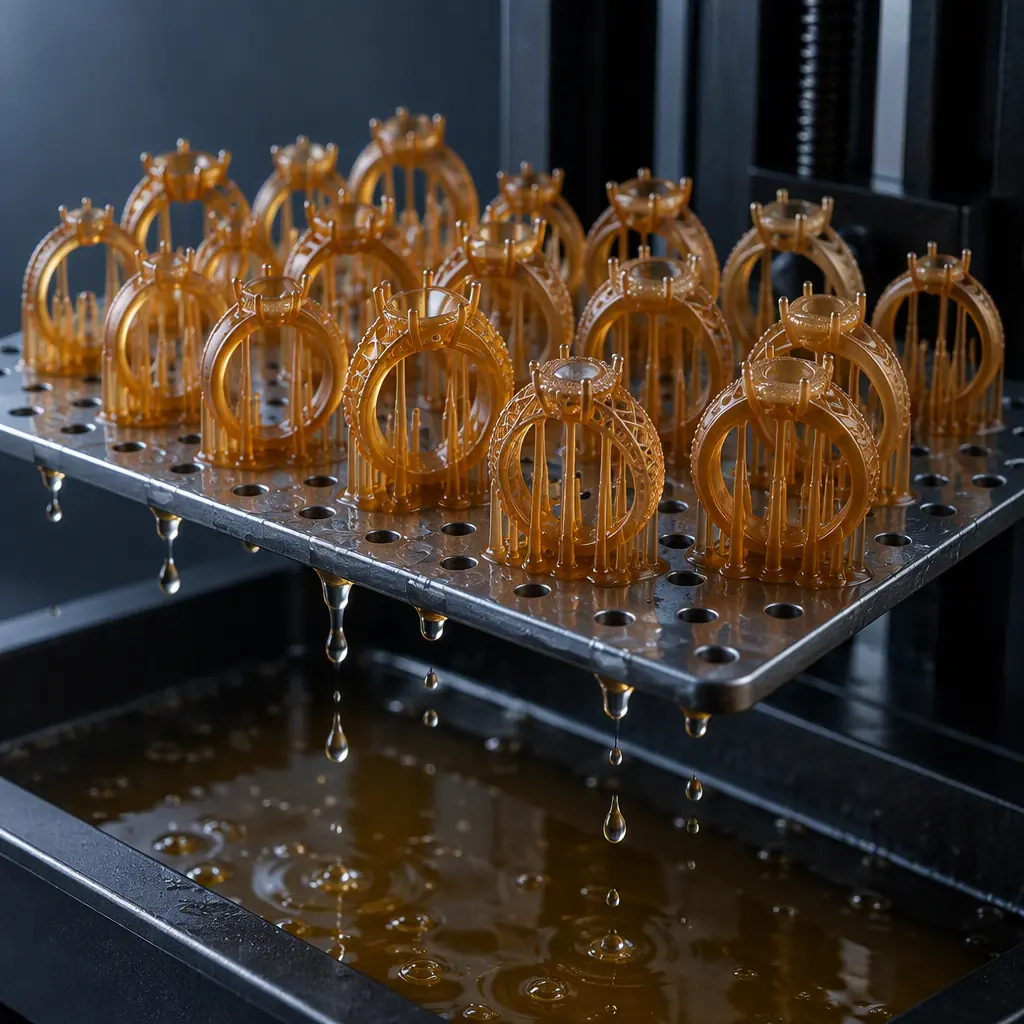
Castable Resins: What Separates a Working Resin from a Failed Casting
Castable resin is the consumable that decides whether the process works, and the differences between products show up only in the flask. The properties that matter are not the ones on the marketing page.
Ash residue is the first filter and the least visible. When the pattern burns out of the investment, everything that does not combust stays behind as ash in the mould cavity, and ash translates directly into surface defects and internal porosity in the casting. A resin with high residue produces castings that need more finishing, or that fail entirely on fine detail. This is the single property that most reliably separates a professional castable resin from a cheap one, and it is why price per kilogram is a misleading comparison.
The burnout cycle is the second filter and it interacts with capacity. A resin requiring a slower ramp and longer hold consumes furnace time, and furnace time is flask throughput. A cheaper resin that adds two hours to the cycle can cost more in lost flasks than it saves in material. When comparing resins, compare the manufacturers' recommended cycles as operating parameters, not as fine print.
Thermal expansion behaviour matters because the pattern and the investment expand and contract together, and a mismatch stresses the mould wall, producing cracks or dimensional error in the casting. This is the technical reason a pattern printing resin and an investment powder are best treated as a paired system, validated together, rather than selected independently.
Storage stability is the practical one. Resin that drifts in dimension over weeks in a workshop means a pattern printed today is not the pattern a customer approved last month, and repeat orders no longer match. In a business built on repeatable product lines, this is a commercial risk rather than a convenience issue, and the consumable management discipline is the same as for any printing material, covered in material handling and storage.
What you're looking for: A number and a record, not a datasheet claim. A shop that has never weighed the residue after burnout is carrying an unknown defect rate it is paying for in finishing labour.
Tree Building and Support Strategy as a Yield Variable
Tree building is treated as bench craft, and it is a yield variable with measurable effects on casting quality. Three decisions determine the outcome.
Sprue diameter and geometry. The sprue has to fill the cavity before the metal starts to solidify, and going too small is the most common error in hand-built trees. A sprue that freezes early produces a short pour on the outermost patterns, which is why the failure appears at the edge of the tree rather than at the base. The diameter needed scales with the mass of the tree, not with the individual pattern, which is the opposite of the intuition most people bring from single-item casting.
Pattern spacing and orientation. Patterns need enough separation that the investment flows between them without voids, and orientation should place the most critical surface away from the ingate, since that is where turbulence and shrinkage porosity concentrate. For rings, this typically means the band faces the flow and the setting face is protected. Spacing rules taken from general casting guidance are usually too close for the fine features that make pattern production valuable in the first place.
The drainage question. Hollow or thin patterns hold uncured resin, and trapped resin burns out violently and leaves aside from the ash problem, it can crack the investment. This is why the print orientation that makes drainage easy is worth a slower print, and why a hollow print is often a false economy. A solid, well-drained pattern prints faster through burnout than a hollow one that looks efficient on the plate.
The measurable effect: a shop that previously rejected 15 to 25 percent of castings for surface or fill defects typically finds more than half of those are tree and sprue problems rather than print or metal problems. Sorting that out costs nothing and increases effective capacity immediately, which is why yield belongs in the capacity calculation rather than being treated as a quality issue. The same yield multiplier logic appears in cost per part models, where failure rate is a divisor on every other line.
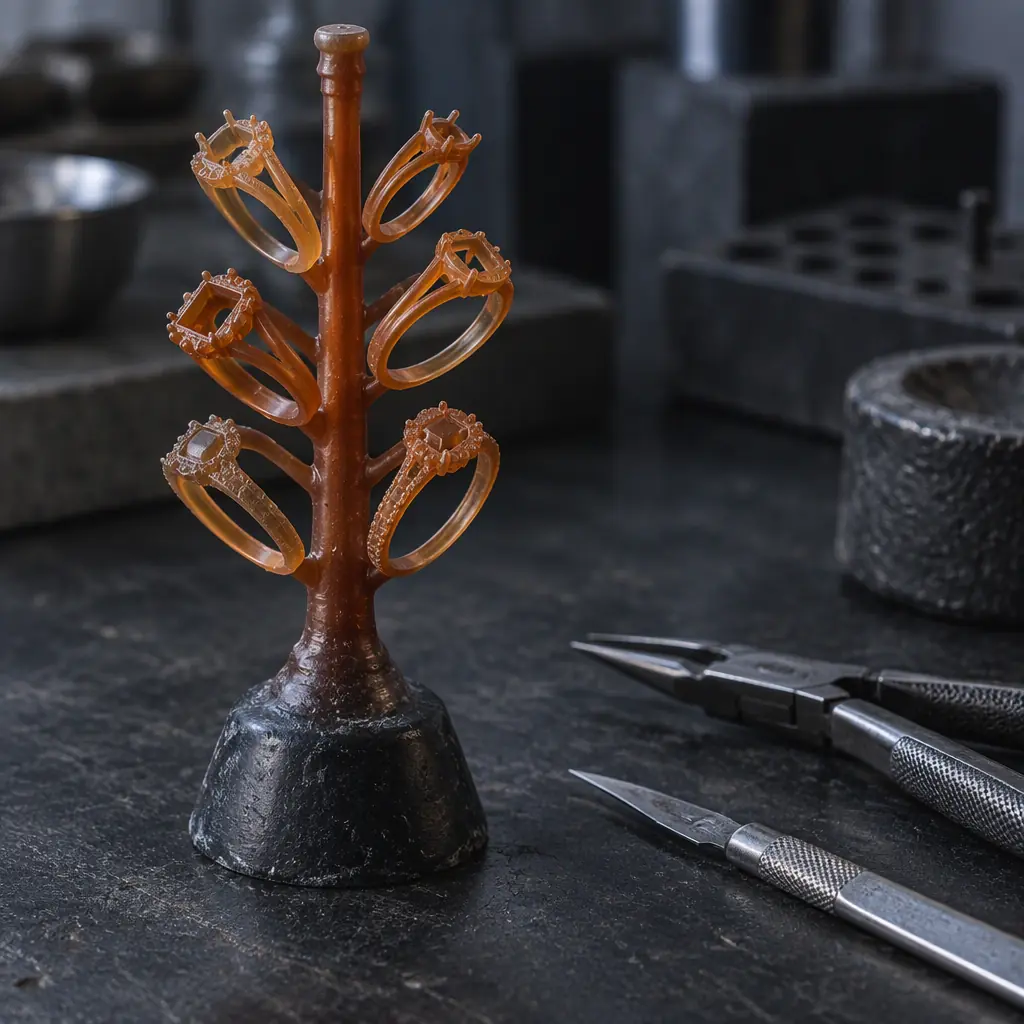
Surface Finishing After Printing, Before Casting
A printed pattern is not a finished pattern. Layer lines on the surface transfer directly into the casting, and in jewelry they are visible immediately after polishing. Finishing is therefore not optional, and understanding it changes print parameters and capacity.
What the finishing stage involves, and the time it takes:
Multiplied across a plate of 60 patterns, finishing is several hours of hand labour, and it is the second capacity constraint after tree building. This is the practical reason layer height matters commercially: printing at a finer layer height adds print time, which is unattended, but reduces sanding time, which is not. A shop running three shifts of printer time to save bench time is making a rational trade, and the calculation should be done in minutes of hand labour rather than in print hours.
Two techniques reduce finishing without compromising the pattern. Orienting so that the visible surface of the finished piece faces away from supports eliminates most support-mark repair, which is the slowest part of the process. And choosing a resin with better green strength reduces handling damage before cure, which is a quiet source of rejects that never gets recorded because the pattern simply disappears from the batch.
Shrinkage, Detail and Dimensional Allowance
Every step between CAD and finished casting changes dimensions: printing, investment expansion, metal shrinkage on cooling, and finishing removal. Each has a different magnitude and the total determines whether a part fits as designed.
The practical approach is to measure rather than calculate. Cast a test piece with the alloy and investment combination you use, measure the result against the CAD model, and back out a single compensation factor to apply to the design. Re-derive it whenever anything in the chain changes, including a new resin, a new investment lot, or a new alloy. The printed pattern itself should be dimensionally stable enough that it does not add drift on top of the casting shrinkage, which is another argument for a resin with good storage stability.
The detail question runs the other way. Fine features survive printing well; what threatens them is investment penetration into narrow gaps and metal failing to fill thin sections before freezing. Minimum reliable feature sizes in precious metal casting are therefore set by the casting process more than by the printer, and quoting a design whose minimum feature is below what the metal will fill is a delivery problem created upstream of the printer. Where the requirement is to measure the achievable envelope, the methods in our guide to dimensional tolerances and accuracy apply, and where surface quality is the specification, the measurement approach is covered in part metrology and inspection.
Cost Per Finished Pattern
Building the cost per finished pattern makes the outsource-versus-in-house decision arithmetic rather than preference, and it surfaces the lines that dominate.
Labour is 66 percent of the cost, material is 3 percent. That ratio should reframe every optimisation conversation, because it means the returns come from reducing bench time and reject rate rather than from a cheaper resin or a faster printer. It also explains why resin price is a weak lever: doubling resin cost adds nine cents to a pattern that carries over two dollars of labour.
Against an outsourced pattern price, the comparison is only valid at the same rejection rate and finishing standard, which is where in-house business cases usually go wrong by comparing a supplier's polished price with an optimistic internal estimate. The honest comparison uses your measured reject rate and labour time, and the resulting figure is typically competitive from a few hundred patterns per month upward once the labour is genuinely available. Below that volume, outsourcing remains cheaper because you are buying the supplier's utilisation rather than your own.
The equipment side of the comparison is a machine and materials package sized to the volume you actually have, which is covered in our guide to the jewelry casting channel, and the wider workflow in industrial investment casting where the same tree and shrinkage logic operates at a larger scale.
When to Keep Outsourcing and When to Bring It In-House
The decision turns on four variables, and three of them are not about cost.
- Volume and consistency. Below roughly 200 patterns a month with irregular demand, outsourcing keeps cost low and risk external. Above that with a stable product line, in-house pays back on labour avoidance.
- Iteration speed. If the design cycle is measured in days and each change needs a new pattern, in-house turns a weekly loop into a daily one. This is frequently worth more than the cost difference.
- Confidentiality. Design work that cannot leave the building for commercial reasons settles the question regardless of volume.
- Bench labour availability. In-house pattern production consumes skilled jeweller time. If finishing labour is already the constraint, adding pattern printing does not add capacity, it moves the queue.
The failure mode is buying a printer without buying the bench time, which is why the fourth variable is listed. A machine that can produce 200 patterns a day is useless if the bench can finish 40. In practice the best entry point is to bring in the printing stage, keep the bench at its current level, and only add moulding and casting when the printer is consistently running a full plate and the finishing queue is under control.
A staged approach also produces evidence for the next decision, because after three months you know your real reject rate, your labour minutes per pattern, and your plate utilisation, which is a far better basis for expansion than any projection.

What to Ask a Supplier Before You Buy
- What build plate capacity does the machine offer for ring-sized patterns, and at what plate fill does quality degrade?
- Which castable resins are validated on the machine, with published burnout cycles and ash residue figures?
- What dimensional tolerance is achievable across a full plate, at the corners as well as the centre?
- What resin consumption does a typical plate require, so the consumable cost per pattern can be modelled?
- What software supports plate nesting and tree building, and can it output a sprue tree that matches your flask size?
- What documentation ships with the machine for electrical safety and material compliance?
- What is the wear-part set that affects build consistency, and what is its replacement interval?
The pattern across these questions is that the machine specification matters less than the ecosystem around it: resin validation, plate capacity, nesting software, and documented consumable behaviour. A machine with an unvalidated resin and no nesting support will cost more in bench time than it saves. Precise3D supplies castable-resin compatible machines with CE LVD (EN 62368-1) and RoHS documentation. If you are moving pattern production in-house, send us your monthly pattern volume, the alloys and production sizes you work with, and your flask dimensions, and we will work the plate and flask throughput arithmetic through with you.