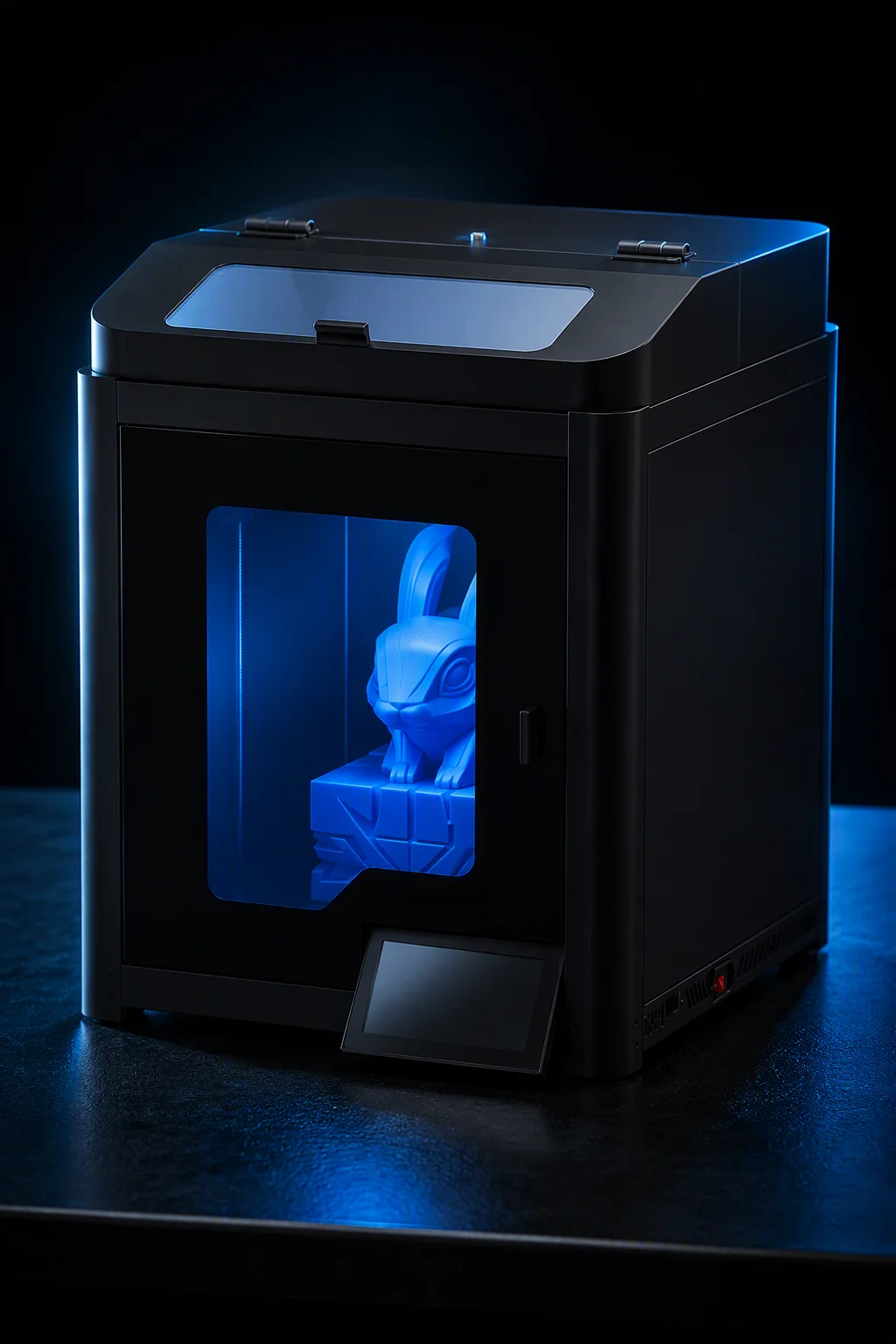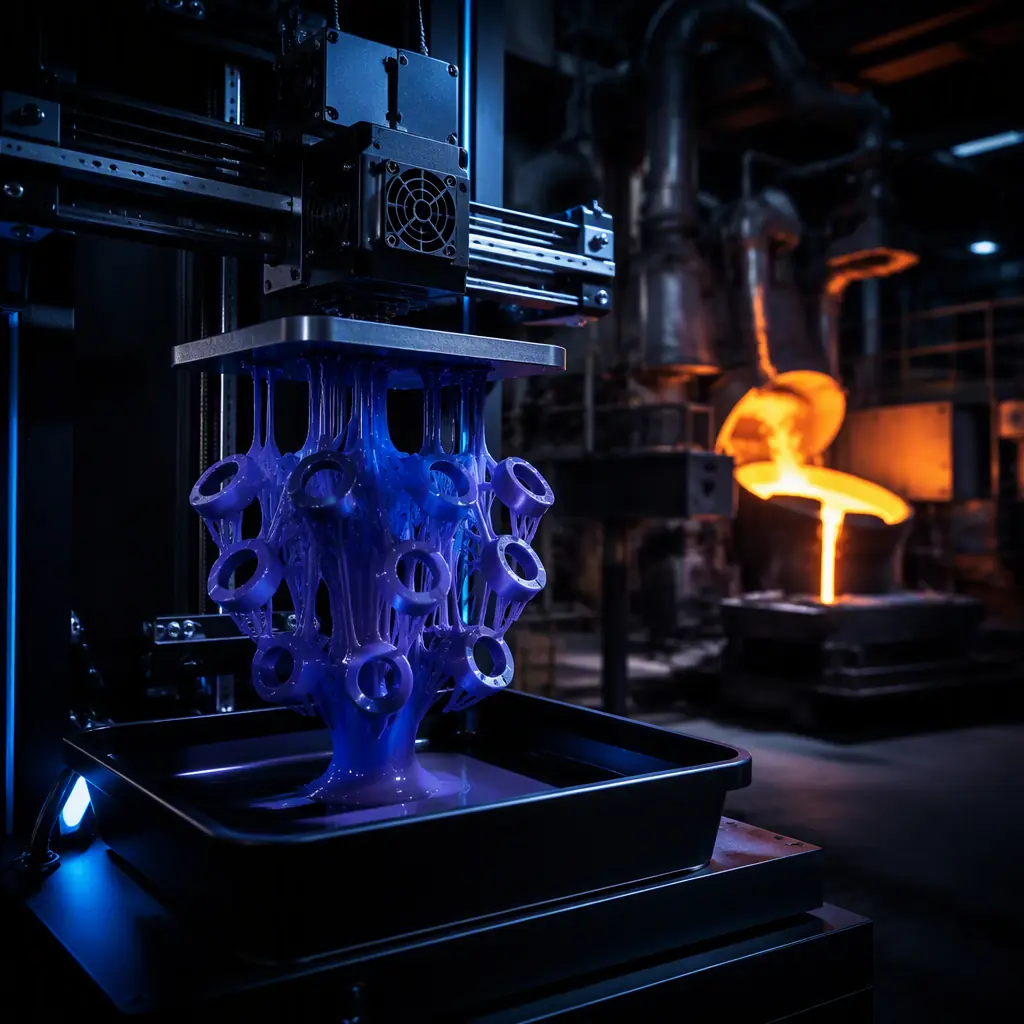
The foundry industry's shift to printed tooling is being driven by the arithmetic of low-volume casting. Traditional investment casting requires a metal die to inject wax patterns — but the die only makes sense when the casting run is large enough to amortize it. When a customer needs 200 impellers for a pump rebuild, or a defense contractor needs 50 housings for a prototype batch, the die cost per piece is absurd. Printed patterns bypass the die entirely: a castable resin or wax-like pattern is printed directly, attached to a sprue, invested in ceramic shell, and burned out — leaving a cavity that is filled with molten metal. The pattern is consumed in the process, which is exactly why it works as a recurring-revenue product for distributors. The broader context of why engineering teams adopted 3D printing as a production-adjacent tool is in our R&D and rapid prototyping guide.
The Three Printed-Tooling Paths Foundries Buy
Foundry demand clusters into three distinct paths, each with different hardware, materials, and buyers. A distributor who can position all three walks into any foundry with a complete answer instead of a single-product pitch.
- Printed investment casting patterns — castable resin or wax-like patterns printed on resin (SLA/MSLA) machines, then invested and burned out. This is the highest-growth path: it replaces metal dies for low-volume runs, handles complex internal geometry that dies cannot (undercuts, curved cores), and the pattern material is the recurring consumable. Accuracy is ±0.1–0.2 mm in the casting, limited more by shell and metal shrinkage than by the print.
- Sand casting patterns and core boxes — printed pattern plates, matchplates, and core boxes for green sand and no-bake molding. These are larger parts printed in PA12, PA-CF, or epoxy-like resins, mounted on existing molding equipment. The pattern survives hundreds of molding cycles when coated, and a printed pattern plate for a valve body costs $500–3,000 versus $10,000–30,000 machined.
- Foundry production tooling — gauges, mold handling fixtures, riser and sprue sleeves, and assembly aids that stay on the foundry floor. These are everyday maintenance-style parts printed in PA12 or PETG, the easiest entry sale, and the family that builds the recurring order book.
The common thread: all three paths replace tooling that is slow, expensive, and single-purpose. A foundry that adopts printing for one path almost always expands to the others within a year — which is why the distributor who starts with maintenance parts can grow into a pattern supplier. The material economics of this shift mirror what we document in our manufacturing tooling playbook.
Burnout-Compatible Materials: The Casting-Grade Shortlist
Investment casting is unforgiving about pattern chemistry. The pattern must burn out cleanly — leaving less than 0.5% ash residue — or the ceramic shell will have inclusions that show up as defects in the cast metal. This requirement filters the printable material list down to a short shortlist.
Castable resins for SLA/MSLA are the workhorse.
Dedicated castable resins are formulated to burn out with minimal ash, printing at 25–50 micron layers for the smooth surface finish that casting needs. The alternative for larger patterns is wax-like filament or machinable wax printed on FDM machines — less detailed, but cheaper per part and easier to scale for big patterns. The resin printing technology landscape, including SLA vs DLP vs MSLA trade-offs for surface quality, is covered in our resin printer technology guide, and the resin types and their casting properties are detailed in the resin selection guide.
For sand casting, the material bar is lower and the parts are bigger.
Pattern plates and core boxes in PA12 or PA-CF survive the abrasion of sand molding for hundreds of cycles — a PA-CF pattern plate routinely outlasts a pine pattern plate by 10×. Coating the pattern with a release agent extends life further. The nylon material family, including PA-CF's stiffness and wear behavior, is covered in our nylon filament guide, and the carbon-fiber economics are in the CF filament guide.
For foundry-floor tooling, high-temperature polymers matter.
Riser sleeves, ladle accessories, and handling fixtures near molten metal need materials that hold up at 150–250°C: PEEK, PEI (Ultem), and PPSU are the candidates, at a material cost of $300–600 per kg versus $40–90 for PA12. The full high-temperature comparison — continuous service temperature, chemical resistance, and print requirements — is in our PEEK/PEI/PPSU materials guide.
Design Rules for Castable and Pattern Tooling
Printed patterns fail in the foundry for predictable reasons, and the fixes are design rules. First, design for burnout and drainage: patterns with trapped volumes or thick solid sections cause shell cracking during burnout as the pattern expands. Hollow thin-wall patterns (2–4 mm walls) with drainage holes burn out cleanly, and the shell quality is better because the pattern expands less. Second, account for double shrinkage: the casting shrinks as it cools, and the pattern material shrinks or distorts during burnout — a well-tuned printed pattern compensates for both, typically scaling the CAD model 1.5–2.5% depending on alloy and shell. The dimensional behavior of printed parts, including how material choice affects final dimensions, is detailed in our tolerances and dimensional accuracy guide.
Third, match layer height to the cast surface: every layer line on a pattern transfers to the shell and then to the metal. For castings that need smooth surfaces, print at 25–30 micron layers and post-cure fully; for functional surfaces that will be machined anyway, 50–100 micron layers are fine. The surface-finishing options for patterns — sanding, solvent smoothing, and coating — are covered in our post-processing and finishing guide. Fourth, design pattern trees for yield: the sprue, runners, and gates that connect multiple patterns to the pouring cup are as printable as the patterns themselves, and a distributor who can design an optimized tree (more patterns per pour, less metal waste) is selling engineering, not plastic — which is exactly how the fastener and insert guide advises building value into printed production parts.
What you're looking for: Inclusions in investment casting almost always trace back to incomplete burnout — the pattern resin left ash residue in the shell. Check the burnout schedule: most castable resins need a slow ramp to 700–900°C with a hold at the resin's decomposition temperature, not a fast furnace ramp. If burnout was clean, the roughness is a surface-finish issue: layer lines at 50+ microns transfer to the shell, so the fix is finer layers (25–30 micron), full post-cure, and a light surface seal on the pattern. This is the most common first-run failure we see in foundry accounts, and both fixes are things a distributor can coach — which is what turns a parts sale into a partnership.
The Distributor Go-to-Market Playbook for Foundries
Foundries buy in a predictable sequence. The entry point is the tooling and maintenance shop: foundry-floor fixtures, riser sleeves, and handling aids are low-risk, no-compliance parts that prove the printer's value in the first month. From there, the conversation moves to sand casting patterns — where the buyer is the pattern shop manager who is currently waiting 8–14 weeks for machined aluminum — and finally to investment casting patterns, where the resin itself becomes the recurring consumable and each new part number is a new pattern order.
The hardware requirements span both technologies: an enclosed FDM machine for PA12/PA-CF patterns and floor tooling (nylon warps without an enclosure), plus a resin machine with 25–50 micron resolution for castable investment patterns. Distributors should carry the consumable stack — castable resin, wax-like filament, PA12, PA-CF, and a small PEEK/PEI line for high-temp tooling — because the material is where the recurring revenue lives. The jewelry casting market shares this exact workflow at smaller scale, and the jewelry casting guide documents the unit economics of castable-resin accounts. The aerospace and defense angle — where most investment casting demand originates for flight-critical parts — is covered in our aerospace and defense guide.
The bottom line: industrial foundries are one of the most structurally perfect verticals for 3D printer distribution because their tooling demand is inherently low-volume, high-variety, and recurring. Every new part number means a new pattern — and in investment casting, the pattern is consumed with every pour, guaranteeing reorders. A distributor with burnout-schedule knowledge, double-shrinkage compensation skills, and the right material stack becomes a pattern supplier and process partner, not a box shipper. The foundry does not need to be convinced that printing works; it needs a supplier who shows up with the right castable resin, the right design rules, and the right tree design on day one.
Reviewed by the Precise3D engineering & OEM team. Compliance files that accompany the catalog are auditable at the certification register.
Start Your Partnership
Ready to Bring industrial foundry investment casting to Your Market?
Our OEM program supports industrial foundry investment casting programs end to end - the product line, firmware and compliance files that travel with each shipment.