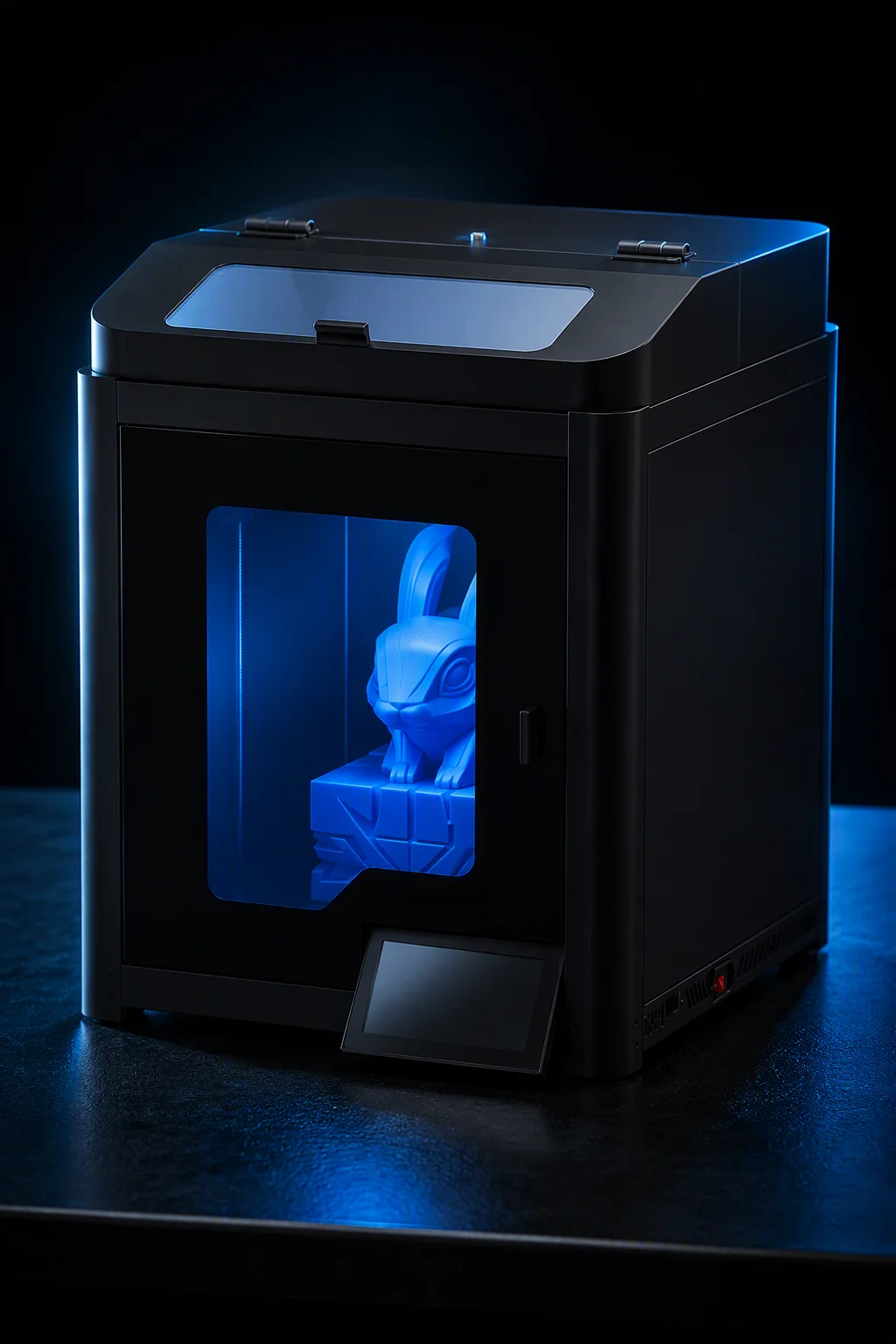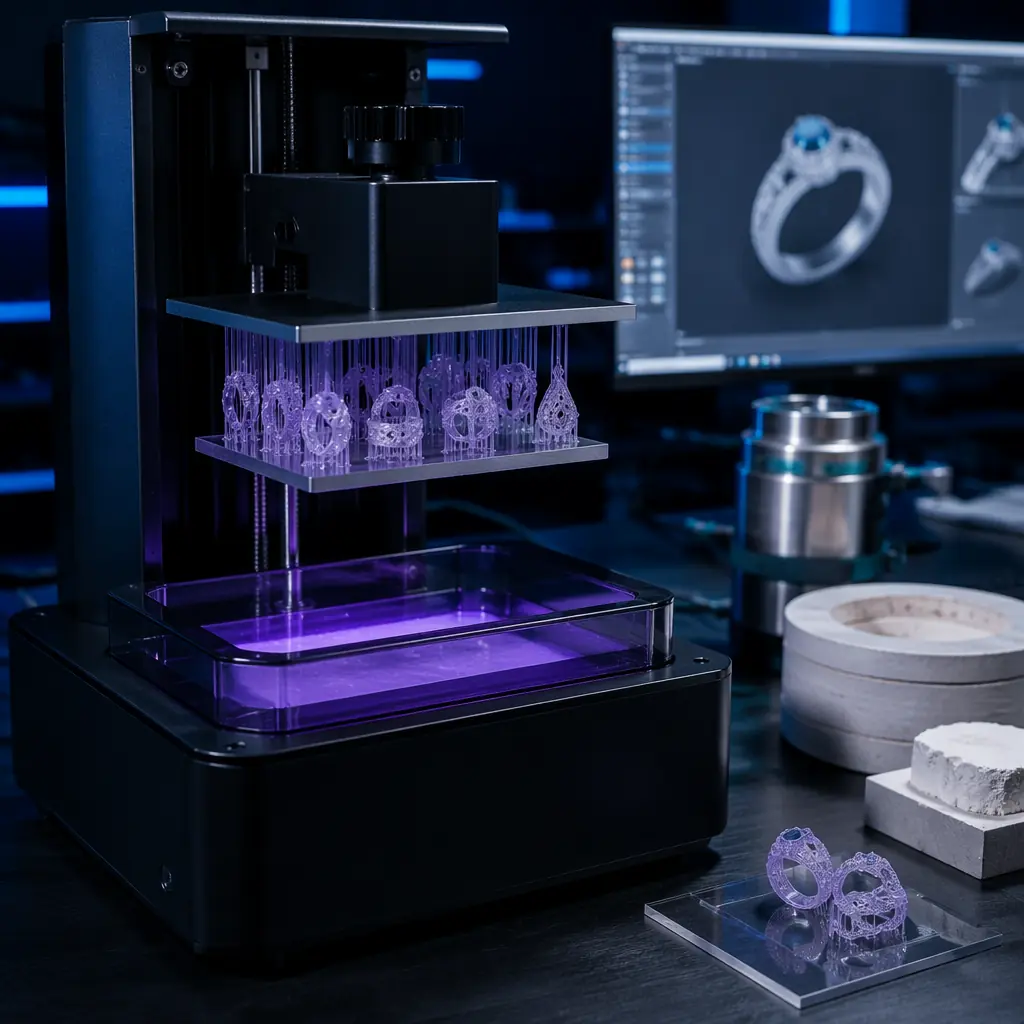
How Jewelry 3D Printing Actually Works: The Three Technology Paths
Every distributor entering the jewelry market needs to understand that 3D printing doesn't replace casting — it replaces the wax carving step that precedes it. For 5,000 years, jewelers carved patterns in wax by hand, invested them in plaster, burned out the wax, and poured molten metal into the cavity. 3D printing digitizes the pattern-making step: the printer produces the positive pattern, and everything downstream — investment, burnout, casting, finishing — stays exactly the same. This is why adoption barriers are low: the printer slots into an existing workflow that every casting house already runs.
There are three distinct technology paths, and they serve different segments of the market:
Path 1 — Castable Resin (LCD/DLP):
The printer uses a UV LCD screen to cure layers of photopolymer resin formulated to burn out cleanly — no ash, no residue, no casting defects. Build layer heights of 35–50 μm produce patterns with surface finish fine enough that minimal pre-casting finishing is needed. This is the highest-volume path: a single LCD resin printer can produce 50–100 ring patterns in a 2-hour print, making it the workhorse for casting houses and service bureaus. Castable resins cost $80–150/L and yield 150–250 ring patterns per liter. This is the path that creates the recurring consumable revenue distributors want. For a deeper look at resin printer technology and distribution strategy, see our resin 3D printer distribution guide.
Path 2 — Wax Printing (MJP/drop-on-demand):
Dedicated wax printers deposit micro-droplets of molten wax layer by layer, producing patterns that behave identically to hand-carved wax in the burnout cycle. Surface finish is superior to castable resin (25 μm layers), and the burnout is cleaner because wax is the native pattern material for investment casting. The trade-off: wax printers are 3–5× more expensive ($15,000–60,000), slower per-build, and use proprietary wax cartridges that lock customers into a single supplier. This is the premium path for high-end custom jewelers and brands where surface finish is non-negotiable. Distributors can sell wax printers profitably, but the recurring revenue model is weaker — fewer printers sold, lower consumable volumes, and closed-cartridge ecosystems limit margin flexibility.
Path 3 — Direct Precious Metal Printing (SLM/DMLS):
Laser powder-bed fusion prints directly in gold, silver, or platinum — no pattern, no investment, no casting. The technology exists and produces stunning results, but at $80,000–250,000 per machine and $3,000–8,000/kg for precious metal powder, it's viable only for the top 1% of jewelry manufacturers. For 99% of the addressable market — the 50,000+ independent jewelers, casting houses, and CAD service bureaus worldwide — Path 1 (castable resin) is the economically rational choice.
The Jewelry 3D Printing Market: Size, Segments & Why Now
The global jewelry manufacturing market is $280 billion at retail, with $4.5 billion in the manufacturing equipment and consumables segment where 3D printing competes. Digital adoption — CAD + 3D printing — has reached approximately 35% penetration among professional jewelry manufacturers, up from 15% in 2019. The remaining 65% still carve wax by hand or outsource pattern-making to service bureaus. That's the distributor's addressable market: tens of thousands of workshops that know they need to digitize but haven't found the right technology partner.
The market segments break into four tiers, each with different printer requirements:
Three structural trends are accelerating adoption right now. First, the CAD bottleneck is dissolving: RhinoGold, MatrixGold, and 3Design have made jewelry-specific CAD accessible to non-engineers. A jeweler who can sketch a ring on paper can learn to model it in CAD within 2–4 weeks. As CAD skills spread through the industry, the demand for 3D printed patterns follows immediately — you can't do anything with a digital model except print it. Second, castable resin chemistry has crossed the reliability threshold: five years ago, castable resins were inconsistent — 10–15% of patterns had casting defects from residual ash or incomplete burnout. Today's third-generation resins (BlueCast, PowerResins WAX, Phrozen Wax-Like) achieve clean burnout with defect rates under 2% in a properly controlled investment cycle — comparable to hand-carved wax. Third, the service bureau pricing model has created a make-vs-buy tipping point: a jeweler paying a service bureau $8–15 per pattern for a 50-piece order spends $400–750/month. A $1,500 LCD resin printer with $100/month in castable resin produces the same 50 patterns at $2.00/pattern — a 6-month payback period. For more on how to structure your distribution business across multiple market segments, read our portfolio strategy guide.
Printer Selection: What Jewelry Customers Actually Need
Jewelry customers don't buy printers — they buy pattern throughput and casting reliability. The printer specifications that matter to a jeweler are different from those that matter to a hobbyist or prototyping engineer. Here is what to lead with in every sales conversation.
XY resolution — the non-negotiable:
Jewelry patterns need 35 μm or better XY pixel resolution. At 50 μm, fine details on ring shanks — filigree, pavé settings, engraving — lose definition and require manual cleanup before casting. At 35 μm, these details print clean and the pattern is investment-ready straight off the build plate. The resolution requirement eliminates most budget LCD printers (which use 50–75 μm screens) and positions the mid-range 8K/12K LCD segment as the jewelry sweet spot.
Build volume — more patterns per cycle:
A 192 × 120 mm build area can fit 40–60 ring patterns in a single print. At 2 hours per print with 35 μm layers and 3-second exposure, that's 150–250 patterns per 8-hour shift from one printer. For a casting house running two shifts, two printers produce 600–1,000 patterns/day — enough to replace a team of 4–6 hand-carvers. Build volume directly determines the ROI story you tell: more patterns per cycle = faster payback = easier close.
Heated vat — yes, it matters for castable resin:
Castable resins are more viscous than standard modeling resins, especially at room temperature. A heated resin vat (25–30°C) lowers viscosity by 40–60%, ensuring consistent layer formation, reducing print failures, and improving surface finish on fine features. This isn't optional for jewelry — it's the difference between a 2% failure rate (acceptable) and a 15% failure rate (unacceptable for a production workflow). Our post-processing guide covers the full workflow from print to casting-ready pattern.
Open material system — your competitive advantage:
EnvisionTEC and Solidscape lock customers into proprietary castable resins at $200–400/L. An open-system LCD printer running third-generation castable resin at $80–120/L delivers equivalent or better burnout results at a 60–70% lower consumable cost. This is the value proposition that displaces incumbents: the customer saves $2,400–7,200/year in resin costs alone — and the distributor captures the ongoing resin revenue with 30–40% gross margins. The printer sale is the entry point. The resin is the business. For guidance on building a full consumables bundling strategy, see our consumables and accessories guide.
Castable Resins & Waxes: The Consumable That Builds Your Business
The jewelry distributor business model is structurally identical to dental: hardware is the entry point, consumables are the recurring revenue engine. A single jewelry account consuming 2 liters of castable resin per month at $100/L with a 35% distributor margin generates $840/year in recurring gross profit — and the account relationship typically lasts 5+ years because switching validated resin workflows is operationally painful.
Three categories of castable materials to stock:
General-purpose castable resin ($80–120/L):
For rings, pendants, earrings, and standard jewelry in gold, silver, and platinum. Third-generation formulations from BlueCast, PowerResins, and Phrozen achieve clean burnout with ash residue under 0.02% — well below the threshold that causes casting porosity. One liter yields 150–250 patterns. This is the volume SKU — 80% of your resin revenue will come from this category.
High-detail castable resin ($120–180/L):
For micro-pavé settings, filigree, and high-end pieces where surface finish is critical. Lower viscosity (150–250 cP vs 300–500 cP for general-purpose) enables finer detail reproduction and easier support removal. Stock one high-detail SKU for the top 20% of your accounts that serve premium jewelers.
Castable wax resin hybrid ($100–150/L):
Formulated to behave like wax during burnout — melts and flows out of the investment mold rather than vaporizing like standard resins. Preferred by traditional casting houses that are skeptical of resin burnout. This SKU is your bridge product for old-school jewelers who say "we only trust wax." Let them print with a wax-like resin that follows their existing burnout cycle, and you earn the right to move them to general-purpose castable resin once they see the results.
The 90-Day Distributor Entry Plan: From Zero to Revenue
This is the single most important section of this guide. Unlike dental — where regulatory barriers, biocompatibility certifications, and multi-stakeholder purchasing create 6–12 month sales cycles — jewelry has a faster adoption curve. A jeweler can evaluate a printed pattern in 2 hours (print it, cast it, inspect the result). Here is a phased 90-day plan that takes a distributor from market entry to recurring revenue.
Phase 1 — Technology qualification (Day 1–14):
Select 1–2 LCD resin printer models with 35 μm XY resolution, collimated UV light source, and heated vat. Qualify them with 2–3 castable resins — one general-purpose (BlueCast or equivalent), one wax-like for traditionalists, and one high-detail for premium accounts. Print and cast 20+ sample patterns (rings, pendants, earrings with pavé settings) on each printer-resin combination. Have the castings evaluated by an experienced casting house. Photograph the printed patterns next to the finished castings. This visual side-by-side — the resin pattern next to the polished gold piece — is your single most powerful sales asset. It answers the customer's only real question: "will this actually work with my casting process?" Document everything in a one-page validation sheet. For foundational distributor business setup, see our distributor startup guide.
Phase 2 — Pilot accounts (Day 15–60):
Identify 5–10 target accounts in your region: a mix of casting houses (high volume, recurring resin), independent manufacturing jewelers (relationship-driven, loyal), and CAD service bureaus (technically sophisticated, refer business). Offer a 14-day printer loan with starter resin kit and one day of on-site setup. The pilot proves the workflow in the customer's own casting process, with their own metal alloys, their own investment powder, their own burnout schedule. If the patterns cast clean in their environment, you've won the account. The close rate on properly executed pilots in jewelry is 70–80% — significantly higher than dental because the evaluation cycle is measured in hours, not months.
Phase 3 — Channel partnerships (Day 60–90):
The highest-leverage growth lever in jewelry distribution is not direct sales — it's partnerships with jewelry CAD training providers, casting supply companies, and precious metal dealers. These businesses already have relationships with thousands of jewelers and visit workshops weekly. A casting supply company that sells investment powder, flasks, and furnaces to 500 jewelry workshops can add your validated printer-resin package to their catalog with zero additional sales cost. Offer them a 12–15% commission on hardware and 8–10% on ongoing resin orders. One well-chosen channel partner with 300+ active jeweler relationships can generate more qualified leads than 6 months of direct outreach. Our portfolio strategy guide covers multi-channel distribution across verticals in detail.
The Unit Economics: What a Jewelry Account Is Worth
Let's put numbers on the opportunity. A mid-size jewelry manufacturer producing 200 patterns per month will operate 1–2 LCD resin printers and consume 2–3 liters of castable resin monthly across general-purpose and high-detail applications. Here is the five-year revenue projection.
The structural dynamic is the same as dental, with one advantage: jewelry accounts are easier to acquire. A casting house evaluating a castable resin printer needs 2 hours to print and cast a test pattern — not 3 months of biocompatibility validation and regulatory paperwork. The faster evaluation cycle means a distributor can close 2–3× more jewelry accounts per month than dental accounts with the same sales effort. A distributor with 25 jewelry accounts generating $2,100/year in gross margin each runs a $52,500/year gross margin business from 25 relationships. At 40 accounts, that's an $84,000/year business — built on selling a consumable that customers reorder monthly, for a workflow they cannot easily switch once validated.
Competing Against Established Jewelry 3D Printing Brands
EnvisionTEC (Desktop Health), Solidscape (Stratasys), and 3D Systems dominate the jewelry 3D printing market — but their position creates a structural opening for distributors selling open-material alternatives.
The incumbents' vulnerability:
Proprietary material lock-in. EnvisionTEC's jewelry printers require EnvisionTEC-branded castable resins at $200–350/L. Solidscape wax printers use proprietary wax cartridges at $250–400/kg. A casting house operating 3 printers and consuming 8 liters of resin per month at $250/L spends $24,000/year on materials with zero ability to switch suppliers or negotiate pricing. This is exactly the same vulnerability that open-system resin printers exploit in dental — and the economics are equally compelling in jewelry. An open-system LCD printer with third-generation castable resin at $100/L saves the customer $14,400/year in material costs. The savings pay for the printer in under 2 months. Our certification and compliance guide covers how to position open-material systems against locked ecosystems.
Where the incumbents still lead:
Brand trust in the high-end segment. Tiffany & Co., Cartier, and Bvlgari are not buying open-system LCD printers — they're buying Solidscape wax printers with 15-year track records and dedicated support contracts. That's fine. The top 5% of the jewelry market will stay with the incumbents. The distributor's addressable market is the other 95%: the 50,000+ independent jewelers, casting houses, and CAD bureaus that want precision and reliability at a rational price point. This market is growing faster than the premium segment because digital adoption is moving downmarket — from luxury houses to mid-tier manufacturers to independent custom jewelers. The distributors who capture this wave now own it for a decade.
The cross-vertical play:
A distributor who sells castable resin printers into jewelry can use the same printer platform to sell model resin into dental labs — and vice versa. The hardware is identical; only the resin, the validation documentation, and the sales narrative change. This means the distributor's investment in technical knowledge, printer inventory, and support infrastructure serves two independent revenue streams. A customer who buys a printer for jewelry patterns today is a warm lead for dental model resin tomorrow — if the distributor has built both verticals. For the dental counterpart to this guide, see our dental lab distribution guide — the unit economics, entry strategy, and competitive positioning mirror the jewelry playbook almost exactly.
Bottom Line
Jewelry 3D printing is not a niche — it's a $4.5 billion equipment-and-consumables market growing at 18% digital adoption, and it's the natural second vertical for any distributor who has already built competency in dental or engineering resin. The technology is mature (castable resins now rival hand-carved wax in burnout quality), the customer ROI is instantaneous (2-month payback on consumable savings alone), and the recurring revenue model is structurally superior to consumer 3D printing — fewer accounts, higher value per account, and resin reorders that compound monthly.
The window of opportunity is defined by the 65% of jewelry manufacturers who have not yet adopted digital pattern-making. They are evaluating their options now — not next year, not when the technology gets better (it already works), but now. They need a distributor who can sell them a validated workflow: the right printer, the right castable resin, the right burnout schedule, and a printed-then-cast sample that proves the result. That distributor can build a $100,000+ gross margin business from 40 jewelry accounts — with 75% of that revenue recurring from resin reorders — in a market where account acquisition is faster and less regulated than dental, and where competition from other open-system distributors is minimal because everyone else is fighting over the consumer filament market. At Precise3D, our LCD resin printer platform — with 35 μm XY resolution, collimated UV LED light source, heated vat, and open material compatibility — is built for the jewelry casting workflow: precise enough for pavé settings, productive enough for batch runs, and open enough that your customers control their material costs. Because in jewelry, the printer is the tool. The resin is the business.
Reviewed by the Precise3D engineering & OEM team. Compliance files that accompany the catalog are auditable at the certification register.
Enter the Jewelry Market
Ready to Bring Castable Resin 3D Printing to Jewelry Workshops in Your Region?
Join our network of global distributor network. Jewelry-qualified LCD resin printers with 35 μm accuracy, validated castable resin partnerships, casting-house-tested workflows, and a 90-day go-to-market playbook — everything you need to capture the second-largest vertical in additive manufacturing.