Two Kinds of End-of-Life, Two Lead Times
Fleet owners treat obsolescence as one event and get surprised by it twice. Electronics and mechanics leave the market by completely different routes, and the notice period for one is measured in months while the other gives you none at all.
Announced end-of-life is the electronics route. A controller board, a stepper driver module or a display assembly is built around components that the semiconductor supply chain itself discontinues. The board maker issues a product change notice or an end-of-life notice with a defined last order date, typically six to twelve months out, and often a last time buy window inside that. This is the well-behaved case: you get a date, you get an order form, and if you miss it you can sometimes pay a broker four times the original price for parts of unknown provenance.
Silent discontinuation is the mechanical route. A hotend assembly, a gantry extrusion profile, a proprietary bed carriage or a specific heater cartridge simply stops appearing in the catalogue. There is no notice, because the maker considers it a catalogue change rather than a lifecycle event. By the time a service organisation notices, the part is unavailable everywhere and the machine-specific tooling that produced it has been retasked.
The response differs because the lead times differ. For announced EOL you are optimising a purchase quantity against a known deadline. For silent discontinuation you are running a detection system: monitoring catalogue listings, second-source availability and supplier health, so that you find out while stock is still moving. The obsolescence programme that catches one does not automatically catch the other, which is why fleets that handle EOL notifications well still get caught out by a discontinued bed carriage.

The Last Time Buy Quantity Formula
A last time buy is not a guess about how many parts you might want. It is a calculation with four inputs, and every one of them is either measurable now or must be explicitly assumed. Write the assumptions down, because in year three the argument will be about which number was wrong.
Input one, installed base. The number of machines of that model still in service, not the number ever purchased. Fleets shrink, and parts bought for retired machines are pure waste. Use the fleet asset register, not the original invoice.
Input two, failure rate per machine per year. Take this from your own service records, because vendor MTBF figures describe a population that is not your population and a duty cycle that is not your duty cycle. A controller board that fails 0.04 times per machine per year in a well-cooled workshop fails at 0.11 in an unventilated one. Our guide to MTBF, MTTR and uptime explains why the published number is not transferable.
Input three, remaining service life. The years you intend to keep those machines. If the fleet is scheduled for replacement in 2030, you need parts to 2030, not to the machine's theoretical maximum life.
Input four, attrition and spares already held. Machines are retired or scrapped early, so the base decays; and you may already hold stock that covers the first year. The LTB quantity is the shortfall above what you have, not the gross requirement.
The working form is: quantity equals installed base multiplied by annual failure rate multiplied by remaining years, multiplied by a safety factor of 1.2 to 1.5, minus stock on hand. For a 40-machine fleet with a 0.06 per machine per year board failure rate, four remaining years and eight boards in stock, that gives 40 x 0.06 x 4 = 9.6 failures, times 1.3 safety = 12.5, minus 8 = roughly 5 boards. Most fleets buy 40 in this situation, because 40 feels safe and the unit price break is at 40.
Reading a Product Change Notice Before the Deadline
A product change notice is not a single document, and the dangerous ones are the notices that do not say "end of life" anywhere in the subject line. Read every PCN for four specific things before deciding it does not affect you.
The distinction between a change and a discontinuation. Many notices announce a revision, a new firmware baseline, or a component substitution on the board. A substitution can be harmless, or it can break a machine-specific profile that took months to tune. If the notice says the onboard thermistor amplifier changed part number, the temperature calibration in your fleet's profiles is now suspect, and that is a fleet-wide issue even though nothing is discontinued.
The last order date versus the last ship date. These are usually different by four to eight weeks. Ordering on the last order date is already too late if the factory's allocation is exhausted, so treat the last order date as the deadline for raising a purchase requisition, not for receiving a quote.
Minimum and multiple. A last time buy is often subject to a minimum lot quantity set by the remaining component stock. A notice that offers a last buy at a minimum of 250 units for a fleet that needs 6 has effectively ended availability for that fleet, and the correct response is to look for a functional equivalent or a repair route rather than to buy 250 boards.
Whether an alternative is qualified or merely suggested. "A replacement is available" means a pin-compatible part exists. It does not mean it has been validated in your machine, at your firmware version, with your profiles. A replacement part that is not qualified is a project, and a project needs to be started before the old part runs out.
What you are looking for: A clear answer to all three in writing. A supplier who answers only the first has not read their own notice, and you are about to size a purchase on an incomplete deadline.
Which Parts Deserve a Last Time Buy and Which Do Not
Not every part merits an LTB. Buying a last-time quantity of a part that has three interoperable third-party equivalents is a way to convert working capital into shelf space. The decision turns on substitutability, not on how critical the part feels.
Genuine LTB candidates are parts where the failure of the part ends the machine and no substitute exists: proprietary controller boards with encrypted firmware handshakes, bed carriages with a machined mounting pattern unique to the model, integrated hotend assemblies that combine heater, thermistor and heatbreak in one non-separable unit, and any sensor whose calibration constant is baked into the firmware rather than the part.
Poor LTB candidates are parts with open or commodity interfaces: standard heater cartridges and thermistors in common resistance values, generic 40 mm and 50 mm fans, standard nozzle threads, common linear rail sizes and belt profiles, and anything a machine shop can reproduce from a drawing. For these, the LTB is unnecessary because the supply route is broad, and a modest buffer plus a drawing on file is cheaper than four years of inventory.
The middle case is the one that costs money: proprietary mechanics that could be reproduced but only with effort. A discontinued extruder body that a machine shop could mill for 60 dollars each is not an LTB candidate at a 12 dollar purchase price, because buying forty of them at 12 dollars ties up 480 dollars to avoid a future 60 dollar problem. The arithmetic flips only when the part's geometry is complex enough that reverse engineering is a project rather than a job. Our multi-site spare parts logistics guide covers how to hold that buffer across locations rather than duplicating it in every warehouse.
For a fleet, the useful classification is a two-column register: parts where loss of supply stops production, and parts where loss of supply costs a day of rework. Only the first column gets an LTB.
Storage That Does Not Destroy the Parts You Just Bought
The cruellest outcome of a well-sized LTB is buying the right quantity and destroying it in storage. Four years is a long time for a part with a polymer component, an electrolytic capacitor or a pre-applied adhesive.
Electronics. Controller boards should be stored in antistatic bags with a humidity indicator card, in a dry space below 60 percent relative humidity, and away from temperature cycling. Electrolytic capacitors degrade faster at elevated temperature; the usual working rule is that every 10 degrees Celsius of excess storage temperature roughly halves the useful life of the capacitor. A board stored in a roof-space container through three summers arrives at year four with a failure rate far above the one that justified the purchase.
Polymer and elastomer parts. Belts, gaskets, silicone socks and TPU components take a compression set and oxidise. Store them relaxed, not stretched or compressed in a bundle, away from sunlight, ozone sources such as electric motors, and solvent vapours. A silicone sock that has been squashed in a box for four years will not stay on the heater block.
Thermal interfaces. Pre-applied thermal paste on a heatbreak, adhesive-lined heat shrinks and any pressure-sensitive adhesive degrade on a schedule independent of use. Check the manufacturer's shelf life and treat it as real. Where the interface is critical, buy the uncoated part and apply paste at installation.
Documentation. Every LTB box should carry the date of purchase, the firmware version current at that date, the machines the part is compatible with and the storage conditions required. Without that label, year-four maintenance becomes an exercise in identifying a board by its silkscreen. This is the same discipline described in our guide to the fleet asset registry, applied to the stock rather than to the machines.
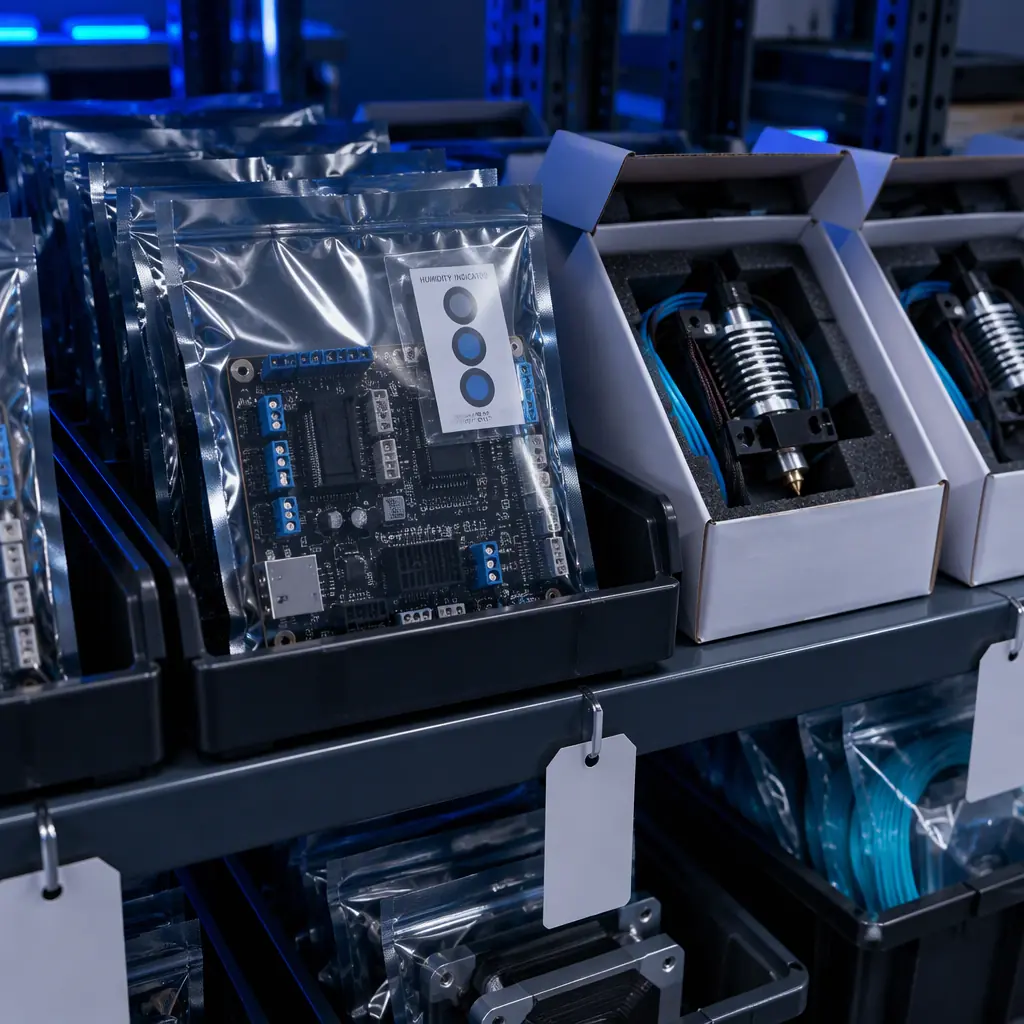
The LTB Trap: Dead Inventory versus Dead Machines
Both failure modes are expensive and they pull in opposite directions, which is why LTB decisions get made emotionally. The dead-inventory version is familiar: a shelf of boards bought for machines the customer scrapped eighteen months later, written off at the next audit. The dead-machine version is worse and less visible: a machine with a failed board that cannot be repaired, sitting in a corner because scrapping it costs more politically than leaving it idle.
The instrument that resolves the tension is a retirement schedule tied to the LTB. When you buy a last-time quantity, you also decide the machine retirement date, because the two are the same decision. If the calculation says six boards for a four-year horizon, the machine model retires in four years and the fleet plan says so. That single linkage converts an inventory gamble into a resource plan, and it gives the finance function a number they can accept instead of an argument about optimism.
There are three legitimate ways to reduce the exposure. First, split the buy: a firm quantity covering the first two years, plus a contractual option or a hold on remaining stock with the supplier, if the supplier will agree. Second, qualify a repair route, because a component-level repair service for a controller board extends the effective life of ten boards considerably and is often available from third parties even after the maker discontinues the part. Third, qualify a functional substitute in advance, so that when stock runs out the fleet has a validated path instead of a scramble.
The one thing that does not reduce exposure is refusing to decide. A fleet that defers the LTB decision until the last order date has already lost the option to size the purchase rationally, and it will buy whatever is left.
Where the fleet is large enough to matter to a manufacturer, the last-time buy can also be negotiated as a service rather than a purchase. Our guide to parts obsolescence and end-of-life service covers the supplier-side commitments worth asking for, including a parts availability guarantee for a defined post-production window and a published end-of-support date. For a service organisation running a mixed fleet, the spare parts aftermarket guide covers how holding LTB stock becomes a revenue line rather than a cost centre, because the fleet owner who cannot source a board will pay for one.
What is a last time buy?
A last time buy is the final purchase order placed for a part before the manufacturer ends production, sized to cover the remaining service life of the machines that need it. The quantity comes from installed base, measured failure rate, remaining years and stock already held, not from intuition.
The practical test of whether a fleet has done this properly is simple: can the maintenance manager state, without looking anything up, which parts are in last-time-buy status, what quantity was bought, when the stock was purchased and what the machine retirement date is. A fleet that can answer that has an obsolescence plan. A fleet that cannot has a shelf of parts and a hope.
For distributors, this is a service product, not an inconvenience. A customer who has just received a PCN is highly motivated, the conversation is technical rather than price-driven, and the supplier who can produce a quantity calculation, a storage recommendation and a repair alternative in one meeting is not being compared on unit price. Our critical spares kit guide covers the complementary question of what should be on site before the failure rather than in the warehouse after it.

Lifecycle Planning
Get the EOL Notice With a Quantity Calculation
Precise3D issues product change notices with last order dates, minimum lot quantities and a qualification status for any replacement part, so a fleet can size its last buy on facts.