Why Sintering Breaks the Assumptions Buyers Bring From FDM
A buyer moving from filament printing to metal binder jetting carries four assumptions that are all wrong for the new process, and each one produces a costly misunderstanding in the first purchase order.
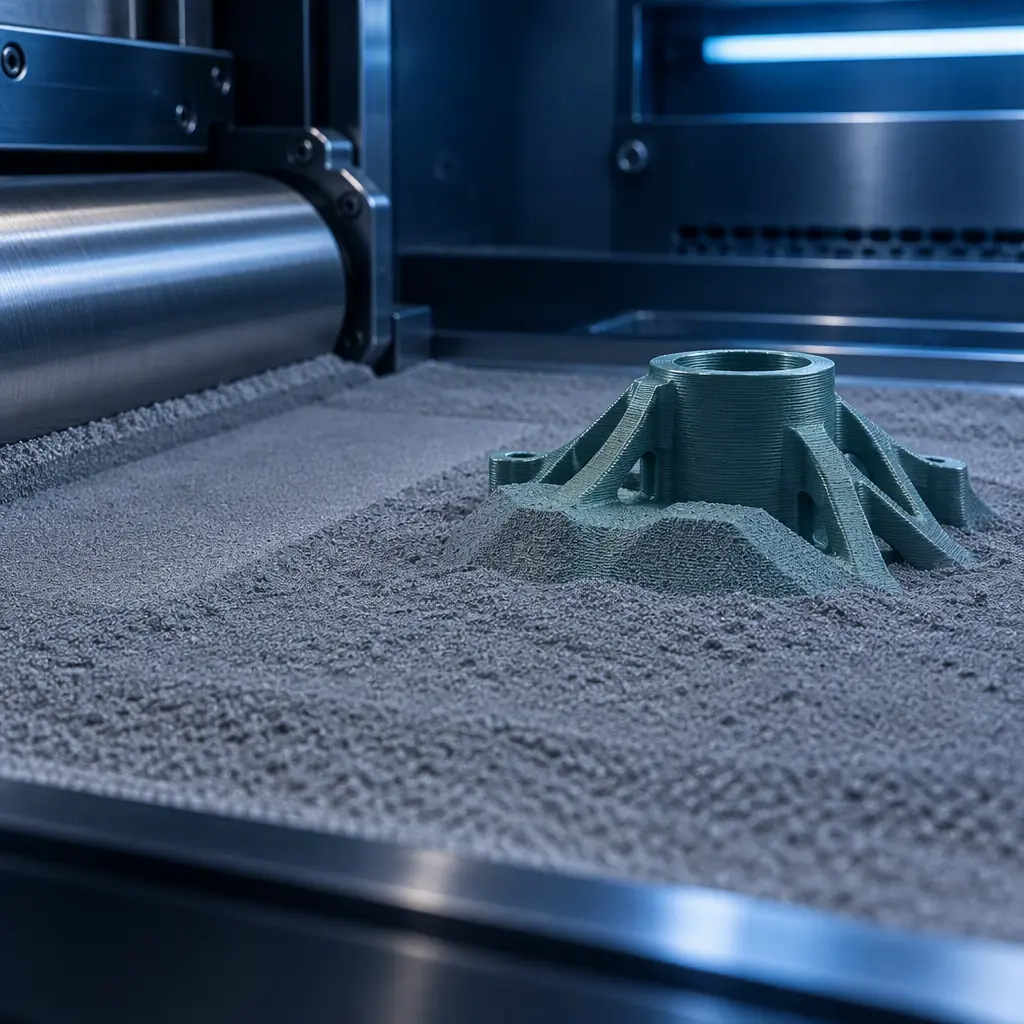
The first assumption is that the printed part is the part. In binder jetting, the printed object is a green part: metal powder held together by a polymer binder, typically at 55 to 62 percent of the theoretical density of the alloy. It is fragile, it is roughly 20 percent larger than the finished component in every dimension, and it has almost none of the mechanical properties the drawing specifies. Nothing about the green part is a deliverable. It is an intermediate.
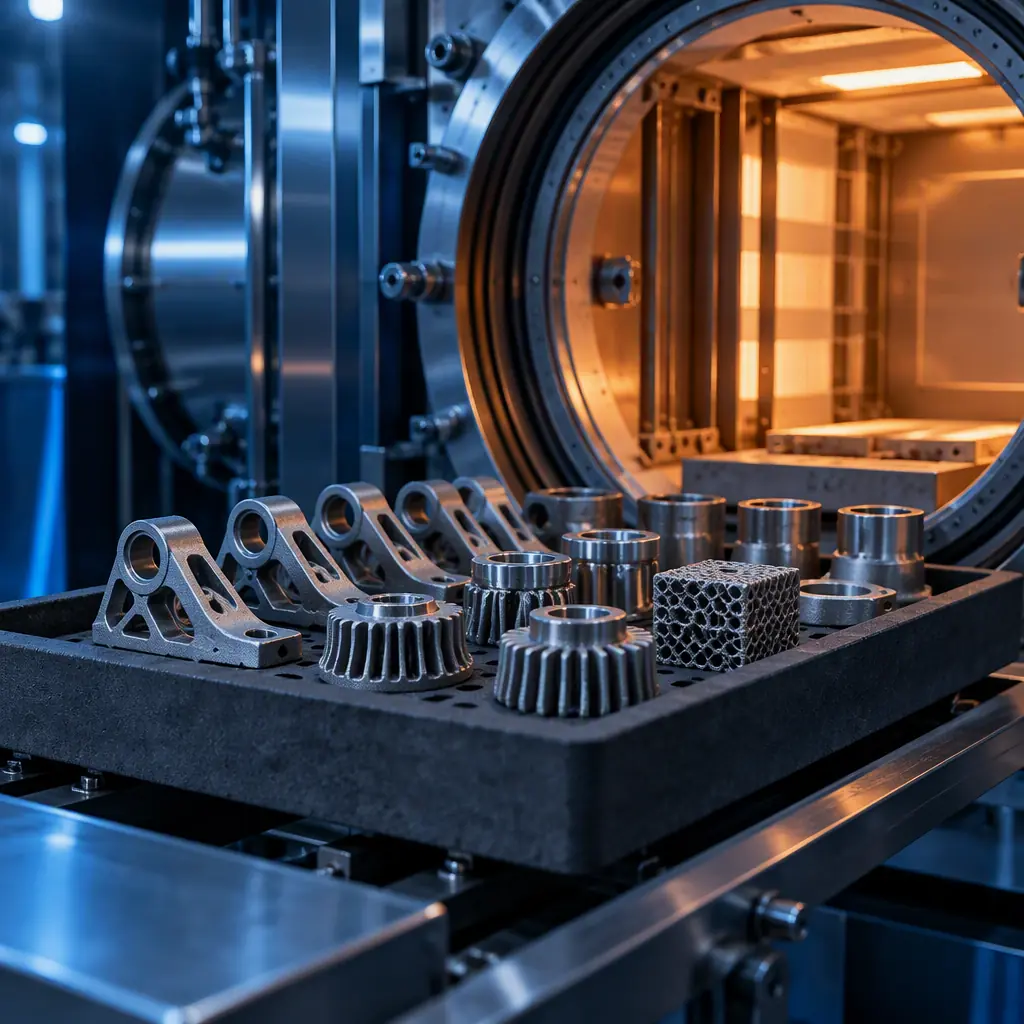
The second assumption is that the furnace is a finishing step. Debinding and sintering is not a finishing step; it is where the part is actually made. It sets the final dimensions, the final density, the final microstructure and most of the final cost. A supplier with an excellent printer and a mediocre furnace will deliver worse parts than a supplier with an adequate printer and a well-characterised furnace, and this inverts the way most buyers assess metal AM suppliers.
The third assumption is that tolerance is a machine property. In metal binder jetting, the achievable tolerance is the sum of the printer's placement accuracy, the shrinkage model's accuracy, and the furnace's thermal uniformity. Only the first of those three is a machine specification, and it is usually the smallest contributor. Our guide to printed part tolerances covers the polymer-side tolerance stack; the metal stack is dominated by different terms.
The fourth assumption is that material certification covers the process. A certificate for the powder says nothing about whether the sintered part met its density target. That has to be measured on the part, which is why metal AM quality documentation looks different from filament documentation. Our guide to PPAP and production part approval explains what the submission pack contains for processes where the material specification and the as-built property are separate claims.
The Shrinkage Chain: Four Terms That Multiply
Everything in metal binder jetting dimensional control comes down to predicting and compensating shrinkage. The compensation is not a single number, because shrinkage happens in stages and the stages do not scale identically.
The dominant term, sintering densification, is not a fixed material constant. It depends on the green density achieved by the printer, the alloy, the powder particle size distribution, and the furnace profile. Pushing green density higher reduces the shrinkage that has to happen in the furnace, which improves dimensional control, which is why printer green density is a more meaningful specification than print speed for anyone buying for production.
The anisotropy term is the one that surprises buyers. Because the powder is deposited in layers and the green part has directional structure, the contraction along the build axis differs measurably from the contraction in the build plane. A supplier applying a single uniform scale factor to the CAD model will hit nominal on one axis and miss on the other. This is why the compensation is properly a per-axis scale, and why a part with tight tolerances on two different axes exposes a supplier who is using a scalar.
The practical consequence for a buyer is that the first article is not optional and not a formality. A new geometry, a new alloy lot, a new furnace load configuration, or a new powder batch each shift the effective shrinkage. The compensation that worked last quarter is a starting point, not a guarantee. Our guide to factory audit and QC checklists covers the audit questions that establish whether a supplier actually re-derives compensation per lot or reuses an old value until a customer complains.
Debinding: The Stage That Quietly Destroys Good Parts
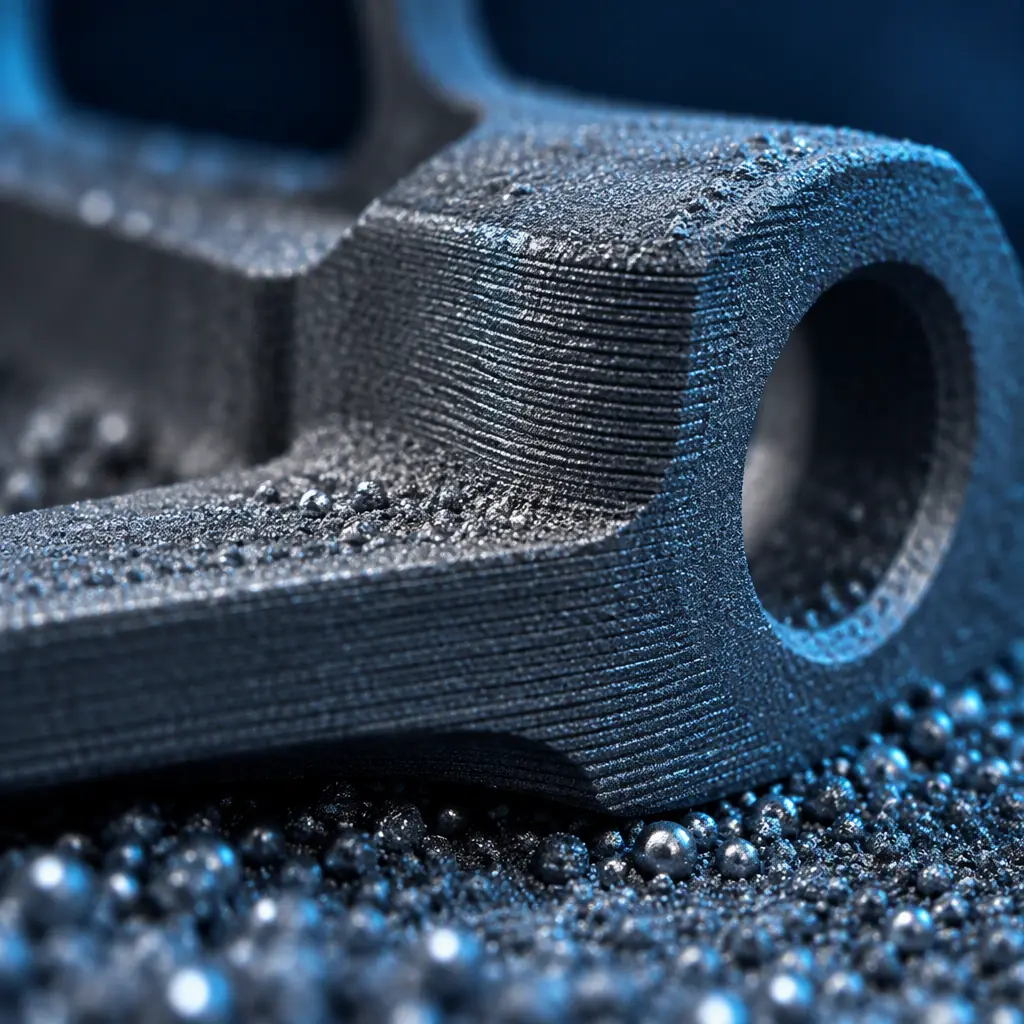
Debinding removes the polymer binder before the part can be sintered. It has to be done slowly, because the binder leaves as gas and the gas has to escape through the pore network of the green part. Push the temperature up too fast and internal pressure builds, and the part cracks or blisters from the inside. Push it too slow and the cycle cost becomes uneconomical.
Two binder systems dominate, and they demand different cycles.
Catalytic debinding
A small amount of binder (typically 2 to 4 percent by weight) is formulated to depolymerise in the presence of an acid vapour at relatively low temperature, commonly around 110 to 140 degrees Celsius in a dedicated catalytic furnace. Debinding is fast, on the order of a few hours, and the low temperature means less risk of thermal distortion. The trade is that the acid vapour environment is aggressive to the furnace itself and to certain alloys, and the binder formulation is tied to the printer, so you cannot simply switch powder suppliers.
Thermal debinding
A higher binder fraction, often 8 to 15 percent by weight, is removed by a slow thermal ramp in a controlled atmosphere, with holds positioned to let each fraction of the binder depart before the next begins. The cycle is long, commonly 24 to 72 hours, and the ramp profile is alloy-and-binder specific. Thermal debinding is more flexible on materials and less aggressive on equipment, and it places the entire burden of quality on the profile.
Either way, the debinding cycle is the part of the process most sensitive to section thickness. A part with a 3 millimetre wall and a part with a 15 millimetre boss cannot share a debinding ramp without one of them being wrong. Thick sections need slower ramps because the gas has further to travel, and thin sections need faster ones because prolonged heat exposure degrades them. A supplier who runs one standard debinding cycle for all geometries is a supplier whose thick-section parts blister.
What you're looking for: A supplier who describes ramp selection in terms of maximum section thickness and binder fraction is running a controlled process. A supplier who says the ramp is standard for the material is either only running one geometry class or is not measuring the result.
Sintering: Density, Atmosphere and the 98 Percent Line
Sintering is where the part becomes metal. The green part is heated to a temperature below the alloy's melting point, typically 70 to 90 percent of the melting temperature in absolute terms, and held long enough for diffusion to close the pores between powder particles. The part contracts and densifies.
The target is relative density, expressed as a percentage of the alloy's theoretical density. The practical bands matter because they correspond to different property claims:
Most buyers who need a structural part should specify a density floor in the purchase order, and most should specify something in the 96 to 98.5 percent band. Specifying above 99 percent without a functional reason pushes the supplier into hot isostatic pressing, which is a separate process, a separate cost, and a separate supply chain risk. Specifying nothing leaves density to the supplier's default, and the default is often whatever their furnace naturally produces for that alloy rather than what the application needs.
Atmosphere control is the other half. Stainless steels and most engineering alloys need a vacuum or high-purity inert atmosphere, with residual oxygen held low enough that oxide films do not impede diffusion. A furnace that leaks, or that runs at marginal vacuum, produces parts that measure correctly on density but fail on ductility because the interparticle boundaries are contaminated. This is a failure mode that dimensional inspection cannot see, which is why mechanical testing to ASTM methods belongs in the qualification pack for any structural metal part, and why non-destructive testing is needed to catch internal porosity in production.
Furnace Load Design: Batch Economics and the Uniformity Problem
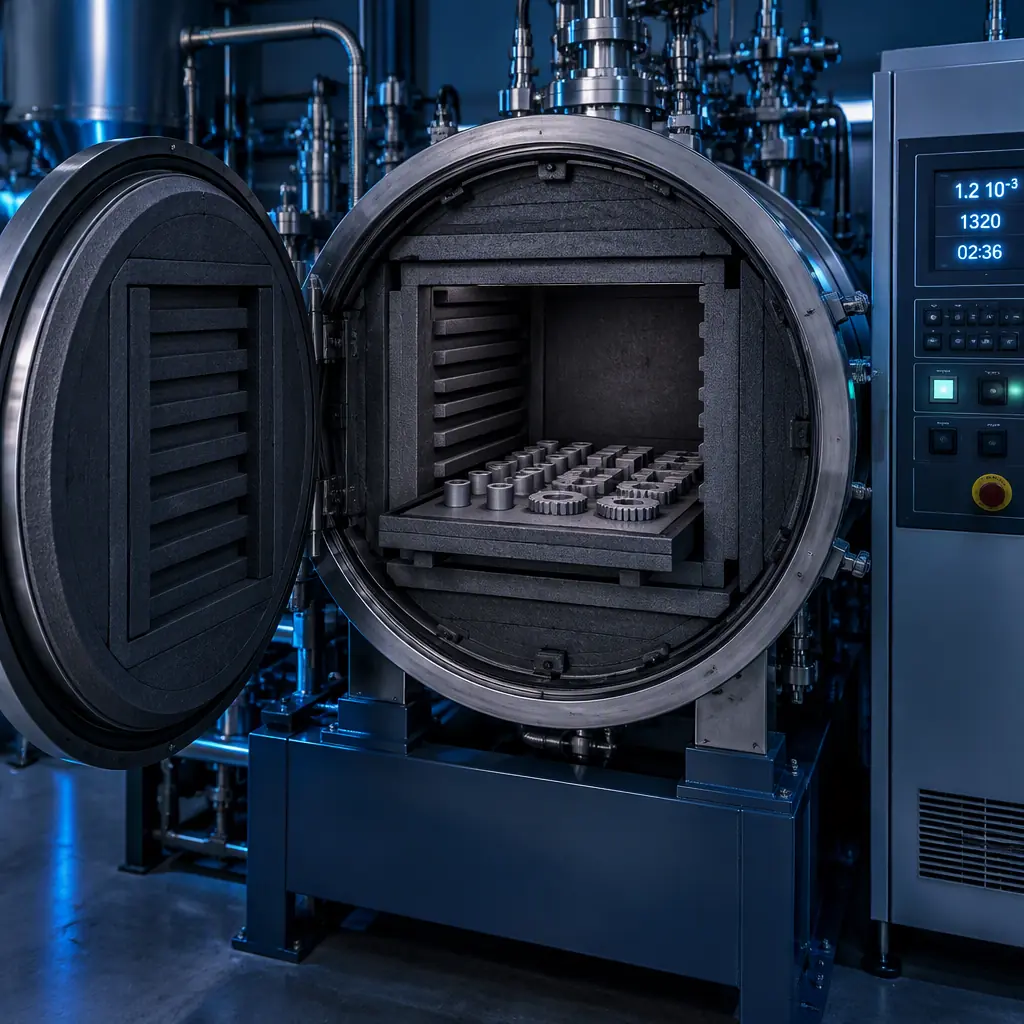
A sintering furnace is a batch asset, and its economics are driven by how full the useful hot zone is. This creates a tension that buyers rarely see in quotations.
The hot zone has a temperature map. Regions near the heating elements run hotter than the centre, and the working volume where uniformity is within specification is smaller than the physical chamber. Placing parts outside that working volume produces parts that shrink differently from the rest of the load, which shows up as a bimodal dimensional distribution in the delivered batch. A supplier who fills the chamber edge to edge is buying furnace utilisation at the customer's expense.
The second tension is load mass. A heavy load takes longer to reach the soak temperature and the exothermic or endothermic behaviour of the debinding residue can vary across a mixed load. Mixing alloys in one load is a genuine hazard, because different alloys sinter at different temperatures and vaporised species from one can contaminate another. A supplier who quotes a fast turnaround by combining your stainless parts with someone else's bronze parts is transferring risk to both customers.
The third tension is the load configuration itself. Parts must be supported during sintering because they contract and can distort under their own weight while the structure is at its weakest. Support design is geometry-specific and, like the debinding ramp, cannot be standardised across a mixed batch without compromise. This is why a metal binder jetting quotation that does not ask about geometry orientation and support requirements is incomplete.
The practical implication for a buyer is that the price per part is a function of how well your part batches with the supplier's other work. A part that fills a load efficiently gets a better price than a part that has to be run in a partially empty load. If the volume is large enough, asking the supplier to quote a dedicated load is worth doing: it removes the contamination and uniformity risks entirely, and the price difference is often smaller than expected. Our guide to cost per part modelling shows how to express that comparison as a per-part figure rather than a batch figure.
What a Metal Binder Jetting Qualification Pack Should Contain
Because the material specification and the as-built properties are separate claims in this process, the qualification pack has to carry more than a material certificate. A pack that answers the following is one you can defend to your own customer.
- Powder certificate with lot number, particle size distribution and chemistry. The D50 and the span matter because they drive both green density and shrinkage. A certificate that states only the alloy grade is insufficient.
- Green density recorded for the actual build. This is the input to the shrinkage model, and without it the compensation cannot be audited.
- Debinding and sintering profile as run, not as standard. Temperatures, ramps, holds, atmosphere and furnace identification. A profile from a different furnace is not a record of your parts.
- Relative density measured on the delivered parts. By Archimedes method or metallographic cross-section, with a stated method. This is the single most informative quality number for a sintered part.
- Dimensional report against a compensated model. The report should identify which dimensions were compensated and by how much per axis, so the customer can verify that a per-axis scale was used.
- Mechanical properties if the part is structural. Tensile or hardness results on witness coupons from the same load, or on the parts themselves.
A supplier who can produce that pack is running a characterised process. A supplier who cannot is asking you to accept the process on faith, and faith is not a defensible position when the part goes into a customer's product. Our overview of metal AM technology and what distributors should know puts binder jetting in context against the laser powder bed routes, which have a different cost structure and a different set of quality risks.
If you are specifying a metal part and want to know whether binder jetting is the right route, or whether your geometry can hold the tolerance you need through the shrinkage chain, send us the drawing, the alloy and the annual volume. We will tell you honestly where binder jetting fits and where it does not.