A distributor sells a $799 enclosed CoreXY printer. The customer buys two spools of filament, one PLA, one PETG, and maybe returns six months later for a third. Total lifetime consumables revenue: roughly $60–80. Now imagine the same distributor sells that printer bundled with a multi-material system. The customer loads four spools on day one. They discover that multi-color prints consume support interface material, purge towers, and color transitions. A single four-color print can consume 40–60 grams of filament just in waste. Within three months, that customer has consumed 12–16 spools. Lifetime consumables revenue from a single printer: $250–400 and climbing. This is not speculation. It's the documented economics of Bambu Lab's AMS ecosystem, and it's the single most important product category that 3D printer distributors are underinvesting in during 2026.
Multi-material systems have existed in the 3D printing hobbyist space for over a decade, from dual-extruder setups on RepRap printers to the Prusa MMU (Multi-Material Upgrade) in its third generation. What changed in 2024–2026 is that multi-material went from a tinkerer's project to a consumer appliance. Bambu Lab's AMS ships as a plug-and-play sealed filament box with RFID spool detection, automatic filament loading/unloading, and integrated desiccant drying. Creality's CFS, launched alongside the K2 Plus, brings the same concept to the broader Creality ecosystem. Prusa's MMU3 refined a decade of open-source development into a reliable five-filament multiplexer. For distributors, the strategic question is no longer "should I stock multi-material systems?". It's "which architecture should I build my consumables strategy around?"
The Multi-Material Business Model: Why One Printer = 4x Filament Sales
The economics of multi-material printing are defined by three consumption drivers that don't exist in single-filament printing. Understanding these drivers is what separates distributors who treat multi-material as an accessory from those who build their entire consumables forecasting around it.
Driver 1: Purge waste.
When a printer changes from one filament color to another, it must purge the previous color from the nozzle before the new color arrives. Bambu Lab AMS users typically see purge volumes of 200–400mm³ per color change on the X1/P1 series, roughly 0.25–0.5 grams of filament per transition. A model with 200 color changes (common in a detailed 4–5 color print) consumes 50–100 grams of filament purely in purge. That's half a spool of filament that goes into a waste bin, not the model. The printer's firmware can optimize this by purging into infill or support structures instead of a dedicated purge tower, but even optimized, color transitions are the #1 driver of filament consumption that single-material printers simply don't have.
Driver 2: Support interface materials.
The highest-value application of multi-material systems is not aesthetic, it's engineering. Loading a dedicated support material (PVA, BVOH, or a specialty breakaway PLA like Bambu Lab's Support for PLA) in one slot enables printing geometries that are impossible with single-material setups: internal channels, overhanging features, snap-fit assemblies printed in place. The support interface material is typically consumed at 1–2 interface layers between the model and support structure, but it's a premium-priced consumable ($35–50/kg vs $18–25/kg for standard PLA). Every spool of support material sold represents a margin multiple of 2–3x over standard filament. A distributor who bundles the printer + AMS + 2 spools of support material has already doubled the consumables revenue of a printer-only sale before the customer prints a single model.
Driver 3: Inventory multiplication.
A single-filament printer owner purchases filament when they run out of the one color they're using: typically 1–2 spools at a time, reorder interval 6–12 weeks. A multi-material printer owner maintains an active inventory of 4–8 spools (the AMS holds four; many owners have a second set of four ready to swap). They purchase to fill color gaps ("I don't have a dark green," "my white ran out mid-print"), not just to replenish depleted stock. The result is a consumables reorder frequency that's 3–5x higher than a single-filament user, with 2–3x the average order value. These numbers are visible in any distributor's sales data if they segment customers by whether they purchased a multi-material system. For context on how this consumables model interacts with distributor pricing and margin strategy, see our pricing strategy guide for distributors.
Bambu Lab AMS: The Ecosystem That Redefined Multi-Material
Bambu Lab's Automatic Material System (AMS) is the reference implementation against which all other multi-material systems are measured. It's the reason multi-material went from a niche enthusiast feature to a mainstream consumer category, and it's the system that every distributor should understand in detail, even if they don't stock Bambu Lab printers, because it defines customer expectations for the entire category.
Architecture:
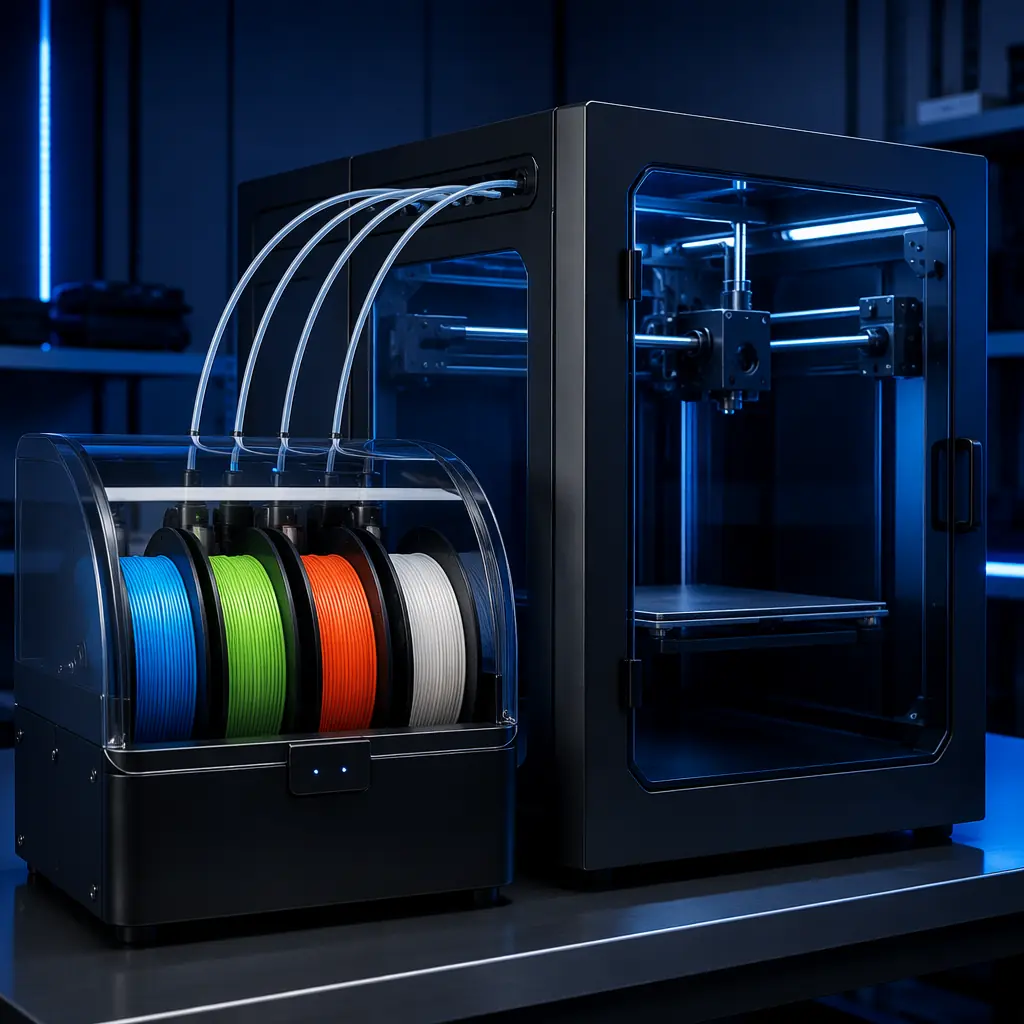
The AMS is a sealed, actively-desiccated filament storage box with four motorized spool rollers. Each roller has a first-stage feeder that pushes filament into a four-into-one hub, which routes into a single PTFE tube to the printer. The AMS communicates with the printer via a dedicated 4-pin cable, not USB, not WiFi, providing power, ground, and a CAN-like serial protocol. Inside the AMS, a humidity sensor monitors the desiccant chamber (target: < 20% RH, indicated by an LED that changes from green to yellow to red). The desiccant is a reusable silica gel pack that can be dried in a microwave — a small but deliberate design choice that reduces consumable waste and increases user interaction with the system.
RFID spool detection:
Bambu Lab's proprietary RFID tags embedded in every official spool are the most strategically significant feature of the AMS from a distributor's perspective. When a spool is loaded, the AMS reads the RFID tag and automatically populates the filament type, color, remaining material estimate (calculated from spool weight at manufacturing), and recommended print temperatures. This is not a gimmick, it eliminates the most common cause of multi-material print failure (wrong filament type configured in the slicer) and creates a powerful lock-in effect. A customer who buys 12 Bambu Lab RFID spools has invested $240–360 in filaments that provide a seamless experience. Switching to a third-party filament means manually configuring filament parameters, losing automatic material tracking, and accepting a slightly degraded experience. The RFID ecosystem is Bambu Lab's moat, and it's why AMS owners buy 80%+ of their filament from Bambu Lab directly. A number that every distributor should understand when planning their own multi-material consumables strategy. For a broader view of how proprietary ecosystems affect distributor portfolio decisions, see our open-source vs proprietary printer guide.
Reliability and failure modes:
The AMS is not immune to issues. The most common failure mode is filament retraction failure. When the AMS attempts to retract filament during a color change, the filament tip may have a bulge or string that catches in the PTFE tube or the hub. The AMS retries three times before alerting the user. This occurs in roughly 1 in 50–100 filament changes depending on filament type (TPU and flexible filaments are essentially incompatible with the AMS and are explicitly marked as such in Bambu Lab's documentation). The second most common issue is first-stage feeder wear: the plastic gears that grip the filament wear down after approximately 500–800 spool changes, at which point they begin slipping. Replacement feeder units are $35 and user-replaceable in 5 minutes. A distributor selling AMS units should stock 1 replacement feeder per 20 AMS units sold and consider this a recurring parts revenue stream equivalent to nozzle replacements. For an overview of spare parts strategies across the entire product line, see our spare parts revenue guide.
Creality CFS: Bringing Multi-Material to the Creality Ecosystem
Creality's Color Filament System (CFS), introduced alongside the K2 Plus flagship printer in late 2024, is the first credible competitor to the AMS from a major manufacturer. It follows the same architectural template, four-spool sealed box with active drying, but makes different engineering tradeoffs that reflect Creality's position as the world's largest 3D printer manufacturer by unit volume.
Key differences from AMS:
The CFS does not use RFID spool detection. Instead, it relies on manual filament configuration in Creality Print (Creality's branded slicer, based on OrcaSlicer/Bambu Studio). This is both a weakness and a strength: a weakness because it removes the seamless "load and print" experience that AMS users expect; a strength because it makes the CFS fully compatible with any brand of filament without the subtle friction that AMS users experience when using third-party spools. For a distributor who sells their own private-label filament, this is strategically significant, the CFS creates no ecosystem lock-in that competes with the distributor's own consumables brand. Our private-label brand guide covers how to build a filament brand that multi-material systems accelerate.
Build quality and reliability data:
The CFS uses a direct-drive feeder mechanism that pushes filament from the spool box to the printer's toolhead, a different approach from the AMS, which uses a two-stage feeder (one in the AMS, one in the printer). The CFS direct-drive approach reduces the number of pinch points where filament can jam, but requires a more powerful motor in the CFS unit itself. Early adopters report that the CFS handles flexible filaments marginally better than the AMS (TPU with shore hardness 95A and above is usable with reduced speed), but the active drying system is less effective, the CFS's heater maintains the chamber at 50–55°C vs the AMS's desiccant-driven approach that achieves lower humidity without active heating. In practice, this means CFS users should pre-dry their filament before loading; AMS users with fresh desiccant can load directly from a vacuum-sealed package.
Which Multi-Material System Should a Distributor Build Their Product Line Around?
The answer depends on the distributor's filament strategy. These three systems represent three different business models, not three different products.
If you want to sell proprietary filament with recurring lock-in:
Stock Bambu Lab printers + AMS. Accept that Bambu Lab's RFID ecosystem will capture a significant share of your customers' filament purchases, but recognize that the overall consumables volume from a Bambu Lab customer is 3–5x higher than from a customer who buys a printer without a multi-material system. The economics work even if you only capture 20–30% of the filament spend, because the total spend is so much larger. Additionally, Bambu Lab's first-party filament availability varies by region; a distributor who maintains local stock of popular Bambu Lab filament SKUs captures sales that would otherwise go to Bambu Lab's online store with 2–3 week shipping times.
If you want to sell your own private-label filament:
Stock Creality K2 Plus + CFS, or open-source printers with MMU-compatible toolheads. The CFS's lack of RFID lock-in means your customers' filament purchasing decisions are driven by price, availability, and quality. Exactly the dimensions where a distributor's private-label brand can compete. A distributor who sells the K2 Plus + CFS bundle and includes a sampler pack of their own filament (4 spools in complementary colors) establishes the habit of buying filament from the distributor from day one. For more on building a consumables sampling and subscription strategy, see our consumables subscription guide.
The Numbers: Multi-Material ROI for Distributors
The following data represents the documented consumables consumption pattern of a single multi-material printer owner over a 12-month period, based on aggregated user reports from Bambu Lab, Prusa, and Creality communities.
The LTV multiple is the number that should drive stocking decisions. A multi-material printer customer is worth 3.7 times more over three years than a single-filament customer. The multi-material system (AMS/CFS/MMU) itself sells for $299–349, roughly 35–45% of the printer's retail price. But the consumables uplift it generates is worth 5–8 times the cost of the multi-material unit. For a distributor deciding between stocking a $799 printer-only SKU and a $1,148 printer + multi-material bundle, the bundle generates roughly triple the lifetime margin. And the competitive moat is deeper because once a customer's filament library is built around a specific multi-material ecosystem, switching costs are high.
The Consumables That Multi-Material Unlocks
Multi-material systems don't just multiply filament sales, they create entirely new consumables categories that don't exist for single-material printers. A distributor who stocks these categories captures revenue that their single-material-only competitors leave on the table.
Support interface materials:
Dedicated breakaway and dissolvable support materials (Bambu Lab Support for PLA, Support for PETG, PVA, BVOH) are the highest-margin filament category in the multi-material ecosystem. A spool of Bambu Lab Support for PLA retails for $34.99 for 500g. $70/kg, roughly 3.5x the per-kg price of standard PLA. The engineering value proposition is real: a print that uses support interface material has a perfectly clean underside with no scarring, no sanding required. For functional parts that need dimensional accuracy on supported surfaces, it's the difference between a usable part and a post-processing project. Distributors should stock support interface materials at a 1:4 ratio to standard filament, for every four spools of PLA sold to a multi-material customer, expect to sell one spool of support material.
Color-matched bundles:
The single most effective consumables upsell for multi-material printers is a pre-curated 4-pack of filament spools in complementary colors. A "Mechanical Parts Bundle" (matte black, dark gray, white for labels, and translucent PETG for light pipes) sells as a single SKU at $79.95, $10 more than buying individually, but the curation saves the customer 60 minutes of decision-making and ensures all four spools arrive with matched drying states and diameters. Distributors who create 3–5 curated color bundles and promote them on the same product page as the multi-material printer capture 40–60% of initial filament attach rate (vs 15–25% for individual spool listings).
Reviewed by the Precise3D engineering & OEM team. Compliance files that accompany the catalog are auditable at the certification register.
Build Your Multi-Material Product Line
Source Multi-Material 3D Printers & Consumable Ecosystems
Precise3D provides complete multi-material printer + consumables bundles, AMS/CFS-ready printers, curated filament 4-packs, and support material inventory programs. Factory-direct pricing with verified multi-material reliability testing.