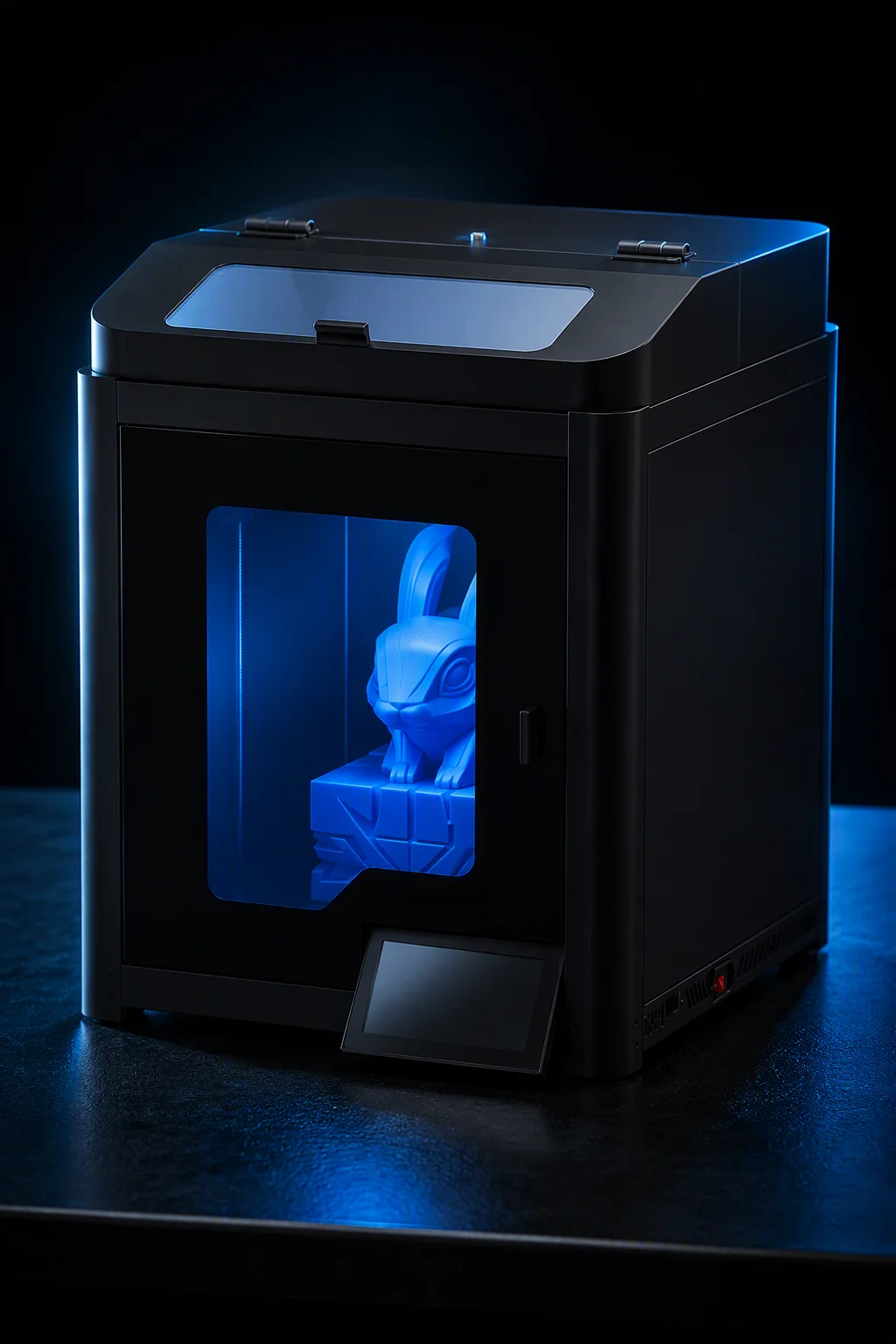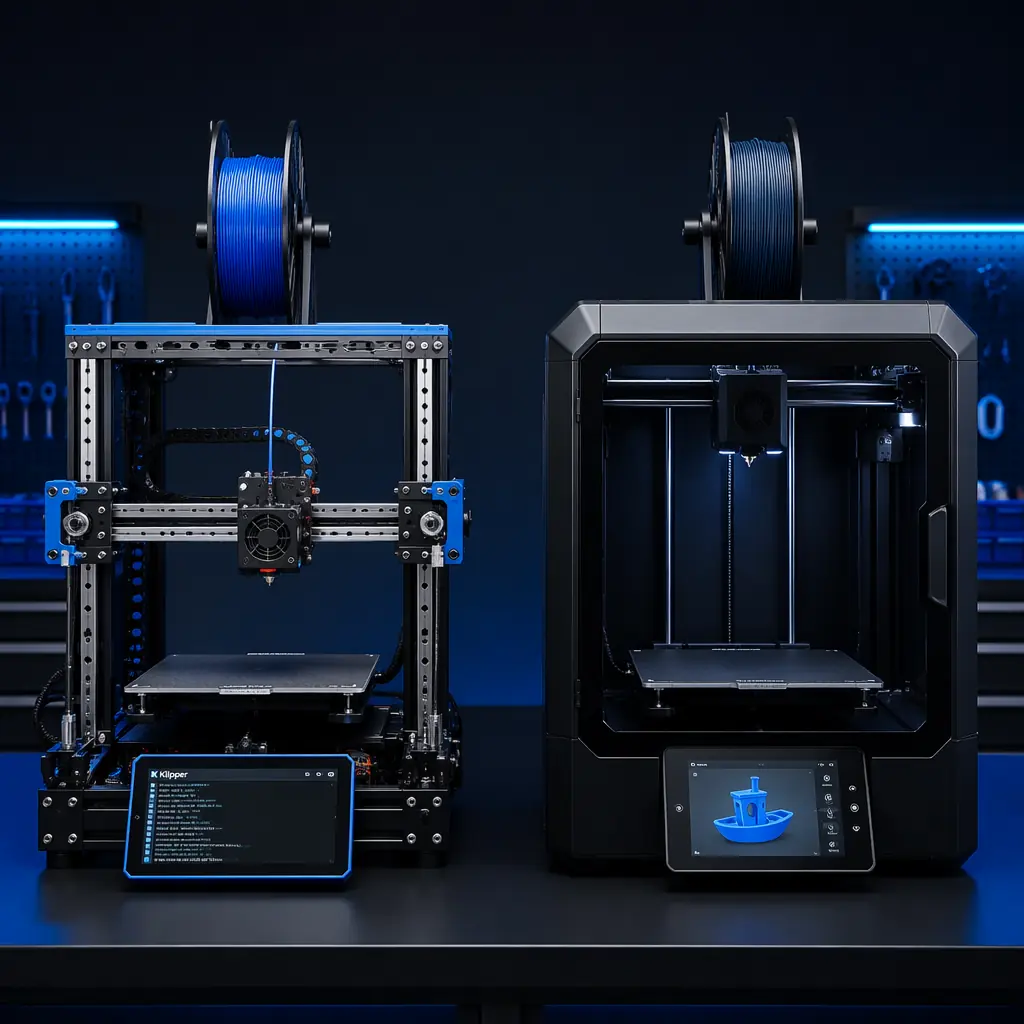
The open-source vs proprietary debate in 3D printing has shifted. Five years ago, rep-rap derivatives and open-source Marlin firmware dominated the sub-$500 market while proprietary systems (MakerBot, Ultimaker, Stratasys) occupied the $2,000+ enterprise segment. In 2026, the boundary has blurred: Bambu Lab ships proprietary firmware on printers starting at $299, Klipper-powered open platforms compete at $800–$1,500, and distributors face a genuine portfolio allocation decision at every price tier.
This guide treats the question as a business decision, not a philosophical one. Open-source vs proprietary is not about which is "better" — it is about which platform structure produces the right margin profile, support burden, consumables attachment rate, and customer lifetime value for your market and your operational capabilities.
The Four Dimensions That Matter for Distributors
Distributors should evaluate open-source vs proprietary platforms across four dimensions — not two. The industry default is to compare "freedom vs convenience" or "price vs quality," but those framings miss the dimensions that actually determine distributor profitability.
The four dimensions rarely align in one direction. A proprietary platform with high margin and high consumables attachment also comes with higher pre-sale skepticism — customers resist "walled gardens" even when the garden produces better prints. An open-source platform with low barrier to entry also creates margin compression as competitors list the same printer at lower prices. The portfolio decision is about which tradeoffs your market tolerates and which ones your operation can absorb. For a complete product portfolio planning framework, see our portfolio strategy guide.
Platform Profiles at Each Price Tier
Entry Level ($199–$399)
The sub-$400 segment is dominated by open-source platforms (Marlin firmware, generic components, community slicer profiles) and a rising wave of affordable proprietary systems. The distributor calculus at this tier:
Open-source entry printers ($199–$299) carry 12–18% gross margin after freight. The support burden is significant — entry-level customers generate 3–5× more support tickets than prosumer customers, and the tickets are harder to resolve because the customer is often a first-time user who cannot distinguish a leveling issue from a slicing issue from a hardware defect. However, these printers are the top of your funnel. A customer who buys a $249 open-source printer and has a positive experience returns 12–18 months later for a $699 enclosed printer. If you do not sell them the $249 printer, someone else does — and that someone else gets the $699 upgrade sale.
Proprietary entry printers ($299–$399) deliver 22–28% margin but the volume commitments are steep: minimum order quantities of 100–200 units, MAP (minimum advertised price) enforcement that prevents discounting to move slow inventory, and firmware locks that prevent customers from using generic consumables. The support burden is lower because the firmware handles calibration automatically and the manufacturer's cloud service provides remote diagnostics. But the platform risk is real: if the manufacturer discontinues cloud support or raises filament prices, your customers are trapped — and they blame you, not the manufacturer.
Prosumer ($500–$999)
The $500–$999 segment is where the open-source vs proprietary decision becomes genuinely strategic. This is the volume-and-margin sweet spot for most distributors, and the platform choice determines your entire support infrastructure and consumables revenue model.
Open-source prosumer printers (typically Klipper-based, CoreXY kinematics, $599–$899) deliver 18–25% margin. The support burden moderates at this tier because prosumer customers are technically literate — they understand G-code, they can level a bed, they read release notes before updating firmware. The consumables attachment remains low (they buy generic filament and third-party nozzles), but the upgrade path is lucrative: a prosumer open-source customer often buys a second printer, upgrades to linear rails, installs an enclosure kit, and adds a dedicated Klipper host — each of which is a separate sale with 40–60% margin on accessories. For the motion system options, our linear rails vs v-wheels guide covers the upgrade economics.
Proprietary prosumer printers ($699–$999, enclosed, multi-color capable) command 25–35% margin and generate $120–$250/year in branded consumables revenue per active printer. The support burden is the lowest in the industry: automatic calibration, cloud-based failure detection, manufacturer-hosted slicer profiles. The tradeoff is portfolio concentration risk — if 60% of your revenue comes from one proprietary platform and that platform has a supply chain disruption, quality issue, or pricing change, your business absorbs the full impact with no diversification. Most successful distributors in this segment carry one proprietary platform as their flagship and one open-source platform as their diversification hedge. For firmware strategy specifically, see our Klipper firmware guide.
Industrial/Enterprise ($2,000+)
Above $2,000, the open-source vs proprietary distinction largely disappears. Enterprise buyers do not care about firmware philosophy — they care about service-level agreements, material certification, and dimensional accuracy specifications. The platform question becomes a procurement question: can the manufacturer provide ISO 9001 documentation, CE/UL/FCC certifications, and a spare parts SLA? If an open-source platform manufacturer can meet those requirements, the enterprise buyer does not distinguish it from a proprietary platform. If a proprietary platform manufacturer cannot provide those documents, the platform advantage evaporates. For certification requirements across markets, see our certification and compliance guide.
The Distributor's Portfolio Allocation Framework
Based on Precise3D's distributor data across 18 countries, the optimal portfolio allocation depends on your primary customer segment. The table below shows the allocation that maximizes total gross profit across printer sales, consumables, and accessories for each distributor type.
The 50/50 balanced allocation is not a compromise — it is a deliberate risk management strategy. When one platform type encounters a headwind (proprietary cloud outage, open-source component shortage, tariff changes affecting one supply chain), the other half of the portfolio continues generating revenue. Distributors with 90%+ concentration in one platform type experience revenue swings of 30–50% during platform-specific disruptions. Balanced-portfolio distributors experience 10–15% swings during the same events. For the complete risk management framework, our warranty and reverse logistics guide covers the operational side of platform risk.
The 2026 Trend: Proprietary Features on Open Hardware
The most significant platform trend in 2026 is the convergence layer: manufacturers shipping open-source Klipper firmware with proprietary front-end interfaces, cloud services, and slicer integrations. This hybrid model attempts to capture the advantages of both approaches — the community development velocity of open-source firmware running on standardized hardware, combined with the user experience polish and recurring revenue of a proprietary cloud layer.
For distributors, the hybrid model creates an interesting positioning opportunity. You can sell the printer as "open platform, no lock-in" while offering the manufacturer's cloud service as an optional subscription — converting the lock-in objection into an upsell. The customer who declines the subscription still buys the printer. The customer who accepts the subscription generates recurring revenue with no additional hardware cost. This model works best in the $500–$900 prosumer segment where customers are technically capable of running their own Klipper instance but willing to pay $5–$9/month for automatic cloud backups, remote monitoring, and one-click slicer profiles.
The hybrid model also changes the support economics. A customer on the manufacturer's cloud service generates fewer support tickets because firmware updates, slicer profiles, and print monitoring are handled server-side. A customer running their own Klipper instance on a Raspberry Pi generates more tickets but buys more accessories (Pi kits, touchscreens, cameras, accelerometers for input shaping). Both paths are profitable — the key is that the distributor captures revenue either way, unlike a pure proprietary model where the customer who rejects the ecosystem rejects the printer entirely.
Decision Framework: When to Choose Which Platform
If you are building a 3D printer distribution portfolio from scratch or rebalancing an existing one, the following decision tree based on Precise3D's distributor performance data can accelerate the platform selection process:
Choose open-source as your lead platform if:
your primary customer acquisition channel is price-comparison marketplaces (Amazon, AliExpress), your team has strong technical support capability (you employ at least one person who can compile Marlin firmware), and you plan to differentiate through accessories, upgrades, and community engagement rather than through the printer itself.
Choose proprietary as your lead platform if:
your primary channel is B2B direct sales to schools and enterprises, you compete on ease-of-use and total cost of ownership rather than on unit price, and you have the working capital to meet minimum order quantities (typically 100+ units for MAP-protected pricing) without straining cash flow.
Choose a hybrid approach if:
you serve multiple customer segments, you have the operational bandwidth to manage two supply chains and two support knowledge bases, and you want to hedge against the risk of any single manufacturer changing terms, raising prices, or discontinuing a product line. Most Precise3D distributors above $500K annual revenue operate a hybrid portfolio. For the full distributor startup framework, see our distributor startup guide.
Reviewed by the Precise3D engineering & OEM team. Compliance files that accompany the catalog are auditable at the certification register.
Partner With Precise3D
Build a Portfolio That Works for Your Market
Precise3D offers both open-platform Klipper printers and proprietary-enclosed systems — so you can build the exact portfolio mix your market demands without managing multiple manufacturer relationships. Our distributor team will help you model the margin, support, and consumables economics before you place your first order.