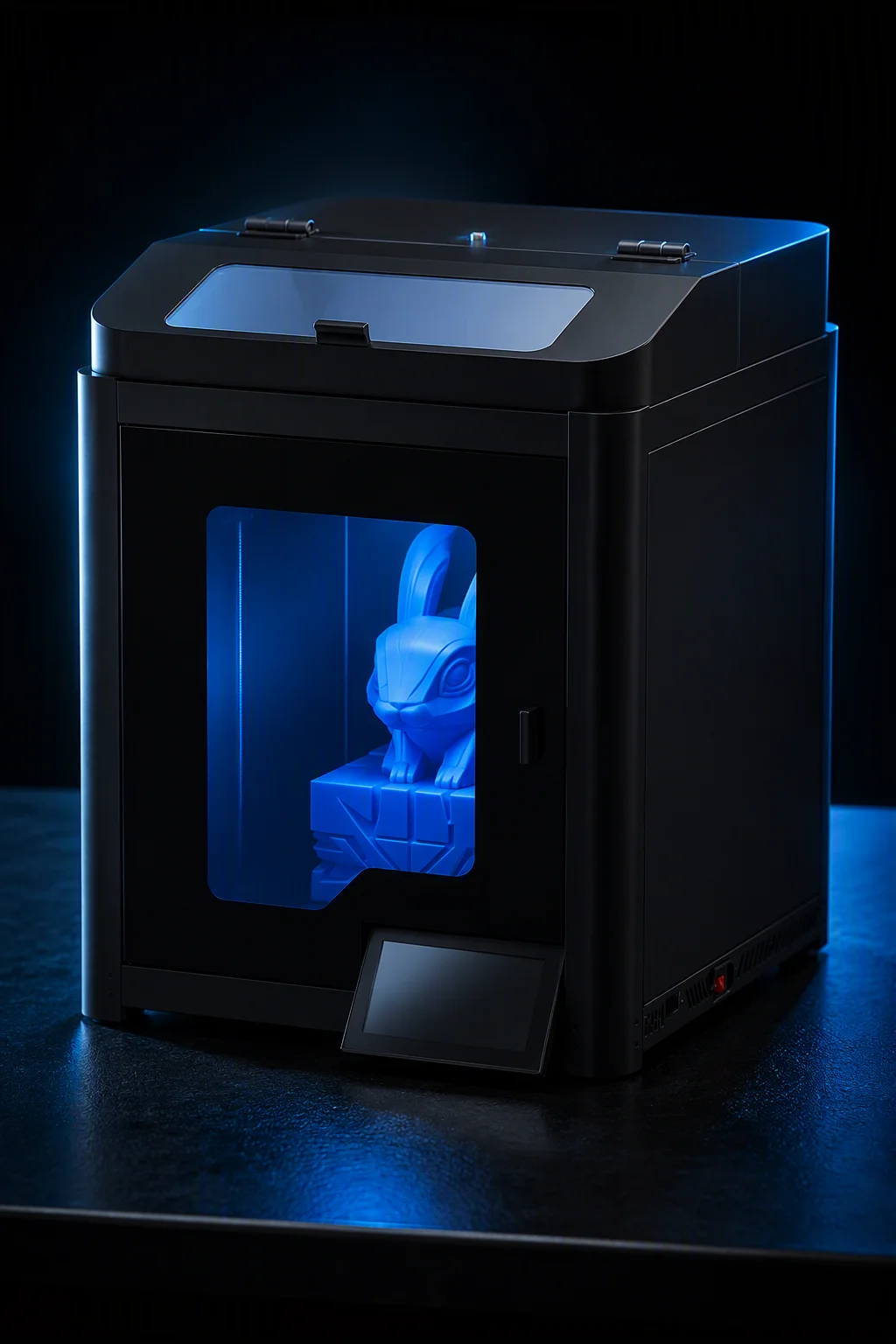
Why Resin Post-Processing Is a Workflow Problem
Resin printing sells itself on detail and then hands the customer an awkward set of manual steps: drain, detach from the plate, wash, dry, cure, remove supports, inspect. Each step is short, and together they decide the throughput of a resin line far more than the printer does. A fourteen-hour print that requires forty minutes of careful handling per plate produces less than a printer that prints in ten hours and flows through a defined wash-and-cure sequence.
For a distributor, this is the most commonly under-specified part of a resin proposal. The printer, resin and post-processing equipment are sold as three separate decisions, when the customer's actual cost per part depends on how the three work together. This guide covers the workflow design: tank and solvent choice, wash and cure durations by resin type and geometry, solvent life and disposal, and the labour and floor plan that make the sequence flow.
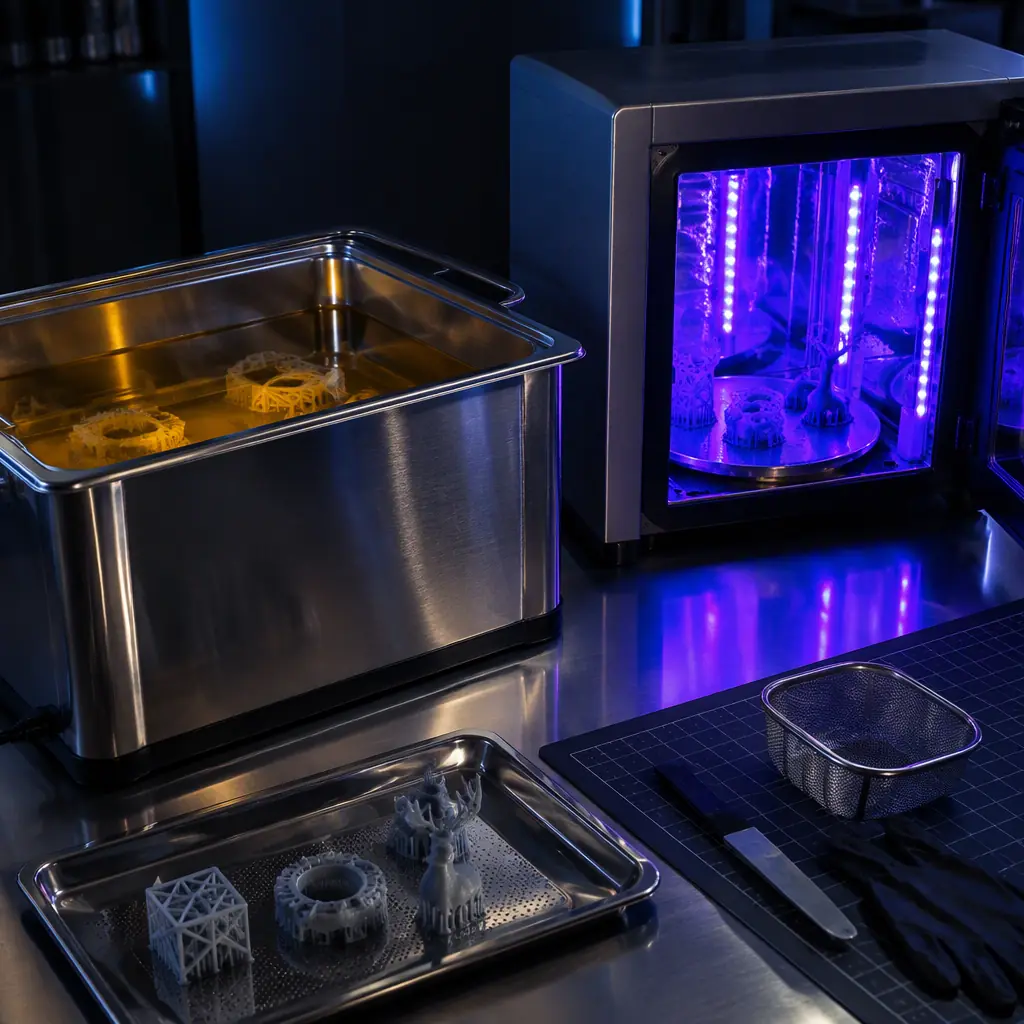
The Sequence and Where It Breaks
A complete resin workflow runs drain, detach, first wash, second wash where used, air dry, cure, support removal, inspection. Two points in that sequence cause most of the problems distributors are called in to solve.
The first is the gap between detaching and washing. Resin left on a part drains slowly and cures in ambient light, and a part left on the bench for twenty minutes before washing takes longer to clean and can show surface defects. Parts should go from plate to tank without a queue in between.
The second is the gap between washing and curing. A part that is still wet with solvent cures unevenly, and a part cured with resin residue on the surface has a sticky or cloudy finish that cannot be corrected afterwards. Both gaps are layout problems, not equipment problems, and both are solved by placing the wash station and the cure chamber within arm's reach of the printer.
The total hands-on time per plate is typically 5 to 15 minutes. The total elapsed time is 30 to 90 minutes, and that ratio is what makes the workflow designable: one operator can run several plates in parallel provided the stations are arranged so that no step waits for a station.
Wash Chemistry and Tank Design
Two chemistries dominate: isopropyl alcohol at 90 percent or above, and water-washable resin washed in water with a small amount of detergent or in a dedicated wash solution. The choice has consequences that reach beyond the tank.
- IPA. Fast, effective, aggressive on some printed parts if soaked too long, flammable, and it evaporates. Wash tanks must be covered and the room ventilated. IPA waste is hazardous and cannot go down a drain.
- Water-washable resin. No solvent cost or disposal for the wash step, but the resin itself is typically more expensive per litre and more brittle in thin sections, and the wastewater still contains uncured resin and must be cured and filtered before disposal in most jurisdictions.
- Dedicated wash solvents. Blends marketed for resin cleaning, effective and less flammable than IPA, more expensive, and often not recoverable. Check local disposal classification before offering them.
Tank design matters more than most buyers expect. A magnetic stirrer agitation tank uses far less solvent than a full immersion bath, and two small tanks in series (dirty then clean) use less solvent and clean better than one large tank. A tank that holds ten litres and is changed monthly consumes more than two tanks of four litres changed weekly, and the second arrangement produces cleaner parts.
Wash and Cure Durations by Resin and Geometry
Durations published by resin manufacturers are a starting point and are almost always measured on a standard test coupon. Real parts need adjustment for section thickness and for how much uncured resin is trapped in internal geometry.
Over-curing is a real failure mode and it is invisible in the first part. Excess UV exposure makes many resins more brittle, yellows clear materials, and moves dimensions in thin features. Over-cured parts fail later, in the customer's hands, which is why cured dimensions should be verified on a first article rather than assumed. Post-cure shrinkage and its effect on tolerance is covered in our dimensional accuracy guide.
Solvent Consumption and Disposal as a Cost Line
Solvent is the resin workflow's filament: a recurring consumable that is easy to ignore until it appears as a monthly invoice. The realistic figures:
- IPA at four to ten litres per month for a small dental or jewellery lab running one printer, and thirty to sixty litres per month for a service bureau running six.
- Disposal cost per litre of contaminated IPA, which in many EU jurisdictions is higher than the purchase price of the solvent.
- Water-washable route: resin cost premium of 30 to 60 percent per litre against standard resin, offset by eliminating solvent purchase and disposal.
The arithmetic usually favours IPA for low volume and water-washable for high volume, with a crossover that depends on local solvent prices more than on anything technical. For a distributor, presenting both routes with the customer's own volumes is a better conversation than arguing the merits in the abstract, and the margin analysis is set out in our water-washable versus standard resin guide.
Labour and Throughput for a Resin Line
A resin line's capacity is set by the slowest station, and in most small operations that station is the operator rather than the equipment. The design target is to keep hands-on time per plate below the print time per plate, so that a single operator can tend several printers without a queue forming.
Above ten printers the manual sequence stops paying, and the investment shifts to automated plate handling and larger cure chambers with rotating turntables. Before that point, the largest gains come from small layout decisions: two wash tanks beside the printer, a cure chamber at elbow height rather than on a shelf, and a drain tray under every plate position.
The upstream production side of the same problem, print-to-print consistency and build-plate throughput, is covered in our print farm operations guide, and the machine-level comparison between resin technologies by resolution and cost in our SLA, DLP and MSLA comparison. Where a resin line feeds an assembly step, the fixture side is covered in our threaded insert and assembly fixture guide.
Quality Control in a Resin Workflow
Resin parts fail differently from FDM parts: the failures that matter are usually surface (incomplete cleaning, uncured residue) and dimensional (over-cure shrinkage, support witness marks), and neither shows up unless they are checked deliberately.
- Cleanliness. Wipe a cured surface with clean IPA on a white lint-free cloth. Any visible residue means the wash step is failing, typically from exhausted solvent.
- Cure verification. First article checked for hardness and, where specified, tackiness. Clear resins checked for yellowing against a retained reference.
- Dimensional first article. After any change of resin lot, wash time or cure time, measure the critical features before the batch continues.
- Support witness marks. Recorded on a limit sample so the acceptance standard survives a change of operator, as covered in our limit sample guide.
Retaining cured first articles by resin lot is the cheapest way to close the loop, because a customer complaint six weeks later can be checked against a physical reference rather than reconstructed from memory.
Precise3D in a Resin Workflow
Our resin and filament platforms are specified to work as line equipment rather than as single units: documented plate dimensions and drain paths so wash and cure equipment can be sized to the build plate, per-material cure profiles supplied with the resin rather than left to trial, and dimensional data for cured parts so tolerance chains can be built downstream. Machines ship with CE LVD (EN 62368-1:2014+A11:2017) and RoHS (EU 2015/863) documentation from a 3,500 sqm Shenzhen production network applying a documented control plan at incoming and outgoing QC.
For distributors, the practical benefit is that the post-processing recommendation in a quotation can be tied to documented plate and cure data, which shortens the customer's validation cycle and reduces returns caused by workflow rather than by hardware. Equipment lists, cure profile sheets and MOQ terms are available on request with MOQ from 100 units.
Reviewed by the Precise3D engineering team. Durations, consumption figures and throughput numbers are industry-typical ranges for orientation and are not a validated protocol for any particular resin, medical device or regulated application. Regulated workflows require validation on the customer's own equipment.

Sizing a Resin Line?
Ask for Plate Dimensions and Cure Profiles per Material
Tell us your resin types and target plates per day. We will send documented build-plate and drain dimensions so wash and cure equipment can be sized properly, plus cure profiles per material and the dimensional data needed for a tolerance chain.