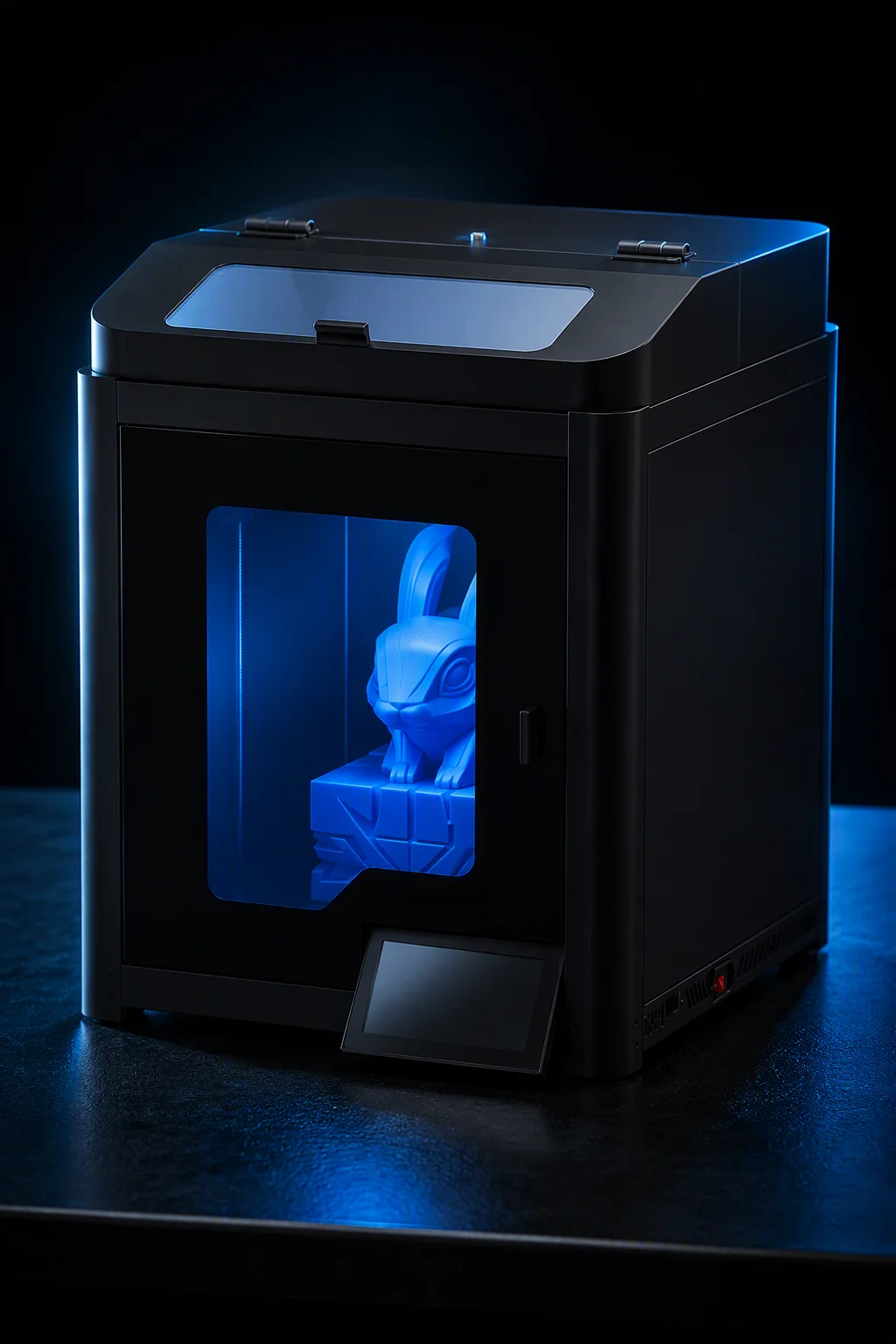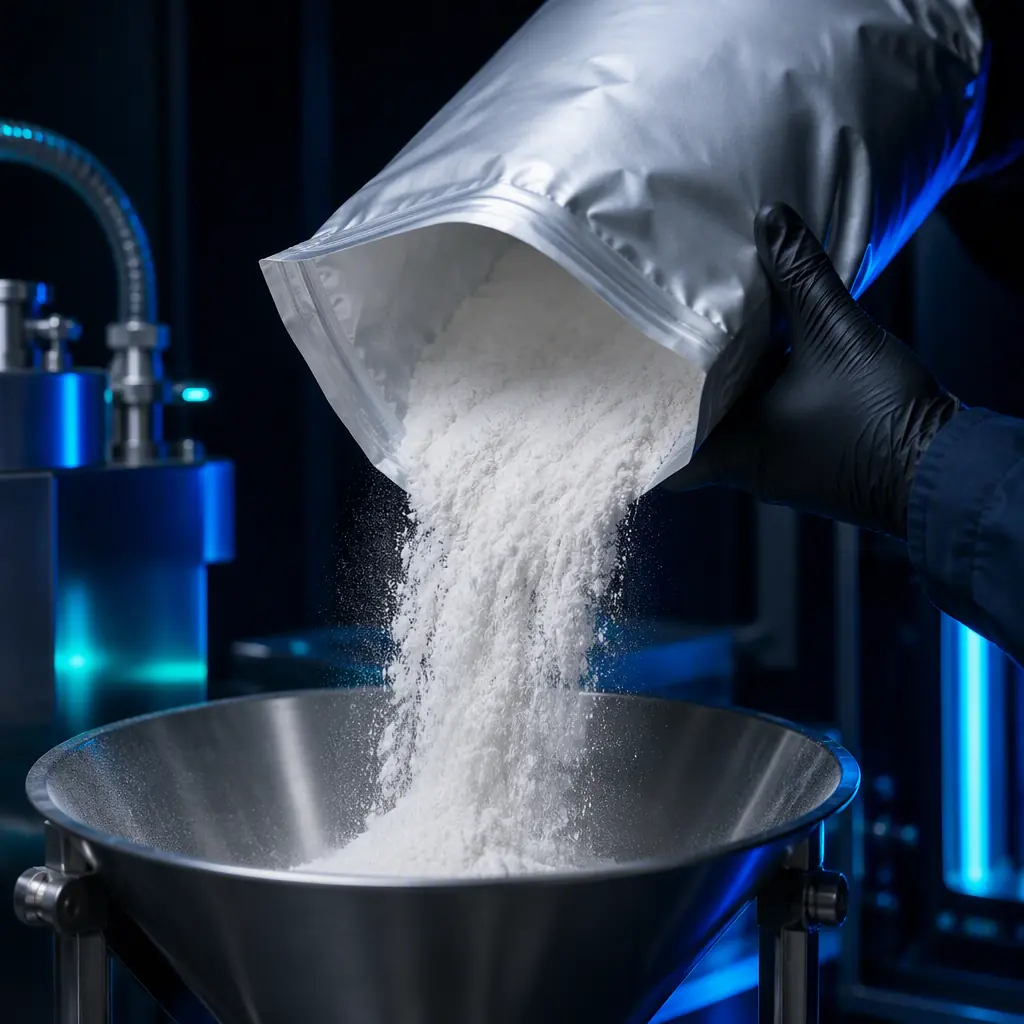
SLS (selective laser sintering) fuses nylon powder layer by layer with a laser, and the powder is both the raw material and the support structure, unsintered powder holds the part during printing. That dual role is why powder sourcing decisions have outsized consequences: a bad powder batch does not just make parts ugly, it collapses whole builds. This guide covers the sourcing side of SLS, grades, particle specs, refresh ratios, supplier qualification, pricing and margin strategy, as the procurement companion to our SLS technology guide, which covers the machines, the process and the applications.
Why Powder Is the Profit Center of SLS
Run the numbers on an SLS install and the consumable math is stark. A typical SLS build consumes 3-8 kg of powder per job when you count the full powder bed, of which only 10-20% becomes parts; the rest is recovered and reused. At $60-140 per kilogram depending on grade and source, powder is 30-50% of the customer's total operating cost, larger than the electricity, the maintenance, and the machine's own depreciation combined. For the distributor, this converts a one-time machine margin of $3,000-8,000 into a recurring powder margin of $15,000-40,000 per year per active machine at typical utilization. The recurring-revenue playbook for consumables is developed in our consumables & bundling strategy guide, and the full economics of an SLS service operation are in our TCO & ROI calculator guide.
Three structural facts drive the sourcing decision. First, powder is not a commodity: two bags labeled "PA12" can differ in particle size distribution, melt flow and laser absorption, and print completely differently. Second, brand lock-in is the default: every SLS machine OEM recommends its own branded powder, often at 2-3x the price of equivalent third-party powder. The margin play is finding compatible powder that holds quality. Third, the market is consolidating around a handful of real manufacturers (BASF, Arkema, Evonik, EOS, HP, Farsoon, Eplus3D and a tier of Chinese producers), and most "brands" resell one of those base resins. Which means the distributor who understands the supply chain can buy the same polymer at 40-60% less.
The Powder Grades That Matter: PA12, PA11, PA-CF
Three nylon families dominate SLS, and each has a distinct sourcing profile:
The sourcing rule: start with PA12 as the volume line, add PA-CF as the margin line, and treat PA11 as a specialty. PA12 is where the price competition is fiercest and where a distributor can lock in a 40-60% margin; PA-CF is where customers happily pay a premium because the parts replace machined aluminum jigs; PA11 is a differentiator for customers with impact or fatigue requirements, the application reasoning is in our SLS technology guide and the nylon filament cousin of this material family is covered in our nylon filament guide.
Particle Size & Flowability: The Specs That Predict Print Quality
Powder quality is defined by measurable specs, and a distributor should demand the data sheet, not trust the label. The critical numbers:
- Particle size distribution (D50): the median particle diameter. SLS PA12 typically runs 45-60 µm D50; a batch at 70 µm prints with visibly coarser surfaces and weaker detail, while a batch at 30 µm flows poorly and can sinter too aggressively. Ask for the D10/D50/D90 spread, a tight spread prints more consistently.
- Bulk density: typically 0.42-0.50 g/cm³ for PA12. A batch that is 10% below spec means the powder bed compacts differently and parts shift density.
- Melt flow rate (MFR): measured in g/10 min at the polymer's melt temperature. It predicts how the powder fuses; a high-MFR batch over-sinters and a low-MFR batch under-fuses.
- Moisture content: nylon absorbs water aggressively; a data sheet value above 0.1% is a red flag, and any powder that has been exposed to humid air needs drying before use. The drying discipline for the filament side is covered in our filament drying & storage guide and applies to powder with even more force.
The verification step that separates serious distributors from box movers: run a test coupon on every new powder batch before committing a full build. A 30-minute single-layer test on a known geometry tells you more than any data sheet. If the test part's surface, density and dimensions match the reference batch, the powder is good. The quality-control framework for incoming consumables is in our incoming QC & inspection guide.
New vs Recycled Powder: The Refresh Ratio Math
SLS economics depend on powder reuse. Unsintered powder is recovered after each build and mixed with fresh powder for the next one. The refresh ratio (fresh powder added to the hopper mix) is the single biggest cost lever in the process, and it is also the biggest quality risk. The working range:
- Standard refresh: 30-50% fresh powder per build. Most SLS machines and materials are qualified at 50/50 new/recycled; some materials (PA11, PA-CF) require higher fresh content, 60-70%, to hold properties.
- Recycled powder degrades. Each thermal cycle raises the molecular weight slightly and yellows the powder; after 3-5 cycles the "overflow" powder becomes unusable for structural parts and should be downgraded to non-critical runs or disposed.
- Never sell recycled blends as virgin. A distributor that repackages recycled powder as new creates a quality liability that will surface as field failures, the exact failure pattern documented in our return fraud & quality liability guide.
The margin implication is direct: a customer running 30% fresh refresh instead of 50% cuts powder spend by 40%, and a distributor who educates the customer on refresh management, and supplies the right fresh/overflow mix, wins loyalty and volume. The operational side of running an SLS print farm is covered in our print farm operations guide.
Supplier Evaluation: What to Verify Before the First Order
The qualification checklist for a powder supplier, run it in this order, and walk away if the basics fail:
The qualification protocol is deliberately strict because the failure cost is asymmetric: one bad powder batch can ruin a week of builds and an entire customer relationship. The factory-audit version of this checklist, for distributors buying directly from Chinese manufacturers, is in our factory audit & QC checklist guide, and the material-testing rigor is shared with our filament quality evaluation guide.
Pricing Reality & MOQ Benchmarks
What the current market actually looks like for a distributor buying in volume:
Two sourcing strategies make sense depending on your volume. Low volume (under 50 kg/month): buy a major brand through distribution and pass through at 40-50% margin. You pay more per kilo but zero qualification risk, and the brand does your marketing. High volume (50+ kg/month): qualify a Chinese manufacturer with the checklist above, buy at $45-75/kg, and either resell under your own label (the private-label playbook is in our private label & OEM sourcing guide) or pass the margin to customers to lock the account. The import mechanics, HS codes, tariffs and customs classification for polymer powders, are covered in our import & customs guide, and the shipping reality for powder freight is in our China logistics guide.
The Distributor Powder Playbook: Build the Recurring Margin
Five moves turn powder sourcing into a durable revenue line:
1. Sell the system, not the powder. Price powder as part of a print-cost-per-part package with the machine, so the customer optimizes total cost instead of shopping your price against a competitor's bag, the package structure is in our consumables bundling guide.
2. Lock the refresh math in the service agreement. Include the fresh-powder refresh schedule in the machine's annual service contract, tying powder sales to the maintenance relationship, the contract playbook is in our annual service contracts guide.
3. Stock the full grade ladder. PA12 for volume, PA-CF for margin, PA11 for specialty accounts. And keep a test-batch policy so every new lot is qualified before it reaches a customer's hopper. The inventory planning method is in our inventory & SKU planning guide.
4. Use powder as the account wedge. A distributor who saves a customer 30-40% on powder cost without quality loss owns the renewal conversation when the next machine order comes, the account strategy is in our dealership growth roadmap.
5. Never compromise the virgin claim. The recycled-blend shortcut destroys accounts and creates liability. The quality-assurance framework that protects your brand is in our incoming QC guide.
The bottom line: SLS powder is where the machine sale becomes a business. The distributor who sources powder with the same rigor as the machine, data sheets, test batches, refresh math and honest grading, builds a recurring revenue engine that compounds for the life of every installed machine.
Reviewed by the Precise3D engineering & OEM team. Compliance files that accompany the catalog are auditable at the certification register.
Partner With Precise3D
Ready to Build an SLS Powder Revenue Line?
Get wholesale pricing on SLS machines and compatible powder supply, PA12, PA11 and PA-CF grades with full data sheets, test-batch support, and the procurement playbook that protects your margin.