A distributor selling PLA filament earns approximately $8–12 gross margin per kilogram after landed cost, warehousing, and fulfillment. A distributor selling nylon filament earns $25–40 gross margin per kilogram on the same operational footprint. Because the customers who need nylon are not hobbyists comparison-shopping on Amazon. They are engineering firms, manufacturing departments, automotive suppliers, and industrial prototyping labs that place recurring orders and value material consistency over price. The catch: nylon absorbs moisture from ambient air at 10x the rate of PLA. A spool left unsealed in a humid warehouse for 48 hours will print with surface finish defects that make it unsellable to the very customers who pay premium prices. This means the nylon filament business is fundamentally a dry-storage-and-education business with a filament product attached. Get the storage and education right, and you own a recurring revenue stream with 40–55% gross margins. Get either wrong, and you own a shelf of ruined inventory and angry customers. For the broader consumables bundling strategy, see our consumables bundling guide.
Why Nylon? The Customer Profile That Justifies Premium Pricing
Nylon filament customers are fundamentally different from PLA customers. A PLA customer is typically a hobbyist or educator who buys 1–2 spools at a time, compares prices across three websites, and may switch brands to save $3. A nylon customer is an engineer or procurement manager who specifies a material grade in a production process, buys 10–50 spools per order, and will not switch suppliers as long as the material performs consistently, because the cost of validating a new material exceeds any per-spool savings. Understanding which customers need nylon, and why, is the first step to building a profitable nylon consumables business.
The crucial insight in this table: the customers with the highest price sensitivity (prosumers) also have the lowest recurring revenue. The customers with the lowest price sensitivity (automotive, aerospace, medical) have the highest recurring revenue. This means nylon filament pricing strategy should be anchored to industrial budgets, not consumer comparison shopping. A distributor selling PA12-CF at $85/kg to an automotive supplier is not competing with the $65/kg PA12-CF on Amazon. The automotive supplier is not buying from Amazon because they need batch traceability, consistent lot numbers, and a supplier who answers the phone when a print fails. For guidance on stocking the full range of engineering materials, see our engineering filaments guide.
PA6 vs PA12 vs PA-CF: The Material Selection Matrix
Not all nylon is the same. The three main grades of nylon filament, PA6, PA12, and carbon-fiber-filled variants, serve different applications, print at different temperatures, and carry different margin structures. A distributor who stocks all three and knows when to recommend each will capture the full spectrum of nylon customers, from the budget-conscious prototyping shop to the aerospace supplier with unlimited budget and zero tolerance for material variation.
PA12's lower moisture absorption (1.0–1.5% vs PA6's 2.5–3.0%) is the deciding factor for many industrial buyers. A PA6 part left in a humid environment will absorb enough moisture in 72 hours to measurably change its dimensions and mechanical properties. A PA12 part in the same environment is far more stable. This makes PA12 the default recommendation for functional end-use parts that will operate in uncontrolled environments, automotive under-hood components, outdoor drone airframes, marine fittings. PA6 is the better choice for jigs, fixtures, and tooling used in climate-controlled factory environments, where its higher strength and lower cost provide a better value proposition. PA-CF variants bridge the gap to metal: a PA6-CF part with 20% carbon fiber fill has a flexural modulus of 6–8 GPa, approaching the stiffness of die-cast aluminum at a fraction of the weight and without the tooling cost. For the storage infrastructure required to keep these materials print-ready, see our filament drying and storage guide.
The Dry Storage Problem: Why Nylon Demands Infrastructure Investment
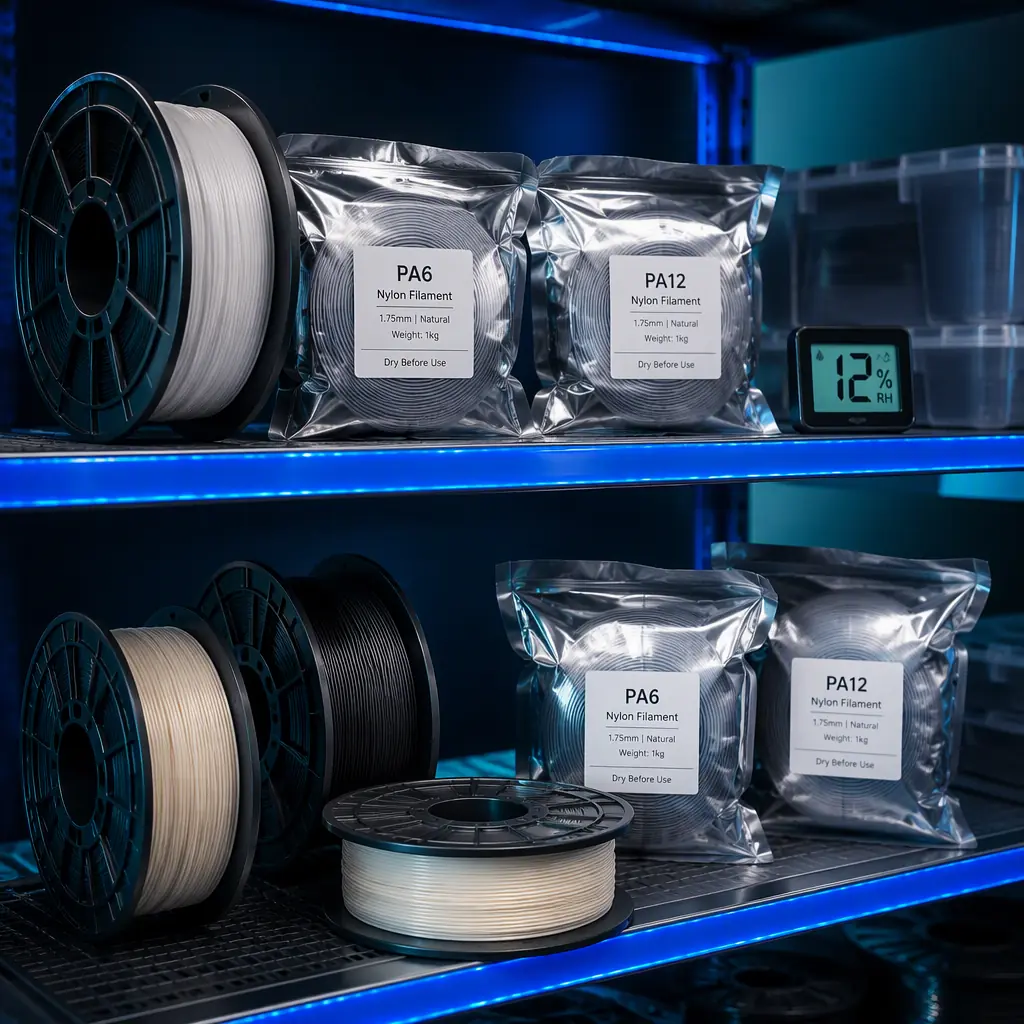
Nylon is hygroscopic. It absorbs moisture from ambient air at a rate that makes PLA look hydrophobic by comparison. A 1 kg spool of PA6 removed from its vacuum-sealed bag and left in a warehouse at 50% relative humidity will absorb enough moisture to reach print-ruining levels (above 0.2% water content by weight) in approximately 8–12 hours. At 70% RH, common in coastal and tropical distribution centers, that window shrinks to 4–6 hours. The symptom a customer experiences is not subtle: the filament pops and hisses during extrusion as water flashes to steam in the hotend, producing a surface finish that looks like sandpaper, with mechanical properties reduced by 30–50% compared to dry-printed material. A customer who pays $65/kg for PA12 and gets this result will return the spool and never buy from you again.
What you're looking for: If the answer is "I don't know" or the RH is above 20%, you are degrading your nylon inventory every hour it sits unsealed. The fix is not a dehumidifier for the room. It is sealed storage containers with rechargeable desiccant (silica gel or molecular sieve) that maintain <15% RH inside the container regardless of ambient conditions. A $40 airtight storage bin with 500g of color-indicating silica gel holds 8–10 spools and pays for itself the first time it prevents a single spool of PA-CF from being ruined.
The drying solution that works for industrial nylon users is a dedicated filament dryer capable of maintaining 70–80°C for 6–12 hours. Consumer-grade dryers that max out at 50–55°C are insufficient. Nylon requires sustained heat above the boiling point of water to drive moisture out of the polymer matrix. A proper dryer for nylon costs $60–120 at wholesale and represents a high-margin upsell that turns a $65 filament purchase into a $150+ transaction. The bundle math: filament dryer ($45 landed cost, $89 retail) + hardened steel nozzle 3-pack ($8 landed, $25 retail) + 1 kg PA-CF ($48 landed, $85 retail) = $101 landed cost, $199 retail, $98 gross margin on a single transaction. Compare to selling 1 kg of PLA: $12 landed, $22 retail, $10 gross margin. The nylon customer generates 10x the transaction margin. For the nozzle requirements in detail, see our nozzle and hotend technology guide.
Nozzle Wear: The Hidden Cost That Kills Customer Satisfaction
Carbon-fiber-filled nylon filaments are abrasive. A standard brass 0.4 mm nozzle printing PA6-CF will wear from 0.4 mm to approximately 0.6 mm in 500–800 grams of filament throughput. The customer does not notice the wear happening. They notice that their prints suddenly have over-extrusion, dimensional inaccuracy, and surface defects that were not present 48 hours ago. They conclude the filament is inconsistent, return the spool, and leave a negative review. The actual problem is that they used a brass nozzle with abrasive filament. The solution is a hardened steel or ruby-tipped nozzle, which costs $8–15 and lasts for the entire lifetime of the printer when used with abrasive materials. Every nylon filament sale to a customer who is new to the material must include a nozzle recommendation. The simplest approach: include a hardened steel 0.4 mm nozzle in the box with every spool of PA-CF, printed with a card that says "This filament requires a hardened nozzle. We included one." The nozzle costs $3 at wholesale and prevents a $65 return. For the full nozzle materials comparison, see our nozzle materials and sizes guide.
Stocking Strategy: What to Carry, How Much, and When to Reorder
A nylon filament SKU lineup does not need to be wide. It needs to be deep in the grades that industrial customers actually order. The minimum viable nylon lineup for a distributor entering this category is four SKUs:
Initial inventory investment: approximately $2,500–3,200 at wholesale landed cost for 65 spools across four SKUs. At the retail prices and margins described above, this inventory generates $4,200–5,500 in revenue and $1,700–2,300 in gross profit when sold through. The key metric to track is not sell-through rate, nylon is not PLA, and it will not sell 50 spools per week, but customer acquisition: each new nylon customer represents $500–3,000 in annual consumable revenue that is highly recurring as long as the material performs consistently. Five industrial nylon customers generating $2,000/year each = $10,000 in annual recurring consumable revenue from a $3,000 inventory investment. For guidance on managing the broader consumables SKU portfolio including more common filaments, see our filament stocking guide.
Customer Education: The One-Pager That Sells Nylon
The single biggest barrier to nylon filament sales is not price. It is that most 3D printer operators have never printed nylon and assume it is "too difficult." This perception is rooted in the early days of desktop 3D printing (2015–2018) when nylon required a 280°C+ all-metal hotend, a 100°C+ heated bed in an actively heated enclosure, and an elaborate drying ritual. Modern nylon filaments from reputable manufacturers print at 250–270°C on stock all-metal hotends, adhere to standard PEI or garolite build surfaces with glue stick, and require only the drying and nozzle precautions already described. The educational content that converts a PLA-only customer into a nylon customer is a simple one-page cheat sheet included with every nylon order, covering:
Print settings cheat sheet for nylon:
Nozzle 250–270°C (PA6/PA12), 260–290°C (PA-CF). Bed 80–110°C with glue stick on PEI or garolite surface. Enclosure recommended but not required for small parts; required for parts larger than 100 mm in any dimension to prevent warping. Print speed 30–50 mm/s for optimal layer adhesion; faster is possible but reduces Z-strength. Cooling fan OFF for all layers (nylon crystallizes too quickly with active cooling, causing layer delamination). Dry filament for 6–12 hours at 70–80°C before first use; store in sealed container with desiccant between prints. Use hardened steel nozzle for CF-filled grades; brass is acceptable for unfilled PA6/PA12 but will wear over 5–10 kg of throughput.
A distributor who includes this cheat sheet, a hardened nozzle, and a desiccant pack with every nylon order is not just selling filament, they are selling a successful nylon printing experience. The customer who succeeds on their first nylon print becomes a recurring customer. The customer who fails becomes a return. The difference is a $3 nozzle and a printed card. For a complete breakdown of the customer training and onboarding process that builds long-term loyalty, see our customer training guide.
Bottom Line
Nylon filament is the highest-margin consumable category in desktop 3D printing, with gross margins of $17–55 per kilogram versus $8–12 for PLA. The customers who buy nylon, automotive R&D teams, industrial tooling departments, aerospace manufacturers, medical device labs, place recurring orders, have low price sensitivity, and value material consistency and supplier reliability above all else. The infrastructure required to sell nylon profitably is a $200 investment in sealed storage containers and desiccant, plus a $3 hardened nozzle included with every CF-grade spool. The minimum viable inventory is 65 spools across four SKUs at a landed cost of approximately $3,000, which generates $10,000+ in annual recurring revenue from five industrial accounts. The competitive moat is simple: most consumer-focused filament retailers will not invest in the storage infrastructure and customer education that nylon requires, which means the distributors who do invest capture the entire industrial nylon market in their region with minimal competition.
Reviewed by the Precise3D engineering & OEM team. Compliance files that accompany the catalog are auditable at the certification register.
Start Your Partnership
Ready to Bring nylon pa filament to Your Market?
Our OEM program supports nylon pa filament programs end to end - the product line, firmware and compliance files that travel with each shipment.