Filament quality is invisible at the point of sale. A spool of PLA on a shelf looks identical whether it is premium material extruded to ±0.02mm tolerance in a climate-controlled clean room, or budget material extruded to ±0.08mm in a warehouse with open windows. The customer discovers the difference 3 hours into a print, when a diameter spike causes a nozzle jam, or a section of brittle filament snaps in the extruder, or moisture in the material produces a bubbled, weak print surface. And when that happens, the customer does not blame the filament supplier — they blame the distributor who sold it to them. For the complete filament stocking strategy, see our filament stocking guide.
This guide covers the five quality dimensions every distributor should verify before committing to a filament supplier — and the seven-point supplier audit checklist to use during factory visits. For distributors who brand their own filament (OEM/white-label), this guide also covers the specification sheet you should include in your supplier contract — because the tolerance numbers you agree to on paper are the only leverage you have when quality drifts six months into the relationship.
Dimension 1: Diameter Consistency — The Single Most Important Metric
Filament diameter is the foundation of print quality. A 3D printer's extruder calculates volumetric flow based on the assumption that the filament entering the hotend has a known, consistent diameter — typically 1.75mm. When the actual diameter deviates from 1.75mm, the extruder pushes too much or too little plastic through the nozzle, producing visible artifacts: over-extrusion bulges, under-extrusion gaps, and inconsistent layer bonding.
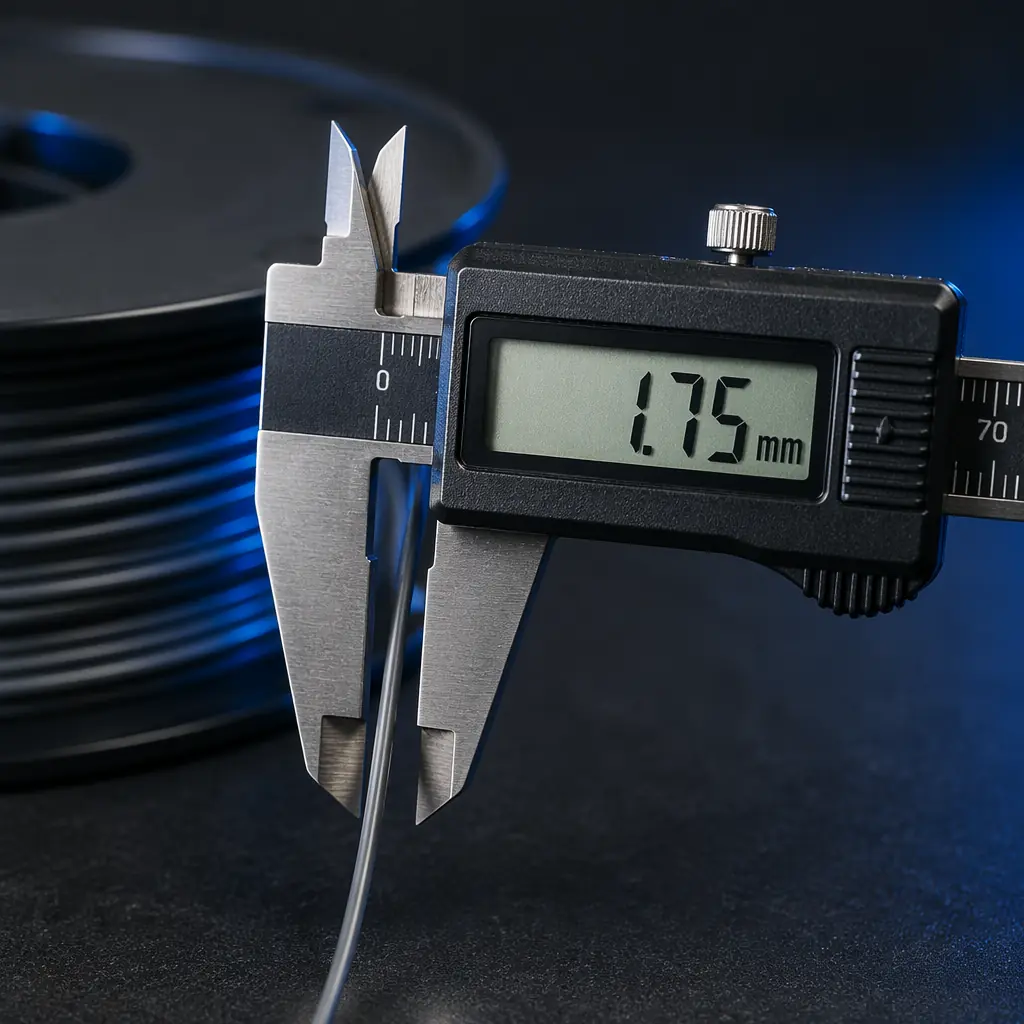
Industry-standard filament diameter tolerance is usually advertised as ±0.05mm or ±0.02mm. The difference between these two numbers is the difference between acceptable and excellent — but only if the supplier actually delivers what they advertise. Many budget filament brands print "±0.02mm" on the box but ship material that measures ±0.06mm when independently tested. The only way to know is to measure.
The measurement protocol distributors should use when auditing a supplier: take a 5-meter sample from the beginning, middle, and end of three randomly selected spools from a production batch. Measure diameter every 10cm along each 5m sample using a digital micrometer with 0.001mm resolution — that is 150 measurements per spool, 450 measurements across the three-spool sample. If more than 2% of measurements fall outside the claimed tolerance band, the supplier's quality claim is not credible. This takes approximately 30 minutes with a digital micrometer and a simple measurement log spreadsheet, and it tells you more about the supplier's quality control than any certificate they can print. For the precision tools needed in the QC workflow, our advanced calibration guide covers the full toolkit.
Dimension 2: Ovality — The Hidden Diameter Problem
Diameter consistency can pass inspection while ovality still ruins prints. A filament that measures 1.75mm across the X-axis but 1.82mm across the Y-axis has 0.07mm of ovality — the extruder sees an alternating thick-thin-thick-thin profile as the filament rotates through the extruder gears. The result is a rhythmic extrusion pattern that appears as repeating vertical bands on the print surface.
Ovality is measured by taking each diameter reading in two perpendicular axes and calculating the difference. Any filament with ovality exceeding 0.03mm should be rejected — the print quality degradation is visible to the end user and generates support tickets that cost the distributor far more than the per-kg savings on the filament itself. The most common cause of ovality is a worn extrusion die that has become elliptical over time, and the fix is a die replacement that costs the supplier approximately $200 — a trivial cost compared to the distributor relationship damage caused by shipping oval filament.
Dimension 3: Moisture Content — The Shelf-Life Determinant
Moisture is the silent filament killer. PLA absorbs approximately 0.3–0.5% of its weight in moisture under normal ambient conditions over 6 months. PETG absorbs 0.8–1.2%. Nylon absorbs 2–3% within 24 hours of exposure. When moisture-laden filament enters a 200°C+ hotend, the water instantly vaporizes, creating steam pockets that rupture through the extruded plastic — producing popping sounds during printing, bubbled surface finish, and dramatically reduced interlayer adhesion strength.
The moisture content of incoming filament should be verified at receipt and monitored throughout storage. The measurement method is straightforward: weigh a 10g filament sample on a 0.01g-resolution scale, dry it in a food dehydrator or filament dryer at the material's recommended drying temperature for 4 hours, and re-weigh. The weight loss percentage is the moisture content. Acceptable thresholds:
The most important supplier requirement is vacuum sealing with a fresh desiccant pack. Every spool should be vacuum-sealed at the factory within 24 hours of extrusion. The desiccant pack inside should be a minimum of 10g of silica gel or molecular sieve — the tiny 2g packets found in budget filament are decorative, not functional. A simple test: take a freshly received vacuum-sealed spool, cut open the bag, and place the desiccant pack on a 0.01g scale. If it weighs less than 8g, the supplier is cutting corners on packaging. If the vacuum bag does not audibly "whoosh" when opened — indicating pressure differential — the seal has failed and the filament has been absorbing ambient moisture during transit. For guidance on how to help customers manage filament once it is in their hands, see our filament drying and storage guide.
Dimension 4: Spool Winding Quality — The Jam Prevention Metric
A perfectly wound spool feeds filament smoothly from the first meter to the last. A poorly wound spool creates tangles, cross-overs, and snags that cause print failures — typically at hour 6 of an 8-hour print, when the customer is asleep. Spool winding quality is the most underrated filament quality metric because it does not show up in diameter measurement data, yet it causes more support tickets than any other defect.
There are three winding defects to inspect for when evaluating a supplier's spools:
The supplier audit for winding quality is simple: take three spools from the production line, manually pull 20 meters of filament from each spool at a consistent speed, and count snags. Any spool with more than zero snags in 20 meters is a winding quality fail. The spool should also be weighed to confirm the net filament weight matches the label — a variance of more than ±3% indicates either the winding machine's length counter is miscalibrated or the supplier is short-filling spools.
Dimension 5: Color Consistency and Material Additives
Color consistency across batches matters more than most distributors realize. A customer who buys two spools of "Precise3D Matte Black PLA" six months apart expects them to be the same color — and when they visibly are not, the customer perceives a brand quality problem, even if the filament prints perfectly. Color variation between batches of more than ΔE 1.5 (barely perceptible) is a supplier QC issue. Variation exceeding ΔE 3.0 is visible to any customer and will generate complaints.
The practical audit method does not require a spectrophotometer. Request color swatch cards from the last three production batches — small printed chips of the actual filament material — and compare them side by side under daylight-balanced lighting (5000K). If you can see a color difference without squinting, customers will see it too. The supplier should be able to explain their masterbatch (color concentrate) sourcing and mixing process. A supplier who buys masterbatch from different vendors depending on spot price will have batch-to-batch color drift. A supplier with a single approved masterbatch supplier and automated dosing will have consistent color.
Beyond color, material additives require verification. "PLA+" and "Tough PLA" are marketing terms — they mean different things to different manufacturers. The supplier should provide the specific impact modifier or copolymer blend used to achieve the claimed properties. If they cannot or will not name the additive, the material is likely standard PLA with a "+" on the label. Distributors selling engineering-grade materials to professional customers cannot afford to discover this distinction through customer returns. For the full engineering material portfolio, see our engineering filaments guide.
The 7-Point Supplier Audit Checklist
When visiting a filament supplier's factory — or commissioning a third-party audit — these are the seven checkpoints that separate professional-grade manufacturers from commodity extruders. Each checkpoint maps to a quality dimension covered above:
A supplier that passes all seven checkpoints will deliver filament that generates near-zero customer complaints — and the slightly higher per-kg cost (typically $1–2 more than a commodity supplier) is recovered many times over in avoided returns, support tickets, and customer churn. A supplier that fails three or more checkpoints should not be your primary filament source, regardless of price. The cost of poor-quality filament is not the purchase price — it is the lost customers who blame your brand for failed prints. For the complete factory audit framework, see our factory audit checklist.
Reviewed by the Precise3D engineering & OEM team. Compliance files that accompany the catalog are auditable at the certification register.
Quality Starts With Your Supplier
Get the Filament QC Protocol and Supplier Audit Template
Precise3D distributors receive our complete filament quality control protocol: the 7-point audit checklist in printable format, the diameter measurement spreadsheet template, moisture content testing procedure, and a list of pre-vetted filament manufacturers that have passed our internal audit. Sell filament your customers trust.