Capabilities · Materials Engineering
Materials Science
Meets Print Performance
An in-house materials testing lab that validates 40+ filament types, develops optimized print profiles, and qualifies new materials — so your customers get perfect prints from the first layer, with every spool, on every material.
Overview
Why Materials Engineering Matters for OEM Partners
The best hardware in the world cannot compensate for poorly characterized materials. Print failures, support tickets, and returns disproportionately trace back to material-related issues: wrong temperatures, incorrect bed adhesion, moisture-contaminated filament, poor layer bonding. Our materials lab solves this problem before it gets to your customers.
We do not just test whether a filament "works" in a printer. We characterize every material across five performance dimensions — mechanical strength, thermal behavior, chemical resistance, printability window, and post-processing compatibility. The result is a comprehensive print profile that guarantees repeatable, high-quality results for your end users, reducing support burden and return rates across your distribution channel.
Material Compatibility
Comprehensive Filament Compatibility Matrix
Every filament in our matrix undergoes a standardized validation protocol of calibration and quality prints. The results are documented, maintained across filament batch variations, and delivered to your customers as plug-and-play print profiles.
| Material | Nozzle °C | Bed °C | Enclosure | Speed | Difficulty | Best Applications |
|---|---|---|---|---|---|---|
| PLA | 200-220 | 50-60 | Not needed | High | Easy | Prototypes, decorative models, consumer goods |
| PLA+ / Pro | 210-230 | 55-65 | Not needed | High | Easy | Functional prototypes, mechanical parts, jigs |
| Silk PLA | 205-225 | 55-65 | Not needed | Medium | Easy | Display pieces, jewelry, art, gifts |
| PETG | 230-250 | 70-85 | Optional | Medium | Moderate | Structural parts, outdoor use, food-safe containers |
| PETG-CF | 240-260 | 75-85 | Optional | Medium | Intermediate | Stiff, lightweight structural parts, drone frames |
| ABS | 240-260 | 100-110 | Required | Medium | Intermediate | Automotive, enclosures, durable consumer goods |
| ASA | 240-260 | 100-110 | Required | Medium | Intermediate | Outdoor parts, UV-exposed applications, automotive trim |
| TPU 95A | 220-240 | 40-60 | Not needed | Slow | Moderate | Phone cases, gaskets, vibration dampeners, wearables |
| TPU 85A | 210-230 | 35-55 | Not needed | Slow | Advanced | Soft-touch grips, shoe soles, seals, flexible joints |
| Nylon PA6 | 250-270 | 80-100 | Required | Slow | Advanced | Gears, bearings, high-strength mechanical components |
| Nylon PA12 | 250-265 | 90-105 | Required | Slow | Advanced | Chemical-resistant parts, medical devices, snap fits |
| Nylon-CF | 260-280 | 85-100 | Required | Slow | Expert | Race drone frames, tooling, high-stiffness fixtures |
| Polycarbonate (PC) | 270-300 | 100-110 | Required (50°C+) | Slow | Expert | High-temp environments, transparent enclosures, structural |
| PC-ABS Blend | 255-275 | 100-110 | Required (40°C+) | Medium | Advanced | Automotive interior, electronics housings, durable goods |
| HIPS | 230-245 | 100-110 | Required | Medium | Intermediate | ABS support material, lightweight structural parts |
| PVA | 190-210 | 45-60 | Not needed | Slow | Advanced | Water-soluble supports for complex geometries |
| Wood PLA | 190-220 | 50-60 | Not needed | High | Easy | Decorative objects, furniture accents, art pieces |
| Marble PLA | 200-215 | 50-60 | Not needed | High | Easy | Sculptures, architectural models, decorative vases |
| Glow-in-Dark PLA | 195-215 | 50-60 | Not needed | Medium | Easy | Toys, safety markers, novelty items, signage |
| PP (Polypropylene) | 220-240 | 85-100 | Optional | Slow | Advanced | Living hinges, chemical containers, battery cases |
Additional specialty materials — conductive, magnetic, color-changing, flexible, POM, PEI-class — are covered through the same qualification path. Contact us for the full matrix or to request qualification testing of a specific filament you already stock.
Print Profile Engineering
The Tuning Protocol
Our materials lab follows a systematic tuning protocol for every filament: temperature, retraction, speed and flow, cooling, bed adhesion, drying and storage. Each parameter is optimized independently, then validated in combination, producing a print profile that delivers consistent results across batch variations and ambient conditions.
1. Temperature Optimization
Temperature tower printed in 5-degree increments across the filament's rated range. Visual inspection for layer adhesion, stringing, surface finish, and bridging quality at each temperature step. Break test to determine maximum interlayer bond strength. Optimal nozzle temperature documented with a +/-5-degree safe operating window. Bed temperature determined by first-layer adhesion and warping assessment on PEI, glass, and textured surfaces.
2. Retraction Calibration
Systematic retraction distance and speed testing using a multi-pillar retraction test model. Retraction distance tested from 0.2mm to 8.0mm in 0.2mm increments (direct drive) or 0.5mm increments (Bowden). Retraction speed tested from 20mm/s to 80mm/s. Optimal values recorded separately for each material. Deretraction (extra prime) amount calibrated to eliminate gaps at travel move starts.
3. Speed & Flow Rate
Maximum volumetric flow rate (MVR) determined using an incremental flow test — extrusion rate increased until underextrusion or skipped steps occur. Speed profiles set at 40%, 60%, 80%, and 100% of MVR for Quality, Standard, Speed, and Draft presets respectively. Acceleration and jerk/junction deviation tuned to maintain dimensional accuracy at each speed tier. Linear/pressure advance calibrated for consistent extrusion through speed changes.
4. Cooling Management
Part cooling fan duty cycle calibrated per material and layer time. Overhang test model (0-80 degrees in 10-degree increments) printed at multiple fan speeds. Minimum layer time set to ensure adequate cooling before the next layer deposits. Bridging fan speed optimized for clean spans. Cooling disabled or minimal for high-temperature engineering materials (ABS, ASA, PC, Nylon) to prevent warping and delamination.
5. Bed Adhesion
First layer settings optimized for each build surface type (smooth PEI, textured PEI, carborundum glass, PC build plate). First layer height, line width, and speed independently tuned. Bed temperature ramp profile (soak time before print start). Adhesion aids tested where needed: PVA glue stick, Magigoo, 3DLAC, blue tape, ABS slurry. Skirt/brim/raft recommendations per material and part geometry.
6. Drying & Storage
Drying requirements documented for hygroscopic materials: recommended drying temperature and duration, storage conditions (dry box with desiccant, vacuum-sealed with silica gel), filament dryness indicators (brittleness, surface texture, popping sounds during extrusion). Pre-print drying workflow integrated into the printer's filament loading routine. Compatible dryer models tested and recommended.
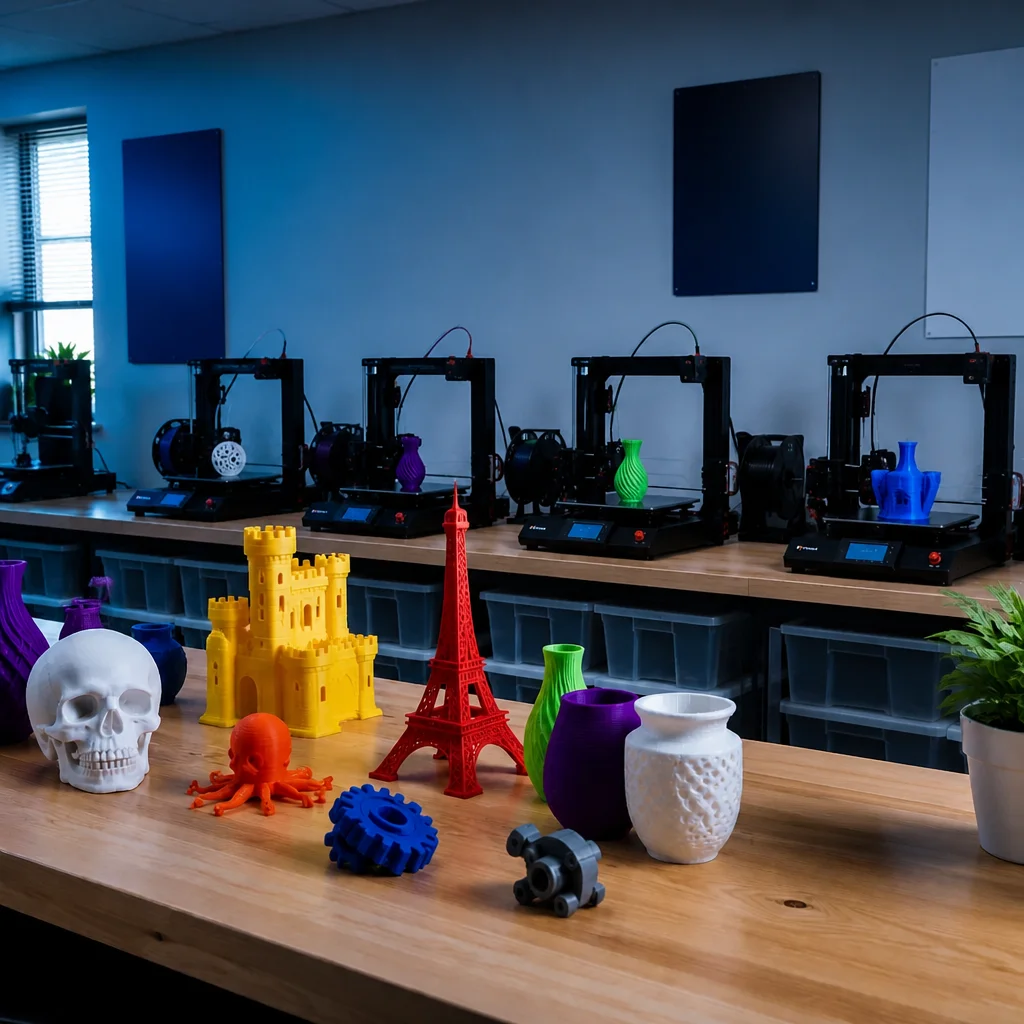
Materials Testing Lab
Mechanical, Thermal & Chemical Characterization
Beyond printability, we characterize the mechanical properties, thermal behavior, and chemical resistance of printed parts — data that your B2B customers in engineering, manufacturing, and healthcare demand.
Tensile Testing
ASTM D638 Type IV dogbone specimens printed in XY and ZX orientations. Ultimate tensile strength (MPa), elongation at break (%), and Young's modulus (GPa) measured on a universal testing machine. Data reported per material, print temperature, and orientation to capture anisotropic behavior.
Flexural Testing
ASTM D790 three-point bend test. Flexural strength and flexural modulus measured. Beam specimens printed in flat and on-edge orientations to quantify stiffness anisotropy. Results inform part design guidelines for load-bearing applications.
Impact Resistance
Izod and Charpy impact testing per ASTM D256/D6110. Notched and unnotched specimens tested. Energy absorption (J/m) measured for comparison across materials. Critical for applications subject to drop impact or dynamic loading.
Thermal Analysis
DSC (Differential Scanning Calorimetry) for glass transition temperature (Tg), melting point (Tm), and crystallization behavior. TGA (Thermogravimetric Analysis) for decomposition temperature. HDT (Heat Deflection Temperature) per ASTM D648 at 0.455 MPa and 1.82 MPa loads.
Chemical Resistance
Immersion testing per ASTM D543 in common chemicals: isopropyl alcohol, acetone, motor oil, gasoline, household cleaners, acids, and bases. Mass change, dimensional change, and visual degradation documented at 24h, 7-day, and 30-day intervals.
UV & Weathering
Accelerated UV aging with UVA lamps and color-change measurement via spectrophotometry, plus mechanical property retention checks after prolonged exposure intervals. Essential for outdoor and automotive applications.
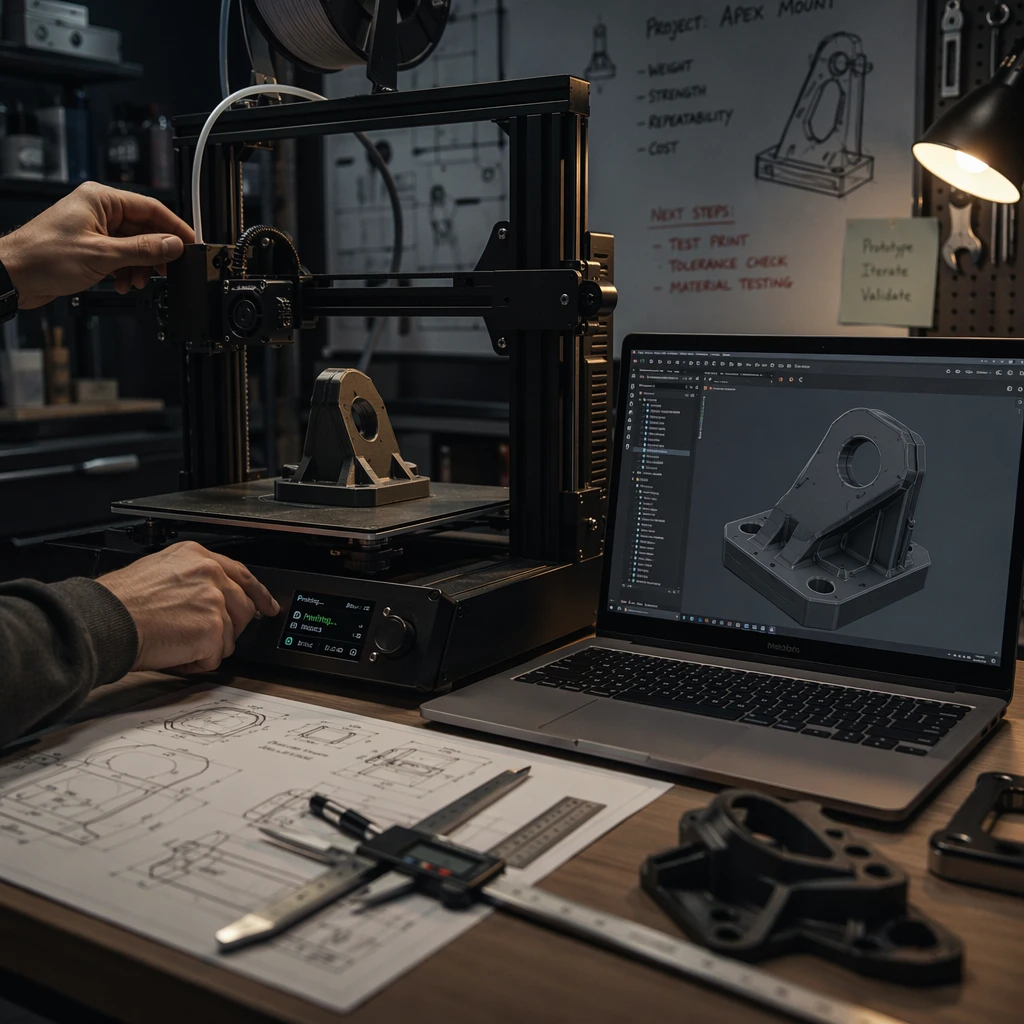
New Material Qualification
Bring Us Your Filament, We Build the Profile
OEM partners often have existing filament supplier relationships or want to offer their own branded filament. Our lab qualifies any filament and produces complete print profiles and material datasheets for your product documentation.
Qualification Process
Supplier submits 2-3 spools per color/variant. Our lab runs the full 10-print validation protocol (temperature tower, retraction test, overhang test, bridging test, dimensional accuracy cube, tolerance gauge, Benchy, vase mode, 24h endurance, mechanical test specimens). Results compiled into a material qualification report with recommended print settings, mechanical property data, and any special handling requirements.
Batch Consistency Monitoring
For partners shipping branded filament, we provide ongoing batch consistency testing: each production batch is sampled and tested against the reference profile, with diameter variation measured on the filament station and color consistency checked via spectrophotometer. Off-spec batches are flagged before they get to customers.
Material Datasheet Generation
Professional material datasheets (MDS/TDS) formatted with your branding. Includes: recommended print settings, mechanical properties (tensile, flexural, impact), thermal properties (Tg, HDT), chemical resistance table, storage and drying instructions, and safety information (MSDS reference). Ready for inclusion in your product documentation and customer support portal.