Engineering Deep-Dive • Polymer Science
Material Science.
The Chemistry Behind Every Successful Print.
Speed is nothing without control. The polymer formulation, thermal behavior, and mechanical properties of each filament determine whether a print becomes a part — or a problem.
Beyond Basic PLA
When the Material Is the Margin
In B2B distribution, material compatibility defines your addressable market. A printer that only handles PLA serves hobbyists. A printer engineered for engineering-grade polymers serves industry.
Most 3D printers ship with a brass 0.4mm nozzle and a PTFE-lined hotend rated for 240 C. That configuration handles PLA, PETG, and maybe ABS on a good day. For a hobbyist buying a single machine, this is good enough. For an industrial buyer equipping a print farm, it is a bottleneck.
The Precise3D Pro X1 ships with a a 0.4mm nozzle (hardened options for composites) and an all-metal hotend rated for 320 C continuous — a configuration that handles the full spectrum: PLA, PLA+, ABS, ASA, PETG, TPU (95A to 75D), Nylon (PA6/PA12), Polycarbonate, and carbon-fiber/glass-fiber reinforced composites. No upgrades required.
For a distributor, this means one SKU that serves every customer segment — from education buyers printing PLA models to engineering firms prototyping in Nylon and PC.
Material property comparison across the six most common FDM polymer families
Material Portfolio
Six Polymer Families. One Printer.
Each material has a job. Understanding the strengths, limits, and ideal applications of each polymer is how distributors close technical sales.
PLA+ — Enhanced Workhorse
190 to 220 C • Bed 50 to 65 C • No enclosure
Modified PLA with impact modifiers and nucleation agents. 30% higher impact resistance than standard PLA, lower warping than ABS, prints without enclosure. The first material every customer tries — and with PLA+, it is also the first that impresses them.
PETG — Industrial Workhorse
230 to 250 C • Bed 70 to 85 C • Enclosure recommended
The sweet spot between PLA's ease and ABS's durability. Chemical resistant, food-safe (FDA grades), and 4x more impact-resistant than PLA. The default choice for functional parts, mechanical components, and any print that needs to survive the real world.
ABS / ASA — Thermal Performance
240 to 260 C • Bed 90 to 110 C • Enclosure required
The standard for automotive and outdoor applications. ABS handles 90 C service temperature; ASA adds UV resistance for years of sun exposure. The Pro X1's enclosed chamber and 100 C bed make these materials reliable, not finicky.
TPU — Flexible Engineering
210 to 235 C • Bed 40 to 60 C • Direct drive required
Thermoplastic polyurethane from 95A (firm) to 75D (rigid). The Pro X1's direct-drive extruder handles flexible filaments that choke Bowden systems. Gaskets, vibration dampeners, phone cases, medical training models — flexible materials open revenue streams that rigid-only printers cannot touch.
Nylon (PA6/PA12) — Engineering Grade
250 to 280 C • Bed 70 to 100 C • Enclosure and dry box
The material that separates prosumer printers from professional tools. Tensile strength of 40+ MPa, self-lubricating, and handles continuous loads without creep. PA12 for chemical resistance; PA6 for maximum strength. The Pro X1's 300 C all-metal hotend prints Nylon as reliably as PLA.
PC and Composites — Extreme Performance
260 to 300 C • Bed 90 to 120 C • Hardened nozzle required
Polycarbonate offers 110 C plus HDT and near-indestructible impact resistance. Carbon-fiber reinforced variants achieve metal-like stiffness at a fraction of the weight. The Pro X1's 320 C hotend and nozzle optionsed steel nozzle (standard, not an upgrade) handles abrasive filaments out of the box — no nozzle swap needed between PLA and CF-PC.
Mechanical Properties
How Materials Perform Under Load
Engineering decisions require engineering data. Below are the measured mechanical properties for each polymer family, tested on Precise3D printers with optimized profiles.
| Material | Tensile Strength (MPa) | Flexural Modulus (GPa) | Elongation at Break (%) | HDT at 0.45 MPa (C) |
|---|---|---|---|---|
| PLA+ | 55 to 65 | 3.2 | 8 to 15 | 52 |
| PETG | 45 to 55 | 2.1 | 15 to 25 | 70 |
| ABS | 35 to 45 | 2.3 | 10 to 20 | 90 |
| ASA | 38 to 48 | 2.2 | 15 to 25 | 95 |
| TPU 95A | 35 to 45 | 0.08 | 400 to 600 | 45 |
| PA6 (Nylon) | 40 to 60 | 1.8 | 20 to 50 | 80 |
| PA12 (Nylon) | 35 to 45 | 1.4 | 15 to 30 | 75 |
| PC | 55 to 65 | 2.4 | 5 to 10 | 110 |
| PA6-CF | 80 to 100 | 6.5 | 3 to 5 | 130 |
Thermal and Chemical Properties
Understanding Environmental Resistance
A print that looks perfect on the build plate can fail in service if the material was not matched to the operating environment.
Thermal Characteristics
Chemical Resistance Guide
Material-to-Application Mapping
Which Material for Which Market
The most common question your customers will ask: "What material should I use for ___?" Here is the answer, organized by industry.
Material-to-application matrix: each polymer family serves distinct industry verticals
| Industry | Primary Material | Key Property |
|---|---|---|
| Education | PLA+ | Safe, easy, odorless |
| Consumer Products | PETG | Durable, food-safe |
| Automotive | ABS / ASA | Heat and UV resistance |
| Medical / Wearables | TPU 95A | Flexible, skin-safe |
| Aerospace / Defense | PA6-CF / PC-CF | Strength-to-weight ratio |
| Manufacturing | PA12 / PETG | Chemical and wear resistance |
| Robotics | PC / Nylon | Structural rigidity |
| Design / Art | PLA+ / TPU | Detail and flexibility |
Material Selection Guide
A Decision Framework for Distributors
When a customer asks which material to use, walk through these four questions. The answer determines the polymer — and the sale.
Question 1: What is the service temperature?
Room temperature: PLA+ or PETG. Up to 70 C: PETG or ABS. Up to 90 C: ABS or ASA. Up to 110 C: Polycarbonate. Above 110 C: Consider whether FDM is the right process — or use PA6-CF with annealing.
Question 2: What mechanical loads will the part see?
Static display: PLA+. Occasional handling: PETG. Continuous load: Nylon or PC. Impact and vibration: TPU or PC. Bearing surfaces: PA12 (self-lubricating). Structural: PA6-CF or PC-CF.
Question 3: What chemicals will the part contact?
Water and humidity: PETG or Nylon (dried). Oils and fuels: Nylon or PETG. Acids and bases: Nylon (PA12 preferred). Solvents: Check specific compatibility — ABS is attacked by acetone; PC by chlorinated solvents.
Question 4: Will the part be used outdoors?
Indoor only: PLA+, PETG, Nylon, PC. Outdoor, shaded: PETG or ABS. Outdoor, direct sun: ASA (UV-stabilized ABS). Marine: PETG or Nylon (watch for hydrolysis in PA6 above 70 C in water).
Commercial Impact
How Material Breadth Drives Distributor Revenue
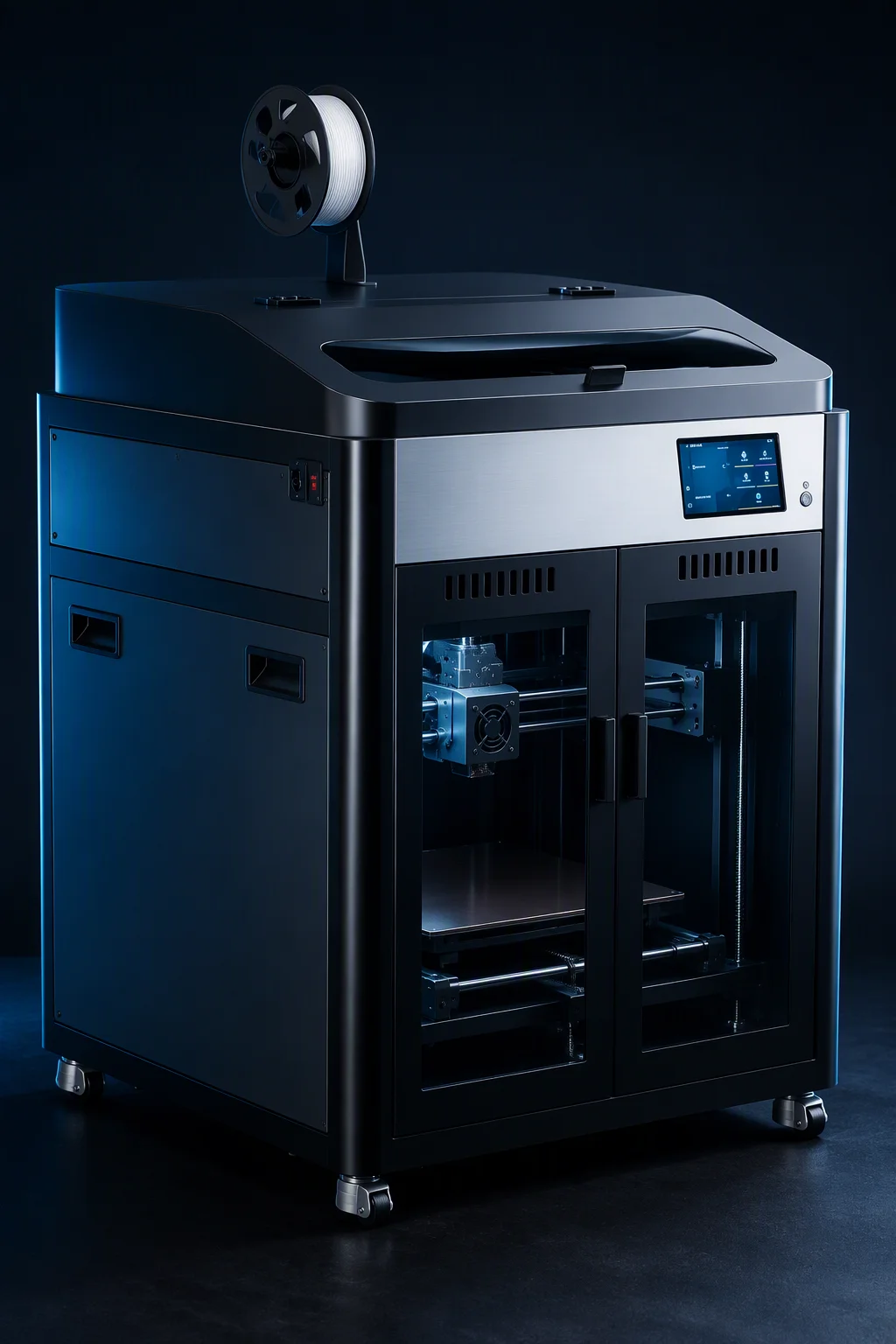
The Pro X1 printing carbon-fiber nylon: one printer handles the full material spectrum
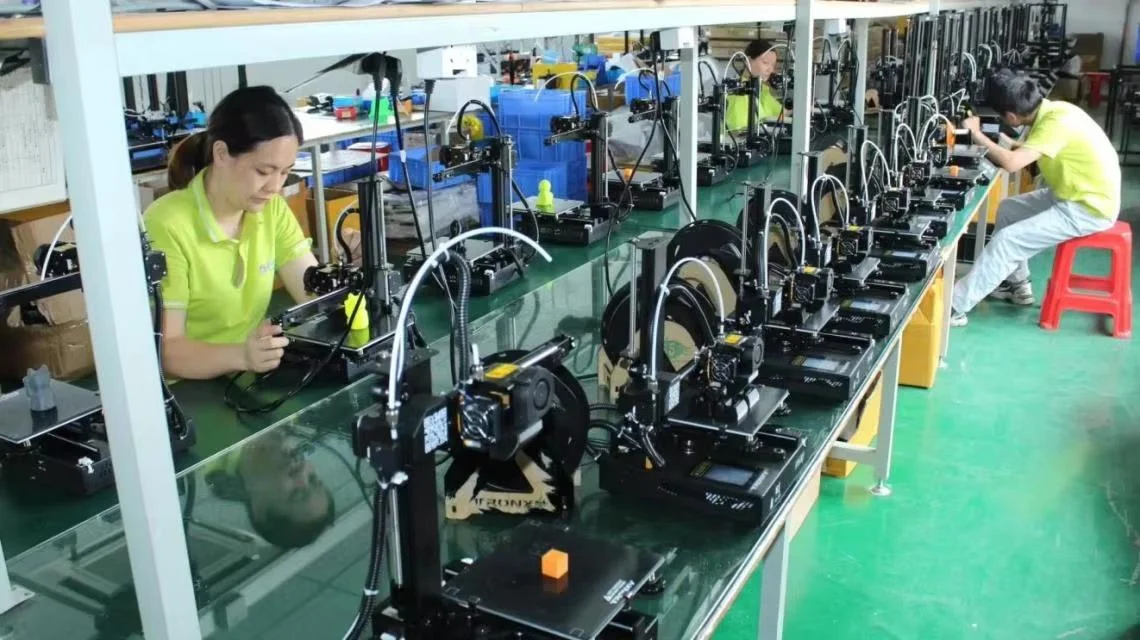
Every material batch is tested before a pre-tuned profile is released to distributors
One SKU, Six Revenue Streams
The Pro X1 ships ready for all six material families. A school buys it for PLA+. Six months later, their engineering program adds Nylon — same printer, no upgrade. Each new material a customer adopts creates a recurring filament revenue stream for the distributor. Average Pro X1 customers purchase 3.4 different material types in their first year.
Consumable Lock-In Without the Lock-In
The Pro X1 uses standard 1.75mm filament — no proprietary cartridges, no DRM chips. Customers can buy filament from any brand. But when the printer is pre-tuned for six material profiles (print temperature, bed temp, retraction, cooling), customers naturally come back to the distributor who made it easy. We ship pre-calibrated material profiles; you earn the consumable revenue.
Fewer Returns From Material Confusion
The number two cause of 3D printer returns (after motion system failure) is "it will not print X material." A customer buys ABS for a printer rated only for PLA, sees warping and layer splits, and returns the machine. The Pro X1's 320 C hotend and material profilesng and pre-loaded profiles eliminate this failure mode — the printer handles everything the customer throws at it.
Premium Materials Equal Premium Consumable Margins
Standard PLA filament margins: 15 to 25%. Engineering-grade filament margins: 40 to 60%. When the printer handles the full material spectrum, every Pro X1 sale opens a high-margin consumable relationship. Carbon-fiber nylon at $45 per kg has 3x the margin of basic PLA at $15 per kg — and the Pro X1 prints both.