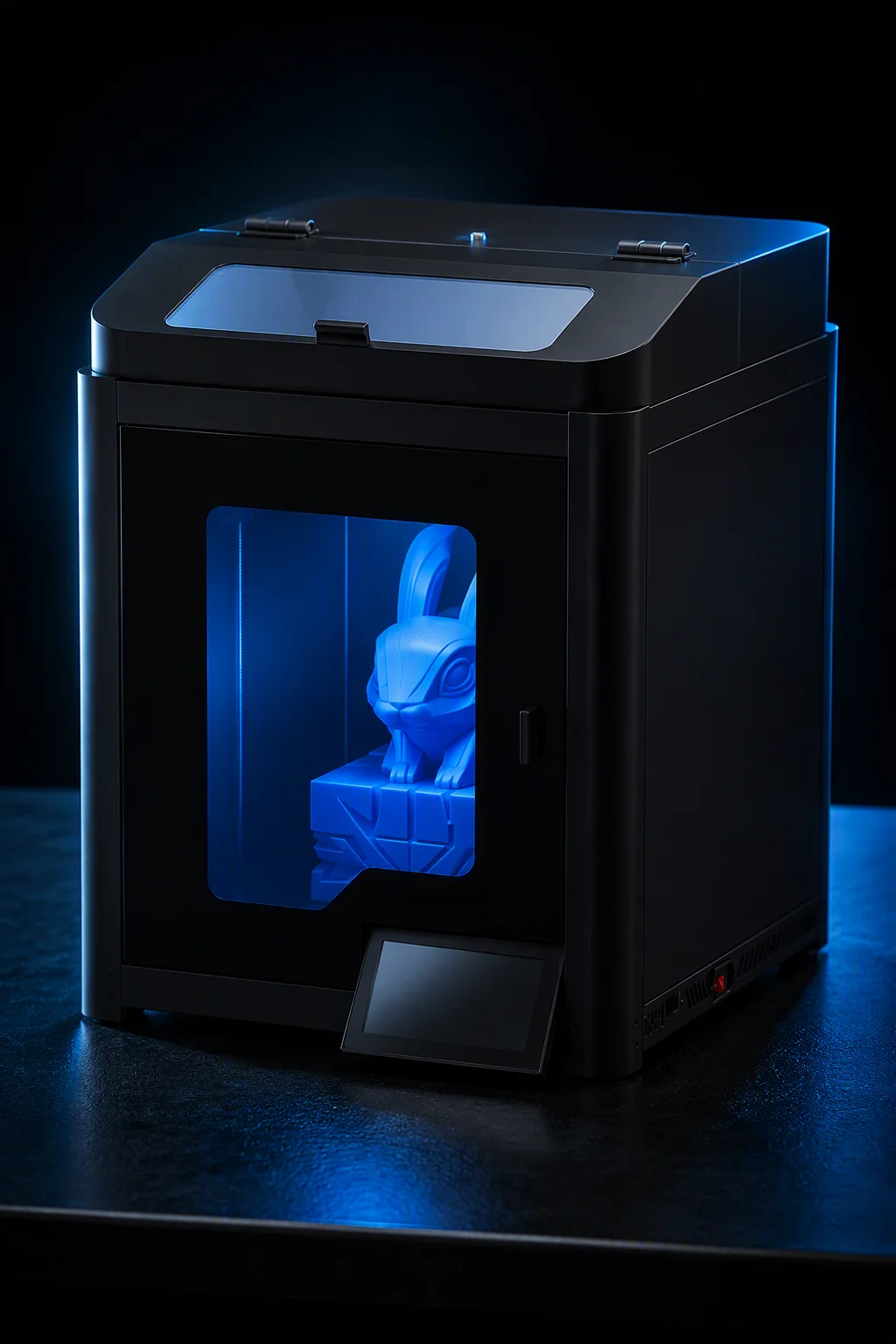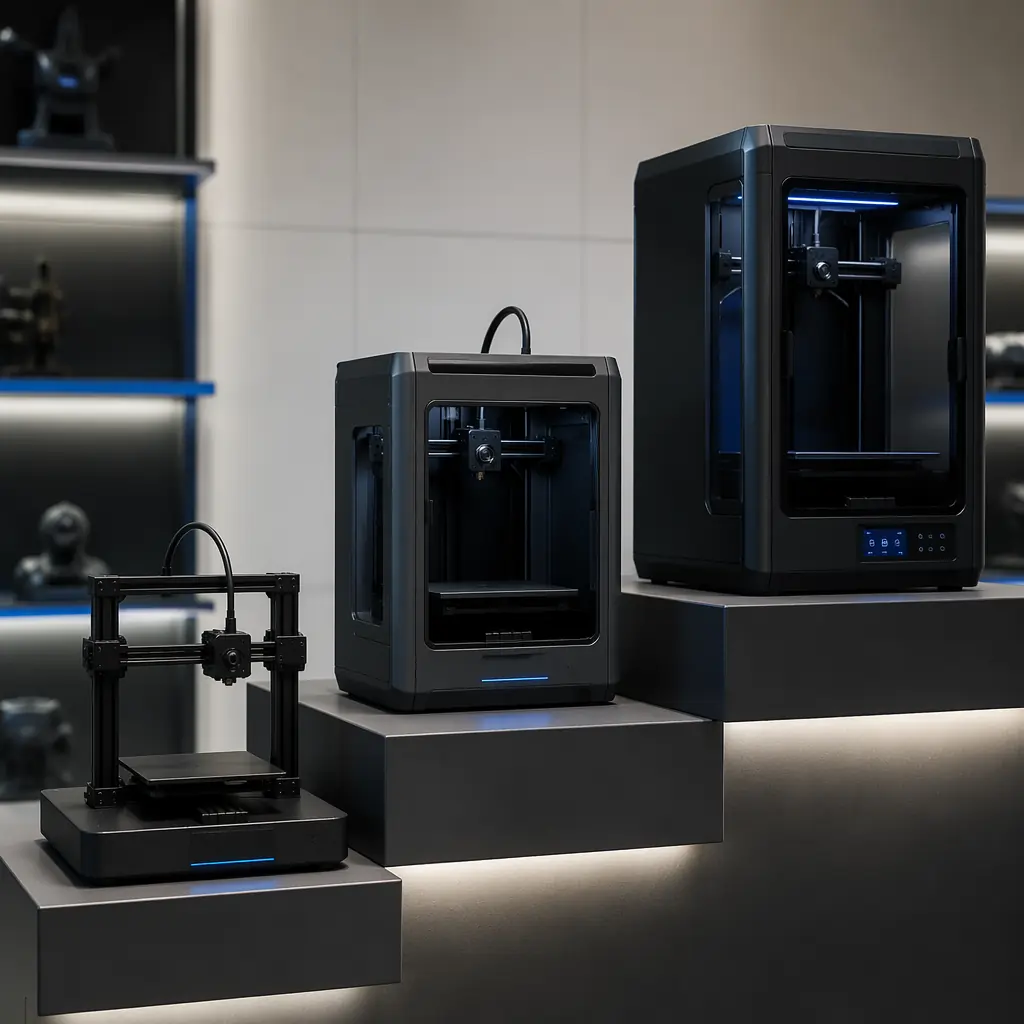
Walk into a 3D printer trade show in 2026 and you'll see machines priced from $99 to $9,999 — all claiming to be "the best." For a distributor building a product line, the real question isn't which printer wins in a vacuum. It's which printer wins for a specific customer at a specific budget. After tracking 200+ distributor portfolios across 30 countries, three price tiers have emerged as the ones that actually move volume: $200, $500, and $800. Here's what belongs in each tier, which customers buy them, and how the unit economics work at distributor scale.
The 3D Printer Market in 2026: Three Tiers, Three Buyers
The consumer 3D printer market has stratified into three clearly defined price bands, each with a distinct buyer profile, purchase trigger, and lifetime value. Stocking one tier means serving one customer type. Stocking all three means capturing customers at entry and keeping them as they upgrade — a portfolio effect that compounds revenue over 18–24 months.
Annual LTV includes printer margin, filament reorders, spare parts, and accessory purchases — the full relationship, not just the initial sale. A $229 printer that generates $120/year in filament margin for five years is a $829 customer. A distributor who only sees the $51 printer margin is leaving 93% of the revenue on the table. For the full margin breakdown, see our distributor pricing strategy guide.
Tier 1: Best 3D Printer Under $250 — The Entry Engine
At $199–249, the entry-level 3D printer is the most competitive segment in the industry. Buyers in this tier are price-sensitive, comparison-shop across 4–6 brands, and make their decision in hours — not days. The winning formula for distributors: a printer that delivers the core experience (reliable PLA printing, auto bed leveling, out-of-box readiness) at a price that leaves healthy margin after freight and marketing costs.
The Precise3D Start S1 ($199–249) hits this formula with specific design choices that matter at scale: pre-assembled (not a kit — kits generate 3× more support tickets), 220×220×250 mm build volume (covers 90% of hobbyist prints), 25-point auto bed leveling (reduces "first layer fail" returns by 40%), and a 6.8 kg shipping weight that keeps freight costs at $18–22/unit in container quantities. At 10-minute out-of-box setup, it removes the friction that kills impulse purchases.
The Start S1 isn't a profit center — it's a customer acquisition machine. At $51 net margin, one unit pays for the marketing to acquire a customer who will generate $600–800 in lifetime filament and accessory revenue. The 1-in-4 upgrade rate means every four Start S1 customers produces one Creator C1 sale within 18 months. Treat the entry printer as a paid acquisition channel with negative customer acquisition cost: you earn $51 to acquire a relationship worth $800+. For logistics planning at this volume tier, read our shipping and import guide.
Tier 2: Best 3D Printer Under $550 — The Margin Engine
The $449–549 prosumer tier is where distributor profitability lives. These buyers know exactly what specifications they need — print speed, material compatibility, build volume — and they're willing to pay a premium for measurable performance advantages. The purchase cycle is 1–3 weeks, driven by research, reviews, and spec comparison rather than impulse.
The Precise3D Creator C1 ($449–549) competes in this segment with specs that match or exceed brands priced $100–200 higher: 300 mm/s maximum print speed (with input shaping and pressure advance), 250×250×280 mm build volume (29% taller than the Start S1), partial enclosure with silent drivers under 45 dB (classroom and office compatible), and a 4.3" color touchscreen with Wi-Fi. The enclosed design supports ABS and ASA in addition to PLA, PETG, and TPU — expanding the addressable use cases to functional prototyping and small-batch manufacturing.
At $144 net margin, the Creator C1 earns nearly 3× the profit of a Start S1 per unit sale. The customer profile is more lucrative too: education buyers order in batches of 10–20 units with annual refresh cycles, and SMB/design-studio customers print 1.1 kg/day across multiple materials, generating $200–280/year in filament margin. One university fab lab with 15 Creator C1s produces $2,160/year in printer margin plus $3,000+/year in consumables — a $5,000+ annual account from a single relationship. For education-specific strategies, see our education market guide.
Tier 3: Best 3D Printer Under $900 — The Profit Flagship
The $799–899 professional tier is the highest-margin segment in consumer 3D printing. These buyers are running print farms, engineering prototypes, or manufacturing jigs and fixtures. They evaluate printers on reliability, material capability, and throughput — and they buy in multiples. A single print farm customer with 20 machines generates more annual consumables revenue than 50 entry-level retail customers combined.
The Precise3D Pro X1 ($799–899) is built for this buyer: CoreXY kinematics for 500 mm/s speeds with maintained precision, fully enclosed chamber with HEPA filtration (mandatory for engineering materials that emit VOCs), 300°C all-metal hotend (nylon, polycarbonate, carbon-fiber-filled filaments), 110°C heated bed with PEI flex plate, and 49-point auto bed leveling mesh. The dual-gear direct drive extruder delivers the consistency print farms depend on — a 2% failure rate across 20 machines running 24/7 wastes 14 hours of production per month.
A single Pro X1 sale at $309 net margin matches the profit of six Start S1 units — but the real story is consumables. Pro X1 customers print engineering materials at 1.5–2.5 kg/day at $12–18/kg distributor margin, generating $450–900/year in recurring filament revenue. One print farm with 20 Pro X1s produces $9,000–18,000/year in filament alone. The sales motion is different from the entry tier: these buyers require spec sheets, sample prints, volume pricing tiers, and dedicated account management — but one print farm customer is worth 50 retail customers in lifetime margin. For building that OEM relationship, read our OEM partner evaluation checklist.
Which Tier Should You Stock First?
The answer depends on your existing channel and customer base — not on which printer has the best specs. Here's the decision framework that our top-performing distributors use:
Retail distributors should start with the Start S1 because shelf presence drives walk-in traffic, and the compact packaging (38×38×28 cm, 6.8 kg) makes it the only tier that fits on a consumer electronics shelf. Education distributors should start with the Creator C1 because schools and universities buy in batches with budgets in the $400–600/unit range — the Start S1 at $229 is below their procurement threshold (they want "real equipment"), and the Pro X1 at $899 is above it. B2B/industrial distributors should lead with the Pro X1 because their customers buy for production, not experimentation, and the 300°C material capability is non-negotiable. For guidance on the full portfolio strategy, read our portfolio strategy guide.
What About Printers Outside These Three Tiers?
Below $199: printers in this range are almost exclusively DIY kits with significant assembly requirements. They generate 3–5× more support tickets than pre-assembled machines, and the thin margins ($15–25/unit net) don't cover the support cost. The exception is if you're selling filament and accessories as the primary business and using the cheap printer as a razor to sell blades — but even then, a $229 Start S1 generates higher customer satisfaction and repeat purchase rates.
Above $899: the $1,200–3,000 range is served by industrial desktop brands (UltiMaker, Raise3D, Markforged) with established distribution networks. Breaking into this tier requires ISO certifications, on-site service contracts, and 3–5 year spare parts availability guarantees — a different business model from consumer 3D printer distribution. The Pro X1 at $899 captures the high end of the consumer/professional overlap without crossing into industrial territory where the support and certification requirements change. For understanding certification requirements, see our certification compliance guide.
How the Numbers Compound: A 12-Month Portfolio Simulation
To make the portfolio effect concrete, here's what happens when a distributor starts with 50 Start S1 units, adds 30 Creator C1s at month 6, and 20 Pro X1s at month 9:
By month 12, filament and consumables revenue ($18,500) approaches printer margin ($22,400) — and unlike printer sales, consumables revenue is recurring. The distributor who stocks only Start S1 units at month 12 has printer margin of approximately $15,000 and filament revenue of $7,200 — total $22,200. The three-tier portfolio at $40,900 generates 84% more revenue from the same 12-month period. For strategies on maximizing consumables attachment, read our accessories bundling guide.
Reviewed by the Precise3D engineering & OEM team. Compliance files that accompany the catalog are auditable at the certification register.
Start Your Portfolio
Get Distributor Pricing Across All Three Tiers
Volume discount schedules, sample unit pricing, and dedicated portfolio planning support — tailored to your market and channel mix.