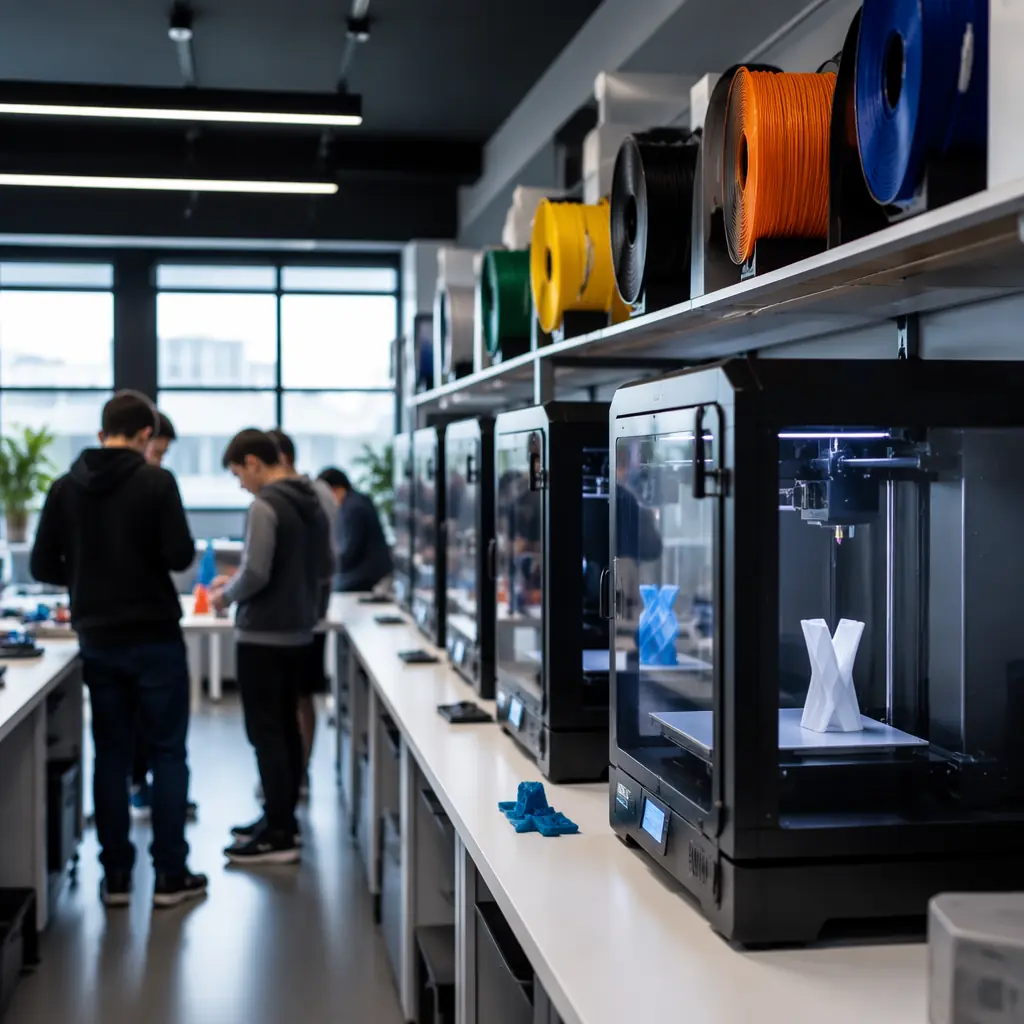
School districts don't buy 3D printers the way hobbyists do. A consumer walks into a store, compares two models on a shelf, and swipes a credit card. A school district spends six months — sometimes eighteen — navigating a procurement process that involves a STEM coordinator, a curriculum director, a purchasing department, and a school board vote. The sale is slower, but the rewards are structurally different: multi-unit purchases (a lab of 12–24 printers, not one), 3–5 year replacement cycles, and consumable reorders that continue long after the hardware purchase. A single school district contract can generate $40,000–80,000 in first-year revenue and $8,000–15,000/year in recurring filament and parts. For distributors who build the right capability, education is not a side market — it's the foundation of a predictable, high-volume business.
This guide covers the education procurement landscape, what schools actually need from a 3D printer (hint: it's not the same as what hobbyists want), how to bundle curriculum and training into your offering, and how Precise3D's product line maps to the K-12 and university segments. If you're already distributing consumer or prosumer printers, the education channel uses the same logistics infrastructure — warehousing, shipping, spare parts — you already have. What changes is the sales motion. This guide is about that sales motion.
Why Education Is the Most Underrated 3D Printer Channel
The consumer market gets the headlines. The education market gets the contracts. Consider the structural differences: a consumer buys one printer every 3–5 years. A school buys 12–24 at once, replaces them on a 3–5 year cycle, and orders filament monthly. The unit economics are fundamentally different — and fundamentally better for distributors.
Market size and growth:
The global education 3D printer market was valued at approximately $520 million in 2023 and is projected to reach $1.5–1.8 billion by 2028, driven by government STEM initiatives, declining hardware costs, and the growing recognition that additive manufacturing literacy is a workforce skill. The US alone has approximately 130,000 K-12 schools and 4,000 degree-granting postsecondary institutions — and as of 2025, only 35–40% of US high schools had at least one 3D printer. That's a 60% untapped addressable market in the country where adoption is highest. In Europe, the penetration rate is lower; in Southeast Asia and Latin America, it's in single digits. For distributors in developing markets, education represents a greenfield opportunity with government funding attached — as explored in our guide on matching printer tiers to market segments.
Budget dynamics that favor distributors:
Education budgets are fundamentally different from consumer wallets. A consumer spending $300 on a printer may comparison-shop for weeks and balk at a $25 spool of filament. A school with a $50,000 STEM lab grant treats the printers as a capital expenditure line item and filament as an operational expense that auto-renews. The approval chain is longer but the price sensitivity is lower — especially when the purchase is grant-funded, meaning the school isn't spending "its own" money. Understanding this psychological difference is the first step to selling effectively into education. For distributors entering new regional markets, our distributor startup guide covers the foundational business setup, licensing, and OEM partner selection that must be in place before pursuing education contracts.
The Education Procurement Calendar: When Schools Buy and How to Time Your Pipeline
The single biggest mistake distributors make when entering the education market: treating it like a year-round sales channel. It's not. School purchasing follows an annual budget cycle with concentrated decision windows. If you miss the window, you wait a year. Here's the calendar, by region.
North America (US & Canada):
Most K-12 school districts operate on a July–June fiscal year. Budget requests are submitted in October–December for the following school year. Purchase orders are issued March–May. Equipment is delivered June–August for installation before the fall semester. The active selling window — when STEM coordinators and curriculum directors are evaluating options — is January through April. If you're reaching out to a school district in August asking if they want to buy printers, you're 5 months late. Higher education operates on a similar cycle but with more flexibility; university engineering departments often have discretionary funds that can be spent outside the formal budget window, making them a good Q3–Q4 target when K-12 pipelines are idle.
Europe:
Varies by country. Most EU member states align with the calendar year (January–December fiscal year), making the evaluation window September–November with purchases in Q1. The UK typically follows an April–March fiscal year. Germany's 16 federal states each have their own education budget cycles — distributors targeting Germany should identify the specific state education ministry (Kultusministerium) timeline for each target region. EU-funded STEM initiatives (Erasmus+, Horizon Europe) have their own application cycles that don't align with national education budgets — these are separate funding streams worth tracking independently.
Asia-Pacific and Middle East:
Private and international schools — which are the primary adopters of 3D printing in these regions — typically follow a September–June academic year with budget planning in Q1. Government-funded STEM initiatives in countries like Saudi Arabia (Vision 2030 education pillar), UAE (Mohammed bin Rashid Smart Learning Program), and Singapore (SkillsFuture) operate on their own procurement timelines and often publish RFPs through official government portals. These are large contracts — sometimes 500+ printers per order — but require local representation and compliance with government procurement regulations. The logistics of fulfilling large government orders are covered in our container shipping and import duty guide.
Grant cycles — the hidden procurement channel:
In the US, an enormous amount of education 3D printer purchasing happens outside the standard school budget process — it's funded by grants. Federal programs like Perkins V (career and technical education), NSF ATE (Advanced Technological Education), and DoD STEM all fund equipment purchases. Private foundations (Gates, Chan Zuckerberg Initiative, Schmidt Futures) fund specific STEM initiatives. State-level grants vary. The key insight for distributors: your customer is not the school. Your customer is the grant writer. Help a STEM coordinator write "15 FDM 3D printers with enclosed chambers, HEPA filtration, and a 3-year curriculum license" into their grant proposal, and you've created a purchase order that didn't exist before you showed up. This is consultative selling at its most effective — and it's a skill that separates education-focused distributors from everyone else.
What Schools Actually Need: The Spec Sheet Nobody Writes
Consumer 3D printer marketing focuses on print speed, build volume, and multi-color capability. School buyers care about exactly none of these — at least not as their primary criteria. Here's what matters in a classroom and why it's different.
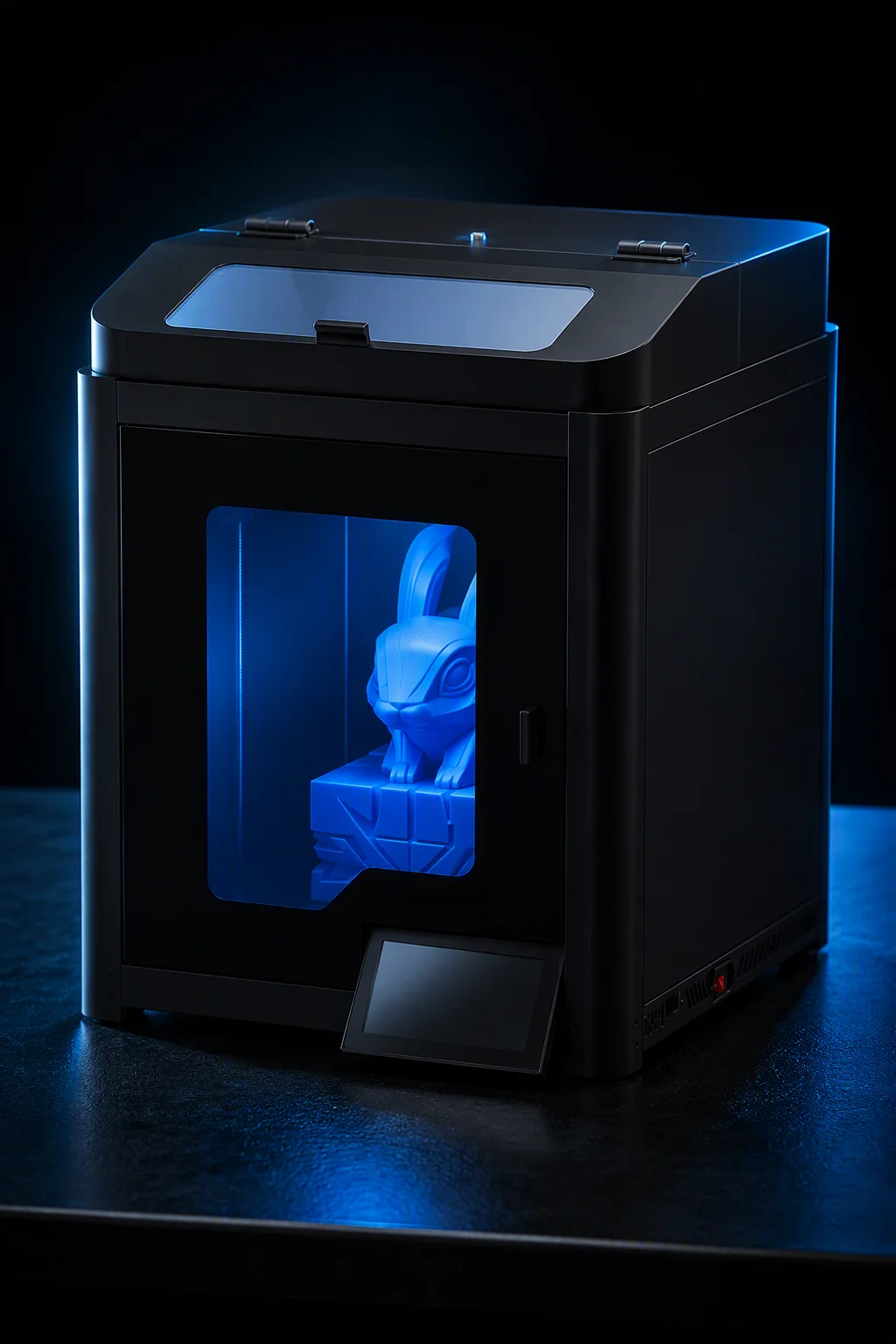
1. Safety and enclosure (non-negotiable for K-12): An open-frame printer in a classroom is a liability. Students touch the hotend. Prints get knocked off the bed. Noise disrupts adjacent classrooms. An enclosed printer with a locked door, HEPA/carbon filtration, and automatic shutoff on door-open eliminates these risks. For K-12, the enclosure is not a feature — it's table stakes. This means the entry-level open-frame bedslinger that dominates consumer sales at $199 is fundamentally unsuitable for schools, regardless of how good the print quality is. The minimum viable education printer starts at the enclosed-prosumer tier, which carries a distributor margin 2–3x higher than the entry-level consumer segment. Our enclosed vs open-frame comparison guide covers the technical and commercial dimensions of the enclosure decision in detail.
2. Reliability and ease of maintenance (not print speed): A school IT administrator supporting 20 printers does not want to level beds, clear jams, or reflash firmware between classes. They want printers that auto-calibrate, recover from power loss, and run 6 hours a day without intervention. Features that consumers tolerate — manual bed leveling, occasional clog clearing, firmware tweaking — are dealbreakers in education. The printer must be boringly reliable. Auto bed leveling, filament runout detection, power-loss recovery, and a user-replaceable hotend assembly are the minimum spec. As explored in our auto bed leveling technology guide, the calibration technology you choose directly impacts the support burden your education customers will experience — and the number of support calls you'll field as their distributor.
3. PLA-only operation with safety certification: Schools print PLA almost exclusively. It's low-odor, biodegradable, and prints at 190–220°C — well below the temperature where harmful off-gassing becomes a concern. ABS, ASA, and engineering filaments require higher temperatures, emit fumes that need active ventilation, and introduce liability the school district's risk management office will not accept. The ideal education printer is optimized for PLA, with a maximum nozzle temperature of 260°C (enough headroom for PLA+ and PETG if needed, but not positioned as an "engineering materials" machine). UL, CE, and FCC certification must be current and documented. A RoHS certificate should be available on request. These are procurement checklist items — if they're missing, the purchase order stalls. Our certification compliance guide covers the full documentation package every distributor should maintain for their product line.
4. Network manageability: A consumer printer connects to one user's phone via Wi-Fi. A school printer connects to a managed network with VLANs, MAC address filtering, and a firewall that blocks unknown devices. The printer must support Ethernet (not just Wi-Fi), have a discoverable IP address, accept firmware updates over the network, and ideally integrate with a fleet management dashboard where the IT administrator can see the status of all 20 printers at once. This is the feature that separates "3D printer that happens to be in a school" from "3D printer designed for education." Our remote monitoring guide covers the connectivity options that enable fleet management across printer models.
Curriculum Bundling: How to 10x Your Per-Sale Revenue
Selling a printer to a school earns you a hardware margin. Selling a printer + curriculum + training + filament subscription earns you a 5-year relationship. The hardware is the foot in the door; the curriculum and consumables are where the economics compound.
Why curriculum matters:
A school that buys 12 printers without curriculum support has 12 printers that sit in a closet by semester two. The STEM teacher who championed the purchase was excited — but they didn't have lesson plans, project templates, or assessment rubrics. They tried to wing it for a few weeks, got frustrated, and went back to teaching the standard curriculum. The printers gather dust, the school board asks why they spent $30,000 on equipment nobody uses, and the distributor who sold them — you — never gets a reorder. This is the most common failure mode in education 3D printer sales, and it's entirely preventable.
What a curriculum bundle should include:
At minimum — grade-level lesson plans (not generic "intro to 3D printing" slides; actual 45–60 minute classroom sessions with learning objectives, materials lists, and assessment criteria), project files (pre-sliced .gcode or .3mf files that print successfully on the specific printer model without tweaking), student worksheets and design challenges, teacher training materials (video walkthroughs of printer setup, maintenance, and common troubleshooting), and alignment to national education standards (NGSS in the US, National Curriculum in the UK, etc.). The curriculum doesn't need to be built from scratch — organizations like PrintLab, MakerBot Education, and Tinkerine offer licensable curriculum platforms. Bundling an existing curriculum license with your hardware sale adds $500–1,500 per school in pure margin while dramatically increasing the probability that the printers actually get used — and reordered.
Training as a recurring revenue line:
A half-day on-site training session for teachers — printer setup, basic maintenance, running the first print, integrating it into lesson plans — typically bills at $800–1,500 per session. A distributor selling into 20 schools per year with a $1,200 training add-on generates $24,000 in services revenue with near-zero cost of goods. Teacher turnover means schools need refresher training every 2–3 years. This is repeat business built into the channel structure. For distributors establishing technical support capability, the training materials and methodology described in our maintenance guide provide a foundation that can be adapted for teacher-focused delivery.
The Education Printer Lineup: Matching Models to Grade Levels
Not all education buyers are the same. A middle school STEM club needs something fundamentally different from a university mechanical engineering lab. Here's how to match printer capability to education segment, using Precise3D's product line as the reference architecture.
Notice the filament economics. A single university lab of 30 printers consuming 300 spools per year at a distributor margin of $8–12 per spool generates $2,400–3,600 annually in recurring filament revenue — from one customer. A distributor with 10 university accounts earns $24,000–36,000 per year in filament margin alone, before counting hardware, parts, training, and curriculum licensing. This is why education is a channel, not a one-off sale. For a complete breakdown of filament SKUs and margin structures, see our filament stocking guide for distributors.
Competing Against Established Education Brands
MakerBot, UltiMaker, and Stratasys have dominated the education market for a decade — but their position is weakening. MakerBot's shift to the METHOD platform pushed their education pricing above $3,000 per unit, pricing out most K-12 buyers. UltiMaker's S-series starts at $4,000+. Stratasys F123 series begins at $12,000. The market has opened a gap at the $300–900 per-unit range where 90% of school purchases actually happen — and that's exactly where Chinese-manufactured enclosed printers with auto-calibration, HEPA filtration, and fleet management compete.
The competitive advantage:
A school district can buy 16 Precise3D education-configured printers with curriculum and training for roughly the price of 4 MakerBot SKETCH units. More printers means smaller student-to-printer ratios — 2:1 instead of 8:1 — which means faster iteration, less waiting, and more actual learning time per class period. The math is simple and it's the first slide in every education sales deck. The quality gap that existed 5 years ago between a $2,000 education printer and a $500 Chinese-manufactured enclosed printer has largely closed — today's motion systems, hotends, and firmware on mid-tier machines deliver dimensional accuracy within ±0.1mm, which is more than adequate for 95% of classroom applications. For the remaining 5% that need engineering-grade tolerances, the university segment buys those separately.
What the incumbents still do better:
Brand recognition among school administrators who haven't researched 3D printing since 2019. Curriculum depth — MakerBot's Thingiverse Education and UltiMaker's Cura ecosystem have years of classroom-tested content. And localized sales/support presence in major education markets. These are surmountable through distributor investment in local training and curriculum partnerships. The hardware is competitive. The missing piece is the go-to-market infrastructure — and that's where distributors who build education-specific sales capability create a defensible moat.
Building an Education Sales Motion: The 4-Step Playbook
You have the right printers. You understand the procurement calendar. You've bundled curriculum and training. Now you need a repeatable sales process. Here's the four-step playbook that works across K-12 and higher education.
Step 1 — Identify the real decision-maker:
It's rarely who you think. In a K-12 district, the person who signs the purchase order is in the purchasing department — but they don't decide which printer to buy. The STEM coordinator or career-technical education (CTE) director makes the recommendation. The superintendent or school board approves the budget. Your sales motion must reach the STEM coordinator first (they're the champion), arm them with data to convince the superintendent (total cost of ownership, curriculum alignment, safety certifications), and make the purchasing department's job easy (pre-formatted quote, compliance documentation, shipping logistics). Cold-calling the purchasing department is a waste of time. Cold-calling the STEM coordinator with a specific proposal for their school's grade levels is the start of a relationship.
Step 2 — Lead with a demo, not a spec sheet:
School buyers are not 3D printing enthusiasts. A spec sheet with nozzle temperature, acceleration values, and stepper driver model numbers means nothing to a curriculum director. What means something: a 20-minute in-person demo where they watch a printer produce a usable teaching model — a topographic map for geography class, a cell model for biology, a geometric solid for math — from start to finish. The sale happens when they see a finished print and think "my students could use this tomorrow." Bring a printer, a spool of PLA, and 3 pre-sliced education-relevant models on an SD card. Do not bring a PowerPoint.
Step 3 — Provide a turnkey proposal within 48 hours:
After the demo, the STEM coordinator is excited. They want to move forward. If they have to assemble a proposal themselves — pricing, specs, curriculum alignment, installation plan, training schedule — the momentum dies. Send them a complete proposal within 48 hours that includes: printer model and quantity recommendation based on their student count, per-unit pricing with education discount, curriculum license details with grade-level coverage, training session outline and pricing, filament starter pack and reorder process, installation timeline, and total cost of ownership projection over 5 years. Make it a PDF they can forward to the superintendent without editing a single word. This is the step where most distributor sales efforts die — not because the school said no, but because nobody made it easy to say yes.
Step 4 — Build the post-sale flywheel:
The first sale to a school is the hardest. The second sale — to the school in the neighboring district that heard about the successful lab — is easier. The third sale, to the same school three years later when they expand from one lab to two, is almost automatic. Invest in the post-sale relationship: check in at 30/90/180 days after installation, offer a free filament restock analysis, share a case study (with permission) that the STEM coordinator can present at the next district board meeting. A distributor who maintains relationships with 15–20 school accounts has a business that compounds — each account generates hardware replacement revenue every 3–5 years, filament revenue monthly to quarterly, and training revenue when staff turns over. For perspective on scaling a distributor operation, our print farm economics analysis covers the operational and financial modeling that applies to distributor-run print services as well.
Bottom Line
The education 3D printer market rewards patience and punishes shortcuts. The sales cycle is 6–12 months. The procurement process is bureaucratic. The margin on the first hardware sale is unremarkable. But the downstream economics — recurring filament, replacement parts, curriculum licensing, training fees, and 3–5 year hardware refresh cycles — produce a customer lifetime value that no consumer channel can match. A single school district relationship, properly managed, can generate $80,000–150,000 over a decade. Twenty such relationships is a $2–3 million business built on an installed base of 300–500 printers that need filament every month, parts every quarter, and replacement every few years. The distributors who invest the time to understand school procurement, build curriculum partnerships, and develop a repeatable education sales motion now will own this channel when the market doubles over the next five years. At Precise3D, our enclosed, auto-calibrating, fleet-manageable printer lineup is designed from the ground up for classroom deployment — safety-certified, network-ready, and backed by a distributor support infrastructure that includes training materials, curriculum partnerships, and a spare parts program that keeps school labs running. Because when a classroom of 30 students is waiting for a print to finish, downtime is not an option.
Reviewed by the Precise3D engineering & OEM team. Compliance files that accompany the catalog are auditable at the certification register.
Start Your Education Partnership
Ready to Bring 3D Printing to Schools in Your Market?
Join our network of global distributor network. Education-configured printers, curriculum bundles, training materials, and dedicated support — everything you need to build a recurring-revenue education channel.