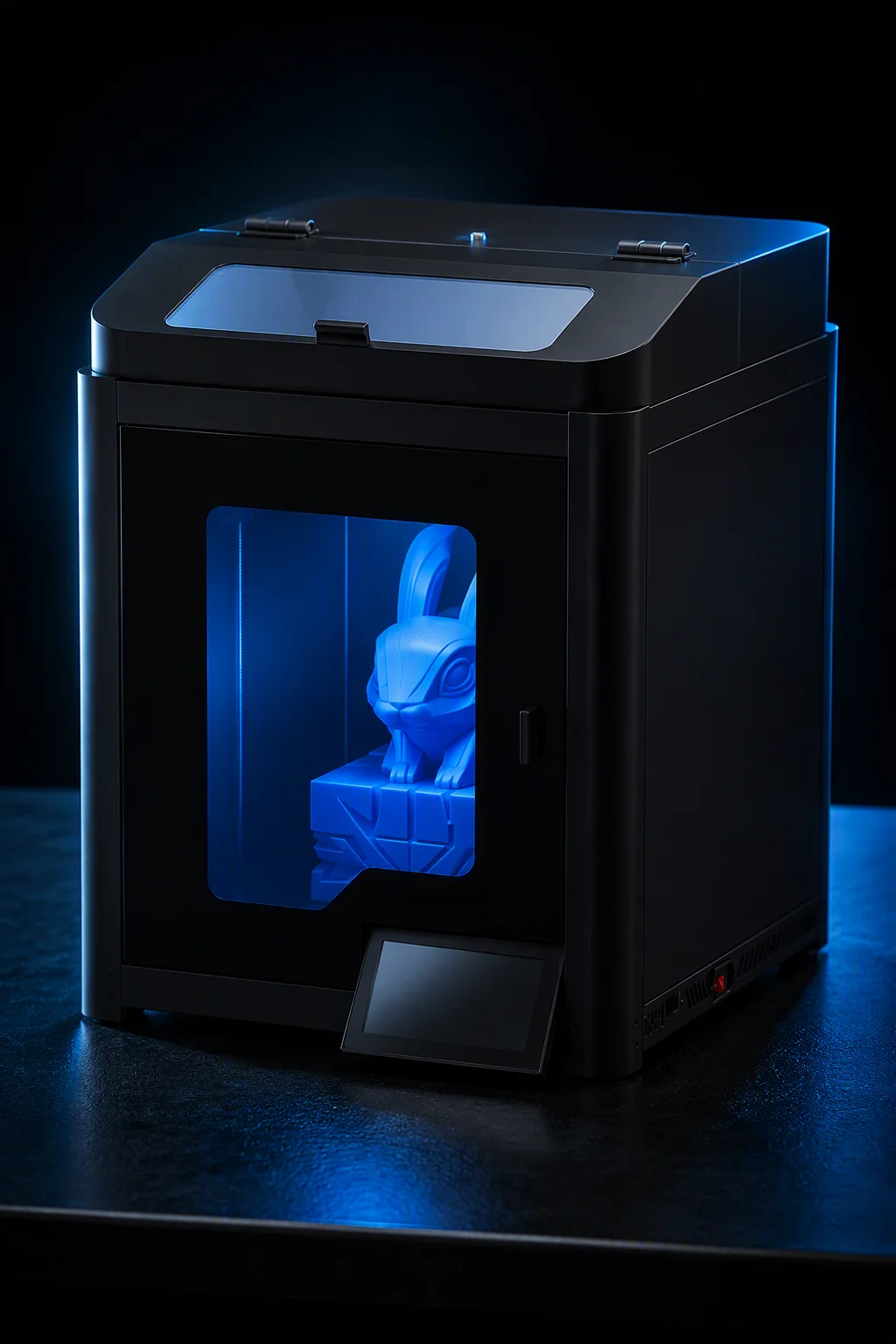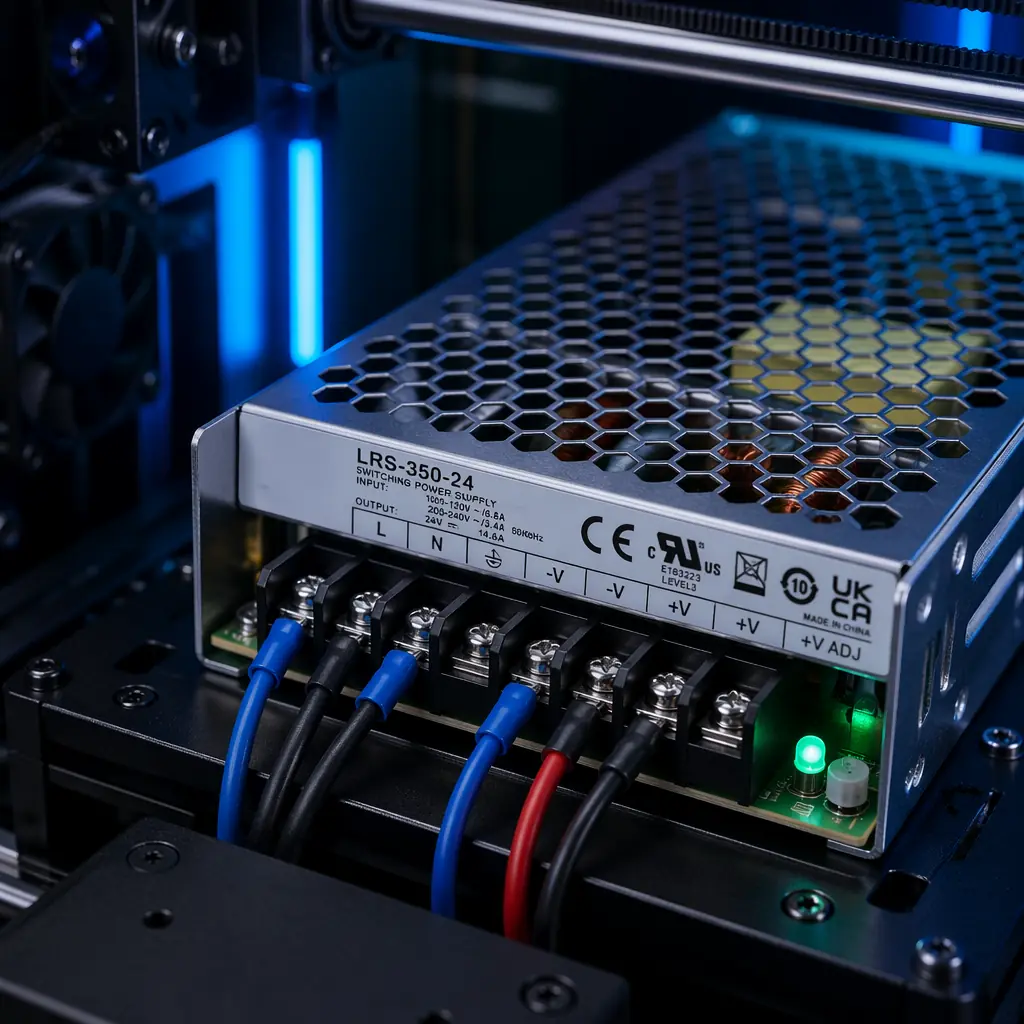
A 3D printer's power supply unit (PSU) is the most overlooked component in the distribution value chain — and paradoxically, the one with the highest failure-rate-to-cost ratio. At Precise3D, we track warranty claims across 30,000+ units shipped per month, and the data is unambiguous: PSU-related failures account for 12–18% of all warranty returns on budget printers, yet switching to a certified Mean Well PSU adds only $6–$9 to the BOM cost. The math is brutal: saving $7 on the PSU costs $45–$80 in warranty processing, return shipping, and lost customer trust per failure.
This guide is written for distributors who want to stop guessing about PSU quality and start auditing it. You will learn the four certification marks that actually matter, how to spot a counterfeit Mean Well, the wattage sizing formula that prevents under-powered printer complaints, and a 5-minute factory-visit PSU inspection checklist you can use at your next supplier meeting.
Why PSU Quality Is a Margin Decision, Not Just a Safety Check
Most distributors evaluate PSUs through a safety lens: does it have CE marking? Will it catch fire? This is the wrong framing. PSU quality is fundamentally a margin decision because the cost differential between a certified Mean Well LRS-350-24 and a no-name equivalent is dwarfed by the downstream costs of PSU failure.
The numbers tell a clear story: the $7–$11 saved on a generic PSU is fully consumed by the first warranty claim, and by the tenth claim per hundred units you are $200–$900 in the red — before accounting for the brand damage of a printer that smokes or catches fire in a customer's home or classroom. For distributors targeting institutional buyers — schools, universities, and print farms — PSU failure is not just a warranty issue; it is a procurement disqualification event.
Mean Well vs Generic: The Real Cost Difference
Mean Well is the de facto standard for industrial-grade 3D printer PSUs, and for good reason. The company has manufactured switching power supplies since 1982 and holds ISO 9001, ISO 14001, and ISO 45001 certifications. Their LRS-series PSUs — the most common in consumer 3D printers — are rated for 30,000 hours at full load at 40°C ambient, which translates to roughly 10–15 years of typical consumer use.
Generic PSUs fail in predictable and dangerous ways:
Counterfeit warning:
The largest PSU risk for distributors is not the choice between Mean Well and generic — it is unknowingly receiving counterfeit Mean Well units. Counterfeit LRS-350 PSUs are flooding the Shenzhen electronics markets, and they look convincing: same case color, same screw terminal layout, same label font. The giveaway is weight: a genuine LRS-350-24 weighs 760g ±10g; counterfeits typically weigh 560–620g because they use smaller transformers and thinner heatsinks. At Precise3D, we weigh every incoming PSU batch as part of incoming QC — a $30 digital scale catches $7,000 worth of counterfeit returns before they leave the factory.
PSU Certification Checklist for International Markets
Certification markings on a PSU are the most abused piece of information in electronics procurement. A sticker with "CE" printed in Arial means nothing. What matters is whether the certification is backed by a recognized testing laboratory and whether you can verify it.
Distributor certification strategy:
You only need to verify certifications once per PSU model — not per shipment. But that once must be thorough. Request the test reports from the OEM's PSU supplier for your target markets. If the supplier cannot produce them within 48 hours, they almost certainly do not have valid certifications. Move on.
For distributors selling into multiple regions, the safe play is to standardize on one PSU model that carries all required certifications for all your markets. The Mean Well LRS-350-24 is the closest thing to a universal PSU in the consumer 3D printer space — it is CE/UL/FCC/CCC/RCM/KC certified and available globally. Our certification compliance guide covers the full regulatory landscape for 3D printer distribution.
Wattage Sizing: Matching PSU to Printer Class
An under-spec PSU is the root cause of the most frustrating failure mode in 3D printing: random mid-print shutdowns that leave no log trace. The bed heater and hotend together draw the majority of power, and when both are active simultaneously — during the initial heat-up phase of every print — the PSU must deliver peak load continuously for 3–8 minutes. This is a fundamentally different stress profile than the "average" power draw most distributors use for sizing.
The 80% rule:
Industrial PSUs are rated for continuous operation at 100% load, but a prudent distributor specifies PSUs that operate at ≤80% of rated capacity at peak draw. This provides thermal headroom for high-ambient environments (warehouses, print farms without climate control) and extends capacitor life. A PSU running at 80% load at 35°C ambient will typically outlast one running at 95% load at 25°C by a factor of 2–3×.
For distributors stocking multiple printer classes, the LRS-350-24 covers 70–80% of the consumer market — it powers standard 220×220mm bedslingers and CoreXY printers comfortably. Stocking one PSU model across your fleet also simplifies your spare parts and accessories bundling strategy.
How to Audit PSU Quality During Factory Visits
You do not need an electrical engineering degree to assess PSU quality in a factory visit. Five targeted checks — all executable in under five minutes — will tell you more about a supplier's PSU quality than any datasheet.
1. The weight test (30 seconds). Pick up a PSU from the production line. A genuine Mean Well LRS-350-24 weighs 760g. A counterfeit or under-built PSU weighs noticeably less — the weight difference is immediately perceptible once you have handled a genuine unit. If the factory cannot produce a scale to confirm the weight, that is itself a red flag.
2. The capacitor brand check (60 seconds). Open the PSU case (manufacturers should have a sample unit available). Look at the large electrolytic capacitors on the primary and secondary sides. Genuine Japanese capacitors — Rubycon, Nippon Chemi-Con, Nichicon, Panasonic — have clear branding, temperature ratings (105°C), and date codes. If the capacitors are unbranded, or branded with names you cannot find on Google in 30 seconds, the PSU is using substandard components. Capacitor quality is the single best proxy for overall PSU build quality.
3. The certification file check (60 seconds). Ask the factory manager: "Can you show me the UL test report for this PSU model?" — not the certificate, the test report from the UL laboratory. A legitimate PSU supplier can produce this in minutes from their records. A supplier who stalls, deflects, or promises to email it later is almost certainly using uncertified PSUs with counterfeit labels. For Mean Well specifically, verify the UL file number E113536 on ul.com/prospector during the meeting — a 30-second verification that reveals counterfeits instantly.
4. The burn-in station check (90 seconds). Walk the production floor and look for a PSU burn-in or aging test area. Serious manufacturers run every PSU through a full-load burn-in test for 2–4 hours at elevated temperature (40–50°C) before installation. You should see racks of PSUs connected to resistive loads with fans blowing. If the factory has no burn-in station, or the station is clearly unused (dust on the racks, disconnected cables), the PSUs are being shipped with zero pre-installation testing. This is a dealbreaker for institutional and education-market distributors.
5. The screw terminal torque check (30 seconds). This seems trivial — it is not. Loose screw terminals on PSUs cause intermittent power loss and arcing, which is the hardest failure to diagnose because it leaves no burn mark on the PCB. Pick up a PSU from the line, insert a wire into each screw terminal, tighten, and pull with moderate force. If the wire slips out, the terminal quality is inadequate. Precise3D uses torque-controlled electric screwdrivers set to 0.5 N·m on every PSU terminal — we verify with random pull tests during QC.
For a deeper dive on what to inspect during supplier visits, see our OEM partner evaluation checklist and motherboard and electronics quality guide.
PSU Spare Parts: A Recurring Revenue Stream
PSUs are not just a quality decision — they are a spare parts revenue opportunity. Unlike hotends and nozzles, which consumers replace frequently from Amazon and AliExpress, PSU replacement is a high-trust purchase. End users are unwilling to risk a $20 generic PSU from an unknown seller when a failed PSU can damage the mainboard or, worse, start a fire.
Every 3D printer you sell should ship with a PSU that matches the original specification, and your spare parts catalog should list that exact model as the recommended replacement. Distributors who do this report PSU spare part attach rates of 3–5% annually — and at a typical distributor markup of 2–3× BOM cost, each PSU replacement generates $25–$40 in gross margin on a component that costs $18–$25 at wholesale.
The PSU also works as a bundling anchor: offer a "Pro Maintenance Kit" that includes a spare PSU, spare hotend assembly, spare build plate, and spare PTFE tubing. Priced at $89–$129 retail, with a landed cost under $40, these kits convert one-time printer buyers into recurring parts customers. Our after-sales support strategy guide covers the full spare parts revenue model.
Reviewed by the Precise3D engineering & OEM team. Compliance files that accompany the catalog are auditable at the certification register.
Partner With Precise3D
Get 3D Printers With Certified PSUs, Factory-Direct
Every Precise3D printer ships with a genuine Mean Well PSU, verified by weight, capacitor brand, and full-load burn-in testing before installation. We provide the test reports for your target market certifications — before your first container order.