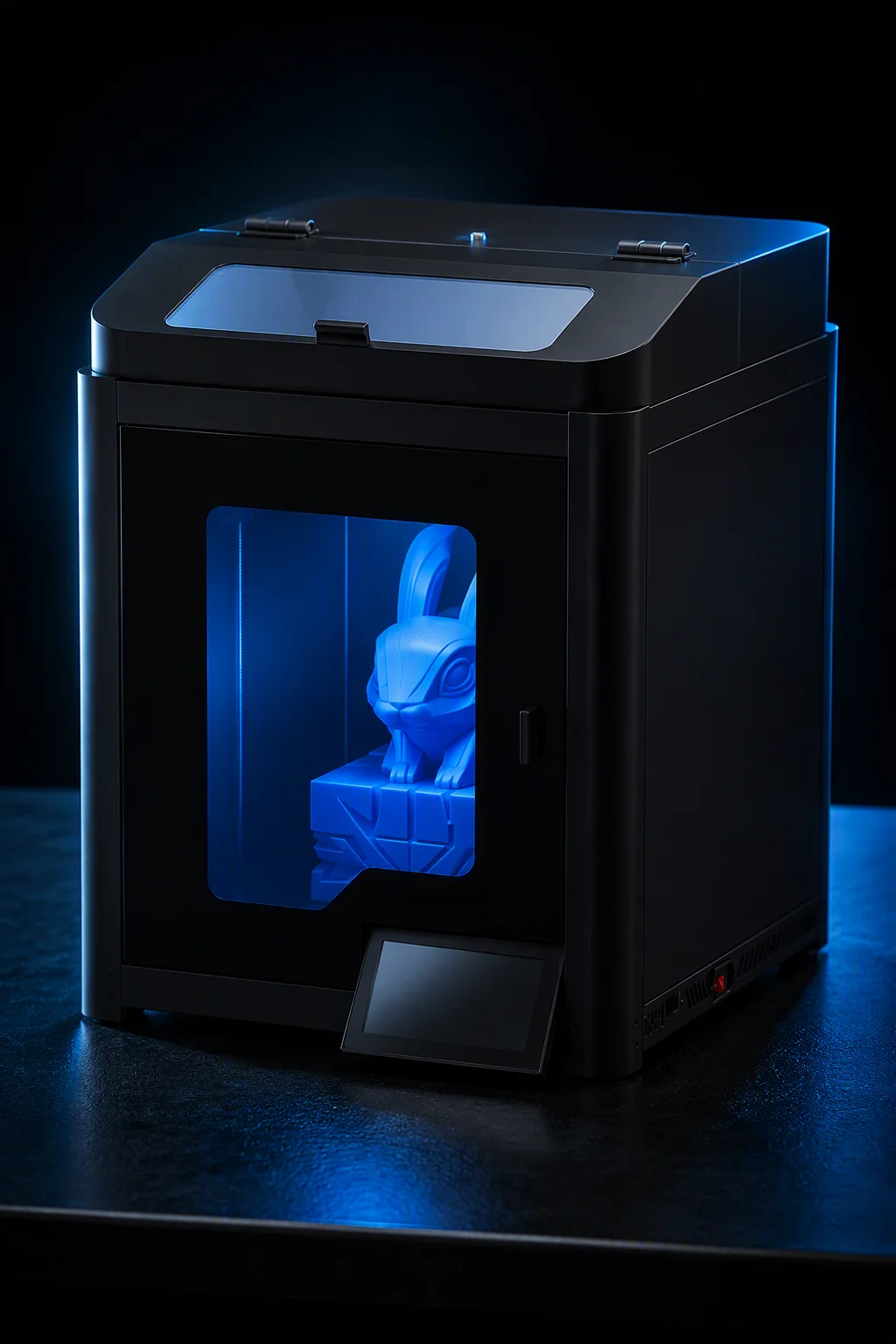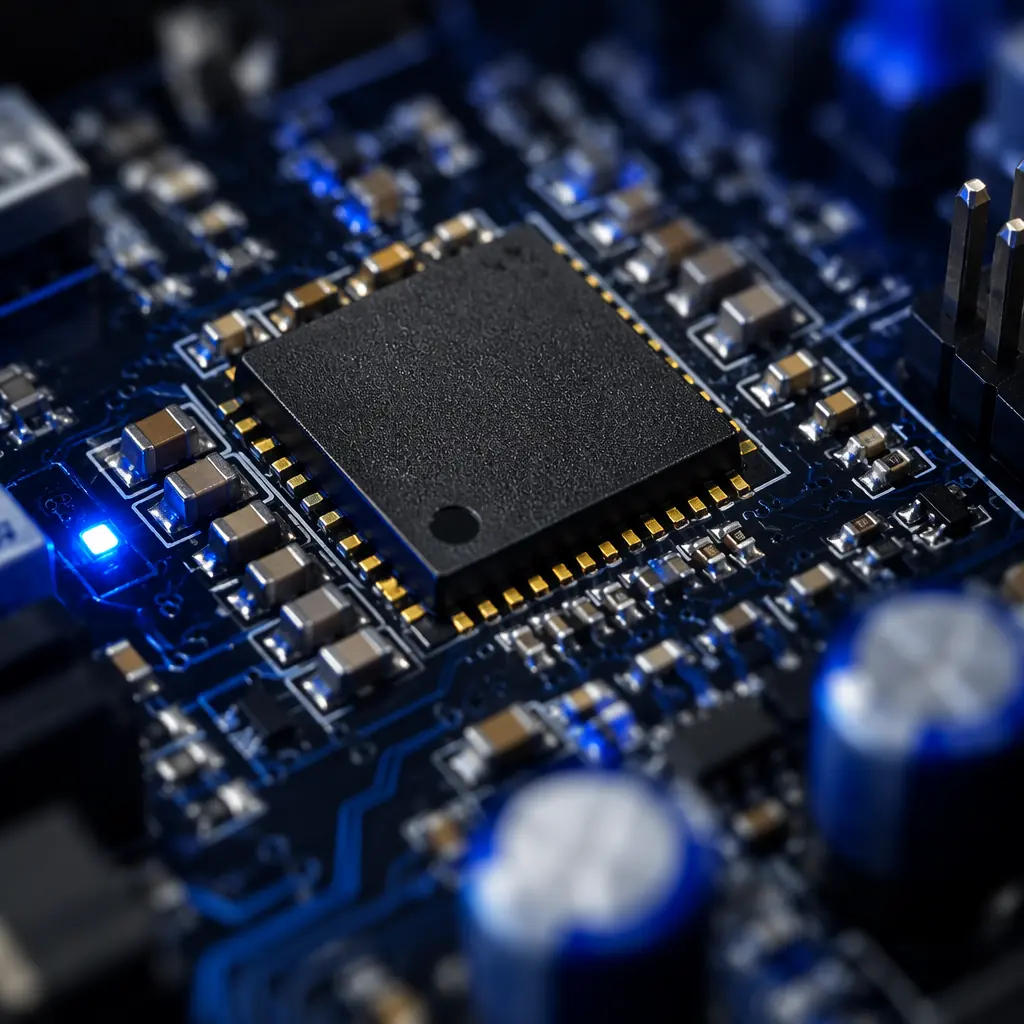
When a customer unboxes a 3D printer, the first thing they judge is the first layer. The second thing — often within 30 seconds — is the noise. A printer with A4988 drivers sounds like a dying dot-matrix printer from 1987. A printer with TMC2209 drivers in StealthChop mode is quiet enough to sit on a desk in an open-plan office. The component responsible for this difference costs roughly $3 at the bill-of-materials level. Understanding stepper driver technology — and the motherboard ecosystem it plugs into — is one of the most concrete ways a distributor can differentiate their product line. This guide covers the four driver generations on the market, what 32-bit vs 8-bit actually means for print quality, and the spec combinations that predict high return rates before they happen.
What a Stepper Driver Actually Does
A stepper motor moves in discrete angular steps — typically 1.8° per full step, meaning 200 steps per revolution. But a full step is coarse: at 1.8°, a 20-tooth GT2 pulley moves the belt roughly 0.2mm per step. That's far too coarse for 3D printing, where layer heights of 0.1mm are standard and XY positioning accuracy needs to be below 0.05mm. The stepper driver solves this by microstepping: it divides each full step into smaller sub-steps by precisely controlling the current in the motor's two coils. A driver running at 1/16 microstepping divides each 1.8° full step into 16 sub-steps of 0.1125°, giving effective positioning resolution of approximately 0.0125mm on the XY axes.
The driver doesn't just chop steps — it controls current, manages heat dissipation, and (in modern drivers) implements advanced features like sensorless homing and stall detection. It is the single component that translates a digital signal from the microcontroller into the physical motion of the print head. A poorly chosen driver produces noisy prints with visible artifacts (salmon skin, VFAs); a well-matched driver, combined with a quality motion system, produces prints that are physically indistinguishable from injection-molded parts at arm's length. Our motion system comparison guide covers how the mechanical side interacts with driver quality.
The Four Driver Generations: A4988 Through TMC5160
Stepper drivers for consumer 3D printers fall into four clear generations. Each generation adds specific features — but the feature that matters most to customers is noise reduction, and the technology behind it has a name: StealthChop.
A4988 — the noisy workhorse:
Introduced by Allegro Microsystems, the A4988 was the standard driver in the RepRap era and is still found in the absolute cheapest printers. It runs at 1/16 microstepping maximum and uses a simple chopper circuit that produces the characteristic "singing" sound — the motor coils vibrate at audible frequencies because the current regulation is unsophisticated. The noise isn't just an annoyance; the vibration it represents translates directly into fine vertical artifacts on print surfaces. An A4988-driven printer will never produce the surface finish of a TMC-driven printer at the same layer height. The A4988 runs hot — 80–100°C at full current without active cooling — and lacks thermal shutdown protection. If a distributor is evaluating a printer that ships with socketed A4988s, the first value-add is a TMC2209 upgrade kit bundled with the sale.
DRV8825 — the trap:
Texas Instruments' DRV8825 solved the microstepping limit (1/32) but introduced a worse problem: extremely non-linear microstep positioning. At low currents, the microsteps were unevenly spaced, producing a distinctive "DRV8825 salmon skin" pattern on print surfaces — a regular, diagonal ripple texture that is instantly recognizable to experienced users. The driver also runs significantly hotter than the A4988 at equivalent current. There is no price point in 2026 where a DRV8825 is a defensible choice; it has been fully superseded by the TMC2208 at equivalent cost. If a manufacturer is still shipping DRV8825s, they are using up old inventory — and that says something about their supply chain priorities.
TMC2208 — the breakthrough:
Trinamic's TMC2208 introduced StealthChop2, a voltage-controlled chopper algorithm that drives stepper motors at frequencies above human hearing (~20 kHz). The result: near-silent operation. A printer with TMC2208s is roughly 20 dB quieter than the same printer with A4988s — in perceptual terms, that's the difference between "need to put this in the garage" and "can run it on my desk while on a Zoom call." The TMC2208 also brought 1/256 microstepping, but at practical speeds the microstep resolution above 1/16 is smoothed by the mechanical inertia of the motor — the real benefit of the TMC2208 is noise, not resolution. The limitation: 1.2–1.4A RMS current capacity, which is fine for NEMA 17 motors in standard bedslingers but insufficient for the larger motors in CoreXY machines printing at 300+ mm/s. The Precise3D Creator C1 uses TMC2208s on X and Y axes — the build volume and print speeds don't demand more current, so the silent-driver experience is delivered without the cost of 2209s.
TMC2209 — the sweet spot:
The TMC2209 is the TMC2208 with three critical upgrades: higher current capacity (up to 2.0A RMS), StallGuard sensorless homing, and CoolStep current control. Sensorless homing eliminates the need for physical endstop switches — the driver detects the spike in motor current when the axis hits its mechanical limit and stops immediately. This reduces wiring complexity, eliminates a mechanical failure point (worn microswitches are a top-5 cause of support tickets), and enables faster homing sequences. CoolStep dynamically adjusts motor current based on load: the driver reduces current when the motor is coasting and increases it when load spikes. In practice, this reduces motor temperature by 10–20°C during long prints. The Precise3D Creator C1 uses a TMC2209 on the Z axis specifically for its stall detection — the Z homing sequence uses sensorless detection at the bed surface, eliminating the need for a Z endstop that drifts with temperature.
TMC5160 — the professional tier:
The TMC5160 is fundamentally different from the TMC2209. Where the 2209 handles motion control in the driver itself (standalone mode), the 5160 is designed for SPI/UART communication with the mainboard — the microcontroller sends high-level motion commands (position, velocity, acceleration) and the 5160 executes them independently with its own onboard motion controller. The practical advantage: the 5160 can handle motor currents up to 4.5A RMS with external MOSFETs, enabling it to drive the high-torque 48V stepper motors found in professional CoreXY machines. At 48V with a 0.9° stepper motor, the 5160 delivers positioning resolution under 0.005mm — the threshold where layer lines become invisible to the naked eye. The TMC5160 also implements DcStep, which allows the driver to maintain torque at velocities where a 2209 would stall. For a printer targeting 500+ mm/s travel moves with a heavy toolhead — the Precise3D Pro X1's operating range — 5160 drivers are not an upgrade option; they are a prerequisite. For comparison with other pro-tier component choices, see our kinematics guide, where driver requirements for CoreXY machines are explained in the context of the full motion system.
StealthChop vs SpreadCycle: Why Print Speed Dictates Driver Mode
Trinamic drivers can operate in two fundamentally different modes, and the choice between them depends on print speed — not price tier. This is the single most misunderstood aspect of stepper driver technology in consumer 3D printing.
StealthChop2 is voltage-controlled: the driver applies a sinusoidal voltage waveform to the motor coils, producing near-perfectly silent operation. The catch is that voltage control becomes inaccurate at high step rates — above approximately 200–300 RPM for a typical NEMA 17 motor, the back-EMF from the motor's own rotation begins to distort the applied voltage, and the driver can no longer maintain accurate microstep positioning. In practical terms: StealthChop works beautifully up to about 100–120 mm/s print speed on a standard bedslinger. Above that, the microsteps start to drift, producing subtle but visible surface artifacts.
SpreadCycle is current-controlled: the driver measures coil current through a sense resistor and adjusts the chopper duty cycle in real time to maintain the exact target current at each microstep position. This is inherently noisier — the chopper operates at a lower frequency — but it maintains accurate positioning at any speed the motor can physically achieve. SpreadCycle is the correct mode for print speeds above 150 mm/s and for all travel moves above 200 mm/s.
The smart implementation — used in Klipper and modern Marlin builds — is hybrid mode: StealthChop for print moves below a configurable speed threshold (e.g., 120 mm/s) and automatic switching to SpreadCycle for travel moves and high-speed prints. This delivers silent printing at normal speeds without sacrificing accuracy during acceleration. A motherboard/firmware combination that supports hybrid mode is one of the strongest selling points at the $299–599 range — it means the printer is quiet when the customer wants quiet and precise when the customer wants speed. Our high-speed printing guide covers how input shaping and pressure advance interact with driver mode selection.
32-Bit vs 8-Bit Motherboards: The Processor Gap
The stepper driver controls the motor, but the motherboard's microcontroller tells the driver what to do — and the 8-bit vs 32-bit divide is the second-most important spec after the driver chips themselves.
8-bit boards (ATmega2560, RAMPS-era): These processors run at 16 MHz with 256 KB of flash and 8 KB of SRAM. They struggle with multiple tasks simultaneously: processing G-code, computing kinematics, updating the display, and handling USB communication all compete for a single-core processor with no floating-point unit. The practical ceiling is roughly 60–80 mm/s print speed with 1/16 microstepping — above that, the processor can't compute step pulses fast enough, and the printer stutters. 8-bit boards also cannot run advanced features like input shaping or pressure advance because those algorithms require floating-point math that the ATmega performs 10–50x slower than a 32-bit ARM processor. If a manufacturer is still shipping an 8-bit board in a $199+ printer in 2026, they are prioritizing BOM cost over user experience — and the returns data will show it.
32-bit boards (STM32, ESP32, RP2040): A typical STM32F407 at 168 MHz with a hardware FPU can process kinematics roughly 20x faster than an ATmega2560. This enables: 1/128 or higher microstepping at high speeds without stuttering, real-time input shaping computed per-layer, pressure advance with fast extrusion changes, and responsive touchscreen UIs with graphical print previews. The difference isn't theoretical — a 32-bit board running Klipper can maintain smooth motion at 500 mm/s with 1/256 microstepping, while an 8-bit board running Marlin at the same speed with 1/16 microstepping produces visible stepping on curved surfaces. For the in-depth firmware comparison that determines which features are available on each board type, see our Klipper firmware guide.
One note on ESP32 boards: they offer built-in WiFi and Bluetooth, which is appealing for cloud-connected features. However, the ESP32 has fewer hardware timers than an STM32, which limits the number of stepper motors it can drive simultaneously at high microstep rates. ESP32 boards are viable for bedslingers and simple CoreXY machines with up to 4 stepper motors; for IDEX or tool-changer systems with 6+ motors, STM32 is the correct choice. For a complete platform comparison including IDEX configurations, see our IDEX distributor guide.
Integrated vs Socketed Drivers: The Repairability Factor
Motherboards come with stepper drivers either soldered directly to the PCB (integrated) or installed in removable sockets (socketed). This design choice affects warranty claim rates, upgrade paths, and the customer's perception of the printer as a maintainable tool vs a disposable appliance.
Integrated drivers save board space and BOM cost — no sockets, no pin headers, no separate driver PCBs. They also enable better thermal management because the driver chips can share the motherboard's ground plane for heat dissipation. The Precise3D Creator C1 uses an integrated design with TMC2208/2209 drivers soldered directly to the STM32-based mainboard. The trade-off: if a driver fails, the entire motherboard is replaced — a $40–60 part. However, driver failure is extremely rare (below 0.1% over 5 years in Precise3D's warranty data) when the board is designed with proper current limiting and thermal protection. For a consumer printer at the $199–449 range, the cost-benefit analysis favors integrated drivers: the failure rate is too low to justify the added BOM cost of sockets, and most customers in this segment will never upgrade individual drivers.
Socketed drivers are common on open-source boards (BTT SKR series, MKS Robin) and appeal to the enthusiast market. The user can swap drivers to upgrade from A4988 to TMC2209, replace a failed driver in 30 seconds, or mix driver types (TMC5160 on XY, TMC2209 on Z and E for cost optimization). For a distributor targeting the hobbyist/enthusiast segment, socketed drivers are a selling point — the upgrade path is tangible and the repairability signals build quality. However, socketed drivers introduce their own failure mode: poor pin contact due to vibration can cause intermittent motor stalling that is extremely difficult to diagnose. A well-designed socketed board includes locking connectors or screw terminals, not just friction-fit pin headers. Our maintenance guide covers how to diagnose and resolve the intermittent contact issues that socketed drivers sometimes cause.
Price Tier Mapping: What Driver+Board Combo Belongs Where
The stepper driver and motherboard are a paired decision — the driver's capabilities are limited by the board's processing power, and the board's value is determined by the drivers running on it. Here is the correct pairing at each consumer price tier, based on Precise3D's product development data and competitive benchmark analysis.
The red flags column is the practical distillation of this guide. At $149–199, an A4988 driver is a dealbreaker: the printer will be loud enough to generate negative reviews regardless of print quality, and the return rate for "too noisy" will spike in the first month. At $199–349, TMC2209s that don't implement sensorless homing are leaving a feature on the table — the hardware supports it, and the firmware that doesn't use it is effectively wasting BOM cost. At $599+, TMC2209s on XY in a printer advertised at 300+ mm/s will hit the StealthChop speed ceiling, forcing SpreadCycle mode with its higher noise — undermining the "silent printer" marketing claim at the exact speeds the customer bought the printer to use. For the complete component selection strategy across all subsystems, see our portfolio strategy guide.
What the Driver Spec Tells You About the Manufacturer
The stepper driver selection is one of the most reliable proxy signals for overall manufacturing quality. Here is how to read the tea leaves — and how Precise3D's component choices differ by segment.
Genuine Trinamic vs clone drivers:
Genuine TMC chips from Trinamic (now part of Analog Devices) cost $2–8 per chip and include factory-calibrated current sensing. Clone chips — typically marked "TMC2209" on AliExpress but manufactured by third parties — cost $0.50–1.50 and vary wildly in current accuracy, thermal behavior, and StealthChop implementation quality. A clone 2209 might produce StealthChop with 3 dB more noise than genuine or fail to switch to SpreadCycle cleanly at the threshold speed, producing a distinctive "chirp" during acceleration. Our certification guide covers how to verify component authenticity as part of a broader supply chain audit.
Heatsink quality:
TMC drivers running above 1.0A RMS require heatsinks. A properly designed board uses adhesive thermal pads with >1.5 W/mK conductivity and aluminum heatsinks with at least 10 fins. A poorly designed board uses generic double-sided tape — thermal conductivity ~0.2 W/mK — and heatsinks that fall off during shipping. This is visible in teardown photos. If the heatsink is attached with what looks like office tape, the printer will experience thermal shutdown on long prints and the return rate for "printer stopped mid-print" will be 3–5x the industry average.
The firmware tells the full story:
A manufacturer that uses TMC2209s but ships Marlin configured for A4988-style standalone mode (no UART communication) is shipping drivers in "dumb" mode — no StealthChop, no sensorless homing, no hybrid threshold switching. The TMC2209 operates as a slightly quieter A4988. This is a cost-cutting pattern: the BOM says "TMC2209" for the spec sheet, but the firmware doesn't use any of the features that justify the chip's cost. A manufacturer that configures UART communication, enables StealthChop2, sets hybrid thresholds correctly, and implements sensorless homing is a manufacturer that has engineers who understand the component, not just a purchasing department that found a good price.
At Precise3D, every printer ships with genuine Trinamic drivers in UART mode with fully configured features. The Creator C1's firmware implements StealthChop2 for all axes below 120 mm/s with automatic SpreadCycle fallback, sensorless homing on Z, and per-axis current control calibrated to the specific motor model in each unit — not a one-size-fits-all current table. The Pro X1 adds TMC5160s on all axes with DcStep and full SPI motion control. No clone chips, no standalone mode, no firmware features left disabled. That is the difference between a spec sheet bullet point and an engineered product.
Bottom Line
The stepper driver is a $3–15 component per axis. Across a 4-axis printer, the difference between A4988s and TMC2209s is roughly $30 at the BOM level — and it is the difference between a printer that gets returned for "too noisy" and one that earns a 5-star review for "surprisingly quiet." The motherboard processor is the other half of the equation: a 32-bit board with a hardware FPU enables features (input shaping, pressure advance, high-speed microstepping) that an 8-bit board physically cannot run. For distributors, the driver+board combination should be one of the top 3 evaluation criteria — right alongside the kinematics architecture and the hotend/extruder system. These three subsystems together determine 80% of the user experience. The remaining 20% — build volume, touchscreen, filament sensor — are optimization. The drivers are the foundation. At Precise3D, every printer in the lineup is built on genuine Trinamic drivers with fully configured UART/SPI communication, and every motherboard is 32-bit STM32. Because the silent first impression — like the first layer — is one you only get once.
Reviewed by the Precise3D engineering & OEM team. Compliance files that accompany the catalog are auditable at the certification register.
Start Your Partnership
Ready to Bring stepper drivers motherboard to Your Market?
Start with the stepper drivers motherboard spec sheet, then validate every claim against the certification register.