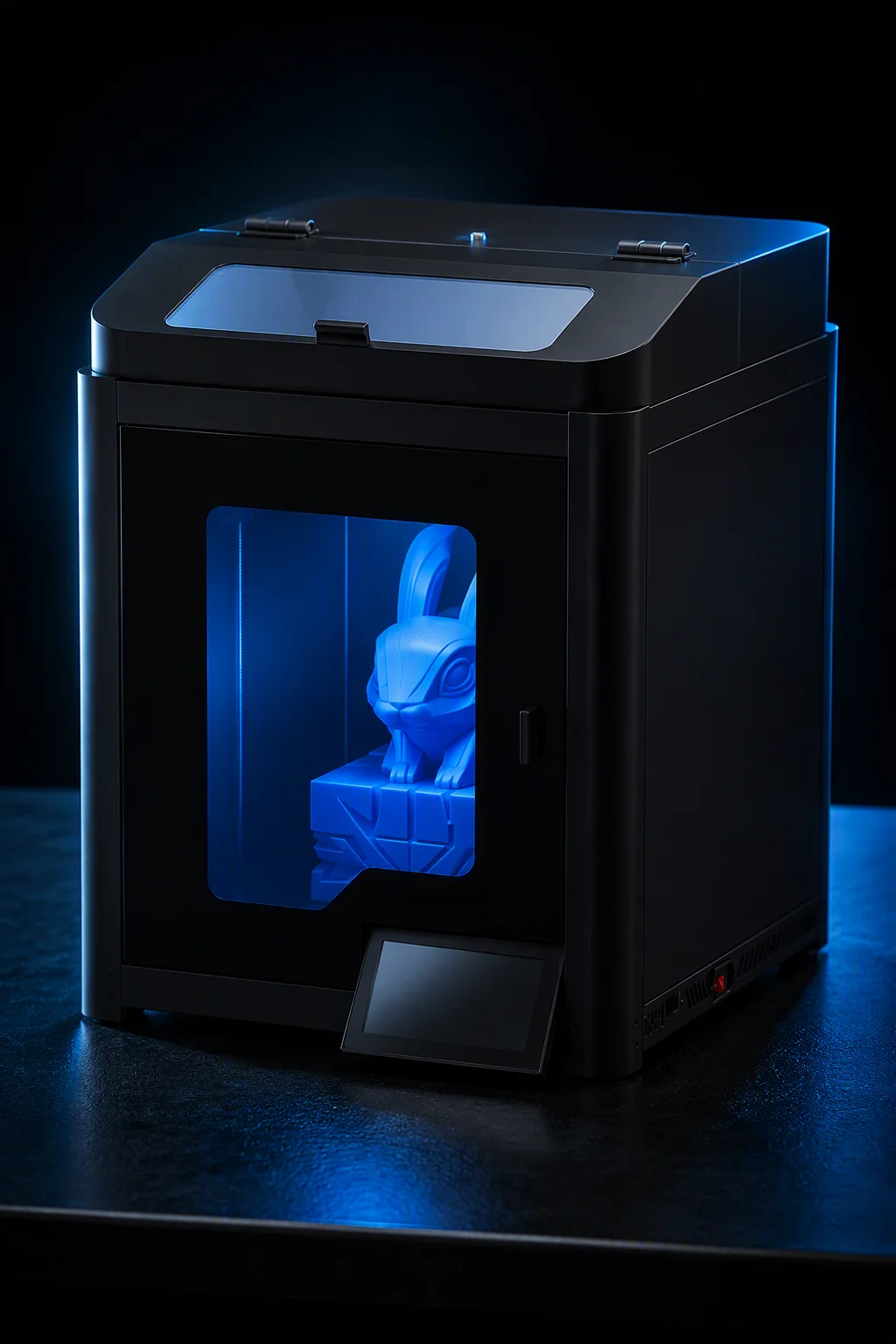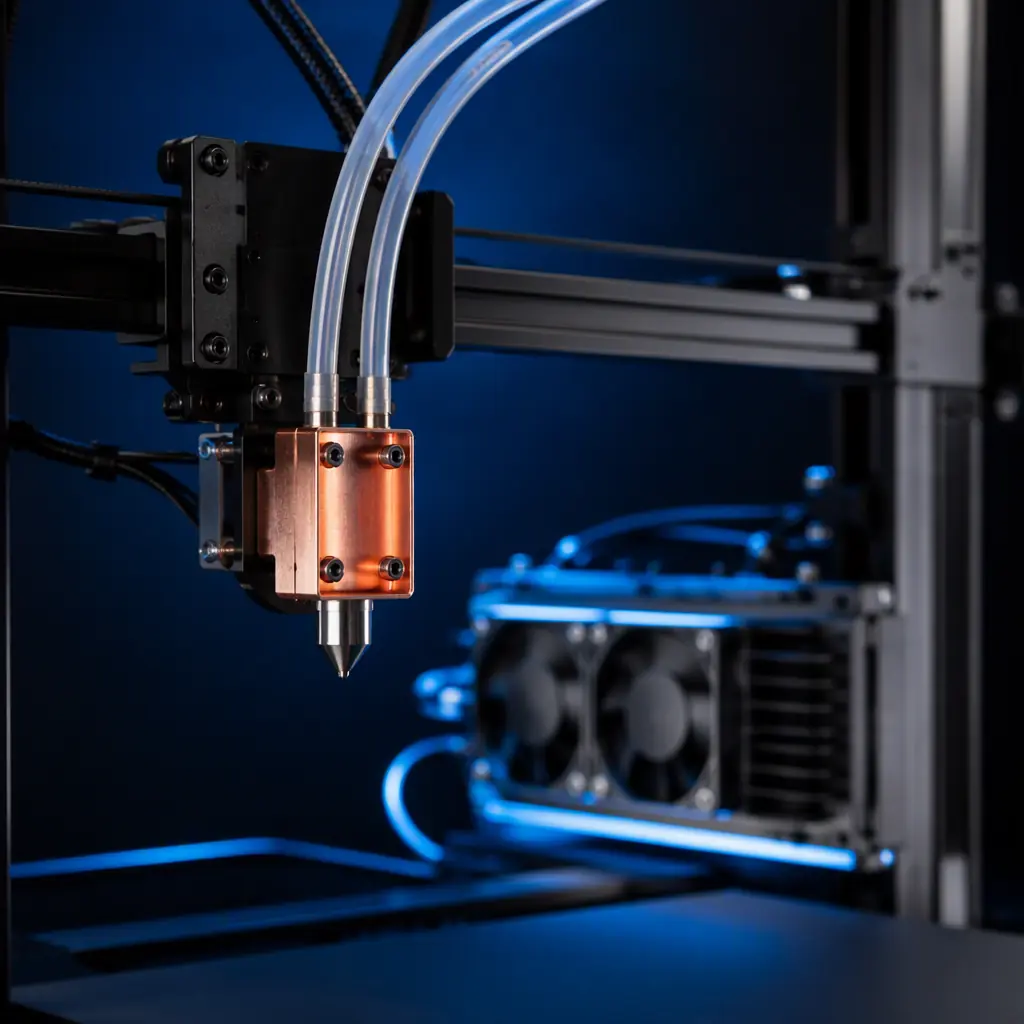
A print farm running 24 enclosed CoreXY machines switched its 0.6 mm high-flow hotends to water cooling after a summer of heat-soak jams: chamber temperatures were holding at 52°C, the extruder steppers were tripping at 70°C, and each jam cost 4-6 hours of lost production. The conversion, a $58 water block, a shared 240 mm radiator, and silicone tubing per machine, cut hotend temperature variance from ±12°C to ±3°C, ended the heat-soak jams, and paid for itself in the first 11 days of uptime. Water cooling is no longer a PC-modding curiosity; for high-speed printers, enclosed chambers, and print farms it is becoming a reliability specification.
Why Hotends Overheat in the First Place
Three forces push modern hotends past what air can handle. First, heater power: high-flow hotends run 60-80 W heaters to sustain 20-30 mm³/s volumetric flow, and a 0.6-1.0 mm nozzle at 260-300°C radiates far more heat than a 0.4 mm nozzle at 210°C. Second, enclosed chambers: a heated chamber at 45-60°C robs the hotend fan of its temperature differential. The air moving across the heat sink is already hot, so cooling capacity collapses exactly when the machine is printing engineering materials that need it most. Third, heat creep: without effective heat-sink cooling, heat conducts up the heat break into the cold zone, softening filament 20-40 mm above the melt zone and causing jams that are intermittent and maddening to diagnose. The thermal design trade-offs between all-metal and PTFE hotends are covered in our hotend comparison guide, and the air-side solution space in our part cooling guide.
What a Water-Cooling System Contains
A complete kit has six components, and a distributor who understands each one can sell upgrades instead of boxed sets:
Water has roughly 25x the specific heat capacity of air by volume, which is why a small block can move heat that would require a large, loud fan array. In a multi-printer farm, one shared radiator and pump loop can serve 4-6 machines, which is where the economics get serious. The electronics side matters too: cooling the extruder stepper motor and, in extreme cases, the mainboard VRM regulators with small water blocks prevents the step-loss failures that plague enclosed high-speed machines, the same class of electronics reliability covered in our stepper drivers & motherboard guide.
Water Cooling vs Air Cooling: The Honest Comparison
The honest framing: water cooling is not "better" for a hobbyist printing PLA in an open frame. A $20 fan upgrade is the right answer there. It wins in three specific conditions: enclosed chambers above ~45°C, high-flow nozzles (0.6 mm+) sustaining high volumetric rates, and multi-printer operations where jam downtime is measured in lost production dollars. For the high-speed printing context where this matters most, see our high-speed printing guide.
Where Water Cooling Wins: The Four Buying Scenarios
Four customer profiles actually purchase water-cooling systems, and they buy for different reasons:
1. Enclosed-chamber engineering users. Printing PEEK, PEI, PC, or nylon in a 50-60°C chamber. Air simply cannot reject heat into already-hot air; water moves it outside the chamber to the radiator. This is the largest single use case, and it pairs naturally with the chamber-temperature requirements in our enclosure temperature control guide.
2. High-flow speed demons. Users running 0.6-1.0 mm nozzles at 25-35 mm³/s who push 80 W heaters to the edge. Water keeps the heat break cold and prevents the creep jams that appear at the 6-8 hour mark of long prints, the exact failure mode analyzed in our print failure diagnosis guide.
3. Print farms optimizing uptime. A farm with 20+ enclosed machines measures every jam in lost billable hours. Water cooling plus remote monitoring is the reliability stack; our print farm operations guide covers the economics of that uptime math.
4. Noise-sensitive offices and labs. Design studios and university labs that cannot tolerate 60 dB fan walls. Water cooling drops sustained noise 15-25 dB, which is why it pairs with the silent-operation upgrades covered in our noise reduction guide.
Risks and Installation: The Real Failure Modes
Water cooling fails in three predictable ways, and a distributor who trains customers on them converts skeptics:
Leaks.
Almost always at fittings, not the block. Barb fittings with worm clamps fail when cheap tubing softens at 40°C+; the fix is silicone tubing with push-fit fittings, tested at 24 hours before installation. A leak dripping onto a live 60-80 W heater is a genuine fire risk, which is why leak testing is non-negotiable. The safety baseline for hotend electronics is covered in our safety & thermal runaway guide.
Pump failure.
The most common failure is a pump that quietly stops, turning the water block into a heater. Modern kits mitigate with flow sensors that trigger a thermal-runaway-style abort; distributors should stock the flow-sensor variant and never the bare loop.
Contamination and algae.
Tap water kills loops in months (mineral scaling). Distilled water with a biocide, changed quarterly, is the maintenance contract. This recurring consumable is exactly the kind of aftermarket revenue stream documented in our maintenance guide.
The Distributor Opportunity: Water Cooling as an Accessory Category
Water cooling is a textbook high-margin accessory: it attaches to printers people already own, solves a specific reliability pain, and generates recurring consumable sales. The economics:
A distributor with 100 enclosed-printer customers converting 20% per year to water cooling generates roughly $6,000-12,000/year in kit margin plus $1,800-3,600 in coolant and service revenue, with zero new printer sales required. The accessory-bundling mechanics behind this are developed in our accessories bundling guide.
Getting Started: The First 90 Days
A 90-day entry plan: Month 1 . Qualify two or three kit suppliers on leak-test standards and flow-sensor integration, stock two SKUs (single-machine kit, farm loop kit), and train your tech team on a leak-test jig. Month 2 . Run a reference install on your own demo machine and document before/after temperature variance and noise readings; publish the data sheet. Month 3 . Launch a "chamber-season bundle" promotion for enclosed-printer customers (kit + installation + first-year coolant), and add water cooling to every new enclosed-printer quote as a recommended option. The PSU and power-budget implications of adding pumps and radiator fans are covered in our PSU selection guide.
Reviewed by the Precise3D engineering & OEM team. Compliance files that accompany the catalog are auditable at the certification register.
Upgrade Your Accessory Line
Ready to Stock Water-Cooling Kits?
Get wholesale pricing on leak-tested hotend water blocks, complete kits, and farm loop systems, plus the installation training and data sheets that close reliability-minded customers.