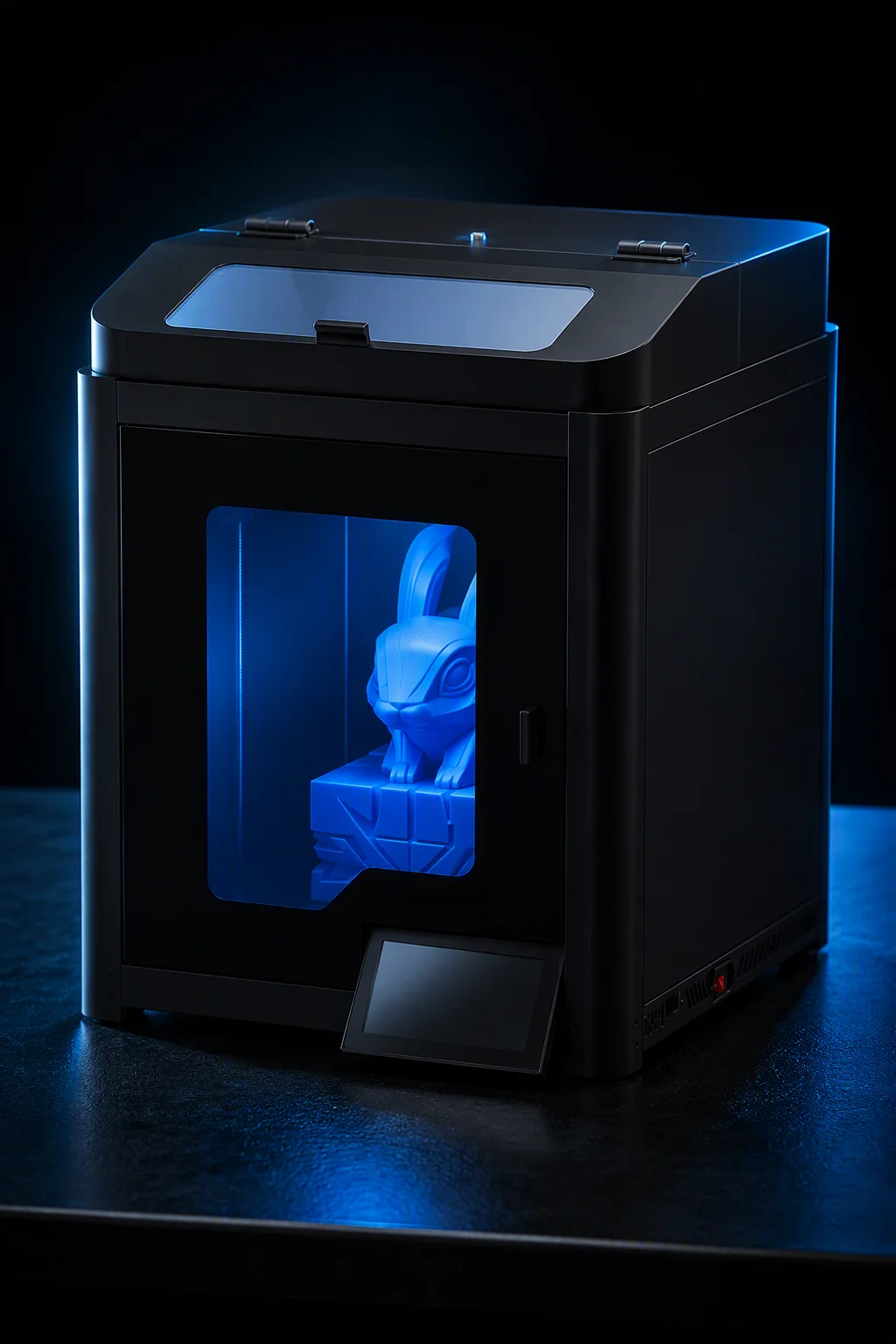
A game store in Ohio sold $41,000 of resin printers, wash/cure stations, and resin in its first 12 months of carrying them — more than its entire miniature wholesale line for the same period. The owner's observation: every customer who walked in asking about a $60 box of unpainted miniatures was one session away from buying a $400 printer. Tabletop gaming is the rare consumer market where the product is a consumable (resin), the workflow demands accessories (wash/cure stations, gloves, UV lamps), and the community generates endless word-of-mouth. For a 3D printer distributor, it is the easiest consumer vertical to enter and the fastest to build recurring revenue in.
Why Resin Is the Default for Miniatures
Miniature painters care about three things: surface detail, layer visibility, and time to paint-ready. Resin printing wins all three against FDM. A 4K/8K LCD resin printer resolves features down to 0.05 mm or better — fine enough to reproduce a sculpted face, chainmail texture, or gun barrel rifling without visible layer lines. Standard FDM at 0.12 mm layers still shows stepping on curved surfaces, which is why serious miniature painters almost universally choose resin. The tradeoff is handling: liquid resin requires gloves, ventilation, and post-processing. That tradeoff is precisely the distributor's opportunity — it creates a natural bundle. For the technical comparison behind the recommendation, see our FDM vs resin guide.
The buyers split into two groups: hobbyists printing for themselves (70% of units) and print-on-demand operators serving game clubs and commission painters (30%). Both groups buy the same hardware but different consumable volumes — a commission painter can burn through 5-8 bottles of resin a month at $30-45 per 1 kg bottle.
The Hardware Bundle That Sells
The winning sale is not a bare printer — it is a complete paint-ready kit. The bundle that closes hobby accounts:
The average basket: printer $280-450, wash/cure $120-200, resin $90-135, safety kit $25-40 — a $515-825 first purchase at roughly 35% blended margin, versus a $350-600 margin on a single FDM printer sale with a one-time filament purchase. Resin's consumable economics are the reason this vertical outperforms: a typical hobbyist reorders 1-2 kg of resin monthly, which is why our consumables subscription model converts so well here.
Material Margins: Where the Recurring Revenue Lives
Resin is the most profitable consumable in consumer 3D printing. Standard 8K grey resin costs a distributor $9-13 per kg at volume; retail lands at $30-45 per kg — a 3x markup that filaments cannot match. Specialty resins push margins higher:
Compare that to the filament side of the business: premium PLA/PETG carries 45-55% margins at best. Resin's combination of higher markup and faster reorder cycles (a painter reorders resin 2-3x more often than an FDM user reorders filament) makes it the single best recurring-revenue line a consumer-focused distributor can carry. For the full material portfolio argument, see our filament stocking guide and our resin types guide.
The Paint-Ready Workflow as a Sales Tool
New hobbyists fear the workflow, not the machine. The distributor that teaches the workflow wins the account. The standard paint-ready pipeline:
1. Print (20-60 min per miniature at 0.05 mm). A 4K resin printer at 0.05 mm layers produces a 32 mm miniature in 25-45 minutes with 3-5 per build plate.
2. Wash (3-6 min in isopropyl alcohol or wash station). Agitated IPA at 96%+ concentration; water-washable resin substitutes plain water — a selling point for apartment-dwelling hobbyists who cannot store IPA.
3. Cure (4-8 min in a cure station). 405 nm UV curing locks mechanical properties; under-curing leaves tacky surfaces, over-curing makes parts brittle.
4. Prime and paint. The printed miniature is ready for primer immediately after curing — no supports to remove on a well-oriented part, no sanding required on 4K surfaces.
Every step except painting consumes a product you sell. The workflow is the upsell engine: a customer who buys only the printer comes back for the wash/cure station within 2-3 weeks once they realize hand-washing in a jar of IPA is miserable. Our wash/cure bundling guide covers this upgrade path in detail.
Winning the Hobby Shop and Game Club Account
Two account types dominate the vertical, and they buy differently:
Hobby and game shops (retail).
The shop is your showroom, demo space, and reorder point rolled into one. The pitch: a demo printer on the counter, a starter bundle on the shelf, and a 60-minute "paint your first miniature" workshop that generates 5-10 new printer sales per event. Shops take 25-35% of your retail margin as their cut, which still leaves you 25-35% at wholesale. The workshop model is the same playbook our demo lab guide describes for B2B — it works even better in retail because the audience is already spending on the hobby.
Game clubs and print-on-demand operators (volume).
Clubs pool money for a printer and resin supply; POD operators run 2-4 printers continuously and sell painted miniatures or STL prints to commission. They buy printers less often but consume 3-5x the resin of a hobbyist — and they are the best reference accounts in the vertical. For the multi-printer economics that make POD operators viable, see our print farm economics guide.
Seasonal and Community Demand Cycles
Tabletop demand is seasonal, and the cycles are predictable: Q4 holiday gifting and tournament season drive November-February sales; new game edition launches and Kickstarter fulfillment waves create mini "gold rushes" of people who need minis printed fast. A distributor who watches the community calendar can time promotions: announce a printer + resin bundle when a major game studio announces a new edition, and have stock ready for the Kickstarter wave 6-9 months later. The seasonal planning discipline that keeps inventory right is covered in our seasonal inventory guide.
Community is the moat. Tabletop players talk — a happy club account in a city of 500k reaches every hobbyist in that city within a quarter. Running (or sponsoring) a monthly "miniature painting night" at your shop account, posting build-plate photos on the community channels, and answering resin questions publicly builds the local reputation that no ad budget can buy. This is the same community-loyalty mechanism we document in our community & loyalty guide.
Common Pitfalls in the Tabletop Vertical
Five failures account for most lost accounts: (1) selling printers without a wash/cure station in the bundle — the customer's first hand-washed print is often their last print, and they blame the printer; (2) under-stocking resin SKUs — running out of grey resin at the start of a tournament season hands the customer to a competitor; (3) ignoring the ventilation and safety conversation — a customer who gets a resin rash from improper handling can sink your shop's reputation; make the safety kit part of every sale; (4) treating miniature printing as an FDM upsell — the workflow is different, the consumables are different, and mixing the two pitches confuses buyers; and (5) competing on printer price instead of bundle value — the $515-825 paint-ready kit beats a bare-printer price war every time. For the safety standards that keep resin sales defensible, see our safety features guide.
Getting Started: The First 90 Days
Month 1 — assemble the paint-ready bundle (printer + wash/cure + 3-resin starter + safety kit), print 10-15 showcase miniatures in grey, water-washable, and clear resin, and open accounts with 2-3 local game shops. Month 2 — run the first "paint your first miniature" workshops; document before/after photos of the print-to-paint pipeline; publish a local community post with build-plate shots. Month 3 — sign the first game-club or POD account, set up the monthly resin reorder (subscription or standing order), and add one specialty resin SKU (translucent or flexible) to the shelf. Tabletop pairs naturally with the broader consumer market — see our consumer electronics guide for the parallel retail playbook.
Reviewed by the Precise3D engineering & OEM team. Compliance files that accompany the catalog are auditable at the certification register.
Enter the Tabletop Vertical
Ready to Sell Resin Printing to Hobbyists?
Get wholesale pricing on resin printers, wash/cure stations, and high-margin resin programs — plus the workshop playbook that turns game shops into recurring accounts.