Aging Is a Property of the Part, Not the Resin
A material datasheet will tell you that a polymer retains 80 percent of its tensile strength after 1,000 hours at 120 degrees Celsius. That sentence is true of a moulded test bar. It is not a prediction about a printed bracket with 0.2 mm layers, a 45 degree wall and a bolted joint, because the printed part has three things the test bar does not: interfaces between layers, residual stress from thermal gradients during the build, and porosity that admits water and oxygen into the interior of the wall.
Every aging conversation that ends badly begins with someone applying a resin datasheet number to a printed geometry. The four failure modes below are what actually determine service life, and they are all testable before a production order is placed.
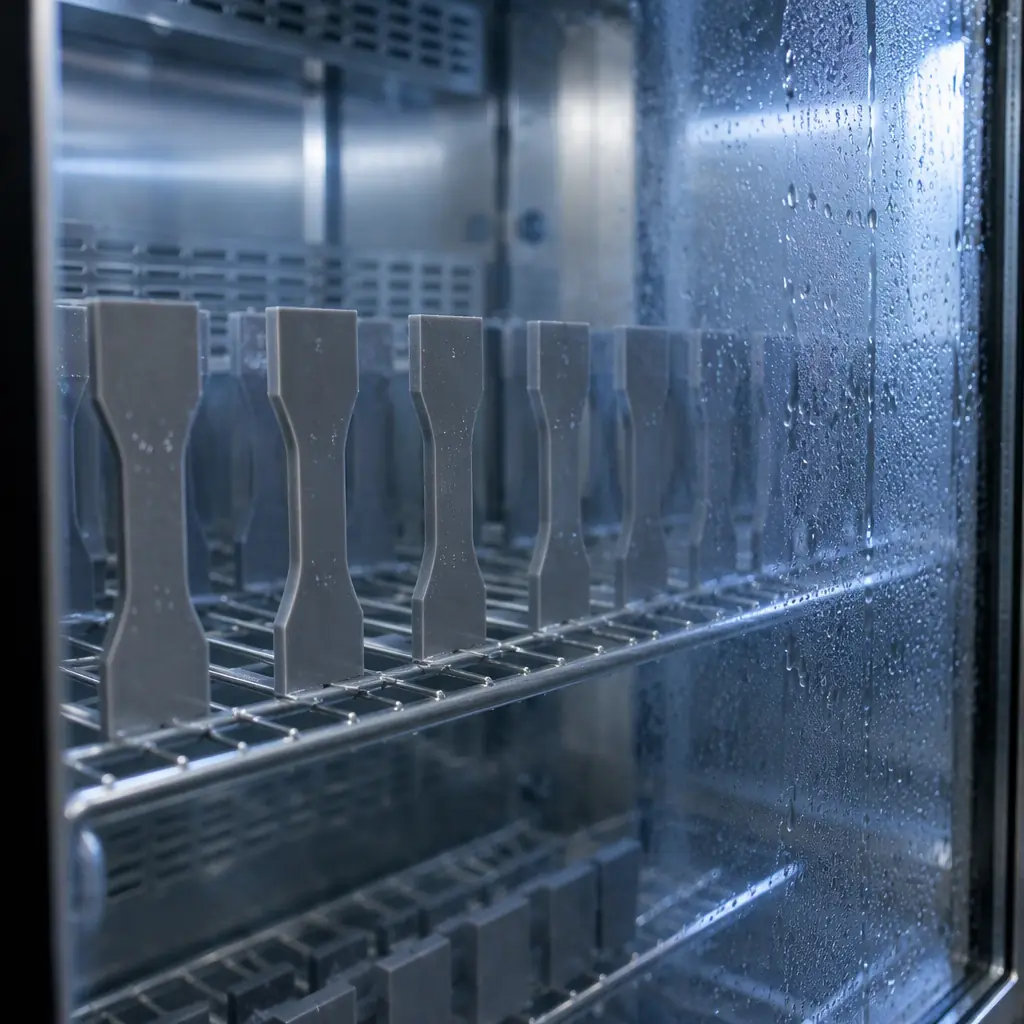
What Actually Ages in a Printed Part
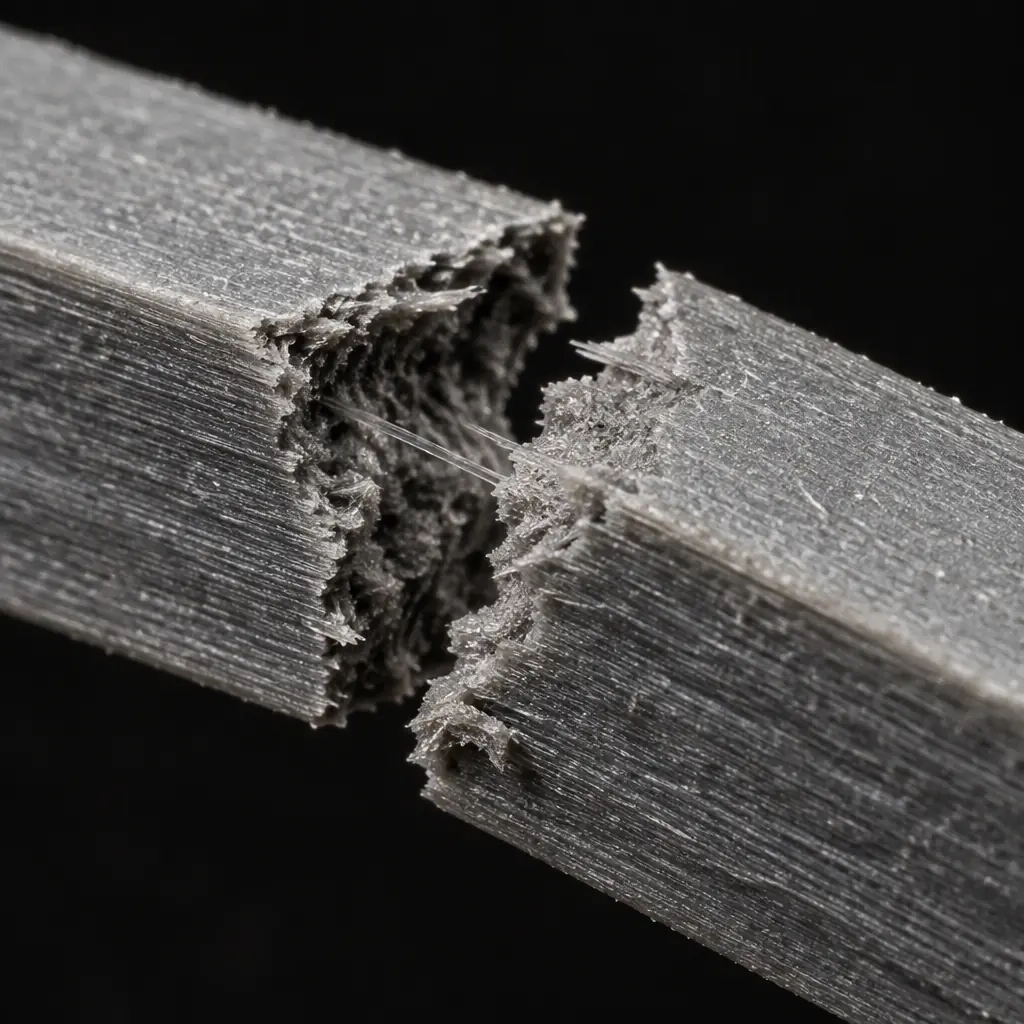
Layer interfaces. The bond between layers is a polymer weld formed at a temperature below the bulk melt, and it is the weakest plane in the part. Aging attacks it preferentially: oxidation at the interface, moisture ingress along the seam, and stress concentration at the void geometry. A printed part aged at temperature typically loses interlayer strength faster than it loses in-plane strength, so a test that measures only tensile bars printed flat will overstate the life of a part loaded across layers.
Residual stress. Every deposited layer shrinks as it cools and is restrained by the layer below. The result is a part that is already stressed before it carries any load. Annealing relieves some of it and changes dimensions in the process, which is why parts that are annealed must be measured after annealing rather than before. A part with high residual stress ages faster under load because the service stress adds to a stress that is already there. Our guide to annealing and dimension shift covers the compensation.
Porosity and the interior surface. The interior of a printed wall is a large surface area of partly bonded material exposed to whatever diffuses in. Water vapour enters through the wall, oxygen enters through the wall, and the interior oxidises and hydrolyses at a rate that has no counterpart in a solid moulding. This is why a printed part in a humid environment can fail from the inside with a surface that still looks intact.
Anisotropy under sustained load. Creep in a printed part is direction-dependent for the same reasons. A part loaded in the build plane creeps differently from one loaded across layers, and the difference can be a factor of two or more in time-to-failure at the same stress. Any accelerated aging test that does not reproduce the service load direction tests the wrong material.
Acceleration Arithmetic and Where It Stops Working
The standard shortcut is the Arrhenius relationship: reaction rate doubles for every 10 degrees Celsius, so testing at an elevated temperature compresses years into weeks. It works, under conditions that are almost never stated in the test report.
The arithmetic is simple enough to do on paper. If a part must survive 10 years at 40 degrees and is tested at 100 degrees, the acceleration factor with a 10-degree doubling rule is 2 to the sixth power, sixty-four. Three thousand six hundred and fifty days at service become fifty-seven days in the chamber. Increase the test temperature to 120 degrees and the factor is 2 to the eighth, two hundred and fifty-six, and the same life is demonstrated in fourteen days.
That calculation is where most test plans stop, and it is wrong for four reasons.
One: the mechanism changes. Acceleration is valid only while the same degradation mechanism dominates at both temperatures. Below the glass transition, a polymer oxidises; above it, it softens and creeps under its own weight. A test at 120 degrees on a material with a glass transition at 105 degrees is measuring a different failure than the one the part will experience at 40 degrees. Keep the test temperature at least 20 to 30 degrees below the glass transition unless the service temperature is also above it.
Two: the doubling rule is a guess. It assumes an activation energy of about 0.7 electron volts, which is a reasonable default for polymer oxidation and a poor one for hydrolysis or for UV. If the failure is water-driven, the relevant acceleration is moisture concentration and the relevant standard is a damp-heat or pressure-cooker protocol, not a dry oven.
Three: accelerated is not the same as equivalent. Six weeks at 100 degrees does not reproduce thermal cycling, and a part that fails by fatigue at the layer interfaces under 5,000 cycles of 20 to 80 degrees will pass a constant-temperature soak with distinction. Where the service involves cycling, the test must cycle.
Four: the failure criterion has to be chosen in advance. A test that ends when someone decides the part looks bad is not a test. Define the acceptance value before the first specimen goes in the chamber.
UV Testing and the Common Misreading
Outdoor parts age by ultraviolet exposure, and the printed part accelerates this in two ways: the surface is rougher and therefore has more area per unit of nominal surface, and the layer texture produces shadowing and repeated exposure that a smooth moulding does not have.
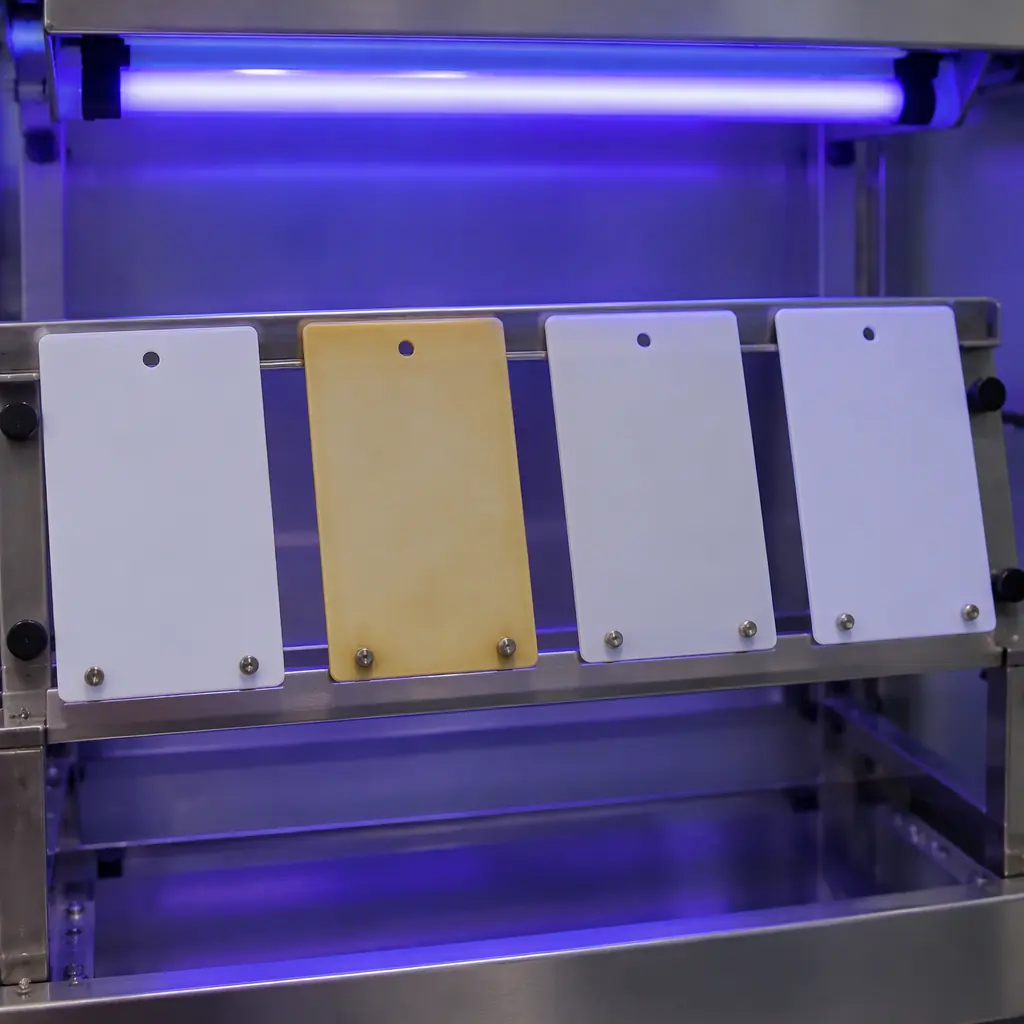
Two lamp types dominate. Fluorescent UVA-340 lamps approximate the solar spectrum in the ultraviolet region between 295 and 365 nanometres and are the sensible choice for simulating daylight. Xenon arc lamps simulate the full solar spectrum including visible light and are better when colour shift matters. Both are specified under ISO 4892, part 3 for fluorescent and part 2 for xenon, and both are run with a wet cycle if the service includes rain.
The misreading is the conversion of chamber hours to outdoor years. A figure of 1,000 hours equating to roughly one to three years of Florida or Arizona exposure is a rule of thumb for coatings, not a guarantee for a printed thermoplastic, and it moves by a factor of two depending on latitude and on whether the part faces the sun. Test reports should state the standard, the cycle, the irradiance and the acceptance criterion, and should present the result as a comparison between candidate materials rather than as a predicted service life.
Practical guidance for a distributor quoting an outdoor application: unmodified PLA fails visibly within a season and should not be offered; PETG hazes and yellows within one to two years; ASA and PC are the credible outdoor choices, with ASA better on UV and PC better on impact and temperature. Our outdoor durability guide covers the material comparison in detail, and the carbon-fibre filled filament guide explains why fibre loading improves stiffness but not UV resistance.
Heat, Load and Water at the Same Time
Real service is rarely one stressor. An outdoor bracket on a machine sees heat, sunlight, rain and a sustained load from whatever it holds, all at once, and single-factor testing systematically overstates the life of components under combined stress.
Heat plus load is creep. A printed part at 60 degrees carrying 40 percent of its short-term strength will deform continuously and eventually fail, where the same load at 20 degrees would be sustained indefinitely. The design margin for sustained load at elevated temperature is typically 4:1 against short-term strength rather than the 1.5:1 acceptable for a transient load. Our creep and fatigue guide has the modulus-versus-time curves and the stress thresholds worth respecting.
Heat plus water is hydrolysis. PA and PET hydrolyse at elevated temperature in humid air, and the reaction is autocatalytic: it produces acid that accelerates further hydrolysis. A nylon part that is dry at 90 degrees may be fine and the same part at 70 degrees and 80 percent relative humidity may lose most of its toughness in a few hundred hours. Testing PA in a dry oven is not a test of anything useful.
Sunlight plus load is a surface-to-core gradient. UV degrades the surface layer, which then cracks under the load that the bulk is carrying, and the cracks admit water. This is why an outdoor part can look fine until a single winter, and then fail at a corner where the stress is highest.
Acceptance Criteria Decided Before the Test
Three measurements cover almost every printed-part aging question, and each needs a number before the first specimen is conditioned.
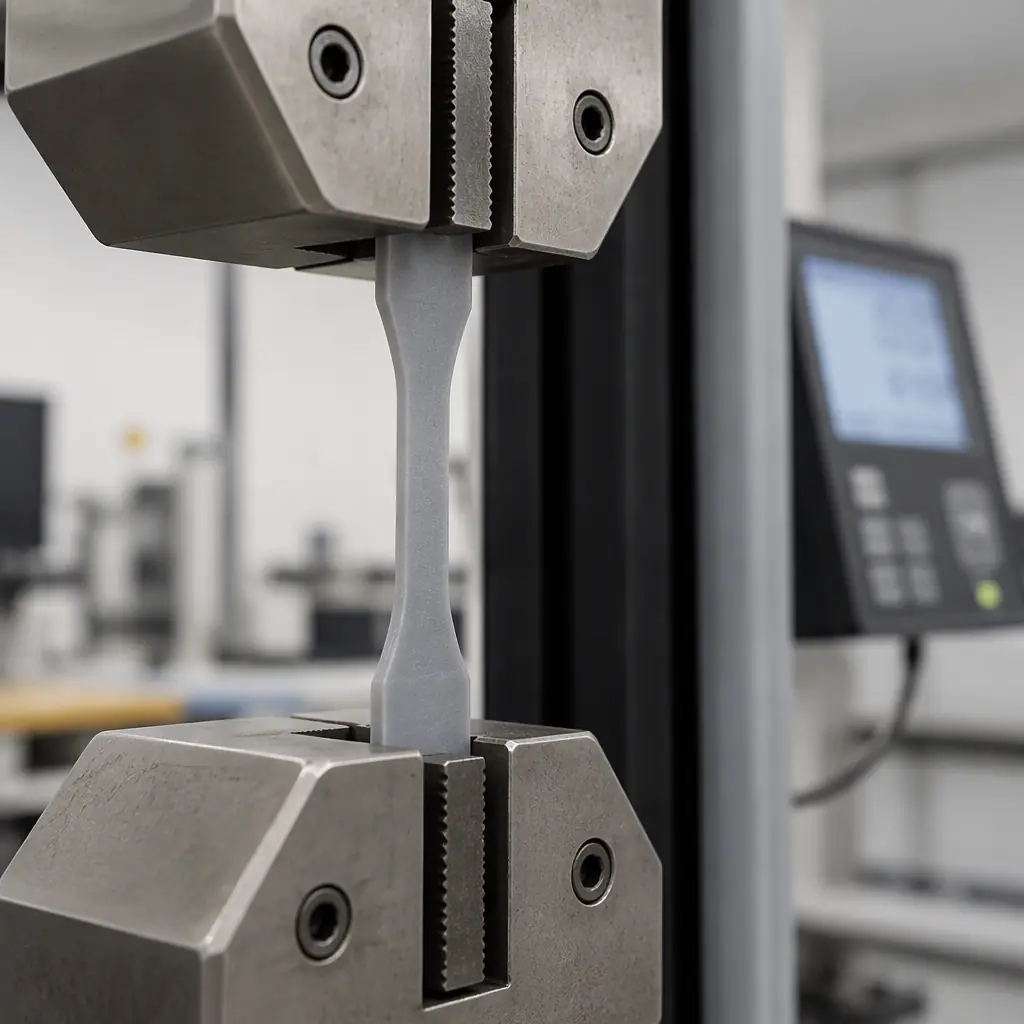
Strength retention. Tensile strength of aged specimens as a percentage of unaged control, tested in the same orientation and on the same machine. A typical specification for an industrial part is 70 percent retention at the end of the accelerated period, with the interlayer direction tested rather than the in-plane direction. Print the control specimens from the same spool and the same job as the parts, because spool-to-spool variation can exceed the aging effect at short durations.
Dimensional stability. Measure the features that matter before and after conditioning, and state the allowed shift. For a part with a 0.3 mm tolerance band, a 0.2 percent shrinkage over 150 mm is 0.3 mm and consumes the whole band. Our guide to post-processing tolerance compensation covers the compensation routes.
Appearance and function. Colour shift measured as a Delta-E value, cracking or crazing under a low-power microscope, and a functional check of any moving feature or electrical property that the part provides. Where the part is an electrical insulator, the relevant post-aging measurement is dielectric strength rather than tensile strength, covered in our dielectric strength guide.
Then write the report so that it survives a customer's qualification review: state the material and spool, the printer, the layer height and orientation, the conditioning standard with its full cycle, the acceleration factor used and its stated validity, the control group, and the acceptance values. Where a full qualification package is required rather than a single aging study, the four-gate protocol in our end-use qualification guide shows where the aging data fits.
What the Distributor Should Put in Writing
Aging claims are where distributors take on liability they did not intend. Three sentences in a quote prevent most of it.
State the basis, not the conclusion. "Material ASA, printed at 0.2 mm layers, tested to ISO 4892-3 for 1,000 hours with a 4-hour wet cycle, retaining 78 percent tensile strength in the interlayer direction" is a claim that can be defended. "Suitable for outdoor use for five years" is a claim that cannot, because it depends on the customer's climate, load and maintenance.
State what was not tested. If the study covered UV and heat but not chemical exposure or salt fog, say so. A customer who discovers an untested condition later will treat every other claim in the report as doubtful.
Offer the test as a service. Aging studies are cheap relative to a field failure: a few hundred grams of material, a conditioning chamber and a tensile tester. A distributor who quotes a 1,000-hour aging study as a fixed-fee engineering service sells qualification rather than parts, and the resulting document is the reason the customer does not switch suppliers for a five percent price difference. Our qualification protocol sets out the full package, and the pricing strategy guide covers how to price engineering work without giving it away.
The summary worth giving any engineer who asks how long a printed part lasts: the resin sets the ceiling, the geometry sets the floor, and only a test in the service orientation tells you where in between the part actually sits.

Material Validation
Age the Part Before the Field Does
Precise3D runs oven, damp-heat and UV conditioning with control specimens from the same spool, and reports strength retention in the interlayer direction the part actually loads.