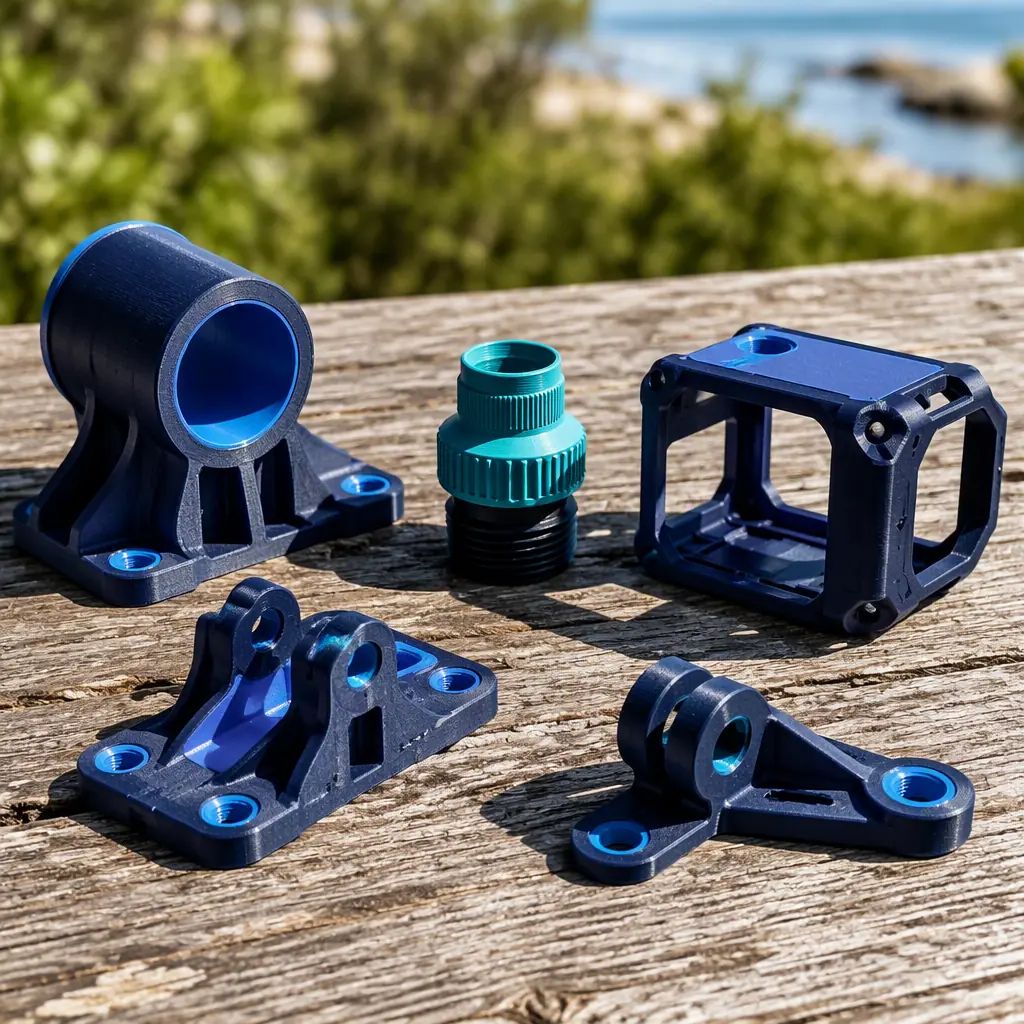
A commercial fishing boat operator in any coastal city replaces 15–30 plastic fittings per year, cable clamps, instrument panel bezels, hatch latches, antenna mounts, rod holder spacers, at an average OEM part cost of $25–60 each. Total annual spend: $500–1,800 per boat. A 3D printer running ASA or PA12 can produce all of these parts for $1.50–8 in material each, at equivalent or superior mechanical properties, with 24-hour turnaround instead of 2–6 week OEM lead times. The boat operator is a recurring customer because saltwater and UV radiation degrade plastic parts on a predictable annual cycle. The same parts break every year, and the same replacements are needed. A distributor who captures five marine customers in their territory generates $2,500–9,000/year in recurring consumable revenue from a vertical that most 3D printer distributors have never considered. This pattern repeats across agriculture (irrigation fittings, equipment gauge housings, sensor mounts), construction (formwork spacers, conduit clips, temporary weather seals), automotive (exterior trim clips, sensor brackets, grille inserts), and outdoor recreation (drone airframes, camera mounts, fishing gear, camping equipment). For a broader view of how to identify underserved verticals in your region, see our portfolio strategy guide.
The Material Stack: What Survives Outdoors and What Fails
Not all filaments advertised as "outdoor" actually survive outdoors. The three environmental stressors that destroy 3D printed parts, UV radiation, moisture, and thermal cycling: each attack different materials in different ways. A material that resists one stressor may fail catastrophically against another. The selection matrix below is based on accelerated weathering data (1,000–2,000 hours of QUV exposure per ASTM G154, equivalent to 1–2 years of outdoor exposure in a temperate climate) and real-world field reports from 200+ Precise3D distributor partners who have deployed outdoor printed parts.
ASA is the clear winner for most outdoor applications: it is essentially ABS with the butadiene rubber replaced by acrylate rubber, which eliminates the UV-degradation pathway that makes ABS turn yellow and brittle after 3–6 months outdoors. ASA parts deployed on boat decks in Florida (extreme UV + salt spray) show no measurable degradation after 24 months of continuous exposure. PETG is the budget option for shaded or partially protected outdoor applications, under an eave, inside an equipment enclosure, or in regions with moderate UV index. PA12 has the best mechanical properties and temperature range of any printable outdoor material, but its moisture absorption (1.0–1.5% in 24 hours at 50% RH) means it must be sealed with a waterproof coating (acrylic clear coat, epoxy resin, or silicone conformal coating) for continuous outdoor water exposure. For the full material selection framework by application, see our engineering filaments guide.
Printer Requirements: What It Takes to Print ASA and Engineering Materials Reliably
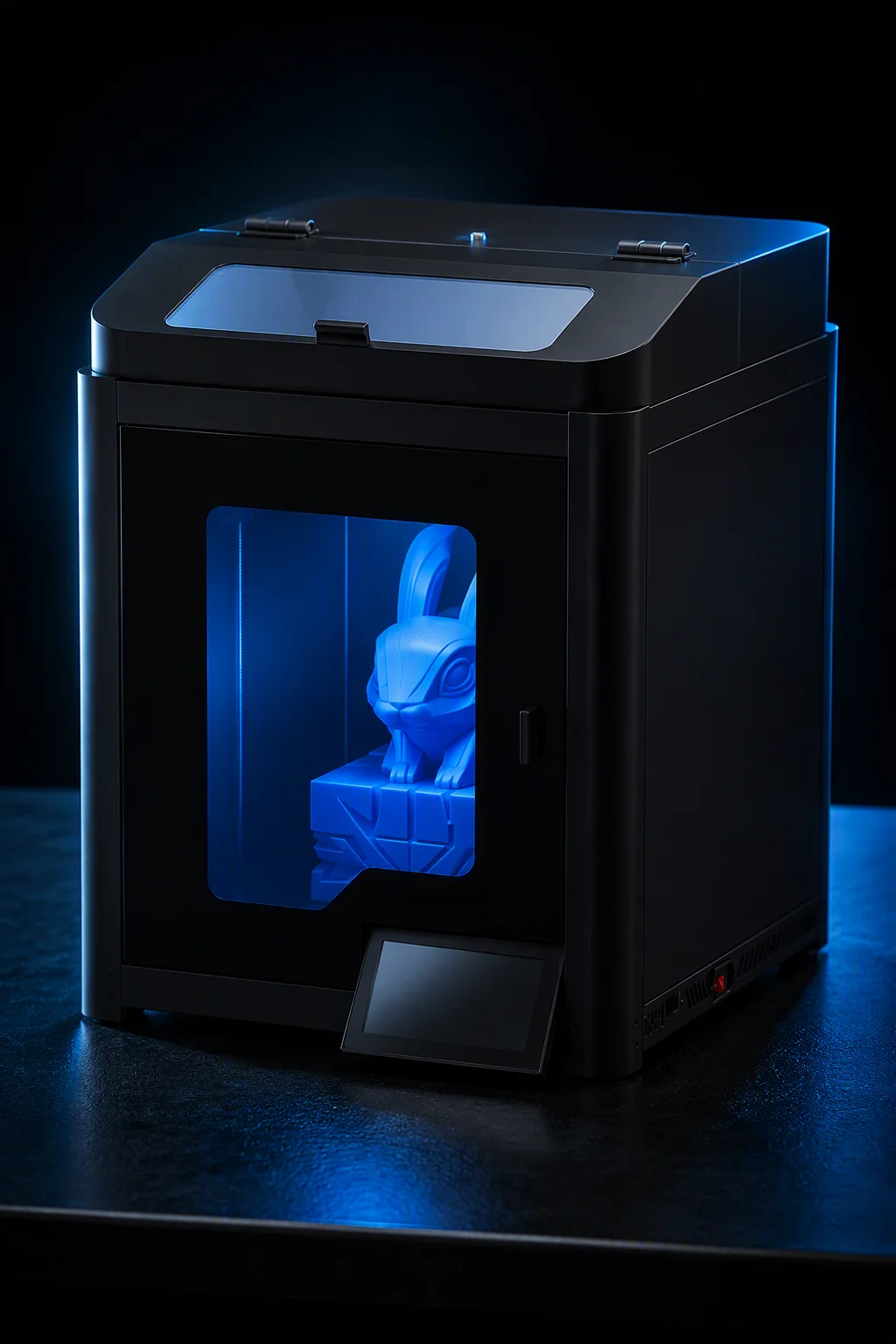
ASA, polycarbonate, and nylon all require an enclosed printer with a heated bed capable of 100–110°C. An open-frame printer, even one with a heated bed, will produce warped, delaminated parts in ASA because the material contracts significantly during cooling and the ambient air currents around an open printer create uneven cooling. The minimum viable printer specification for outdoor-grade parts is:
Enclosure:
Fully enclosed with ambient chamber temperature of 40–55°C during printing (passive enclosure from the heated bed is sufficient for ASA; active chamber heating recommended for polycarbonate and nylon). Hotend: All-metal, capable of 260–300°C sustained operation. PTFE-lined hotends degrade above 240°C and release toxic fumes. Build surface: PEI on spring steel with adhesive (glue stick or specialized ASA adhesive) at 90–110°C. Filtration: Activated carbon filter for ASA and ABS fumes (styrene emissions). Filament storage: Sealed dry box with desiccant feeding directly to the extruder, ASA absorbs less moisture than nylon but still prints poorly if left unsealed for more than 48 hours in humid environments. A printer meeting these specifications retails for $350–600, which is accessible to small marine repair shops, agricultural equipment dealers, and construction contractors. The enclosure, heated bed, and all-metal hotend are the non-negotiable requirements; everything else can be added incrementally. For detailed guidance on matching printers to customer requirements, see our build volume selection guide and our enclosed vs open-frame guide.
Waterproofing and Sealing: The Post-Processing Step That Separates Professional Parts from Prototypes
FDM 3D printed parts are not inherently waterproof, even with 100% infill, the microscopic gaps between extrusion lines create capillary paths that wick water into the part. A part printed at 0.20 mm layer height with 100% infill will leak under any positive water pressure and will absorb water through capillary action even when submerged without pressure. The solutions, in order of increasing effectiveness and cost:
Acrylic clear coat spray (automotive-grade, UV-stabilized):
2–3 light coats applied to all surfaces, cured for 24 hours. Cost: $8–15 per can, covers 20–40 small parts. Effectiveness: waterproof against rain and splash, withstands intermittent immersion for <1 hour. This is sufficient for 80% of outdoor applications — anything that is not continuously submerged. Automotive clear coat also adds UV protection, extending the life of PETG and PA12 parts in direct sunlight.
Two-part epoxy resin coating:
Brush-applied or dipped, cures in 12–24 hours. Cost: $25–40 per kit, covers 10–20 medium parts. Effectiveness: fully waterproof, withstands continuous immersion, chemically resistant to saltwater, fuels, and mild acids. This is the standard for marine parts that will be continuously submerged or exposed to salt spray. The epoxy also fills and smooths layer lines, improving both aesthetics and cleanability for food-contact-adjacent applications (irrigation, aquaculture).
Silicone conformal coating (electronics-grade):
Brush-applied, cures in 1–2 hours. Cost: $15–25 per bottle, covers 30–50 small parts. Effectiveness: waterproof flexible coating, ideal for parts that need to flex or that will experience thermal expansion and contraction (the silicone moves with the part). Best for sealing the interior of electronic enclosures, sensor housings, and connector boots. See our post-processing guide for the complete surface finishing workflow.
What you're looking for: Rain/splash only = acrylic clear coat is sufficient. Intermittent immersion (boat fittings below deck, irrigation valves that cycle on/off) = two-part epoxy recommended. Continuous immersion (underwater sensor housings, pond pump fittings) = two-part epoxy is mandatory, and the part must be printed at 100% infill with 0.12–0.16 mm layer height for maximum inter-layer fusion. No FDM part is rated for continuous submersion at depths exceeding 2 meters without physical testing of the specific geometry and print parameters.
Five Target Verticals: Where Outdoor 3D Printing Revenue Comes From
The outdoor 3D printing vertical is not one market. It is five distinct customer segments, each with different material needs, part geometries, order frequencies, and price sensitivities. A distributor should target one or two verticals that align with their existing customer base and geographic strengths.
The marine vertical is the highest-value target because of the combination of high per-part pricing, recurring annual demand, and the near-total absence of 3D printing penetration in the commercial fishing and marina industry. A single 40-foot fishing vessel carries 200–500 plastic parts that are exposed to saltwater and UV radiation, each of which has an OEM replacement cost of $20–80 and a lead time of 2–6 weeks. A distributor who can produce ASA replacements in 24 hours at 30–50% of the OEM price captures an account that reorders every year because the same parts fail on the same schedule. The agricultural market is the easiest entry point: PETG is forgiving to print, irrigation fittings and equipment parts have simple geometries, and farms in any region represent a large, underserved customer base that already spends money on replacement parts. For guidance on approaching specific industry verticals, see our selling to manufacturers guide.
Print Settings for Maximum Outdoor Durability
Outdoor parts fail at layer lines. The inter-layer adhesion zone is the weakest point in any FDM part, and outdoor environmental cycling, expanding during daytime heat, contracting during nighttime cold, absorbing moisture during rain and drying during sun, concentrates stress exactly at these layer boundaries. The print settings that maximize outdoor longevity are not the settings that maximize print speed or surface finish.
Layer height:
0.16–0.20 mm. Thinner layers (0.12 mm or less) produce more layer boundaries and more potential failure initiation points, despite appearing smoother. Thicker layers (0.28 mm or more) reduce the number of layer boundaries but reduce inter-layer fusion because each layer cools more before the next layer is deposited. The 0.16–0.20 mm range is the sweet spot for outdoor durability in ASA, PETG, and polycarbonate.
Print temperature:
Upper end of the manufacturer's recommended range, plus 5°C. For ASA rated at 240–260°C, print at 255–260°C. The extra heat improves polymer chain diffusion across the layer boundary, increasing Z-axis tensile strength by 10–20% compared to printing at the midpoint of the recommended range. This is especially important for outdoor parts that will experience freeze-thaw cycles where water enters micro-cracks, freezes, expands, and propagates the crack.
Cooling fan:
10–20% maximum for ASA and polycarbonate; 20–40% for PETG. Higher fan speeds cool the deposited layer before the next layer can fuse to it, reducing inter-layer adhesion. The enclosure retains enough heat that minimal active cooling is needed for overhangs up to 45 degrees. For parts with steeper overhangs, increase fan speed only for those specific layers using the slicer's "fan speed for overhangs" setting while keeping the default fan speed low. For the full calibration protocol, see our advanced calibration guide.
Perimeters:
Minimum 3 perimeters (walls) for outdoor parts, 4–5 for load-bearing parts. Each additional perimeter increases the part's cross-sectional area of fused material, reducing the proportion of the cross-section that is infill (which has lower density and more void spaces). A part with 2 perimeters and 25% infill has approximately 40% of its cross-section as structural material; the same part with 4 perimeters and 25% infill has approximately 65–70% structural material, nearly double the effective load-bearing area, with no increase in print time beyond the additional perimeters.
Building the Customer Pipeline: How to Find Outdoor 3D Printing Customers
Outdoor 3D printing customers do not search for "3D printing services", they search for replacement parts for their specific equipment. The marketing strategy is not to advertise 3D printing; it is to be the first result when a boat operator searches for "Yamaha 150HP instrument panel bezel replacement" or a farmer searches for "John Deere 6120M sprayer nozzle adapter." The approach:
Part catalog approach:
Build a library of 50–100 commonly requested outdoor replacement parts for the most popular equipment in your region. For a coastal distributor: the top 20 most-replaced plastic parts on common outboard motors, fishing reels, and marine electronics. For an agricultural distributor: the top 20 plastic parts on John Deere, Case IH, and Kubota equipment. List these parts on your website with photos, material specs (ASA, UV-stabilized), and prices. Each listing targets a long-tail search query with commercial intent. The customer already knows they need the part and is looking for a supplier. The 3D printer is the manufacturing method; the customer is buying a replacement boat part, not "3D printing services." See our digital marketing strategy guide for the customer acquisition framework.
Sample-part outreach:
Print five sample parts relevant to a target customer's equipment, package them with a one-page spec sheet showing the material, UV rating, temperature range, and price compared to the OEM part, and deliver them in person. A marina manager holding a physical ASA latch in their hand, comparing it to the cracked OEM latch on their desk, at a price 50% below the OEM catalog. That is a customer who places an order on the spot. One marina with 40 slip holders = 40 potential recurring customers reached through a single relationship. For guidance on the demo and sales process that converts prospects, see our B2B sales demo playbook.
Bottom Line
Outdoor 3D printing is the highest-margin, lowest-competition vertical in desktop additive manufacturing. It combines an underserved customer base (every marina, farm, construction company, and outdoor equipment dealer needs replacement plastic parts), premium-priced consumables (ASA at $30–45/kg vs PLA at $18–22/kg), recurring demand (outdoor parts break on predictable environmental cycles), and a competitive moat (the enclosure, material, and post-processing knowledge required to print ASA and PETG reliably outdoors filters out 95% of hobbyist-level competition). A distributor who invests $600 in an enclosed printer, $200 in ASA and PETG filament inventory, and one day printing sample parts for the five closest marinas or farm equipment dealers in their territory will capture their first outdoor 3D printing customer within 30 days. That first customer will generate $500–2,500/year in recurring consumable revenue and will refer other businesses in the same industry. The outdoor 3D printing market in any distributor's territory is already there. It is currently being served by OEM parts catalogs with 2–6 week lead times and $40–200 price tags. The distributor who replaces those catalogs with a 24-hour ASA part at half the price owns the market.
Reviewed by the Precise3D engineering & OEM team. Compliance files that accompany the catalog are auditable at the certification register.
Start Your Partnership
Ready to Bring outdoor weather resistant to Your Market?
Distributors selling outdoor weather resistant build margins with OEM & white-label hardware - request the program sheet and volume pricing.