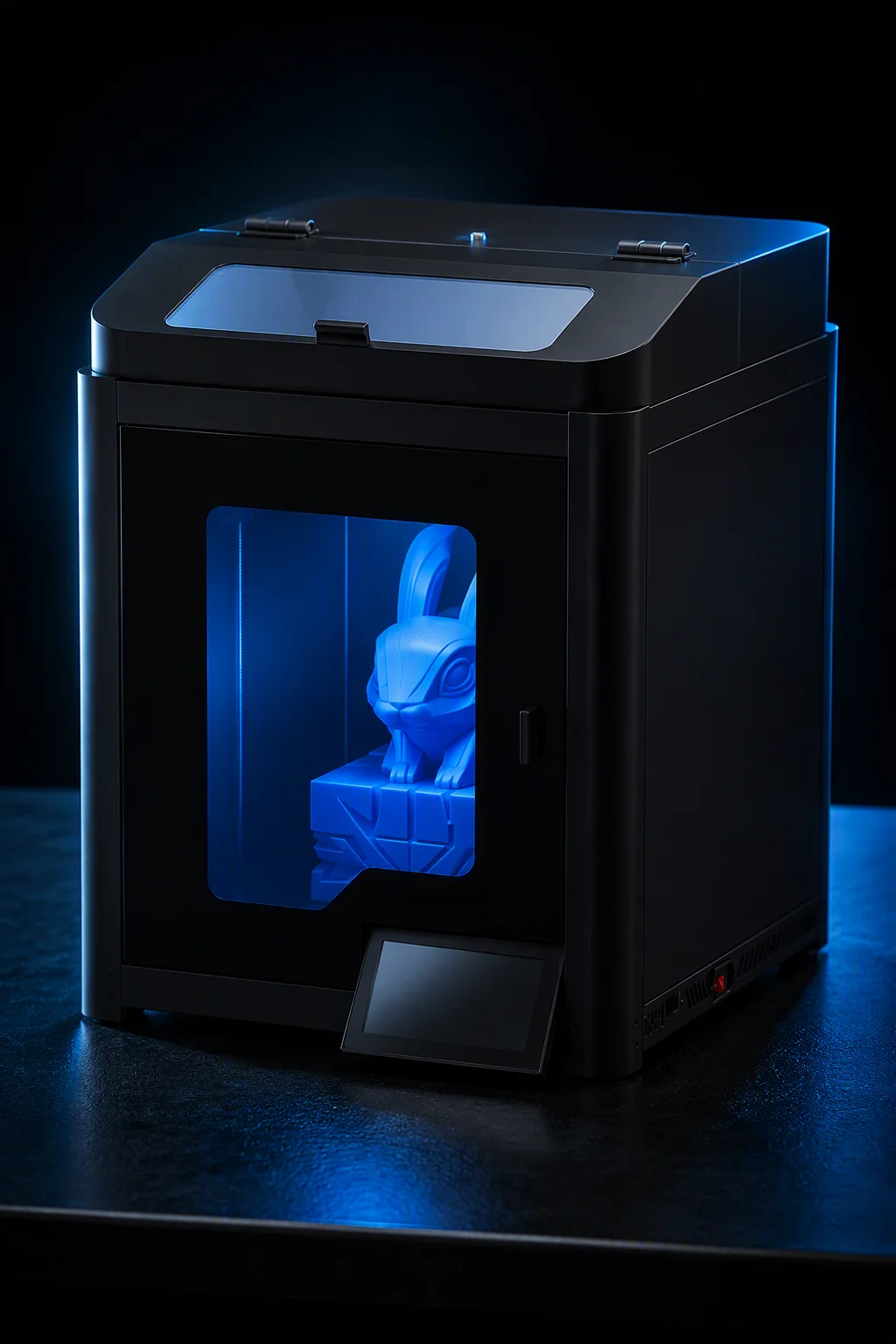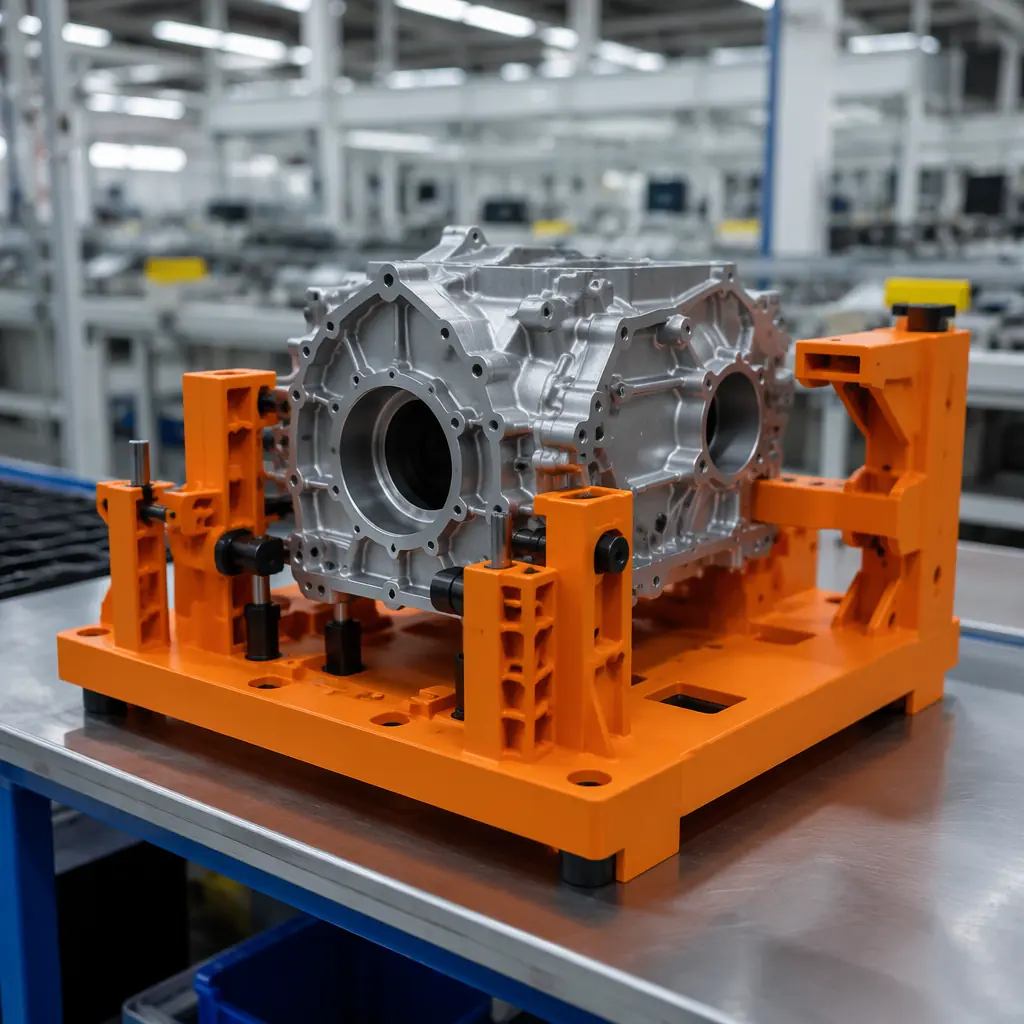
When the word "automotive" meets "3D printing," the image that comes to mind is a concept car with 3D-printed body panels. That's the 0.1% use case. The 99.9% — the $2.9 billion market that actually moves printers and filament — is assembly jigs, inspection fixtures, and end-use production parts that never appear in a press release. A BMW assembly line in Munich runs over 400 3D-printed jigs and fixtures. A Toyota parts supplier in Thailand prints 2,000+ assembly aids per year on $500 FDM printers. These are the accounts that buy printers in quantities of 5–20 units and consume 30–80 kg of engineering filament per month — and most of them don't know a local distributor exists. Here's how to reach them.
Why Automotive Manufacturing Is the Highest-Volume Industrial Market for Desktop 3D Printers
Three structural factors make automotive manufacturing uniquely suited to desktop FDM 3D printing at scale. First, automotive assembly lines are tooling-intensive: a single vehicle platform requires 2,000–4,000 unique jigs, fixtures, gauges, and assembly aids across welding, painting, and final assembly stations. Traditionally, these are machined from aluminum or injection-molded — lead times of 4–12 weeks and costs of $500–2,000 per tool. A 3D-printed replacement printed in 4–8 hours on a $500 printer using $4 worth of PETG or ABS costs $12–25 all-in and is on the line the next shift.
Second, automotive production runs are long enough to justify the tooling investment but short enough that tooling changes are frequent. A vehicle platform runs 5–8 years with a mid-cycle refresh at year 3–4, meaning the entire tooling set for a specific assembly station gets redesigned twice per platform lifecycle. 3D-printed tooling eliminates the tooling amortization problem: print what you need for this platform, and when the refresh comes, print the new design without worrying about sunk cost in machined fixtures.
Third, automotive supply chains are geographically distributed. A Tier 1 supplier in Mexico, a Tier 2 supplier in Poland, and a Tier 3 supplier in Thailand all need the same assembly aids and inspection gauges. Traditionally, the OEM designs the tooling, machines it centrally, and ships it globally — 3–6 weeks of logistics. With a $500 printer at each supplier location, the OEM emails an STL file and the supplier prints the tool overnight. For logistics considerations when shipping printers to manufacturing sites, see our shipping and logistics guide.
Application 1: Assembly Jigs and Fixtures — The Volume Driver
Assembly jigs and fixtures are the highest-volume 3D printing application in automotive manufacturing. A jig holds a component in a precise position while an operator or robot performs an operation (drilling, welding, adhesive application, fastener insertion). A fixture performs the same function for inspection: holding a part at a specific angle for a coordinate measuring machine (CMM) or optical scanner to verify dimensions.
The ROI math is the simplest in any industrial 3D printing application. A machined aluminum assembly jig for a door hinge alignment station costs $800–1,200 and takes 3–4 weeks from a tool shop. The 3D-printed equivalent — printed in PETG-CF (carbon-fiber-reinforced PETG for rigidity) on an enclosed printer — costs $8–15 in material, prints in 5–7 hours, and lasts 6–18 months in production depending on cycle count and handling. When it wears out, you print another one. When the vehicle platform gets a mid-cycle refresh and the hinge geometry changes by 3 mm, you modify the CAD file and print the new jig overnight — no tool shop, no purchase order, no 4-week lead time.
At 400 jigs and fixtures per assembly line per platform refresh, the annual filament consumption for a single mid-size automotive plant is 80–120 kg of engineering-grade PETG, ABS, or nylon. At $25–45/kg retail for engineering filaments with 30% distributor margin, that's $600–1,620/year in recurring filament revenue — from one plant. A distributor serving 5–10 manufacturing accounts generates $3,000–16,000/year in filament margin alone, in addition to the printer sales ($309/unit margin on Pro X1-class machines). For the full consumables economics, see our accessories bundling guide.
Application 2: End-of-Arm Tooling and Grippers — The Robotics Overlap
Every automotive assembly line has robots — welding robots, painting robots, material handling robots — and every robot has an end-of-arm tool (EOAT) that interacts with the part. Traditional EOAT components (gripper fingers, vacuum cups, locating pins) are machined from aluminum and cost $200–600 per component because they're custom-designed for a specific part geometry. A single robot cell with 4 gripper stations, each with 6 custom fingers, requires 24 unique machined components at $4,800–14,400 total.
3D-printed gripper fingers in carbon-fiber-filled nylon (PA-CF) on an enclosed printer with a hardened nozzle cost $6–12 per finger in material, print in 2–3 hours each, and survive 50,000–100,000 grip cycles in production — 12–24 months of continuous operation. The printer that produces them (Pro X1 with hardened steel nozzle, $899 MSRP, $309 distributor margin) pays for itself after printing 3–4 complete gripper sets. After that, every additional gripper set is pure operational savings for the customer and recurring filament revenue for the distributor.
The robotics integration angle is particularly valuable for distributors because it opens conversations with automation integrators — companies that design and install robotic workcells for automotive plants. These integrators buy printers in batches of 2–5 units to place at customer sites for on-demand EOAT production, and they consume engineering filament at 15–30 kg/month per site. One automation integrator with 10 customer sites represents $4,500–9,000/year in filament revenue plus $3,000–7,500 in initial printer margin. For the engineering material capabilities required, see our industrial materials guide.
Application 3: Custom End-Use Parts — Low Volume, High Margin
Beyond tooling, automotive manufacturing uses 3D-printed end-use parts in three scenarios where traditional manufacturing methods break down economically: low-volume production (under 500 units/year — injection mold tooling amortization doesn't work), custom/one-off parts (motorsport, restoration, specialty vehicles), and bridge production (printing parts while waiting 8–12 weeks for injection mold tooling to be completed).
The most accessible end-use part segment for distributors is the automotive aftermarket: custom brackets, sensor mounts, intake ducts, and interior trim pieces for modified and restored vehicles. A performance shop producing 50 cold-air intake adapter plates per year can't justify a $12,000 injection mold, but they can print each adapter in ABS or ASA for $3–6 in material on a $500 printer. At 50 units/year and $80 retail per adapter, the printer pays for itself in the first batch. The distributor sells one printer ($309 margin) plus 15–25 kg of filament per year ($110–185/year in filament margin).
The aftermarket segment scales horizontally: a distributor serving 20 performance shops, custom builders, and restoration specialists generates $8,400–9,900/year in combined hardware and consumables revenue from accounts that buy printers individually rather than in batches. These accounts also tend to be loyal — once a shop has tuned their print profiles for a specific printer brand and filament, switching costs are high enough that they stay with the same supplier for years. For retention strategies, read our after-sales support guide.
How to Sell into Automotive Manufacturing: The Distributor Playbook
Selling 3D printers to automotive manufacturers is fundamentally different from selling to consumers, educators, or even dental labs. Manufacturing buyers evaluate purchases on three criteria — and in this order: ROI (does it reduce cost per unit?), production risk (will it cause a line stoppage?), and quality (does it meet the dimensional tolerance?). Specs and features come after all three. Here's the approach that works:
1. Start with a jig audit, not a printer demo. Walk the assembly line with the manufacturing engineer and ask one question: "Which jigs and fixtures have the longest lead time from your tool shop?" The answer is almost always the custom, low-volume ones — the exact tools where 3D printing delivers 96% cost reduction and 95% lead time reduction. Offer to print one jig as a trial: if it works, they buy the printer. If it doesn't, they've lost nothing. Our top distributors report a 70% conversion rate on jig trials — far higher than cold demos.
2. Sell to the manufacturing engineer, not procurement. Procurement departments optimize for unit cost. Manufacturing engineers optimize for line uptime and changeover speed. A procurement manager sees a $500 printer as a capital expense. A manufacturing engineer sees it as a tool that eliminates 4-week tool shop lead times and keeps the line running during model changeovers. Find the person whose bonus depends on production throughput — that's your buyer.
3. Stock engineering filaments from day one. A manufacturer who buys a Pro X1 to print assembly jigs will ask about material options within the first month: "Can this print something stronger? Something that handles 80°C? Something that doesn't warp with chemical exposure?" If you can't supply PETG-CF, ASA, or PA-CF filament on the same purchase order as the printer, they'll find a supplier who can — and that supplier will sell them the next printer too. For the full engineering filament lineup, see our engineering filaments guide.
4. Target Tier 2 and Tier 3 suppliers before OEMs. Toyota and BMW have centralized additive manufacturing programs with dedicated teams, approved vendor lists, and 12-month sales cycles. Their Tier 2 suppliers — the companies making wiring harnesses, fluid reservoirs, and interior trim subassemblies — have none of that. They have a manufacturing engineer who's frustrated with tool shop lead times and would buy a printer tomorrow if someone showed them the jig ROI math. These are 50–500 employee companies, often family-owned, where purchase decisions are made by the plant manager in a single meeting. One Tier 2 supplier with 3 printers and 30–50 kg/month filament consumption is a $1,500–2,500/year account. Ten of them is a business. For more on factory relationships, see our factory audit guide.
Reviewed by the Precise3D engineering & OEM team. Compliance files that accompany the catalog are auditable at the certification register.
Sell Into Manufacturing
Get Engineering Filament Samples & Jig ROI Calculator
PETG-CF, PA-CF, and ASA filament samples with data sheets. Plus a customizable ROI calculator to show manufacturers the jig cost comparison.