When most distributors hear "medical 3D printing," they think of dental — and for good reason. Clear aligners alone consume 60% of all medical 3D printing output, and our dental lab guide covers that segment in detail. But dental is only one application in a $4.7 billion market that's growing at 17.5% CAGR through 2030. The next three segments — surgical planning guides, custom prosthetics and orthotics, and patient-specific anatomical models — represent $1.8 billion in combined annual spending, and most of them use the same FDM and resin printers that distributors already stock. Here's the segment-by-segment playbook.
Why Medical 3D Printing Is Different — and Why Distributors Should Care
Medical applications differ from consumer and education 3D printing in three ways that matter for distributor economics. First, margins are higher: medical buyers pay for outcomes (a surgical guide that reduces OR time by 45 minutes), not hardware specs, so they're less price-sensitive than hobbyists. Second, consumables consumption is relentless: a hospital printing 12 anatomical models per week goes through 3–5 kg of filament, generating $45–90/week in recurring margin from a single account. Third, the sales cycle is relationship-driven rather than comparison-shopping-driven — once a hospital adopts your printer and material ecosystem, switching costs are high because their workflow, training, and regulatory documentation are built around it.
For a distributor, a single hospital account with two Pro X1 units and one resin printer generates approximately $3,100/year in hardware margin (year one) plus $2,800–4,500/year in recurring consumables margin. A dental lab customer generates similar numbers — see our dental 3D printing guide for those economics. The difference with non-dental medical is that the total addressable market is larger: while dental labs are concentrated in major cities, hospitals, orthopedic clinics, and veterinary practices exist in every secondary market a distributor serves.
Segment 1: Surgical Planning Guides — The Highest-Margin Entry Point
Surgical guides are patient-specific templates that a surgeon places over bone during an operation to ensure cuts and drill holes are positioned with sub-millimeter accuracy. They're used in orthopedics (knee/hip replacement guide alignment), maxillofacial surgery (jaw realignment cutting guides), and spinal surgery (pedicle screw trajectory guides). A single surgical guide that takes 45 minutes to print on a $250 resin printer and uses $3 worth of biocompatible resin sells to a hospital for $150–400 — margins of 85–95% on the consumables, plus the printer sale itself.
The workflow is straightforward for a distributor to support: the hospital's radiology department sends a CT or MRI scan (DICOM format) to a segmentation software package (Materialise Mimics, 3D Slicer — the latter is free and open-source), which converts the scan into a 3D-printable STL file. The guide is printed on a resin printer (SLA or DLP) using a biocompatible resin certified to ISO 10993 for short-term patient contact. The entire process — scan to printed guide — takes 2–4 hours, compared to 3–7 days for a traditional outsourced guide from a centralized service bureau. For the hospital, the printer pays for itself in 3–5 cases: at $350 per outsourced guide vs. $8 in materials for in-house printing, the ROI on a $500 resin printer is approximately 4 cases.
The consumables stream is where surgical guides outperform consumer 3D printing: a hospital using 2 liters of biocompatible resin per month at $150/L with 35% distributor margin generates $1,260/year in recurring revenue from a single account — comparable to 10 Start S1 retail customers combined. For the resin printer distribution fundamentals, see our resin printer distribution guide.
Segment 2: Custom Prosthetics and Orthotics — The Volume Play
Custom prosthetics and orthotics represent the largest non-dental medical 3D printing segment by unit volume. Unlike surgical guides (one-time use, per-patient, per-procedure), prosthetic devices are worn daily and replaced as patients grow or devices wear out — creating a built-in replacement cycle that generates recurring hardware and consumables revenue. The World Health Organization estimates 40 million people worldwide need prosthetic or orthotic devices, and traditional manufacturing (plaster casting, hand lamination) takes 2–6 weeks per device at a cost of $2,000–8,000. 3D-printed prosthetics reduce that to 24–48 hours at $50–300 in materials.
For FDM distributors, the prosthetic socket — the custom-fitted interface between the residual limb and the prosthetic device — is the highest-value print. Traditional sockets are made by wrapping plaster bandages around the patient's limb, waiting for them to set, creating a positive mold, and thermoforming plastic over it — 8–12 hours of skilled labor. A 3D-printed socket is generated from a 3D scan (Structure Sensor, iPhone LiDAR, or dedicated scanner), designed in 30 minutes using parametric CAD software, and printed in 4–8 hours on a $500 Pro X1 or similar enclosed printer using PETG or flexible TPU filament. Material cost: $8–15 per socket. Labor: 1 hour vs. 8 hours for traditional.
Orthotics — custom insoles, ankle-foot orthoses (AFOs), and wrist splints — follow a similar workflow with higher volumes. A single orthotics clinic prints 15–25 devices per week using flexible TPU filament, consuming 4–6 kg/month. At 30% distributor margin on TPU filament ($25–35/kg retail), that's $30–63/month in recurring filament revenue per clinic — modest per account, but scalable across dozens of clinics in a distributor's territory. For the filament stocking strategy to support medical accounts, see our filament stocking guide.
Segment 3: Patient-Specific Anatomical Models — The Education-to-Practice Bridge
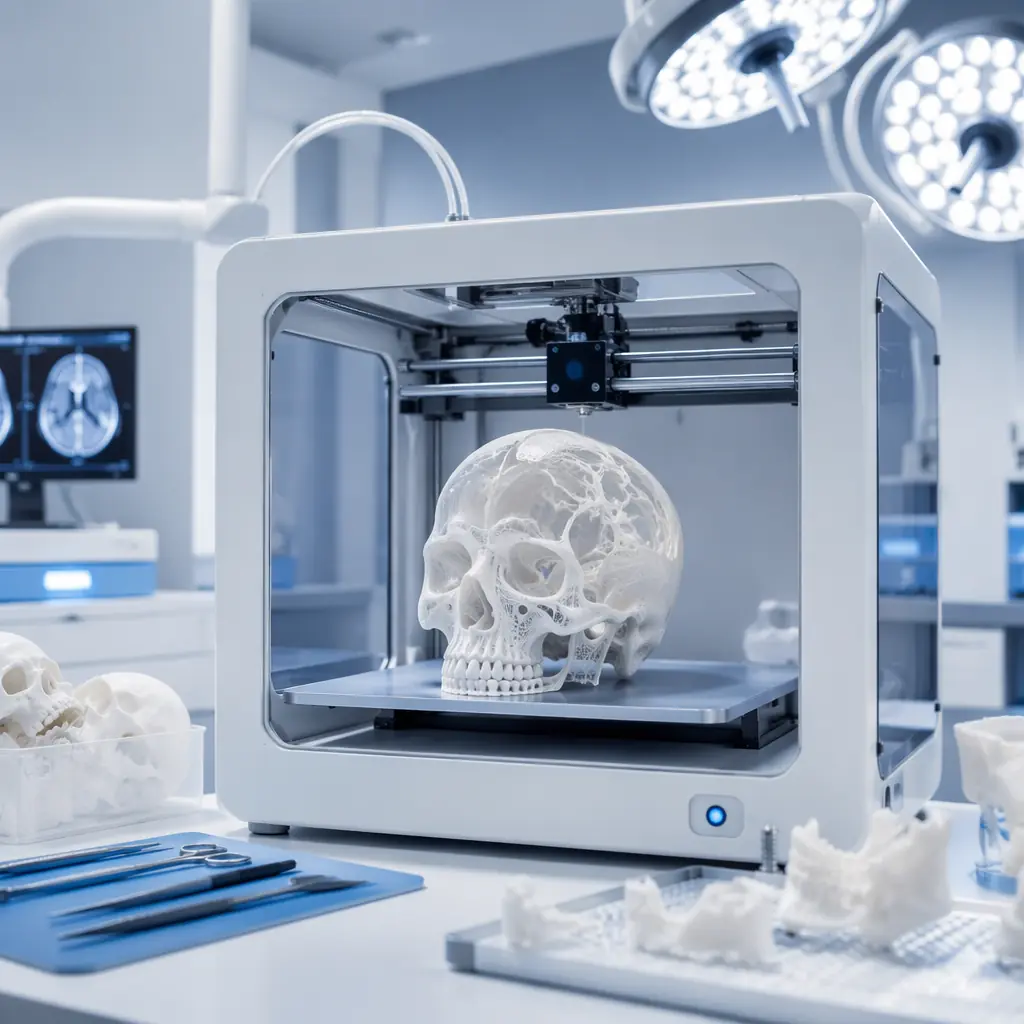
Anatomical models are the most accessible medical 3D printing segment for distributors because they require no regulatory certification. Unlike surgical guides (which contact patient tissue) or prosthetics (which are worn on the body), anatomical models are used for pre-surgical planning, patient communication, and medical education — they never enter the sterile field or contact patients. This means any FDM or resin printer a distributor already stocks can serve this market, using standard filaments and resins without biocompatibility certification requirements.
Hospitals use patient-specific anatomical models in three scenarios: pre-surgical planning (a cardiac surgeon studies a printed replica of a patient's heart with a congenital defect before operating), patient consent communication (showing a patient their own tumor model to explain the procedure), and medical training (residents practicing on printed bone models before operating on real patients). A 300-bed community hospital generates approximately 8–15 anatomical model print requests per month across orthopedics, cardiology, and neurosurgery. Each model uses $3–8 in filament and prints in 2–6 hours on a $500 FDM printer.
Veterinary medicine is an underrated sub-segment for anatomical models. Veterinary surgeons use 3D-printed bone models for complex fracture repair planning (a dog's pelvis with multiple fracture lines, printed from CT data), and the workflow is identical to human medicine — but with fewer regulatory hurdles and faster purchasing decisions. A veterinary referral hospital with 3–5 surgeons prints 10–20 models per month. For distributors targeting veterinary accounts, the sales motion is simpler than human hospitals: no institutional review boards, no FDA device classification concerns, and purchasing decisions made by the practice owner rather than a procurement committee. For a broader view of industry vertical plays, read our portfolio strategy guide.
Regulatory Considerations: What Distributors Actually Need to Know
Medical 3D printing carries regulatory requirements, but most of them fall on the hospital or device manufacturer — not the printer distributor. Here's what matters at the distributor level:
Surgical guides are regulated as Class I or Class II medical devices in the US (FDA) and EU (MDR), but the regulatory burden is on the entity that designs and manufactures the guide — typically the hospital's in-house 3D printing lab or a contracted service bureau. As a printer and materials distributor, you're supplying capital equipment and consumables, not manufacturing medical devices. The key requirement: if you're marketing biocompatible resin specifically for surgical guide use, the resin must have ISO 10993 biocompatibility certification from the manufacturer — but Precise3D and all major resin suppliers provide that documentation. For general certification requirements across all markets, see our certification compliance guide.
Prosthetics and orthotics are regulated differently by jurisdiction, but in most markets, a 3D-printed socket or orthotic is classified the same as a traditionally manufactured one — the manufacturing method doesn't change the device classification. The clinician or prosthetist is responsible for device quality, not the printer supplier.
Anatomical models are unregulated in all major markets because they're used for planning and education, not treatment. This makes them the lowest-barrier entry point for medical 3D printing — no regulatory documentation, no biocompatibility requirements, no device registration. Distributors already active in the education market can add hospital anatomical model programs using the same printers and filaments they sell to universities.
How to Start a Medical 3D Printing Line as a Distributor
The most common mistake distributors make is trying to sell to hospital procurement departments the same way they sell to consumer electronics retailers. Hospital procurement has different requirements: clinical evidence (published studies showing the technology improves outcomes), workflow integration (how the printer fits into existing radiology and surgical planning processes), and training (who teaches the surgical residents to use the software). The distributors who succeed in medical 3D printing do three things differently:
1. Lead with consumables, not hardware. A hospital administrator evaluating a $900 printer sees a capital expense. The same administrator evaluating a surgical guide program that saves $1,200 per case in OR time sees an ROI story. Position the printer as the enabler — the consumables, training, and workflow support are the actual solution.
2. Partner with a segmentation software provider. The hardest part of medical 3D printing isn't the printing — it's converting DICOM medical imaging data into printable 3D models. Distributors who bundle a printer with a software partnership (3D Slicer training, or a reseller agreement with a commercial package) close deals 3× faster than those selling hardware alone.
3. Start with veterinary medicine. Veterinary practices face fewer regulatory hurdles, make faster purchasing decisions, and often have higher per-case margins than human hospitals. A veterinary surgical referral center printing fracture models and surgical guides on a single Pro X1 is a $1,200+/year account (hardware + consumables) with a 2-week sales cycle — compared to 3–6 months for a human hospital. Once you have five veterinary accounts and a track record, the human hospital pitch gets easier: "We've supported 40+ surgical planning cases in veterinary medicine — here's how the same workflow applies to your orthopedic department." For sales strategy fundamentals, read our after-sales support guide.
Reviewed by the Precise3D engineering & OEM team. Compliance files that accompany the catalog are auditable at the certification register.
Enter the Medical Market
Get Medical-Grade Printer & Material Specifications
Biocompatible resin certifications, FDM material data sheets for medical applications, and volume pricing for hospital and clinic accounts.