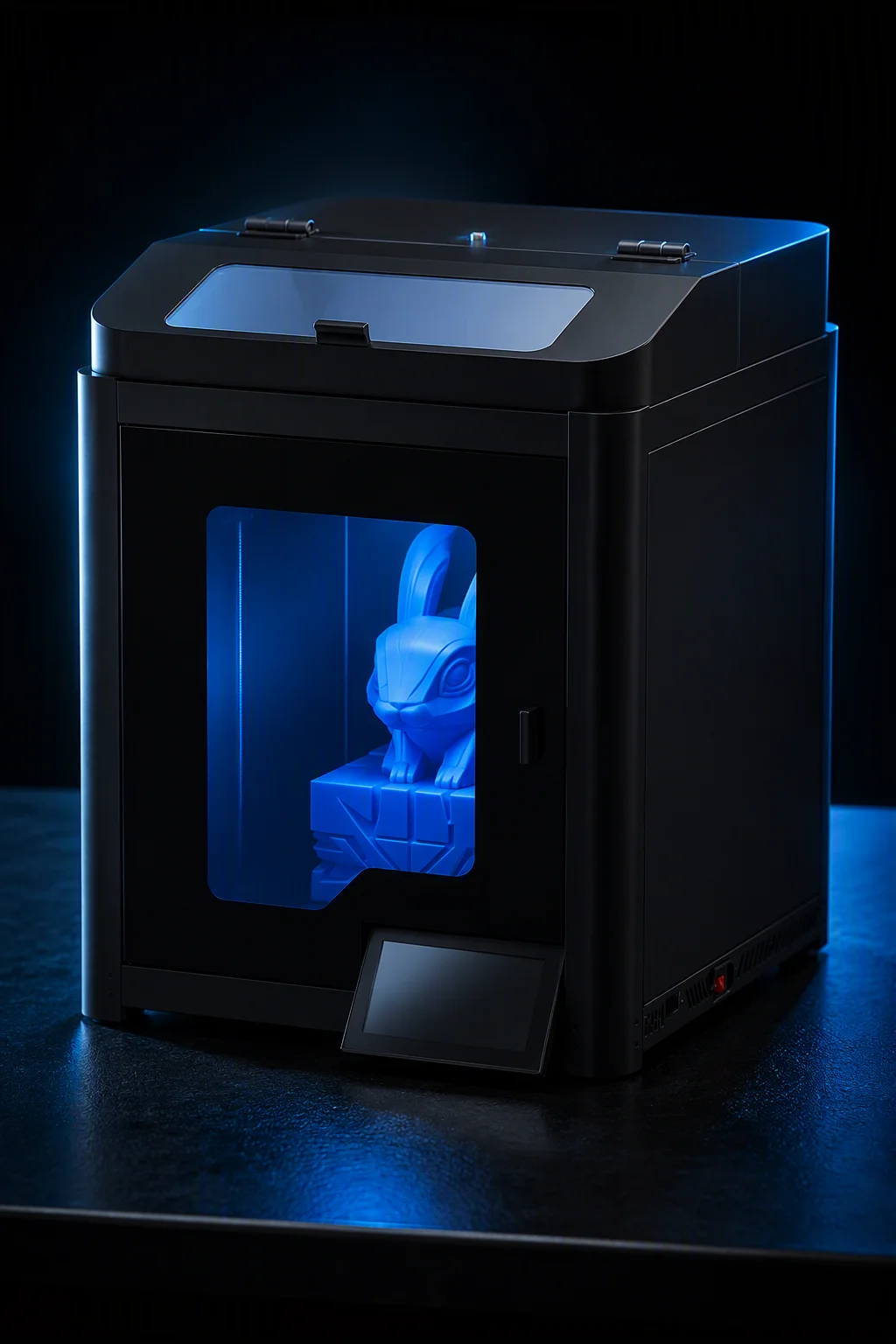
Every Distributor Pays for Packaging Twice
The visible cost of packaging is the foam, the corner blocks and the carton. The invisible cost is the damage claim, and on a fifty-kilogram printer with a five-figure unit price, the invisible cost is usually larger. A one-way foam set that costs a few dollars a unit and a freight claim that costs several hundred, occurring on even a small percentage of shipments, produces a packaging line item that is several times its nominal value.
Printers are worse than most cargo for this reason: they are heavy, they carry a precision gantry and a glass or coated build surface, and the enclosure is a thin shell that transmits impact straight into the frame. A printer that arrives with a bent gantry or a cracked bed is not a packaging failure that a claim settles cleanly. It is a return, a repair, a replacement unit in transit, and a customer who now believes the brand is fragile.
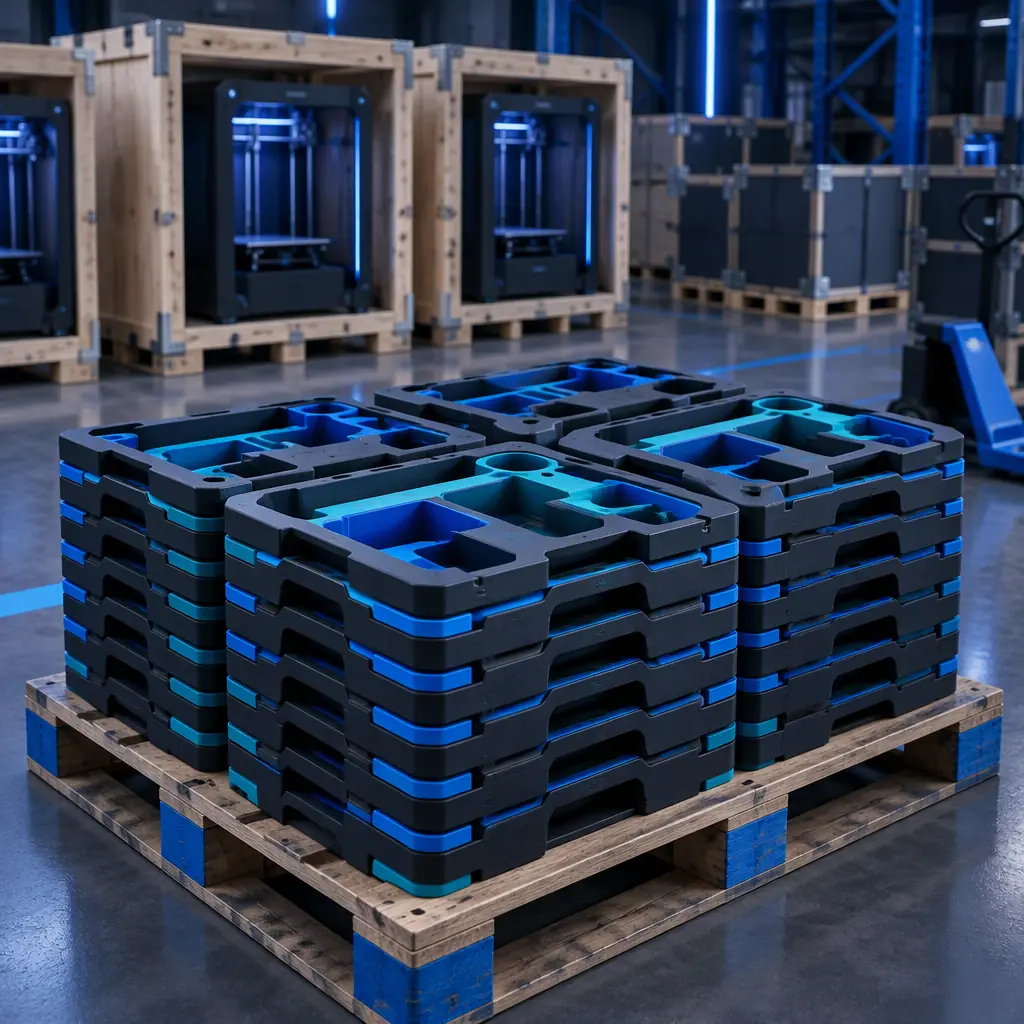
The closed-loop answer is returnable dunnage: a printed insert set that holds the machine in a known position, survives the outbound trip, and comes back with the pallet or the crate for the next shipment. It converts a recurring consumable into a capital asset with a reuse count, and that reuse count is the whole decision. The one-way export crating around it is a separate problem, covered in our international crating guide.
The Loop Break-Even: When Printed Dunnage Beats Foam
The break-even is a straightforward arithmetic problem and it is almost never run. The cost of a returnable insert per trip is the material and print cost divided by the reuse count, plus the cost of returning the empty dunnage, plus an allowance for loop shrink — the percentage of dunnage sets that are lost, discarded or damaged beyond repair on each cycle.
Two variables do the most work. The first is the reuse count, which for a well-designed printed insert in a closed loop is limited by handling damage more than by wear; printed parts that are loaded and unloaded carefully last a long time, and parts that are kicked around a loading dock do not. The second is loop shrink, which is the number that kills closed-loop programmes in practice. If ten percent of your dunnage sets never come back, your effective cost per trip is roughly eleven percent higher than the arithmetic suggests, and at thirty percent shrink the closed loop is a fiction.
Worked against a one-way baseline of roughly four to eight dollars of foam per printer and a damage-claim rate between one and three percent on a several-hundred-dollar average claim, printed inserts usually break even between the twelfth and the twenty-fifth trip. Below ten reuses the one-way solution is genuinely cheaper and the honest answer is to keep buying foam. Above thirty reuses the closed loop is not close.
One-way foam cost per printer4 – 8 USD
Average damage claim per event200 – 900 USD
Typical damage rate, unprotected1 – 3%
Printed insert material + print cost18 – 55 USD per set
Return leg cost per trip2 – 6 USD
Loop shrink, disciplined programme5 – 10%
Loop shrink, uncontrolled25 – 40%
Break-even reuse count12 – 25 trips
Insert Design Rules for a Fifty-Kilogram Printer
A printed insert that holds a fifty-kilogram machine must carry that load through its own geometry, and the failure mode is always the same: the load path runs through the thin enclosure instead of through the frame. The rule that governs everything else is to transfer load into the machine's structural frame and never into the cosmetic panels. A printer's enclosure will dent under a load its frame would barely notice, and a dented enclosure is a cosmetic rejection even when the machine is mechanically perfect.
In practice that means the inserts contact the machine at four defined points that line up with the frame corners or the base plate, and nowhere else. The machine rests on the frame and the inserts simply prevent it from moving; they do not squeeze the enclosure to hold it in place.
Ribbing and wall thickness under a two-metre drop
A printed part resists impact through geometry, not through material thickness. A flat two-millimetre wall will flex and delaminate; the same mass arranged as a ribbed structure at three to four millimetres of wall with eight to twelve millimetres of rib depth absorbs far more energy before failure. The rib direction matters as well: ribs printed in the plane of the impact load carry the load in tension along the extrusion, while ribs printed vertically put the interlayer bond in tension and fail at a small fraction of the same force. Design the insert so the impact is taken along layer lines, not across them.
The crush zone is the deliberate concession in this design. A printed insert should be expected to deform in a serious drop, and the deformation should be engineered to occur in a sacrificial rib that absorbs the energy well away from the machine's frame. An insert that transmits the whole impact pass-through because it was built overly rigid has not protected anything; it has simply moved the failure into the machine.
Load-bearing contact points4, on frame or base
Wall thickness, ribbed insert3 – 4 mm
Rib depth8 – 12 mm
Rib orientationImpact load along layers
Crush-zone featureSacrificial rib
Clearance to enclosure panels≥ 5 mm, no contact
Insert set mass, 50 kg machine2.5 – 6 kg
What to Print and What Not to Print
Printed dunnage is not a substitute for a container. It is a substitute for the shaped foam inside one, and treating it as more than that produces expensive failures. The line between the two is worth drawing explicitly because it is where most first attempts go wrong.
Print the shaped interior. Corner blocks that engage the frame, bed chocks that stop the platform moving under its own inertia, a controller cradle that holds the electronics module in a known orientation, accessory and tool trays, and nozzle or hotend inserts for the spares kit. These are jobs with moderate loads, complex geometry and a need for repeatability, which is exactly where printing wins.
Do not print the outer container. A printed shell is heavier, slower to produce and less impact-resistant than a corrugated carton or a plywood crate, and it will be the first thing to break. Use the printed insert inside a conventional container. Likewise, do not print anything that takes a sustained structural load in a stacked pallet, such as a base block that has to carry the weight of three printers stacked above it; a printed part under continuous static load creeps, and creep is invisible until the stack shifts in transit.
Diagnostic Question: “Did the machine arrive damaged with the insert intact, or is the insert broken too?”
What you're looking for: An intact insert and a damaged machine means the load path bypassed the insert entirely — the machine was contacting the container, or the insert was not pre-loaded against the frame, so the machine moved and struck the box. A broken insert and a damaged machine means the insert absorbed the impact and the load exceeded the design, which points at a higher drop or a heavier machine than the design basis. The two point at opposite fixes.
ESD-Safe Dunnage for Controller and Electronics Modules
The controller, the mainboard and the stepper drivers are the parts of a printer that electrostatic discharge damages invisibly. A machine can be dropped without apparent harm and then fail three weeks later because a driver was exposed to a discharge during packaging, and the failure will be attributed to the driver supplier rather than to the insert.
Printed ESD dunnage is achievable, but it introduces a failure mode that conventional foam does not have. Conductive filaments achieve their properties through a carbon or metal additive dispersed in the polymer, and that additive wears. An insert that starts life in the dissipative band can, after a few dozen loading cycles, wear through its conductive skin on the contact faces and become locally insulative. The result is a cradle that passes an incoming inspection and fails the purpose in service.
The practical controls are to specify surface resistivity in the dissipative band rather than at the edge of conductive, to design the contact faces as replaceable or reversible so that wear is inspected and addressed, and to re-measure resistivity on a sampling basis rather than once at first article. Surface resistivity in the range of 106 to 109 ohms per square is the usual target: low enough to bleed charge, high enough not to create a discharge path through the electronics itself. Insulative is anything above about 1011 ohms per square, and that is where a worn insert quietly ends up.
Conductive band< 10&sup5; ohm/sq
Dissipative band (target)10&sup6; – 10&sup9; ohm/sq
Insulative (failure)> 10¹¹ ohm/sq
Resistivity re-check intervalEvery 10 – 20 cycles
Worn contact-face actionReverse or replace
Whole-insert resistance testPoint-to-point, ≤ 10¹&sup0; ohm
The broader electrostatic discipline that governs tooling and work surfaces is covered in our ESD control and anti-static tooling guide, and the same dissipative-band reasoning applies to packaging inserts that will be used in the same area.
Abuse Testing Before You Trust an Insert
A printed insert that looks right and has never been dropped is an assumption, not a specification. The abuse test that establishes confidence is short, and its parameters come from two numbers: the packed mass and the drop height appropriate to that mass.
Drop height scales inversely with packed mass in every distribution test regime, which is why a fifty-kilogram printer is not tested at the height used for a five-kilogram parcel. The published distribution test conventions, including the ISTA and ASTM D4169 families, set the drop height from the packed weight, and the point of following a recognised regime rather than inventing levels is that a customer or a freight insurer can rely on it.
Four tests cover the realistic damage modes. A corner drop is the most severe and the most likely to crack a printed insert, because all the impact energy enters a single printed feature. An edge drop tests the ribbing in the direction the machine is least supported. A face drop tests the flat panels and the bed. A stacked compression test answers the completely different question of whether the dunnage survives three units stacked for a week in a warehouse, which is where creep shows up. Add a vibration dwell if the shipment will travel by road for more than a day, because a unit that survives a drop into a warehouse can still abrade its own packaging to failure over three thousand kilometres of road.
Test regime referenceISTA / ASTM D4169
Drop height, 50 kg packedset by weight, not assumed
Corner dropMost severe case
Stacked compression dwell3 units, 7 days
Vibration dwell≥ 1 h per axis
Acceptance criterionNo frame contact, no enclosure contact
Sub-Assembly Dunnage and the Kit-Completeness Problem
A printer shipped complete is the easy case. A printer shipped as sub-assemblies — the gantry in one crate, the build platform in another, the controller and tools in a third — creates a different problem: the kit has to arrive complete, and a printed dunnage set is an opportunity to make completeness checkable rather than hoped for.
The design move is to shape each insert so that its pockets are a physical bill of materials. An insert with four shaped pockets that each hold one specified sub-assembly makes a missing item obvious at a glance, because an empty pocket is visible. This is worth designing deliberately rather than letting the pockets be generic, because the cost of a missing bracket or a misplaced tool is a second shipment and a delayed installation, which dwarfs the cost of the dunnage.
The kit-completeness discipline overlaps with the spares provisioning work described in our critical spares kit guide, and the reverse flow — what happens to dunnage returned with a machine that is coming back for repair — belongs with the returns process in our reverse logistics guide. Returning a machine is the moment a dunnage set most often goes missing, because the return shipment is usually packed by whoever has the machine rather than by the warehouse.
Building the Loop: Tracking, Cleaning and Repair
A dunnage set that is not tracked is a dunnage set that disappears. The tracking does not need to be sophisticated: a moulded-in or printed identification number on every insert, a simple log of which set went out on which shipment, and a count on return. What matters is that the set is treated as an asset with an identity rather than as anonymous packaging, because anonymous packaging is the first thing a warehouse discards.
Cleaning and repair are the two maintenance activities that extend the loop. Printed inserts accumulate dust and, in a damp environment, can absorb enough moisture to change dimension slightly; a regular wipe-down and dry storage between trips keeps them dimensionally stable. Damage is usually localised to a single rib or contact face, and a printed insert is repairable in a way that foam is not: a broken rib can be replaced by reprinting that one component from the same file, which is one of the genuine operational advantages of printed dunnage over moulded foam or thermoformed plastic.
Diagnostic Question: “How many of the sets you sent out last quarter came back?”
What you're looking for: If the answer is not known, the closed loop is not running and the economic case is theoretical. Compute the actual return rate before investing further in printed dunnage, because a programme with uncontrolled loop shrink at thirty to forty percent has a worse cost per trip than the foam it replaced, and the arithmetic only looks favourable at the shrink rates an accountable programme achieves.
Selling Dunnage as a Distributor Service
The strongest reason for a distributor to develop printed dunnage is not the internal cost saving. It is that the design capability is a service that can be sold, or given, to strengthen a channel relationship. A distributor who supplies a printer and also supplies a fitted, tested, ESD-safe dunnage set for it has solved a logistics problem for their own customer, and the same design can be offered to a dealer network as a standard accessory programme.
The economics of that are attractive because the design work is done once and the printing is repeatable: a single validated insert set can be produced on demand in the quantities a dealer network actually needs, rather than in the minimum order quantities a moulded foam supplier will require. For a distributor already running printers, the marginal cost of a dunnage programme is machine time rather than tooling investment, which is the specific economic advantage that printing offers over every conventional packaging route. The wider packaging trade that this sits beside, rather than replaces, is covered in our packaging industry guide, and the unboxing presentation layer that a printed insert supports is covered in the unboxing design guide. The equipment handling side that dunnage has to work with is in the warehouse automation guide, and the export logistics context in the China shipping guide.
Logistics Support Programme
Configuring a Returnable Packaging Programme?
Precise3D supports distributors building fitted dunnage and packaging insert lines, with large-format platforms, engineering-material guidance and ESD-capable print profiles for controller and electronics cradles.
← Back to Blog