When a distributor evaluates a 3D printer, the stepper motor is one of the easiest components to overlook, and one of the most expensive to get wrong. These motors are the physical actuators that convert every G-code command into motion: the extruder pushing filament, the print head tracing perimeters, the bed rising one layer height at a time. If the motor is undersized, the printer skips steps on fast travel moves and ruins prints. If it's oversized, the extra weight on the gantry limits acceleration just as badly. If the step angle is wrong, no amount of microstepping can recover the lost resolution. This guide covers the four motor categories every distributor needs to understand, NEMA 17 standard, NEMA 17 pancake, NEMA 23, and 0.9° high-resolution, along with the torque math, brand quality tiers, and price tier mapping that turns motor selection from guesswork into a competitive advantage. For the driver chips that power these motors, see our stepper drivers & motherboard guide . The driver and motor are a paired decision, and the wrong combination cancels out the benefits of either component.
What NEMA Numbers Actually Mean for 3D Printers
NEMA (National Electrical Manufacturers Association) frame sizes describe the mounting face dimensions of a stepper motor, not its torque, not its length, and certainly not its quality. NEMA 17 means a 1.7-inch (42.3mm) square mounting face with M3 screws on a 31mm bolt circle. NEMA 23 means a 2.3-inch (57.2mm) square face. That's it. Everything else, holding torque, rated current, inductance, rotor inertia, step angle, varies by motor length, winding configuration, and magnet quality within the same NEMA frame size. A long-body NEMA 17 from LDO Motors produces 0.65 N·m of holding torque; a short-body generic NEMA 17 from an unbranded factory produces 0.22 N·m. Same NEMA number, 3x difference in usable force.
The more useful metric for 3D printing is holding torque . The maximum torque the motor can apply while stationary with both coils energized at rated current. But even this number is misleading in isolation. A motor's torque drops as speed increases: at 300 RPM (roughly 100 mm/s on a 20-tooth GT2 pulley), a typical NEMA 17 delivers only 30–40% of its rated holding torque. This is the torque curve, and it's the single most important spec that spec sheets omit. High-inductance motors (above 4 mH per phase) have steep torque drop-off. They produce good torque at low speed but fall off a cliff above 100 RPM. Low-inductance motors (below 2.5 mH) maintain flatter torque curves at speed, which is why 48V systems with low-inductance motors can print at 300+ mm/s where 24V systems with high-inductance motors stall. Our PSU selection guide covers the voltage side of this equation. 24V vs 48V motor selection is a paired decision.
NEMA 17 Standard: The Universal Workhorse
The NEMA 17 is the default motor in consumer 3D printing for good reason: it balances torque, weight, and cost better than any other frame size for printers with build volumes up to 350mm³. Standard NEMA 17 motors in the 40–48mm body length range produce 0.40–0.65 N·m of holding torque at 1.5–2.0A rated current, enough to drive a direct-drive extruder with 3:1 gearing, move a 300g toolhead at 300 mm/s on a CoreXY gantry, or lift a 2kg heated bed on dual Z leadscrews.
The torque rating sweet spot:
At $199–449, a NEMA 17 with 0.40–0.50 N·m holding torque is correct for XY axes on a bedslinger and adequate for a single Z motor with POM anti-backlash nut. Below 0.35 N·m, skipped steps start appearing on Y-axis direction changes above 150 mm/s. The motor simply can't accelerate the bed mass fast enough. At $449–799, 0.50–0.65 N·m motors with 0.9° step angle (covered below) become appropriate, especially for direct-drive extruders where the extra torque overhead prevents filament grinding during fast retractions. The Precise3D Creator C1 uses 0.45 N·m NEMA 17 motors on XY and a 0.50 N·m motor on the direct-drive extruder. These torque values were selected based on measured gantry mass (287g including hotend) and acceleration targets (3,000 mm/s² on Y), not parts-bin availability.
Brand quality tiers:
Not all NEMA 17 motors are created equal. LDO Motors (Shenzhen) produces the gold standard: Japanese NSK bearings, genuine Shinano Kenshi stator laminations with 0.35mm silicon steel, and factory-calibrated winding resistance within ±5% across production batches. Moons Industries (Shanghai) is the close second, their MS17HD series uses high-temperature Class H (180°C) insulation and precision-ground rotor shafts with <0.02mm runout. StepperOnline (a trading brand, not a manufacturer) sources from multiple Chinese factories at price points of $5–12 per motor; quality varies by lot, and the "1.5A rated current" on the label is often optimistic by 15–20%. For a distributor, the difference between LDO and generic on a 5-motor printer is roughly $25 at BOM — and roughly 1.5 percentage points of return rate from stepper-related failures (bearing noise, skipped steps, overheating). The Precise3D Creator C1 ships with LDO motors on XY and extruder axes, with StepperOnline-sourced motors on the Z axis where torque demands are lower and bearing noise is acoustically insulated by the leadscrew assembly. For the complete component sourcing strategy, see our OEM pricing negotiation guide.
NEMA 17 Pancake: When Every Gram on the Toolhead Counts
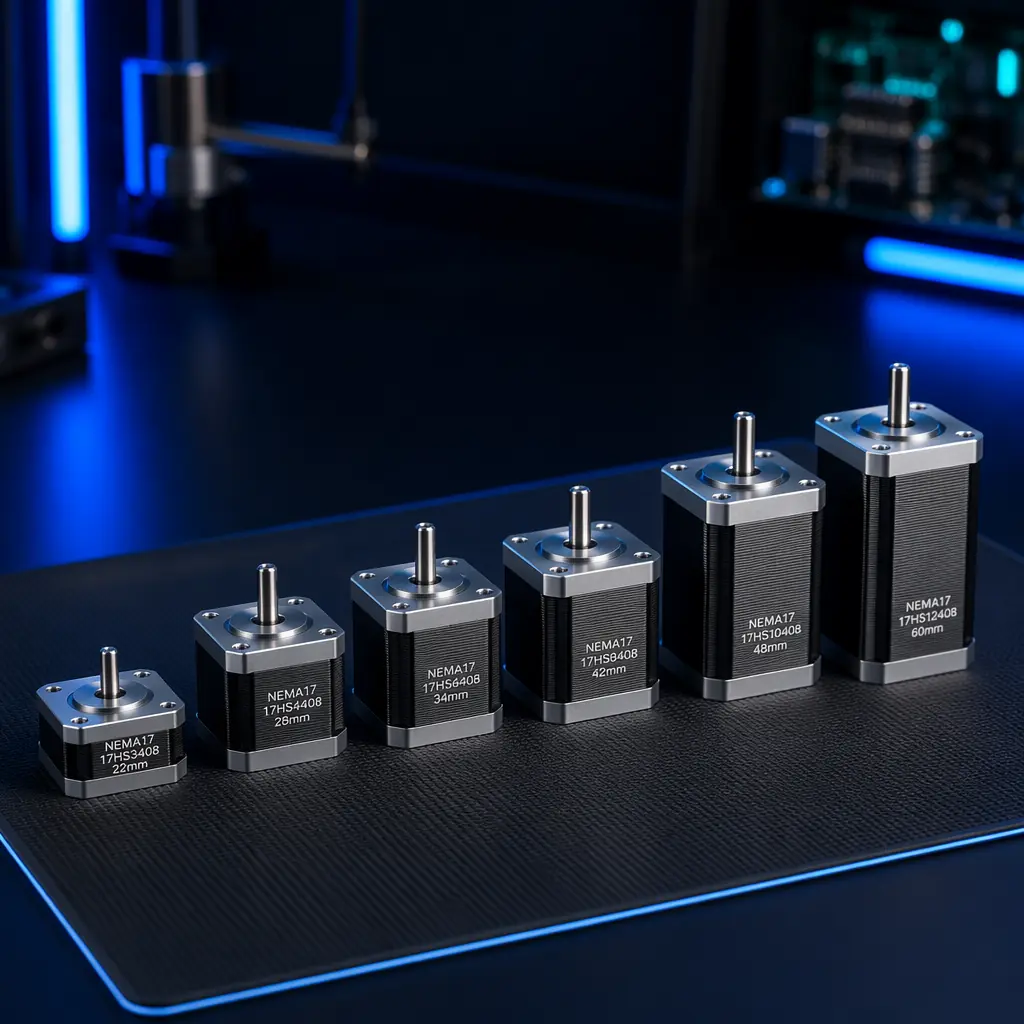
Pancake steppers are NEMA 17 motors with body lengths of 20–26mm, about half the length of a standard motor. Holding torque drops proportionally to length: a 23mm pancake produces 0.15–0.22 N·m, roughly one-third of a 48mm standard motor. The trade-off is weight: at 120–160g vs 280–320g, the pancake saves 140–170g directly on the toolhead. On a CoreXY machine, this weight reduction compounds: a lighter toolhead enables higher acceleration at the same motor torque, which reduces print time on complex models with many direction changes. On a bedslinger, the Y-axis carries the entire bed mass, so toolhead weight matters less. There is no acceleration benefit to a pancake extruder motor on a bedslinger.
Where pancakes make sense:
Bowden extruders with a lightweight dual-drive gear set (BMG-style, ~40g) can operate reliably with 0.18 N·m pancakes. The torque requirement for a Bowden extruder is low because the filament drive gears provide 3:1 to 4:1 mechanical advantage, 0.18 N·m at the motor shaft becomes an effective 0.54–0.72 N·m at the filament. Direct-drive extruders with short filament paths (Orbiter-style, Sherpa Micro) can use pancakes in the 0.20–0.22 N·m range if the extruder gear ratio is at least 7:1. Standard direct drives (Creality-style, single-gear) cannot use pancakes, they need a minimum of 0.40 N·m to avoid filament grinding at retraction speeds above 25 mm/s. A distributor evaluating a printer that uses a pancake on a direct-drive extruder with less than 5:1 gearing should consider it a red flag: the printer will strip filament or skip extruder steps on retraction-heavy prints, and the resulting support tickets will cite "under-extrusion" as the symptom when the root cause is an undersized motor.
Pancake heat management:
Pancake motors have less thermal mass and less surface area for heat dissipation than standard motors, roughly 40% less surface area for a 23mm vs 48mm body. At rated current, a pancake reaches 60–70°C within 15 minutes of continuous printing vs 45–55°C for a standard motor. This heat conducts through the motor shaft into the extruder gears, softening the filament before it reaches the melt zone. The symptom: the extruder starts skipping after 30–40 minutes of printing even though the first layers were perfect. The fix is either a motor heatsink (adds 10–15g, partially negating the weight savings) or reducing motor current below rated value (reduces already-limited torque). For the Precise3D Creator C1, we chose a 48mm standard NEMA 17 on the direct-drive extruder specifically because the thermal margin eliminates this failure mode across 20+ hour prints. For printers using the Bowden configuration, our direct drive vs Bowden guide covers the full toolhead weight budget.
NEMA 23: When the Print Volume Demands Bigger Motors
NEMA 23 motors enter the conversation when the moving mass exceeds what a NEMA 17 can accelerate: typically on printers with build volumes above 400mm³ or toolheads heavier than 500g (IDEX, multi-material, tool-changer). A standard NEMA 23 (76mm body) produces 1.2–1.8 N·m of holding torque, roughly 3x a standard NEMA 17, and weighs 650–1,000g. The rotor inertia is also roughly 3–4x higher, which means NEMA 23 motors accelerate more slowly from rest even though they produce more torque once moving. This creates a speed/torque crossover point at roughly 2,000 mm/s² acceleration: below that threshold, a NEMA 17 can match or beat a NEMA 23 in print time because the lower rotor inertia allows faster direction changes. Above that threshold, large-format machines printing at 150+ mm/s with heavy gantries, the NEMA 23's torque advantage dominates.
The 48V requirement:
NEMA 23 motors almost always require 48V power supplies. The higher inductance of the larger windings (typically 3–8 mH vs 1.5–3 mH for NEMA 17) means the current takes longer to reach its target value at each step, a phenomenon called inductive lag. Doubling the voltage roughly halves the time to reach target current, which is why NEMA 23 motors at 24V produce only 40–50% of their rated torque at speeds above 100 mm/s print moves. At 48V, the same motor maintains 80–90% of rated torque through 200+ mm/s. A distributor evaluating a printer with NEMA 23 motors and a 24V PSU should treat it as a spec-sheet mismatch: the BOM paid for the bigger motor but the power system can't use it. For the full voltage vs motor selection decision tree, our PSU selection guide covers the math in detail.
NEMA 23 motors also require larger stepper drivers, minimum TMC5160 at 48V, or external drivers (Leadshine DM-series, closed-loop servo hybrids) for the heaviest applications. The driver+PSU+motor combination for a NEMA 23 axis costs roughly $80–150 per axis vs $25–40 for a NEMA 17 axis. For distributors, this means NEMA 23 printers occupy a distinct market segment ($1,500+ retail) with different customer expectations: these buyers are comparing the printer to industrial FDM machines (Stratasys, Markforged), not consumer bedslingers. The Precise3D Pro X1 uses NEMA 23 motors on the XY gantry with TMC5160 drivers at 48V. The motor sizing was driven by the 500mm³ build volume and the 1.2kg IDEX toolhead mass, not by a marketing decision to use "bigger" motors. For the full Pro X1 specification logic, see our build volume selection guide.
0.9° vs 1.8° Step Angle: The Resolution Question
Standard stepper motors have a 1.8° step angle, 200 full steps per revolution. High-resolution motors use a 0.9° step angle, 400 full steps per revolution. At 1/16 microstepping, a 0.9° motor delivers 6,400 microsteps per revolution vs 3,200 for a 1.8° motor. On a 20-tooth GT2 pulley with a 40mm belt circumference, this translates to XY positioning resolution of 0.00625mm per microstep (0.9°) vs 0.0125mm (1.8°).
When resolution actually matters:
At layer heights of 0.10mm and above, the difference between 0.00625mm and 0.0125mm positioning resolution is invisible. The extruded filament width (0.40–0.45mm from a 0.4mm nozzle) is 32–72x larger than either resolution figure. The real benefit of 0.9° motors appears in two specific scenarios: (1) printing at layer heights below 0.08mm on high-detail models, where XY positioning errors of 0.01mm become visible as surface texture variations, and (2) reducing vertical fine artifacts (VFAs). A regular surface ripple pattern caused by the interaction between the stepper motor's detent torque (the magnetic cogging force between full steps) and the extruder's flow consistency. 0.9° motors have lower detent torque than 1.8° motors (typically 0.02 vs 0.04 N·m for equivalent frame sizes), which reduces the amplitude of VFAs by 40–60% at print speeds below 100 mm/s. Above 150 mm/s, the belt tension and motion system damping dominate, and the motor step angle becomes acoustically irrelevant.
The torque trade-off:
0.9° motors produce approximately 20–30% less holding torque than equivalent-size 1.8° motors because the rotor's 50 magnetic pole pairs (0.9°) are smaller than the 25 pole pairs (1.8°): each pair stores less magnetic energy. A 0.9° NEMA 17 at 48mm body length typically delivers 0.36–0.44 N·m vs 0.50–0.65 N·m for the 1.8° version. This torque penalty means 0.9° motors are a good fit for lightweight CoreXY toolheads (sub-300g) printing detail models at moderate speeds, and a poor fit for bedslingers where the Y-axis already struggles with bed mass acceleration. The Precise3D Creator C1 uses 1.8° motors on XY specifically because the bed mass on Y (2.1kg at full build plate) requires every N·m of torque the standard motors provide, 0.9° motors would stall on direction changes at the machine's rated 250 mm/s travel speed. Our CoreXY vs bedslinger kinematics guide covers why motor selection is different for each architecture.
Motor Sourcing: What the Brand Label Tells You
For a distributor evaluating OEM printers, the motor brand is one of the most reliable signals of overall component quality. Here is the hierarchy, from premium to budget, based on tear-down analysis of 20+ consumer 3D printer models across $149–2,499.
Tier 1, LDO Motors, Moons Industries:
These motors use Japanese bearings (NSK, NMB) with ABEC-5 or ABEC-7 ratings, 0.35mm silicon steel stator laminations for minimal eddy current loss, and rotor magnets with samarium-cobalt (SmCo) content for temperature-stable magnetic field strength. LDO motors are individually serialized and come with a factory test report showing measured winding resistance, inductance, and holding torque for the specific unit, not a datasheet typical. Moons motors include an integrated connector with locking tab and strain relief that eliminates the most common stepper failure mode: a loose pin in the JST-XH connector causing intermittent motor stalling. Both brands cost $8–18 per motor at OEM quantities vs $4–7 for generic.
Tier 2, StepperOnline (curated):
StepperOnline is a trading company, not a manufacturer, but their higher-end lines ("High Torque" series) source from reputable Changzhou factories with consistent quality. Their 17HS19-2004S1 (0.59 N·m, 2.0A) is the motor equivalent of the E3D V6 hotend, ubiquitous, well-documented, and predictable. At $6–9 per motor, StepperOnline curated motors are the correct choice for the $199–449 price tier where LDO would inflate BOM cost without a visible performance difference at the speeds these printers operate.
Tier 3, Unbranded generic:
These motors cost $3–5 each from AliExpress/Alibaba. The magnet material is ferrite-based, not rare-earth, which means the magnetic field weakens 0.2% per °C of temperature rise vs 0.03% for SmCo. On a long print where the motor reaches 55°C, a ferrite motor loses roughly 6% of its torque relative to cold start, while the SmCo motor loses less than 1%. The bearings are Chinese-manufactured with ABEC-1 or unrated tolerances, producing audible noise within 500–1,000 hours of use. The winding resistance on a batch of 10 motors varies by ±15–25% from labeled spec, which means some motors in the same batch will run hotter and deliver less torque than others. A manufacturer that ships unbranded stepper motors is almost certainly cutting corners on other components as well, the $3 saved per motor signals a cost-driven procurement culture that extends through the entire BOM.
Red flag, "LDO-style" or "Moons-compatible":
These are clone motors using the brand name as a keyword, not the actual product. They cost the same as Tier 3 generics and perform the same. If the listing says "LDO-style" instead of "LDO," it's not an LDO motor. If the motor doesn't arrive in an LDO-branded box with a serial number and test report, it's not an LDO motor. This is the stepper motor equivalent of "Genuine E3D" vs "E3D-style" hotends. The clone costs 40% less and produces 300% more support tickets. For the full component authenticity verification framework, see our certification & compliance guide.
Price Tier Mapping: Which Motor Goes Where
Here is the complete motor selection framework for consumer 3D printers, organized by retail price tier. Each tier lists the correct motor type per axis, the expected brand quality, and the red flags that signal cost-cutting.
Bottom Line
The stepper motor is a $5–20 component that determines three user-facing outcomes: how fast the printer can move, how quiet it sounds while moving, and how smooth the surface finish looks after it moves. A motor that is undersized by 0.10 N·m produces prints that look fine at 60 mm/s and skip steps at 120 mm/s. And the customer doesn't discover the speed ceiling until they've had the printer for a month. A motor with ABEC-1 bearings sounds fine out of the box and develops a bearing whine after 800 hours. A motor with ferrite magnets holds calibration at 25°C ambient and drifts at 40°C in a summer warehouse. These are the failure modes that don't appear on a spec sheet comparison and do appear in return-rate data and support tickets.
For distributors, the motor selection checklist is straightforward: locked-rotor torque matched to the moving mass (not just the spec sheet number), brand bearings with rated tolerances, SmCo or high-grade NdFeB magnets with a temperature coefficient under 0.05%/°C, and winding resistance held to ±5% tolerance across production. The Precise3D Creator C1 ships with LDO NEMA 17 motors on XY and extruder, with the torque values selected against measured gantry mass and acceleration targets, not against a competitor's spec sheet. The Pro X1 ships with NEMA 23 motors on the main gantry and LDO NEMA 17 0.9° motors on the extrusion axes, with 48V TMC5160 drivers matched to the motor inductance. No unbranded motors, no ferrite magnets, no ABEC-1 bearings. Because a printer that skips steps on its 500th hour is a printer that generates a support ticket. And a motor that doesn't skip steps on its 5,000th hour is the foundation of a distribution business built on equipment that outlasts the warranty.
Reviewed by the Precise3D engineering & OEM team. Compliance files that accompany the catalog are auditable at the certification register.
Start Your Partnership
Ready to Bring stepper motor selection to Your Market?
Our OEM program supports stepper motor selection programs end to end - the product line, firmware and compliance files that travel with each shipment.