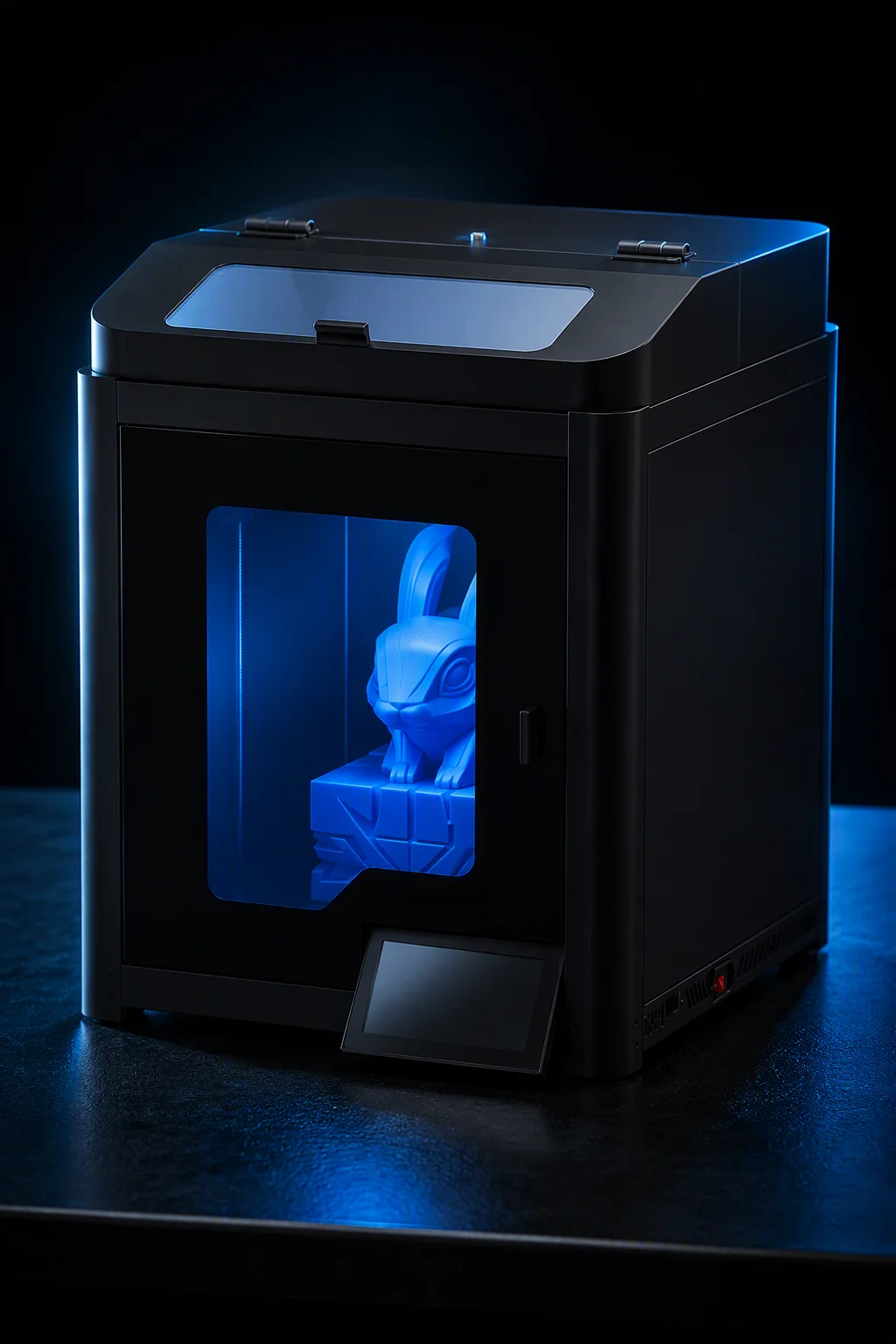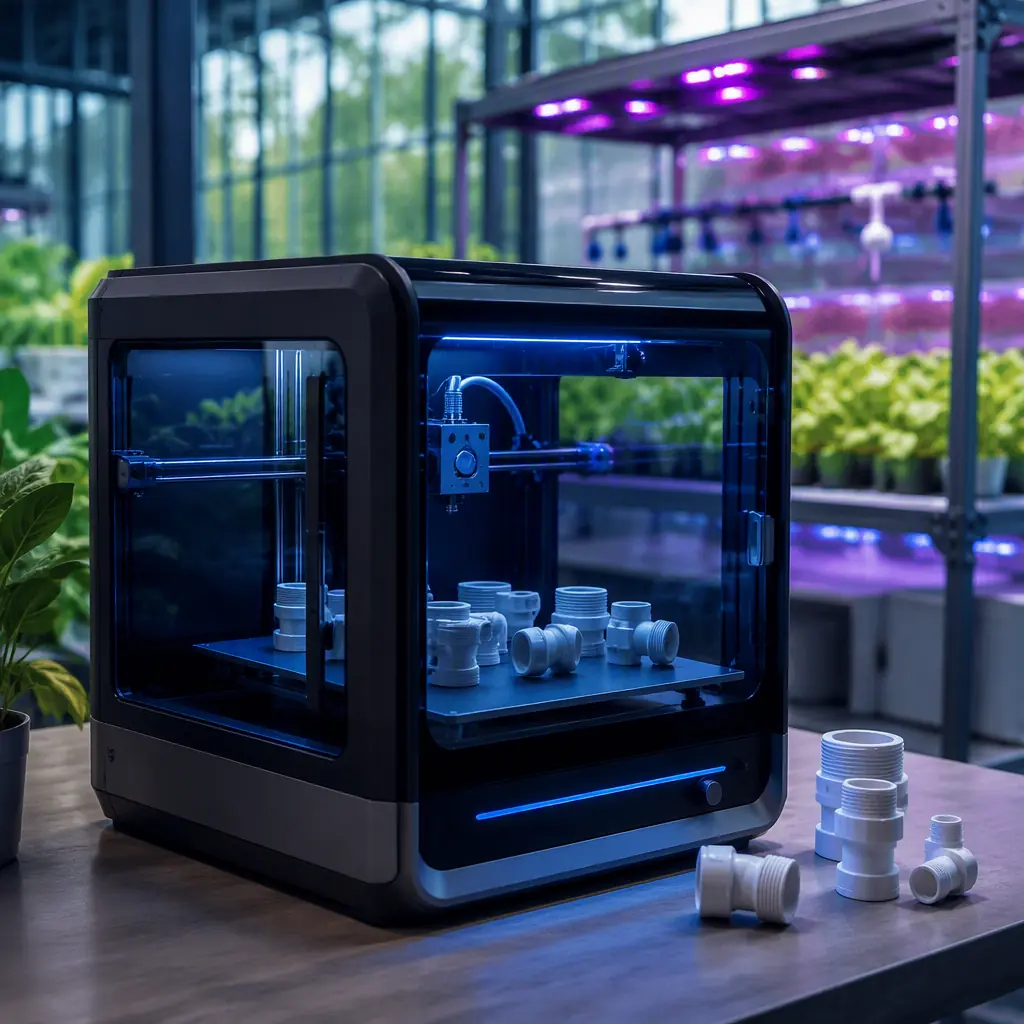
When a commercial hydroponic farm needs 200 custom net cup holders for a new NFT channel system, they have two options: injection-mold them in China with a $5,000 tooling cost and 45-day lead time, or print them on a $600 desktop 3D printer in 72 hours for $40 in filament. When a greenhouse operator discovers that a proprietary irrigation fitting is no longer manufactured, they can either retrofit the entire system for $15,000 or reverse-engineer and print the part for $4. Farming is an industry built on custom fabrication — every farm has slightly different equipment, layouts, and crops — which makes it the ideal market for desktop 3D printing. A single mid-size hydroponic operation with 20 printers running PETG parts generates approximately $3,000-5,000 in annual consumable revenue. For a distributor who understands agricultural applications, the recurring consumable revenue from 10 farm accounts rivals the hardware margin from 100 consumer sales — with far lower support overhead. For the broader vertical market strategy, see our portfolio strategy guide.
The Agricultural Customer Segments That Buy 3D Printers
Agriculture is not one market — it is four distinct customer segments, each with different printer requirements, purchasing processes, and consumable consumption patterns. Understanding which segment you are selling to determines everything from the printer model you recommend to the filament SKUs you stock.
Hydroponic farms are the highest-value segment because they print continuously — irrigation manifolds, channel end caps, spray nozzle holders, and custom mounting brackets are consumed at rates that make filament a monthly reorder item. A 50-acre hydroponic lettuce operation running 10 printers for production parts consumes approximately 15-25 kg of PETG per month. At $18-25/kg retail, that is a $270-625 monthly consumable account from a single farm — and the farm that buys printers and filament from you will buy replacement nozzles, build plates, and maintenance kits from you as well. For the consumables bundling strategy that maximizes per-account revenue, see our consumables bundling guide.
What you're listening for: If the answer is more than $5,000/year and more than 10 unique part SKUs, the customer is a strong candidate for in-house 3D printing. The breakeven point for a farm buying their first printer is typically 6-9 months when the alternative is outsourced custom fabrication. If they are currently modifying off-the-shelf parts with drills and epoxy, the breakeven is immediate — the printer pays for itself on the first custom irrigation manifold it replaces.
Printer Requirements for Agricultural Environments
A farm is not a climate-controlled office. Greenhouses operate at 25-40°C with 60-90% relative humidity. Barn workshops have dust, temperature swings, and occasional water exposure. The 3D printer you sell to a farm customer must survive conditions that would destroy a printer designed for a desktop in an air-conditioned room. The minimum specification for an agricultural-grade printer is an enclosed frame with a sealed electronics compartment, an all-metal hotend capable of 260°C minimum (PETG prints at 240-250°C, ASA at 250-260°C), a heated bed with PEI or textured surface, and firmware-level thermal runaway protection. An enclosure is not optional for agricultural environments — it protects prints from temperature fluctuations and protects the printer from dust, insects, and condensation. For the complete printer selection criteria, see our build volume guide and enclosed vs open frame comparison.
The build volume sweet spot for agricultural applications is 220×220×250 mm to 300×300×350 mm. Larger than 300 mm is rarely needed — most irrigation fittings, manifold components, and mounting brackets fit comfortably in a 256 mm cubed build volume. What matters more than volume is print reliability over long unattended runs. A farm operator who starts a 14-hour print at 6 PM and comes back at 8 AM cannot afford a failed print from a clogged nozzle or a warped first layer. Auto-bed leveling with mesh compensation, filament runout detection, and power-loss recovery are not optional features in this market — they are requirements. The cost of a failed overnight print on a farm is not just the wasted filament; it is a day of lost production on the irrigation system or greenhouse automation that the printed part was supposed to enable.
Filament Selection for Agricultural Applications: Beyond PLA
PLA is the wrong filament for agriculture. It is biodegradable in industrial composting conditions, absorbs moisture from humid greenhouse air, softens at 55-60°C (easily reached in direct sunlight inside a greenhouse), and becomes brittle after 6-12 months of UV exposure. Telling a farm customer to print irrigation fittings in PLA is professional negligence — the parts will fail within a growing season. The materials that work in agricultural environments are PETG, ASA, polypropylene (PP), and in specific applications, flexible TPU and engineering-grade PC blends.
PETG is the workhorse of agricultural 3D printing — it prints reliably on most enclosed printers, costs $15-22/kg at wholesale, and offers the combination of water resistance, moderate UV stability, and food-contact safety that covers 80% of farm applications. ASA is the upgrade for parts exposed to full sun and weather — UV-stable outdoor sensor enclosures, greenhouse ventilation louvers, and tractor instrument panel housings. For customers printing nutrient solution tanks or chemical handling components, polypropylene is the only material that withstands the full range of agricultural chemicals, from pH adjustment acids to fertilizer concentrates. For the complete filament selection and margin breakdown, see our engineering filaments guide.
The Distributor Go-to-Market Playbook for Agriculture
Selling 3D printers to farms is fundamentally different from selling to hobbyists or educators. A farm owner does not search Amazon for "3D printer." They search for solutions to specific agricultural problems: "custom irrigation fittings manufacturer," "hydroponic parts supplier," "greenhouse automation brackets." The distributor who captures this market is not the one with the best Google Ads for "3D printer" — it is the one who shows up at agricultural trade shows with printed irrigation manifolds and says "how much did you pay for this part last year?"
The go-to-market sequence that works for agricultural distribution is: (1) identify the top 3-5 agricultural trade shows in your region — indoor farming expos, greenhouse growers association conferences, precision agriculture summits; (2) prepare a sample kit of 10-15 printed agricultural parts — irrigation fittings, net cup adapters, sensor mounts, bracket replacements, tooling jigs — that a farm operator can hold in their hands and immediately recognize as parts they currently buy; (3) at the booth, the conversation opener is not "we sell 3D printers" but "we help farms reduce their custom parts costs by 70-90% and eliminate 45-day lead times"; (4) the follow-up is an on-site visit to their facility to identify the 5-10 parts that would deliver the fastest ROI, printing those parts as samples, and delivering them within 48 hours. For the complete distributor sales methodology, see our B2B sales demo playbook.
Recurring Revenue: The Consumable Stream That Makes Agriculture Accounts Profitable
The hardware sale to an agricultural customer is the entry point. The recurring revenue comes from filament, replacement nozzles (PETG and filled materials wear brass nozzles within 3-5 kg of throughput), PEI build sheets (agricultural parts with large flat footprints accelerate build surface wear), and maintenance kits. A farm running 5 printers 18 hours per day consumes approximately 25-35 kg of filament, 8-12 hardened steel nozzles, and 2-3 PEI sheets per year. At wholesale-to-retail margins, that is $600-900 in annual consumable revenue per printer — and farm customers exhibit 85%+ retention rates because switching filament suppliers mid-season risks crop-affecting part failures. For the maintenance plan and extended warranty models that lock in recurring revenue, see our maintenance plans guide.
Competitive Landscape: Why This Market Is Undefended
The agricultural 3D printing market is undefended because it sits in the gap between two industries that do not talk to each other. 3D printer manufacturers market to makers, engineers, and educators — not to farmers. Agricultural equipment suppliers sell tractors, irrigation systems, and greenhouse structures — not desktop fabrication tools. The farm operator who needs a custom irrigation fitting today has no established supplier to call. They either pay a machine shop $200 for a one-off aluminum part, order injection-molded parts from overseas with minimum order quantities that far exceed their needs, or jerry-rig a solution with PVC pipe and epoxy. The distributor who bridges the gap — who speaks the language of agriculture and understands 3D printing technology — captures the entire market in their region with zero direct competition. The total addressable market for agricultural 3D printing hardware and consumables in the United States alone is approximately $300-500 million annually across commercial farms, greenhouses, agritech companies, and university research programs. This is not a niche — it is a category in waiting. For the market trend analysis that supports vertical expansion timing, see our 2026 market trends report.
Bottom Line
The agricultural 3D printing vertical is the highest-potential underserved market in desktop fabrication. Farms are not one-time printer buyers — they are production operations that consume filament, nozzles, and build surfaces on a recurring monthly schedule. A distributor with 10 agricultural accounts running an average of 5 printers each generates $30,000-45,000 in annual recurring consumable revenue at 40-55% gross margins — from a customer segment that has no existing 3D printer supplier and therefore no incumbent to displace. The barrier to entry is not capital or technology; it is domain knowledge. The distributor who learns the agricultural applications, builds a sample kit of printed farm parts, and shows up at the next greenhouse growers conference will own this vertical in their region before the rest of the industry even realizes it exists.
Reviewed by the Precise3D engineering & OEM team. Compliance files that accompany the catalog are auditable at the certification register.
Start Your Partnership
Ready to Bring agriculture hydroponics to Your Market?
Distributors selling agriculture hydroponics build margins with OEM & white-label hardware - request the program sheet and volume pricing.