E-mobility procurement divides into four segments with different buying triggers, and each one is a repeatable account for a distributor who speaks its language. Charging infrastructure manufacturers buy for housings, cable management, and thermal management parts. Battery pack and cell makers buy for test fixtures, busbar insulators, and assembly tooling. Wire harness and electronics suppliers buy for connector backshells, grommets, and routing guides. Interior and structural component makers buy for jigs, fixtures, and low-volume production parts. For how these segments fit into a balanced distributor portfolio, see our portfolio strategy guide.
The Four EV Customer Segments and Their Entry Applications
Charging infrastructure is the highest-volume entry point. A wallbox or DC fast charger contains dozens of non-structural plastic parts — display bezels, cable glands, latch mechanisms, airflow vanes, terminal covers — that must meet UL94 V-0 flammability and often UV exposure for outdoor units. Manufacturers iterate on these parts continuously as UL listings and mounting standards change, which makes them natural 3D printing customers long before they commit to production tooling. Battery labs are the fastest closers: a pack development lab builds and tears down test fixtures for every cell format change, and those fixtures have lead times of days, not the 6-8 weeks a machine shop quotes. For the sales methodology that opens these accounts, see our B2B sales demo playbook.
Charging infrastructure and battery labs are the priority segments: they have engineering headcount, they iterate constantly, and they already track the cost of waiting on tooling. A charging maker that validates a wallbox housing revision on a printer in 3 days instead of waiting 6 weeks for an injection mold trial saves $20,000-60,000 per iteration in engineering time alone. For the consumables bundling model that maximizes per-account revenue, see our consumables bundling guide.
UL94 V-0 Materials: The Compliance Gate for Charging Hardware
The material conversation in EV is dominated by one specification: UL94 V-0 flame retardancy. Any plastic part that carries current, sits inside an enclosure, or is within 3 mm of a live component needs a V-0-rated material, and that gate filters which printers qualify for the account. Flame-retardant PC (FR-PC) is the default for charging hardware — it prints at 260-280°C, holds V-0 at thin wall sections, and has the impact strength for enclosures that survive drops during installation. FR-ABS is the lower-cost alternative for interior parts with less demanding thermal duty. ASA brings UV stability for outdoor charge point components, though V-0 ASA is a specialty grade. For battery lab work that doesn't touch flammability rules — test fixtures, alignment jigs, cell holders — nylon PA12 and PETG are the workhorses, and PA-CF adds stiffness for fixtures that hold geometry under clamp loads. For the full industrial material lineup, see our PEEK/PEI/PPSU industrial materials guide and the nylon filament guide.
What you're listening for: The revision count is the ROI script. A charging maker validating 20-30 revisions a year across wallbox families is burning $40,000-100,000 on tooling trials and waiting weeks per cycle — that account justifies three printers on revision velocity alone. The flammability answer tells you which materials to quote first: any yes means FR-PC and FR-ABS are the opening line, and the printer must have an all-metal hotend for 260-280°C printing.
Printer Requirements for Battery Labs and Production Floors
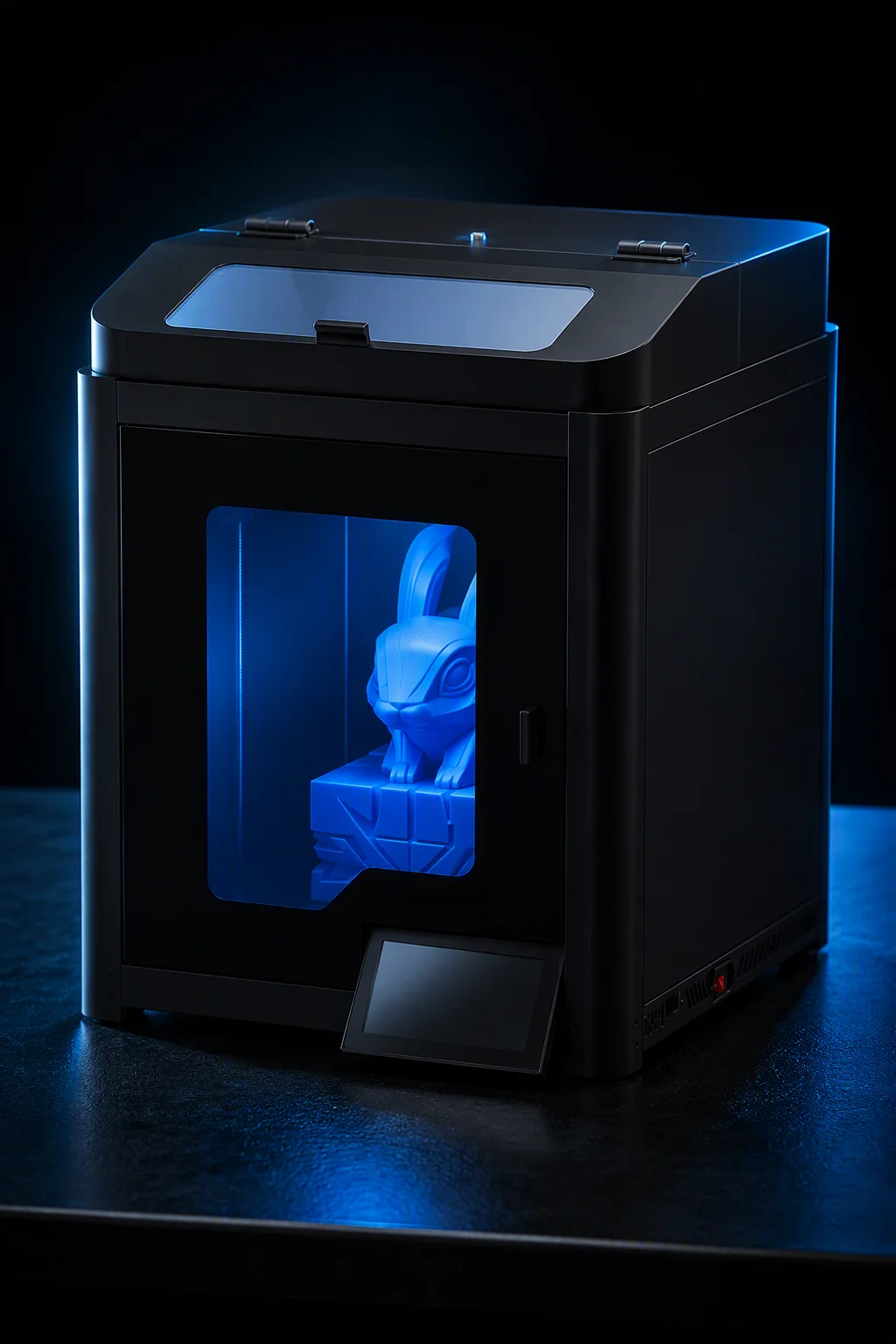
Battery labs and EV production floors demand reliability over speed, because a failed overnight print delays a test cycle that has already been scheduled. The printer stack for this vertical needs an enclosed frame (battery labs control dust and particles), an all-metal hotend for engineering and flame-retardant materials, a heated chamber for warpage control on large FR-PC enclosures, and the full unattended suite — thermal runaway protection, filament runout detection, and power-loss recovery — because an interrupted battery fixture print is a lost test slot. ESD-safe handling matters in battery labs: pair the printer with ESD-safe build plates and grounded enclosures where cells are handled nearby. For the complete printer selection criteria, see our build volume guide and the safety features guide.
Build volume in EV splits cleanly into two tiers. Connector backshells, cable glands, bezels, and cell holders fit a 256 mm cube. Wallbox housing panels, battery module trays, and larger fixtures need 300×350 mm or bigger — a 300 mm-class printer batches 8-15 small parts per overnight run, which is how a charging maker keeps its revision pipeline moving. A battery lab's pilot application is almost always a test fixture: it has zero compliance review, prints in PETG in hours, and gets a printer physically installed in the lab before the production-part conversation starts. For the operational scaling picture, see our print farm operations guide.
The Distributor Go-to-Market Playbook for E-Mobility
E-mobility procurement is engineer-led and iteration-driven, so the distributor playbook is built around velocity, not price. (1) Enter through the engineering or prototyping department — every EV company has one, and it is the one department with budget authority over time-critical parts. (2) Lead with fixtures and validation parts, which need no compliance review and prove the printer in days; busbar insulators and connector backshells come second, once the lab has qualified the material stack. (3) Bundle the compliance story: supply FR-PC and FR-ABS spools with datasheets and print profiles pre-validated, so the customer's UL audit trail is one page instead of a research project. (4) Sell the iteration math: "this wallbox housing revision costs $4,000 and 6 weeks as a mold trial; it is now a 3-day print on your bench." Sales cycles in EV are 3-6 months — faster than any other industrial vertical because the customers are growing and their part lists change constantly. For the recurring revenue models that lock in these accounts, see our spare parts aftermarket guide and the maintenance plans guide.
Recurring Revenue: Iteration Consumes Material on a Schedule
EV accounts consume filament predictably because iteration is continuous. A charging maker validating 20-30 revisions a year runs 25-60 kg of FR-PC and ASA per month; a battery lab cycling test fixtures runs 15-40 kg of nylon and PETG. Add hardened steel nozzles (FR-PC and PA-CF wear brass nozzles within 3-5 kg), PEI build sheets for the engineering materials, spare hotends, and ESD accessories, and a single EV account becomes a $3,000-8,000 monthly revenue stream at 40-55% gross margins. The switching cost is real: once a customer's engineering team has qualified print profiles and a parts library for their chargers and fixtures, changing suppliers means re-validating every material and profile. For the market sizing and trend context that supports the timing, see our 2026 market trends report and the energy & renewables vertical guide.
Bottom Line
The EV supply chain is the vertical where iteration velocity is the competitive weapon, and 3D printing is the only process that matches its cadence. The parts that bottleneck EV development — flame-retardant housings, battery test fixtures, connector backshells, cable management — are small, plastic, compliance-gated, and needed in days. Charging infrastructure makers and battery labs are the entry segments: engineer-led, iteration-driven, and already paying $20,000-60,000 per tooling trial they could print for $40. A distributor with 6 EV accounts averaging 4 printers each builds $90,000-150,000 in annual recurring consumable revenue at 40-55% margins — and rides the fastest-growing procurement curve in manufacturing. The distributor who walks into an EV lab with a printed busbar insulator and an FR-PC spool in hand will own the iteration pipeline before the mold shop even returns the quote.
Reviewed by the Precise3D engineering & OEM team. Compliance files that accompany the catalog are auditable at the certification register.
Start Your Partnership
Ready to Bring ev e mobility to Your Market?
Distributors selling ev e mobility build margins with OEM & white-label hardware - request the program sheet and volume pricing.