The Die Is the Cost
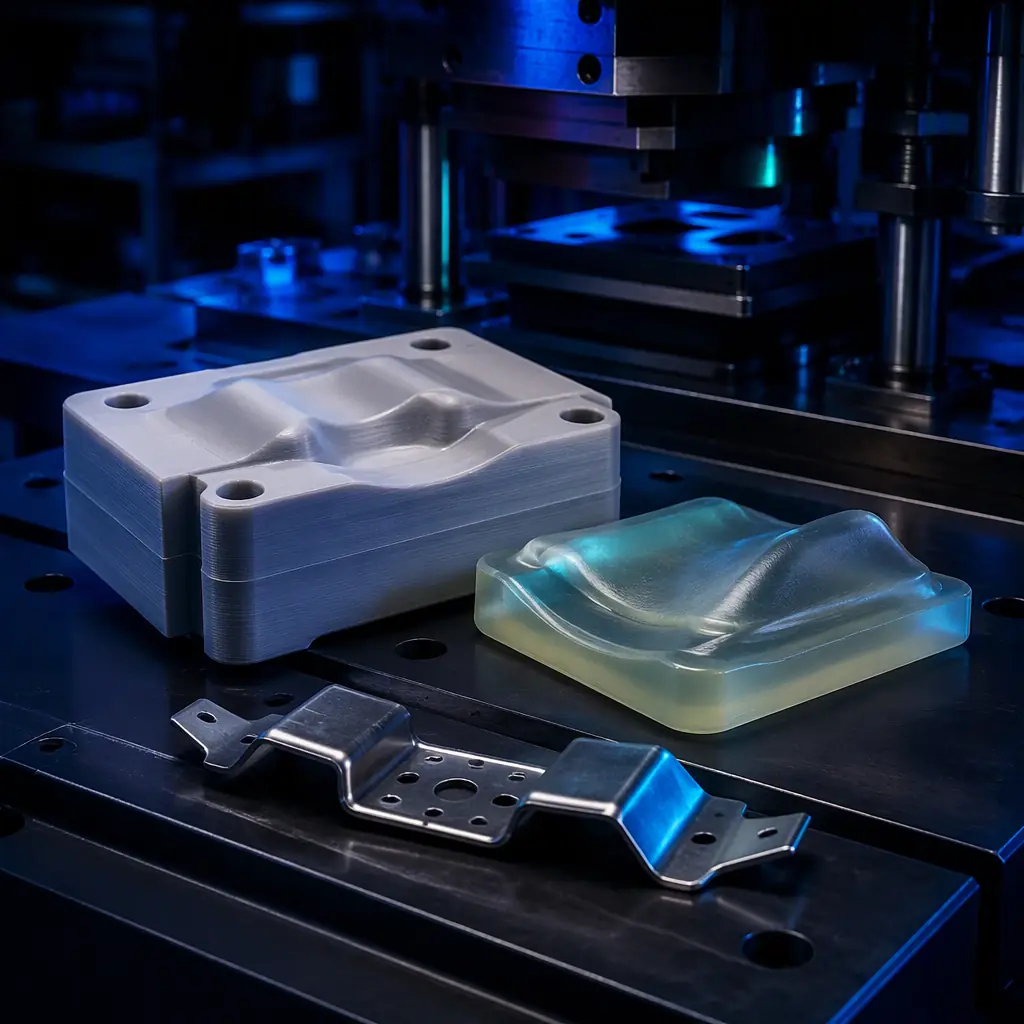
In stamping, the die moves. A steel die for even a modest part can run $5,000–50,000 or more and take weeks from artwork to first run. For a low or medium-volume part, a die that costs more than the whole job is economically absurd. But the part still has to be formed, trimmed and pierced somehow. That gap between "needs a die" and "cannot justify a steel die" is where polymer tooling lives. A printed die from a stiff, wear-resistant filled polymer forms a running part, costs a small fraction of steel, and re-prints wire-to-wire in a matter of days.
The shop that needs this already understands the value of printed production tooling, and the parts they prove out with printed dies frequently move to higher-volumes in our end-use functional parts range. For the shop-owner who is price-sensitive on every die, printed dies are the fast entry.
Where Polymer Dies Work & Where They Do Not
The rule on polymer dies is blunt: they work where forces and wear are moderate and sheet metal is thin or soft, and they fail where a hard steel die is doing heavy blanking, high-volume piercing or cutting thick, hard material. That still leaves a large, profitable middle: forming dies, draw dies, trim dies, urethane die faces, draw beads, cam and wedge tooling for low and medium runs. On soft sheet (aluminium, pre-painted, coated, stainless at thin gauge) a polymer or urethane die is often the better choice because a hard die would mar the finish.
For the geometry discipline that keeps a die true, our dimensional accuracy guide and our design-for-AM rules guide are the correct reads.
Urethane Dies: The Mar-Free Weapon
A urethane die uses a resilient block as the forming medium instead of a hard steel face. It is the go-to for pre-painted, coated, galvanised and soft aluminium sheet, because a hard die would scuff or mark the surface. Urethane dies are cheap, quickly replaced, and conform to the sheet so the finish stays clean. A printed former, matched with a urethane pad, is a common and effective combination: the printed part provides geometry and locating, the urethane provides the yielding, mark-free forming surface.
For the stiffness and wear-resistance the die face needs, our carbon-fibre filled filament guide and our engineering filaments guide lay out the material set.
Draw Beads, Trim & Pierce Tooling
Beyond forming, the recurring printed parts are draw beads (to control material flow and prevent wrinkling in a draw die), trim dies (a printed trim die for thin sheet can replace a machined trim tool on a short run), pierce tooling for punch-and-die work on thin gauge, and a stream of locating blocks, wear plates and stripper pads that keep the tool running. Where the die must shear hard metal at volume, steel wins. But for the pilot, the short run and the soft sheet, polymer tooling is faster and cheaper.
What you're looking for: Heavy blanking, thick hard steel, high-volume shearing → steel die; forming, drawing, locating, thin/soft/coated sheet, prototype and short run → printed polymer or urethane. Confirm the die face survives the intended run without galling and that no sharp edge is expected to hold over thousands of strokes.
Die tooling sits squarely in the printed production tooling opportunity, and it pairs well with the metal-fabrication vertical your shop likely already serves, the same buyer who welds and fabricates stamps.
Distributor Economics: The Die-Driven Account
Stamping shops buy dies the way other shops buy fixture work, whenever a new job or a part revision lands. The value of a printed die is measured against steel: 50–80% under the machined cost and days instead of weeks to stand up. That speed is the revenue driver. A typical shop first buys polymer dies to try a new part cheaply, then buys the printer to make its own dies, then keeps buying material, wear plates and accessories. A die-driven account starts at $500–1,200 for the printer and tooling and grows to $2,500–7,000/year in consumables and replacement dies.
The entry plan:
(1) Run a chamber-heated printer with a hardened nozzle and a stiff PA-CF plus a wear-resistant material set. (2) Print a demo kit of the fastest-moving dies, a forming die, a urethane pad, a draw bead, a trim die. (3) Approach stampers, sheet-metal fabricators and appliance/enclosure makers. (4) Lead with the die-cost-and-lead-time message: steel weeks and thousands, printed days and a fraction. For positioning the overall business, our portfolio & market-segment strategy is the relevant read.
Stamping is a tool-driven vertical: the die gates every job, and a shorter, cheaper die wins the work. At Precise3D, our chamber-heated, hardened-nozzle FDM platform with stiff PA-CF and wear-resistant capability is built to stand up forming, trim and urethane die faces. Accurate, mar-free tooling that keeps a press running and a job profitable.
Reviewed by the Precise3D engineering & OEM team. Compliance files that accompany the catalog are auditable at the certification register.
Enter This Vertical
Ready to Supply Printed Tooling to This Market?
Join our network of global distributor network. Chamber-heated, hardened-nozzle printers with stiff PA-CF, PC and wear-resistant polymers, plus a demo kit of the fastest-moving parts for this vertical, everything you need to open the aftermarket.