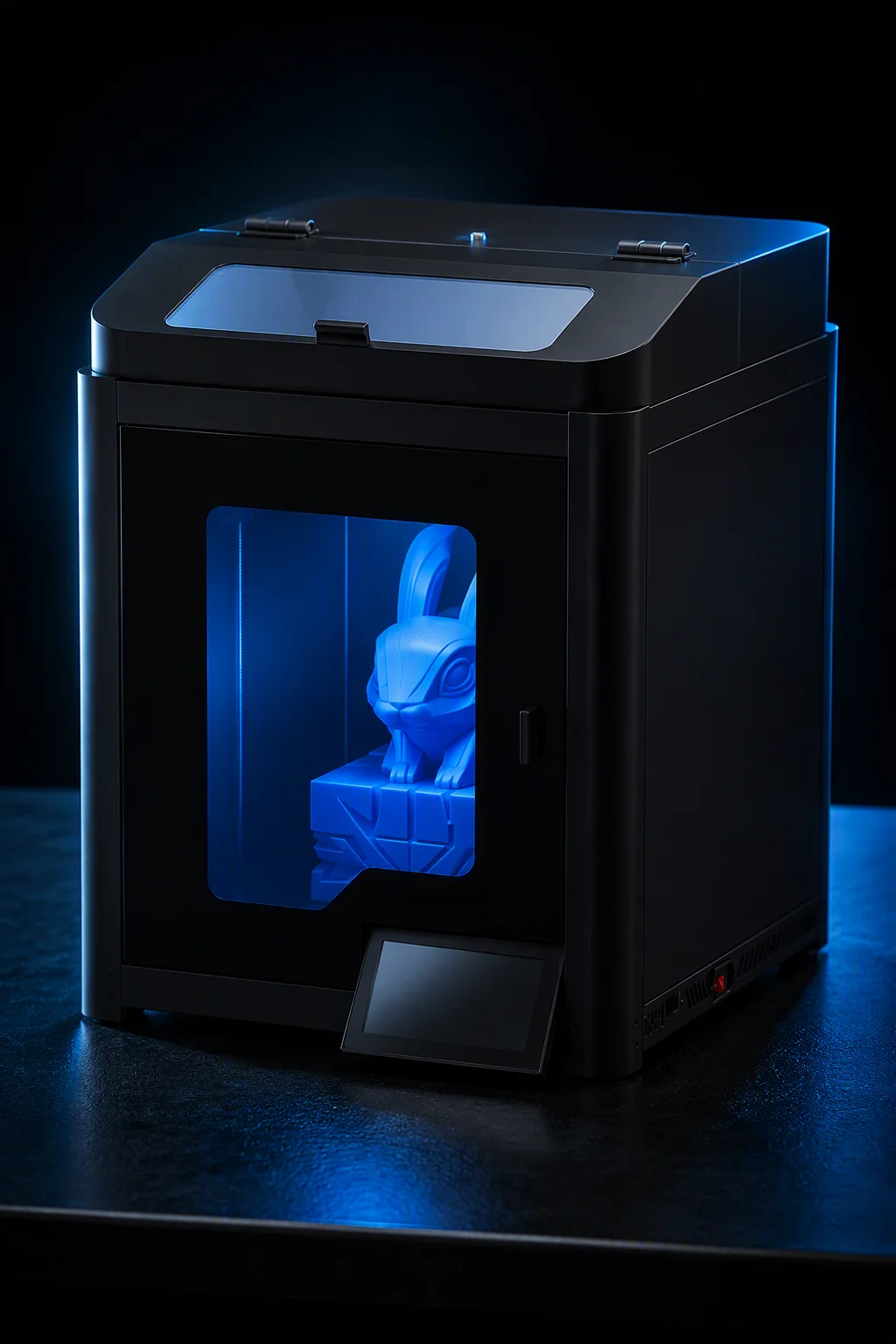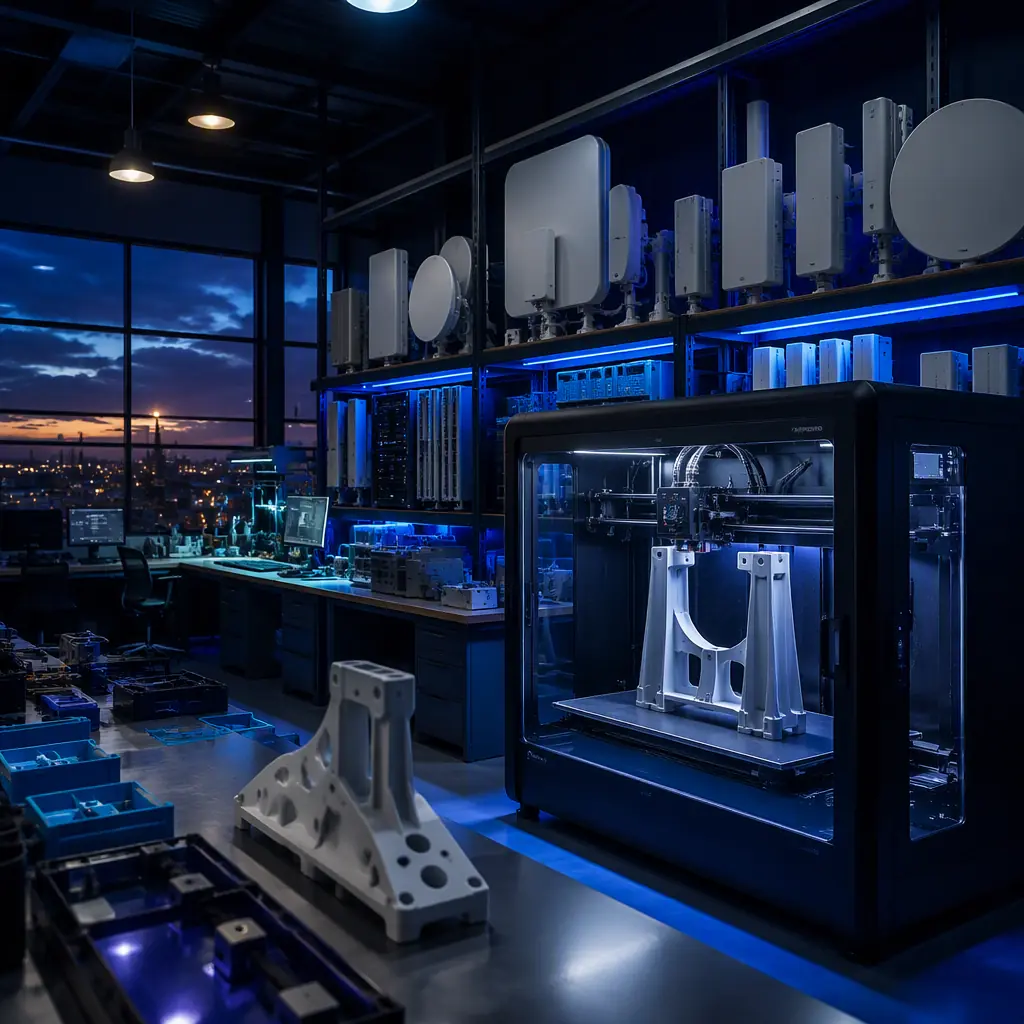
Telecom procurement splits into four segments with different urgency profiles. Network equipment manufacturers (NEMs) buy for prototype housings, antenna-adjacent parts, and test fixtures. Tower and site installation contractors buy for mounting hardware, cable management, and tooling that must survive the field. Fiber and data center operators buy for splice trays, rack accessories, and airflow management. RF design labs buy for test fixtures, waveguide transitions, and antenna prototypes where dielectric properties matter. Each segment is a repeatable account with a different entry application. For how these fit into a balanced distributor portfolio, see our portfolio strategy guide.
The Telecom Customer Segments and Their Entry Applications
Installation contractors are the highest-urgency segment: a site crew that discovers a missing bracket or a damaged cable guide on a tower stops the job and burns $1,500-4,000 per day in crew time while the replacement ships. Contractors who carry a printer and filament in the service truck print the part on site in 2-4 hours. Network equipment manufacturers are the highest-volume segment: their R&D groups iterate antenna housings, radome brackets, and RF test fixtures continuously, and every iteration is a 2-5 day print instead of a 4-8 week tooling cycle. Fiber operators buy the most predictable consumable volume because splice trays and rack accessories are standardized parts printed in repeating batches. For the sales methodology that opens these accounts, see our B2B sales demo playbook.
Installation contractors and NEMs are the priority segments: contractors buy on urgency (a stopped crew is an immediate, quantifiable loss), and NEMs buy on iteration volume. A contractor that avoids two site revisits per month at $2,000 each has paid for a printer in the first quarter. For the consumables bundling model that maximizes per-account revenue, see our consumables bundling guide.
Materials That Survive 20 Years on a Tower
The material conversation in telecom is about outdoor survival: UV degradation, salt fog, thermal cycling from -40°C to +70°C, and water ingress. ASA is the default outdoor workhorse — UV-stable, tough, and printable on any enclosed printer — which makes it the opening material for mounts, brackets, and enclosures. Polycarbonate adds impact strength and higher heat deflection for enclosures near electronics that run hot. PPE/PPE+PS blends (Noryl-type) bring the flame-retardant and low-dielectric profile needed for antenna-adjacent parts, though they print hot and need a hardened nozzle. Nylon PA12 and PA-CF handle mechanical duty — hinge points, clamp bodies, load-bearing brackets — but require UV-tolerant grades for exposed use. One dielectric rule matters everywhere: keep metal hardware and high-permittivity materials out of the antenna's near field unless the part is designed for it. For the full industrial material lineup, see our PEEK/PEI/PPSU industrial materials guide and the outdoor weather-resistant printing guide.
What you're listening for: The revisit count is the ROI script. Two avoided revisits a month at $1,500-4,000 each pays for a printer-and-material kit in the first quarter. The second question is environmental: does the part see direct sun (ASA), salt spray near coasts (ASA or PC with salt-fog testing), or heat near electronics (PC, PPE)? Contractors who track site-visit costs by root cause close fastest — they can already price the failure.
Printer Requirements for Network Equipment Shops and Field Trucks
Telecom printing splits between the lab and the field, and the printer requirements differ. For NEM and RF lab work: enclosed frame, all-metal hotend for ASA/PC/PPE at 250-300°C, heated chamber for warpage control on large enclosure panels, and the unattended reliability suite — thermal runaway protection, filament runout detection, power-loss recovery — because an interrupted overnight radome bracket print delays a test cycle. For field truck use, the priority flips to ruggedness and portability: a compact enclosed printer with a hard case, powered from a generator or inverter, printing ASA parts in 2-4 hours on site. Filtration matters in both settings: printing ASA and PC releases styrene and BPA-class compounds, so a carbon filter or ventilation kit is a required accessory, not an upsell. For the complete printer selection criteria, see our build volume guide, the safety features guide, and the enclosure temperature control guide.
Build volume in telecom splits into two tiers. Cable guides, splice trays, hinges, and small brackets fit a 256 mm cube. Radome stiffeners, enclosure panels, and larger antenna mounts need 300×350 mm or bigger — a 300 mm-class printer batches 10-20 small parts per overnight run for the repeating rack-accessory and tray volume. The pilot application that opens a telecom account is almost always a cable guide or mounting bracket for the contractor's own crews: zero compliance review, printable in ASA in hours, and demonstrably cheaper than the 3-6 week sourcing delay it replaces. For the operational scaling picture, see our print farm operations guide.
The Distributor Go-to-Market Playbook for Telecom
Telecom procurement is split between corporate purchasing (slow, framework-driven) and field urgency (immediate, budget-light), and the distributor playbook attacks both. (1) Enter through the field organization: installation crews with a stopped job are the fastest yes in telecom, and the service-truck printer kit is the wedge product. (2) Build the parts library with the contractor's engineering team — every digitized bracket and tray is a lock-in asset that keeps reordering filament and nozzles. (3) Sell the compliance story for NEM accounts: pre-validated ASA/PC/PPE print profiles with datasheets make the customer's outdoor-rating qualification one page instead of a research project. (4) Sell the urgency math: "this $9 cable guide stopped a $2,000-per-day crew for three weeks; the file is on your tablet and reprints in the truck in 2 hours." Sales cycles are 2-6 months, faster than most industrial verticals because field urgency short-circuits corporate process. For the recurring revenue models that lock in telecom accounts, see our spare parts aftermarket guide and the supply chain resilience guide.
Recurring Revenue: Field Urgency Consumes on a Schedule
Telecom consumable revenue is driven by two predictable rhythms. Field crews consume ASA and PETG continuously as they print replacement brackets and cable management on site — a contractor with 4 printers runs 20-50 kg per month. NEM R&D groups burn PC, PPE, and PA on prototype iterations at 15-40 kg per month. Add hardened steel nozzles (ASA and filled nylons wear brass within 4-6 kg), PEI build sheets, carbon filters (the mandated accessory for styrene-heavy ASA printing), and spare hotends, and a single telecom account becomes a $2,000-7,000 monthly revenue stream at 40-55% gross margins. The switching cost is structural: once a contractor's field team has a qualified parts library and print profiles that work in the truck, changing suppliers means re-qualifying every part and every profile. For the market sizing and trend context that supports the timing, see our 2026 market trends report and the energy & renewables vertical guide.
Bottom Line
Telecom is the vertical where field urgency makes 3D printing a competitive weapon rather than a convenience. The parts that stop 5G work — antenna mounts, cable guides, radome brackets, splice trays, RF fixtures — are small, plastic, outdoor-rated, and needed in hours, and none of them justify an injection mold. Installation contractors buy on urgency and are the fastest entry; NEMs buy on iteration volume and are the deepest accounts; both consume ASA, PC, and PPE on a schedule that a distributor can forecast. A distributor with 6 telecom accounts averaging 4 printers each builds $80,000-140,000 in annual recurring consumable revenue at 40-55% margins — and owns the parts libraries that make the accounts structural. The distributor who puts a printer kit in the contractor's truck and an ASA spool in the NEM's lab will own the 5G spare parts pipeline before the mold shop quotes the tool.
Reviewed by the Precise3D engineering & OEM team. Compliance files that accompany the catalog are auditable at the certification register.
Start Your Partnership
Ready to Bring telecom 5g infrastructure to Your Market?
Our OEM program supports telecom 5g infrastructure programs end to end - the product line, firmware and compliance files that travel with each shipment.