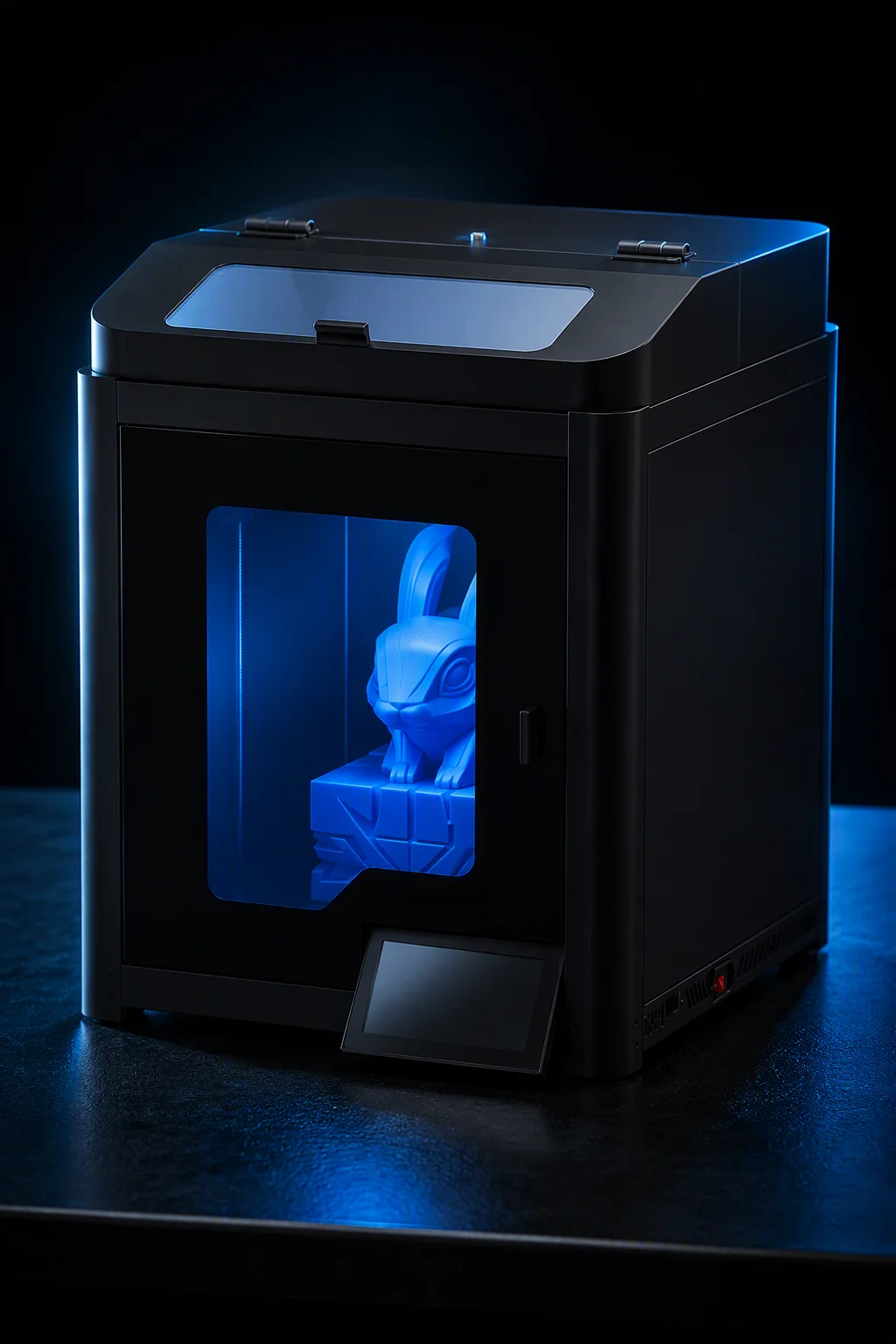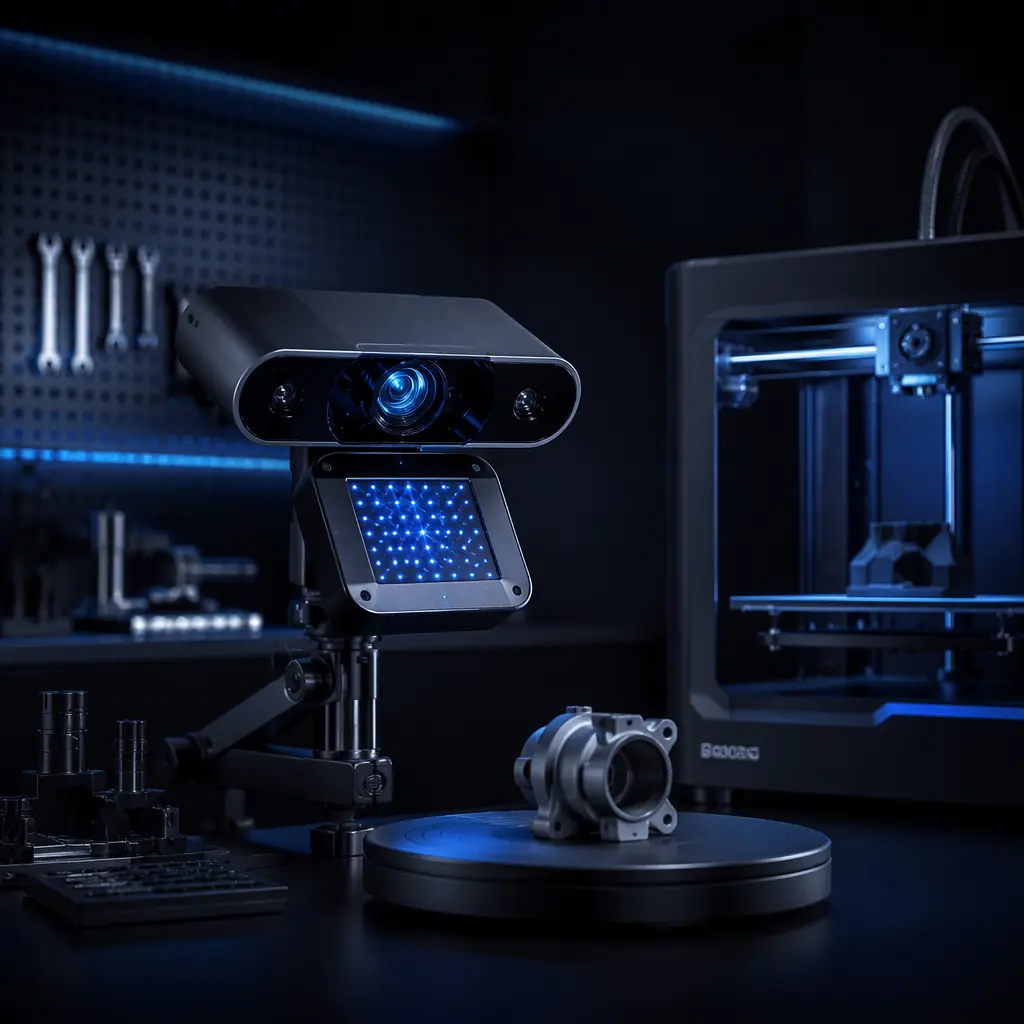
Here's a data point that should change how you think about your product catalog: distributors who sell 3D scanners alongside printers report 3–5× higher average order values than those who sell printers alone. The reason isn't complicated. A 3D printer without a scanner is half a workflow. A dentist needs an intraoral scanner to capture the patient's teeth before the printer can produce a model. A jeweler needs a structured-light scanner to digitize a wax master before the resin printer casts it. An engineering firm needs a laser scanner to reverse-engineer a broken part before the FDM printer can reproduce it.
In every one of these scenarios, the scanner is not optional — it's the input device that makes the printer useful. And yet, across the 200+ distributor conversations we've had in the last 18 months, fewer than 15% stock any 3D scanner at all. This guide explains what scanner technologies to stock, which verticals generate the highest scanner-attached revenue, how to bundle and price scanner+printer packages, and what a minimum viable scanner inventory looks like for a distributor entering this category.
Why Scanners Complete the 3D Printer Sale
Think of a 3D printer as the output device in a digital manufacturing pipeline. Without a scanner, the customer has two ways to feed it: download pre-existing STL files, or design from scratch in CAD. Both approaches limit the printer's addressable use cases to about 40% of what the machine can actually do. The missing 60% — dental restorations, jewelry reproduction, reverse engineering, custom prosthetics, architectural model digitization — all require a scanner as the input device.
When you sell a scanner alongside a printer, three things happen to your distributor economics:
- Order value multiplies. A Formlabs-sized dental bundle (printer + wash/cure + intraoral scanner + resins) routinely hits $18,000–$25,000. The same customer buying a printer alone spends $3,500. That's a 5–7× difference on the same sales call.
- Customer retention locks in. A lab that builds its entire workflow around your scanner+printer combination is not going to switch suppliers for a 10% discount on filament. The switching cost is the entire retraining and recalibration cycle.
- Competitive moat widens. The number of distributors who can competently sell, train, and support a scanner+printer workflow is tiny. If you're one of them, you're competing against maybe 3-5 regional players instead of 30+ printer-only box-movers.
Scanner Technologies: What Distributors Actually Need to Stock
There are three mainstream 3D scanning technologies, and they map cleanly to different customer verticals. You don't need to understand the optics physics — you need to understand which scanner type solves which customer's problem:
Structured light scanners (blue/white LED projection) are the workhorse of the jewelry and small-parts reverse engineering segment. They capture 0.01–0.05 mm detail — enough to digitize a ring's filigree or a connector housing's snap-fit geometry. Price range: $800–$5,000 for desktop units, $8,000–$25,000 for metrology-grade systems. Your sweet spot as a distributor is the $1,200–$3,500 desktop range: these are the scanners that dental labs and jewelry studios actually buy.
Laser triangulation scanners handle larger, less reflective objects — automotive parts, industrial housings, cast metal components. They're slower than structured light (a full scan takes 3–8 minutes vs 30–90 seconds) but they handle dark and shiny surfaces without spray coating. Price range: $2,000–$15,000. These are your upsell for engineering and reverse-engineering customers who need to digitize existing physical parts for modification or reproduction.
Photogrammetry uses multiple photographs from different angles to reconstruct 3D geometry. It's the lowest-cost entry point ($200–$800 for software + camera setup) but the lowest accuracy. Distributors should treat photogrammetry as an educational upsell — "here's a $500 way to try scanning before you invest $2,500 in a structured light unit" — rather than a core inventory line.
Intraoral scanners are a specialized category for the dental vertical. Unlike general-purpose scanners, they're medical devices with regulatory requirements (FDA 510(k) in the US, CE marking in Europe, MDR compliance from 2026). The hardware itself costs $8,000–$25,000, and the recurring revenue comes from scan bodies, calibration targets, and software subscription seats. We treat dental scanning as a separate vertical in the section below, because the sales motion, training burden, and regulatory path are fundamentally different from selling a desktop structured-light scanner to a jewelry studio.
The Dental Bundle: Where Scanner+Printer Economics Peak
Dental is the highest-value scanner-attached vertical in 3D printing distribution, and it's not close. Here's the math on a typical mid-range dental lab bundle:
Compare that to selling the printer alone at $3,500 with a 30% margin: you make $1,050. The scanner-attached bundle generates 5–6× the gross profit on a single customer acquisition. Even if the sales cycle is 2× longer (6-8 weeks instead of 3-4), the math is overwhelmingly in favor of the bundle.
For distributors entering dental, the key decision is whether to carry intraoral scanners from a dedicated dental brand (3Shape, Medit, Dentsply Sirona) or a lower-cost alternative from a Chinese manufacturer (Shining 3D, Launca, Fussen). The dedicated brands bring instant credibility with dental labs but typically require minimum annual purchase commitments of $50,000–$150,000 and certified training programs. The alternatives have lower barriers ($10,000–$30,000 initial order, self-paced training) but require you to build trust yourself through demo units and case studies. Our recommendation: start with 1-2 alternative-brand scanners as a proof-of-concept before committing to a major dental brand partnership. The scanner hardware from tier-2 Chinese manufacturers has improved dramatically since 2024 — accuracy now routinely hits 0.015 mm on the latest Shining 3D and Launca models, which meets the clinical threshold for crown-and-bridge and clear-aligner workflows.
Jewelry: The Low-Barrier Scanner Vertical That Scales Fast
If dental is the highest-value scanner vertical, jewelry is the highest-volume one. A jewelry studio's digital workflow is straightforward: scan a wax master or existing piece → modify in CAD (Rhino or MatrixGold) → print in castable resin → investment cast in metal. The scanner is the first step in every single job. Without it, the studio is hand-carving wax models — a process that takes 4–8 hours per piece versus 30 minutes with scan-to-print.
The scanner economics for jewelry are more accessible than dental:
The jewelry scanner market is also fragmented in a way that favors new-entrant distributors. Unlike dental, where 3Shape and Medit dominate mindshare, jewelry studios don't have a default scanner brand. The buying decision is driven by demo results, local support availability, and bundle pricing — all of which a well-prepared distributor can control.
Engineering and Reverse Engineering: The Industrial Scanner Upsell
Engineering firms and industrial maintenance departments use 3D scanners for a fundamentally different purpose than dental labs: reverse engineering. A factory has a broken injection mold insert from a machine that went out of production in 2012. There are no CAD files. The maintenance team scans the surviving half of the mold, reconstructs the geometry, and 3D prints a replacement — often in a high-temperature engineering filament like PEEK, PEI (ULTEM), or carbon-fiber-filled nylon.
This use case requires a different scanner class: laser triangulation or high-end structured light with 0.02–0.05 mm accuracy on dark and reflective surfaces. The scanner investment is higher ($3,000–$12,000), but the value proposition to the customer is even stronger: one avoided week of production downtime pays for the entire scanner+printer bundle. A single injection mold insert replacement that takes 3 days via scan→CAD→print→machine versus 4-6 weeks via traditional toolmaking is worth $15,000–$80,000 in avoided downtime, depending on the production line.
For distributors, the engineering reverse-engineering vertical requires stronger technical sales capability. You need to be able to demonstrate a scan-to-print workflow on a real part during a sales visit. The training investment is 3-5 days to become competent enough to run a demo. But the reward is a customer segment where price sensitivity is near-zero — the decision is driven entirely by speed and reliability.
How to Price and Bundle Scanner + Printer Packages
There are three proven scanner+printer bundling strategies, and they map to your customer's sophistication level:
Strategy 1: The "Complete Workflow" Bundle (Dental + Jewelry).
Price the bundle at 12-18% below the sum of individual component MSRPs. The discount feels substantial to the customer, but your blended margin only drops 4-7 percentage points because scanner margins (typically 30-40%) are higher than printer margins (20-30%). Include installation and 2-day on-site training in the bundle price — this locks in the relationship and reduces return risk. A dental lab that's been trained on your scanner-to-printer workflow is not going to buy their next printer from a competitor who can't support the scanner they already own.
Strategy 2: The "Scanner as Printer Upsell" (Engineering + General).
Price the printer at standard MSRP. Offer the scanner at a 20-25% discount exclusively to customers who purchase a printer from you within the same quarter. This keeps the printer margin intact while pulling through a scanner sale that wouldn't have happened otherwise. The psychology: the customer was going to buy a $3,500 printer anyway. Getting a $2,800 scanner for $2,100 feels like saving $700 — even though they just spent $5,600 total. This strategy works best for engineering and general-purpose customers who have a specific reverse-engineering project in mind but haven't budgeted for a scanner.
Strategy 3: The "Starter Scanner" Loss Leader (Education + Entry-Level).
Stock one entry-level photogrammetry or low-cost structured-light scanner ($400–$800 wholesale). Sell it at near-cost as an add-on to any printer purchase. Your margin on the scanner is $30–$80, but the customer now has a scanning capability they didn't have before — and within 6-12 months, 40-50% of them will upgrade to a $2,000+ scanner from you because you're the distributor who got them started. This is the razor-and-blades model adapted for scanners: the entry scanner is the razor, the upgraded scanner and recurring consumables are the blades.
Minimum Viable Scanner Inventory for a Distributor
You don't need 15 scanner SKUs on day one. Here's a three-unit starter inventory that covers the three highest-value verticals:
This is not capital-intensive compared to stocking printers. The total scanner inventory investment ($10K–$16K) is roughly equivalent to stocking 3-5 mid-range FDM printers. But the revenue per sale is 3-5× higher because the scanner pulls through the printer, not the other way around.
For the training side: budget 3-4 days of hands-on practice with each scanner type before you attempt a customer demo. The learning curve on structured light and intraoral scanners is steeper than on printers — you're not just leveling a bed, you're aligning scan point clouds, filling mesh holes, and exporting watertight STLs. If your technical salesperson can't do that in under 10 minutes during a demo, the customer will lose confidence.
Common Objections from Distributors (And Why They're Wrong)
"My customers don't ask for scanners." Your customers don't ask for scanners because they don't know scanners are an option from a printer distributor. Dental labs currently buy intraoral scanners from dedicated dental supply companies (Henry Schein, Patterson Dental) at full MSRP with zero bundle discount — because the printer distributor never offered them a combined package. The demand exists; it's just being captured by a different channel.
"The training burden is too high." The training burden on scanners is front-loaded: steep for the first 2-3 demos, then leveling off sharply. After 5-6 customer demos, the scanning portion of a sales call takes 8-12 minutes. Compare that to the 45-60 minutes you already spend explaining Klipper firmware capabilities or IDEX dual-extrusion configurations to a retail customer. The scanner demo is actually shorter.
"The warranty and support risk is too high." 3D scanners have far fewer moving parts than 3D printers. No heated beds, no nozzle clogs, no belt tension drift, no firmware update bricking. The primary failure modes — calibration drift and LED/laser degradation — are predictable and occur on 18-36 month cycles, long enough that most units are out of warranty before the first service event. Your support burden on scanners will be 70-80% lower than on printers, per unit.
Getting Started: The 90-Day Scanner Launch Plan
Week 1-2: Order one demo intraoral scanner and one demo structured light scanner. Spend 3 days learning each device. Scan 20+ objects of varying complexity — teeth models, rings, mechanical parts, organic shapes. Build your demo script.
Week 3-4: Identify your 5 highest-value existing printer customers in dental and jewelry. Offer them a free on-site scanner demo with no purchase obligation. Your goal is not to sell on this visit — it's to observe their reaction, collect objections, and refine your pitch. Track what questions they ask. Those questions become your FAQ and your sales training material.
Week 5-8: Launch the scanner bundle to your full customer list. Price Strategy 1 (Complete Workflow Bundle) for dental labs, Strategy 2 (Scanner as Printer Upsell) for engineering firms. Send a physical demo unit to any customer who expresses interest and is within shipping distance — a scanner in their hands for 3 days converts at 3-5× the rate of a spec sheet alone.
Week 9-12: Review results. Which vertical generated the highest scanner attachment rate? Double down there. Which scanner model had the most demo requests but lowest conversion? Either replace it or adjust your demo script. By month 3, you should have enough data to decide whether to expand to a second scanner SKU or deepen penetration with your existing lineup.
Bottom Line
A 3D printer distributor who sells only printers is leaving 60-80% of the addressable revenue per customer on the table. The scanner is the workflow catalyst — the device that turns a printer from a "nice-to-have prototyping tool" into a "can't-run-the-business-without-it production system." The inventory investment to enter scanning is modest ($10K–$16K). The margin per sale is higher than printers. And the competitive moat — a distributor who can competently demonstrate and support a scan-to-print workflow — is nearly unassailable in most regional markets.
The question isn't whether your customers need scanners. It's whether you want to be the distributor who sells them the complete digital manufacturing workflow — or the one who sells them half of it and watches someone else capture the scanner revenue.
Reviewed by the Precise3D engineering & OEM team. Compliance files that accompany the catalog are auditable at the certification register.
Start Your Partnership
Ready to Bring scanner bundle strategy to Your Market?
Start with the scanner bundle strategy spec sheet, then validate every claim against the certification register.