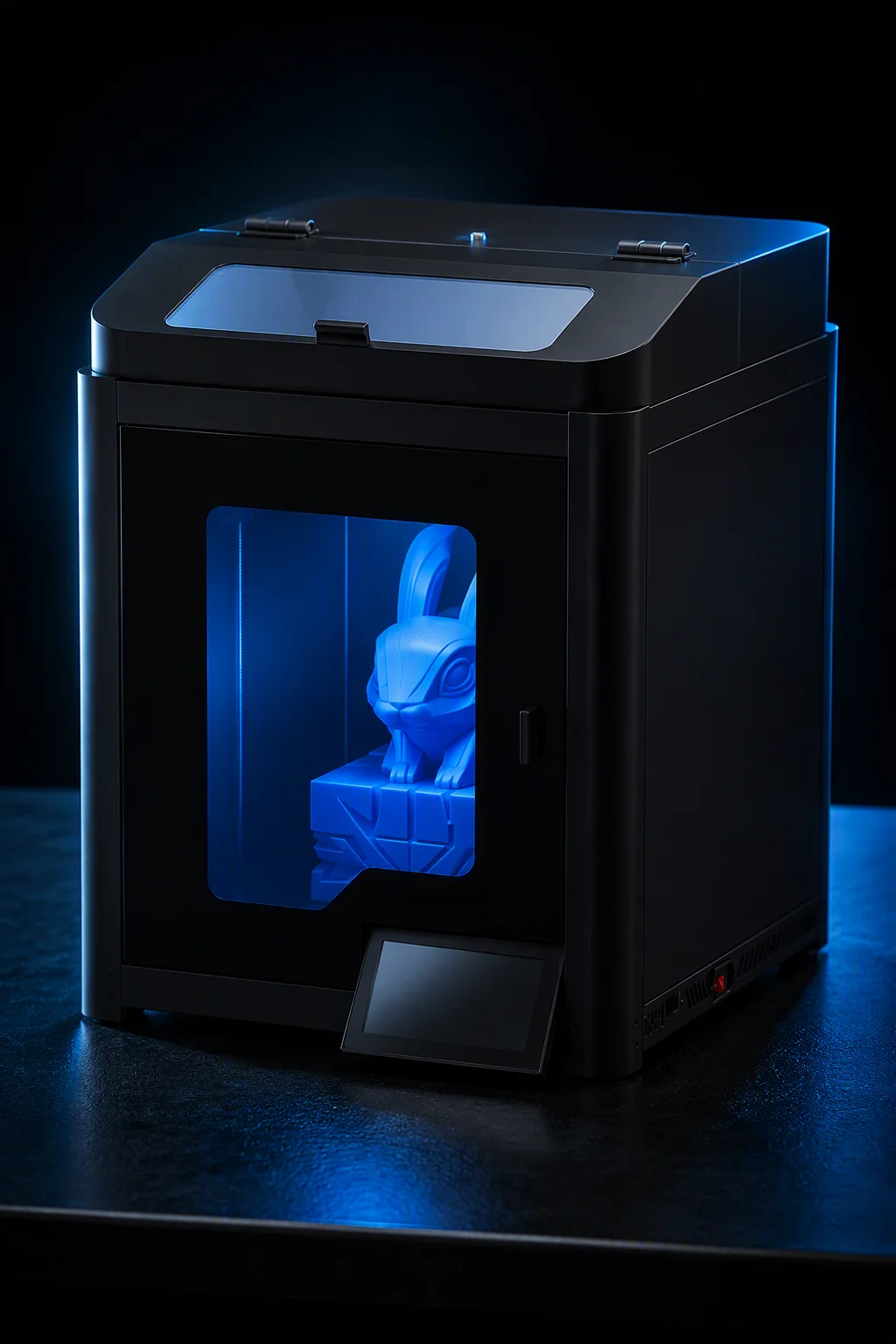
Almost every customer who asks about a heated chamber wants to print ABS or polycarbonate and has already tried an enclosure tent. The tent did not fix it, because a tent only keeps the warm air the printer generates. It cannot hold a setpoint, and the top of a 300 mm tall part still cools at a different rate than the bottom. This guide is about the arithmetic that separates a real active chamber from an enclosure: what temperature range is actually needed, what it costs per part in electricity, and how to size the heating power so the chamber reaches setpoint in a reasonable time. For the passive side of the same problem, see the enclosure temperature control guide and the heated chamber overview.
What a Passive Enclosure Actually Achieves
A well-sealed passive enclosure around a printer with a 250 W heated bed and a hotend running at 260 degC stabilises somewhere between 38 and 47 degC chamber temperature, depending on ambient and print duration. That is enough to stop the worst of ABS warping on small parts. It is not enough for three situations that customers hit regularly:
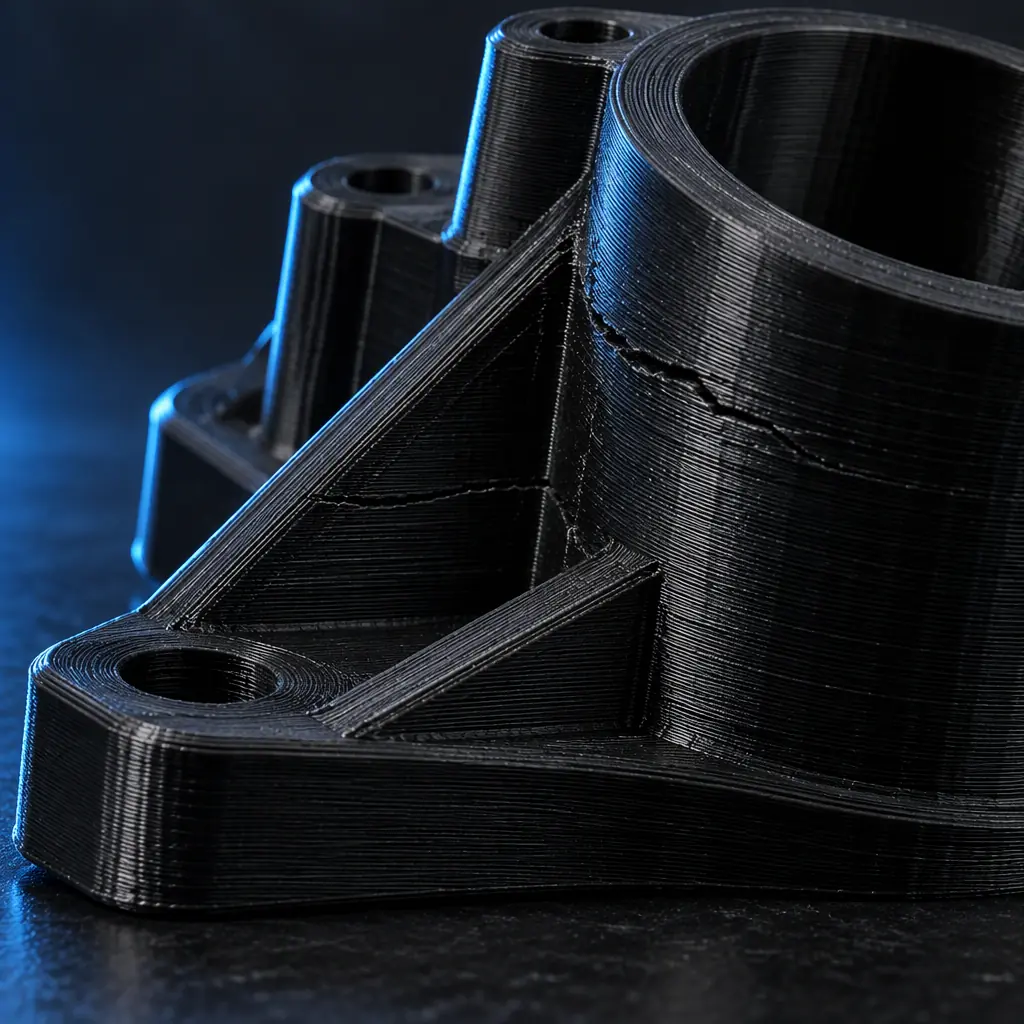
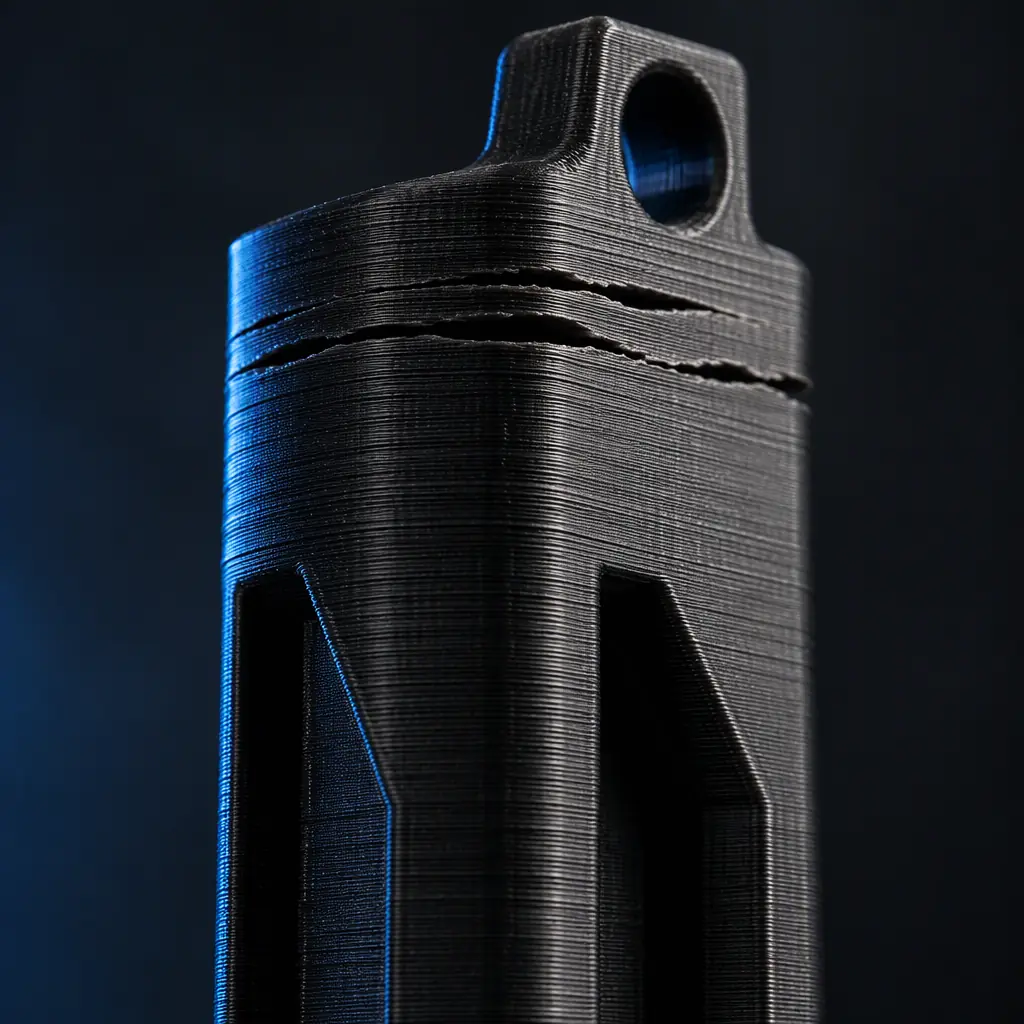
- Tall parts. The temperature gradient between the bottom and top of a 300 mm build stays 10-18 degC in a passive enclosure. Polycarbonate and PC-blend parts crack along layer lines near the top regardless of how good the bed adhesion is.
- Large cross-sections with slow perimeters. Where each layer takes several minutes, the previously deposited layers cool well below their glass transition temperature before the next layer arrives.
- Engineering materials with high Tg. PC prints reliably around 90-110 degC chamber; PPSU and PEI want 150-180 degC. No passive enclosure reaches these numbers.
The commercial consequence is a support call a distributor cannot answer. A customer buys a PC-capable printer, runs a passive enclosure, gets cracked parts, and concludes the printer is not actually PC-capable. The error was in the surrounding system the distributor did not sell.
Sizing the Heater: Power, Setpoint and Time
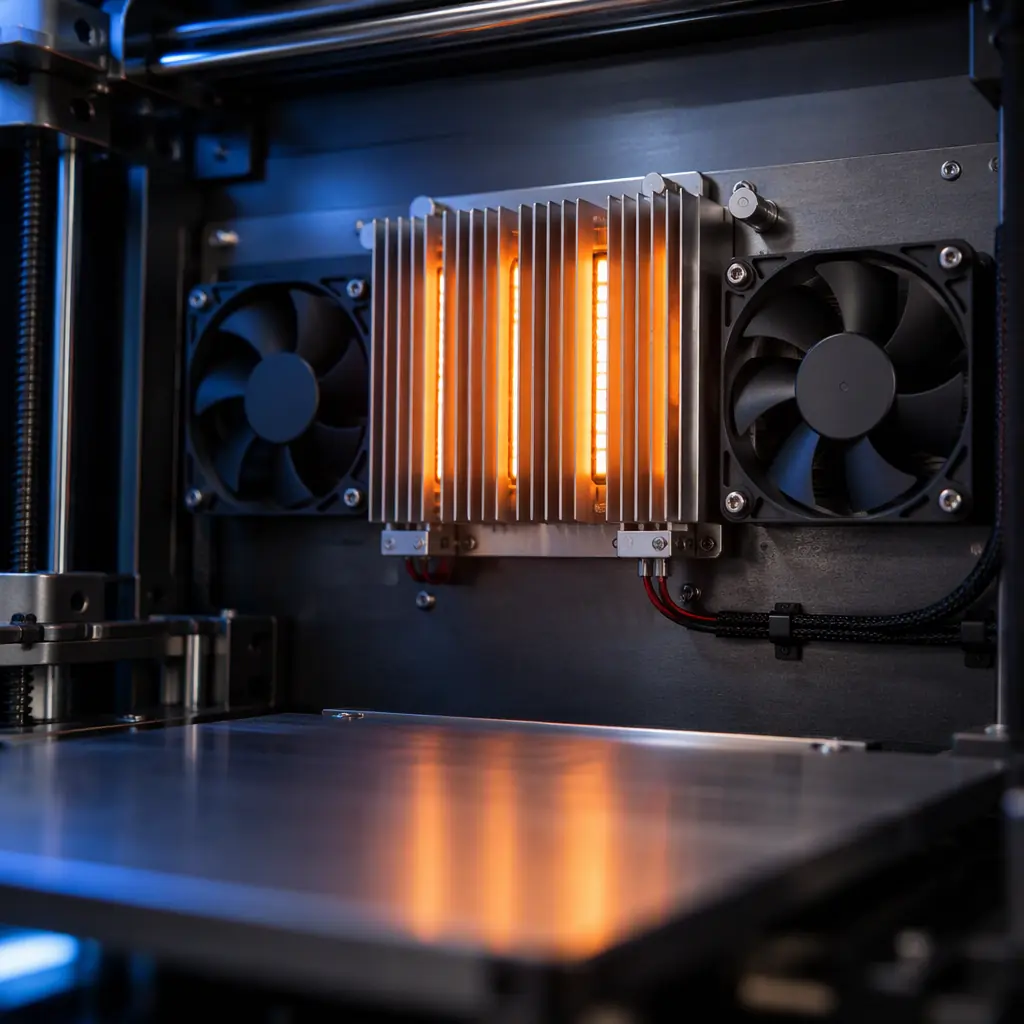
Chamber heating power is commonly undersized. The rule of thumb that holds across the installed base is 15-25 W of chamber heating per litre of enclosed volume for a target setpoint of 60 degC, rising to 30-40 W per litre for 100 degC and above. A typical 400 x 400 x 450 mm enclosure is around 72 litres, which puts a 60 degC chamber at 1.1-1.8 kW and a 100 degC chamber at 2.2-2.9 kW.
That standby figure is the number customers never estimate correctly. Heating 72 litres to 60 degC and holding it for a 20-hour print does not draw 1.4 kW for 20 hours; it draws peak power for the first 15 minutes and then roughly a third of peak to replace losses. On a 20-hour PA print at 60 degC and $0.15/kWh, the chamber adds roughly $4.50-7.00 to the electricity bill. That is the number to quote, not the peak draw, because the peak draw number makes customers reject the idea before they finish the sentence.
The Real Question: Does Chamber Heating Pay for Itself?
For a customer printing functional ABS or PC parts, the ROI argument is about yield rather than energy. This is where distributors can show arithmetic no competitor bothers to present.
Consider a service bureau running three printers on PC-blend parts, average part value $85, average print 6 hours including failures. Without chamber heating they report a 30 percent failure rate concentrated in tall and large parts. The failures are not evenly distributed: they cluster in the top half of the build and on parts over 120 mm, which means roughly 45 percent of their revenue hours carry the risk.
- Three printers, 20 hours per day each, 300 print hours per day at $14/hour machine rate = $4,200 per day.
- Without active chamber: 30 percent failure on the at-risk share translates to roughly 13.5 percent of total capacity lost = $567 per day.
- With active chamber at 90 degC: failure rate on the same parts drops to 6-8 percent, recovering about $450-480 per day.
- Retrofit kit cost for three units at 2.4 kW: $2,400-3,600 installed.
The retrofit pays back in under two weeks of recovered capacity, before counting the customer-relationship cost of a failed part on a deadline. That is the pitch, and it works because the number is specific to the customer's own failure rate rather than an industry average. Ask the failure rate first, then do the arithmetic in front of them.
What an Active Chamber Changes About the Printer
Distributors who retrofit chambers discover a second set of requirements that must ship with the kit or the installation generates support calls. These are not optional accessories; they are consequences of the chamber reaching temperature.
- Stepper motor thermal margin. Steppers lose torque as they heat. In a 60 degC chamber the motors on the Z and extruder axes run 85-95 degC case temperature. Motors rated to 130 degC are necessary; cheap 80 degC-rated motors will skip steps on long prints.
- Belt and bearing lubrication. Standard lithium grease migrates out of bearings above 70 degC. High-temperature PTFE or silicone grease is required, and it becomes a stocked consumable line.
- Electronics relocation or insulation. Control boards rated to 50 degC ambient must be moved outside the chamber or actively cooled. A chamber running at 60 degC with the board inside will destroy drivers within months.
- Filament path. Filament sitting in a 60 degC chamber for 12 hours softens and deforms in the extruder path. External dry-box feeding through a bulkhead passthrough becomes mandatory, not optional.
- Filtration. ABS and PC at chamber temperature release substantially more VOC than at room temperature. Recirculating carbon filtration needs to be sized for the chamber volume.
Those five items are the reason a chamber retrofit is a system sale rather than a heater sale, and they are also the reason the retrofit carries better margin than the printer. A distributor who quotes a heater alone creates a customer who will retrofit a second unit from someone else. For how these components fit the wider consumable programme, see the consumables bundling strategy and the fume extraction guide.
Choosing Between a Retrofit and a Chamber-Ready Printer
The honest answer depends on part size and material, and distributors should be willing to say so. A retrofit makes sense when the customer already owns printers with adequate motion systems and wants to unlock PC or large ABS parts without replacing the fleet. A chamber-ready machine is the better answer when the requirement includes PA, PPSU or PEI, when parts exceed 300 mm in the tall axis, or when the customer needs the chamber temperature recorded as part of a process record for a regulated customer.
For regulated work the retrofit path has a hidden cost: a chamber temperature that nobody validates is not a controlled process parameter. If the parts are going into a medical or aerospace customer's product, the chamber needs a logged thermocouple channel and a documented soak profile, which starts to look like a machine-level feature rather than an add-on. Distributors who understand that distinction can steer a customer to the right purchase instead of selling a retrofit that gets rejected at audit. For the qualification side of that conversation, see the end-use component qualification guide.
Bottom Line
An active heated chamber is a yield investment, not an energy cost. Size the heater at 15-25 W per litre for 60 degC and 30-40 W per litre for 100 degC, quote the standby energy rather than the peak draw, and build the ROI case from the customer's own failure rate on tall parts. Ship the retrofit with high-temperature motors, high-temperature grease, external electronics cooling, a bulkhead filament passthrough and filtration, because each of those becomes a support call if it is missing.
Reviewed by the Precise3D engineering & OEM team. Compliance files that accompany the catalog are auditable at the certification register.
Start Your Partnership
Ready to offer chamber retrofits to Your Market?
Chamber retrofits sell as systems: heater bank, high-temperature motors, dry-box passthrough and filtration. Request the OEM & white-label program sheet and volume pricing.