A machine shop manager evaluating a 3D printer investment is not asking "which is better?" — they are asking "at what point does 3D printing become cheaper, faster, or uniquely capable compared to what I already own?" Answering this question requires understanding the economic breakpoints of both technologies, not generic feature comparisons.
The analysis in this guide draws on 200+ distributor sales conversations with small-to-medium manufacturers across North America, Europe, and Southeast Asia. The data shows a clear pattern: manufacturers who understand the cost inflection point between CNC and 3D printing adopt both technologies. Those who view it as a zero-sum choice leave money on the table — typically 18–34% in prototyping costs and 2–8 weeks in product development timelines.
The Economic Breakpoint: When 3D Printing Beats CNC on Cost
The most common mistake in CNC-vs-3DP comparisons is comparing machine prices. A $2,500 desktop CNC router costs less than a $1,500 3D printer when you factor in tooling, workholding, and operator training — but per-part economics tell a different story. The cost crossover happens earlier than most manufacturers expect.
The critical insight for distributors: the cost crossover for simple geometries (brackets, spacers, flat plates) happens around 30–80 units. For complex geometries (internal channels, lattice structures, organic shapes), 3D printing wins at any quantity because CNC simply cannot produce the geometry. This is your strongest sales argument — not "cheaper" but "physically impossible to machine." For understanding how manufacturers evaluate these trade-offs, see our injection molding vs 3D printing guide which covers a parallel economic analysis.
Geometry Freedom: The Conversation CNC Can't Win
CNC machining is subtractive — it removes material from a block. This means every internal feature requires tool access. Internal channels, undercuts, conformal cooling passages, and lattice structures are either impossible or require multi-axis setups and disposable fixtures that drive per-part costs into three-digit territory even at moderate quantities.
3D printing builds layer by layer with no tool access constraint. Internal geometries cost nothing extra. This is not a "cheaper" argument — it is a capability argument. When a customer says "but my CNC can make this," ask them to describe the geometry of the part they actually want, not the simplified version they redesigned to be machinable. The gap between the ideal design and the machinable design is where 3D printing wins.
What you're listening for: If the customer describes features their current design lacks — weight reduction pockets, internal cooling channels, organic ribbing — they have already validated the 3D printing use case. Your job is to connect their ideal design to a printer that can produce it.
Common geometries that favor 3D printing include: conformal cooling channels in injection mold inserts (25–40% cycle time reduction), topology-optimized brackets (40–60% weight reduction vs machined equivalent), and fluid manifolds with curved internal passages that eliminate 90° elbow fittings. For distributors selling to manufacturers, the 3D printing for manufacturing tooling guide has 12 specific tooling applications with ROI calculations.
Material Reality: What Each Technology Actually Produces
CNC machining works with billet metals — aluminum 6061/7075, stainless 304/316, titanium, brass, and engineering plastics like PEEK and Delrin. The resulting parts have isotropic mechanical properties (same strength in all directions) and predictable fatigue behavior because the material's grain structure is uniform. For load-bearing structural components in production environments, this is still the gold standard.
3D printing produces anisotropic parts — weaker in the Z-axis (layer adhesion direction) than in X/Y. FDM parts typically retain 60–80% of Z-axis strength vs X/Y. However, material science has narrowed this gap substantially. Engineering filaments like carbon-fiber-filled PA6 and PEI (Ultem) achieve 85–92% Z-axis strength retention, making them viable for functional end-use parts in non-structural applications. Our engineering filaments guide has complete mechanical property tables for 14 materials.
The Breakthrough in Tolerances: How 3D Printing Is Closing the Precision Gap
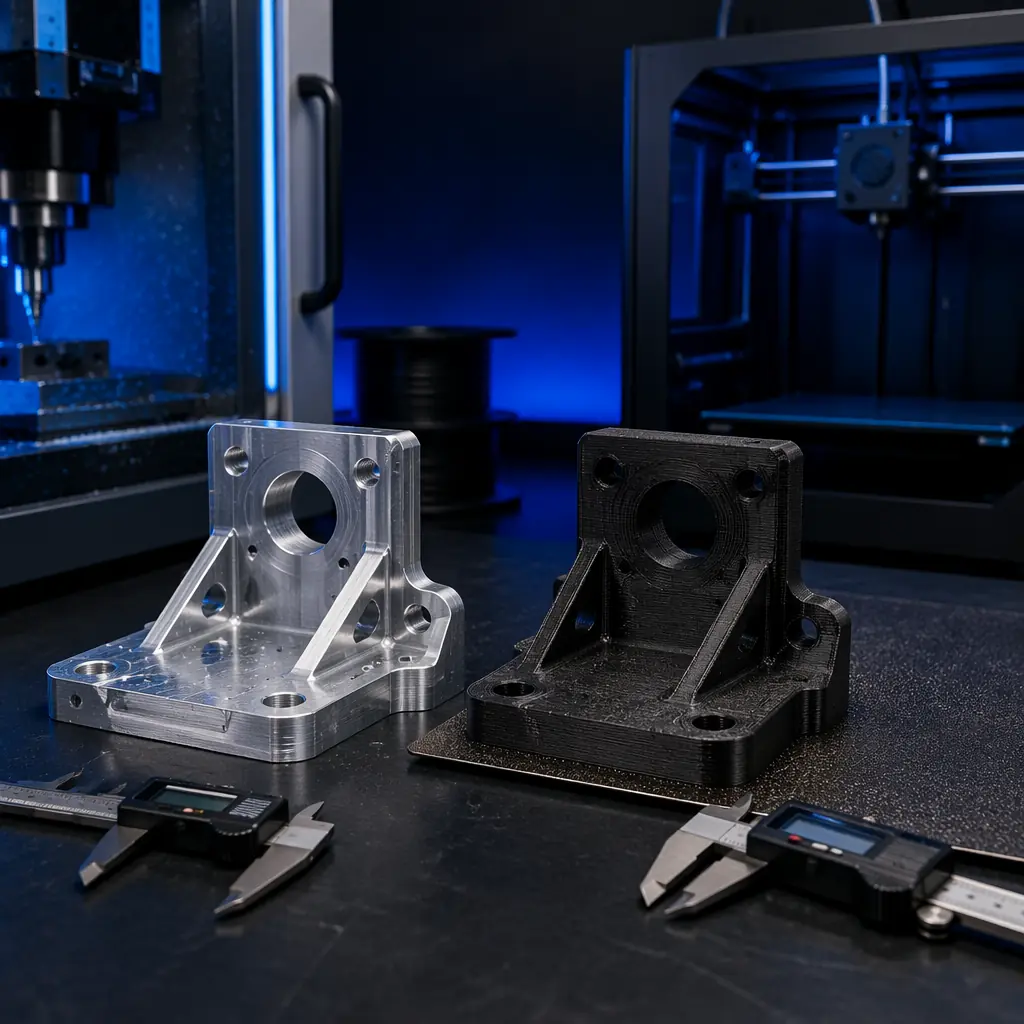
Five years ago, the tolerance argument was a knockout punch: CNC held ±0.025mm while FDM struggled with ±0.5mm. That gap has narrowed dramatically. Modern CoreXY printers with input shaping, pressure advance, and linear rails routinely hold ±0.1mm on XY dimensions and ±0.15mm on Z. Resin printers (MSLA) achieve ±0.035mm — within striking distance of entry-level CNC. For a deep dive into the calibration techniques behind these numbers, see our advanced calibration guide and high-speed printing technology guide.
The practical tolerance conversation with a manufacturer should focus on functional requirements, not specification sheets. Most non-precision mechanical parts (brackets, enclosures, jigs, fixtures, covers, cable guides) require ±0.2–0.5mm — well within FDM capability. The parts that genuinely require CNC-level tolerances (bearing seats, press-fit bores, sealing surfaces) represent 5–15% of a typical assembly's part count. The other 85–95% are candidates for 3D printing — and recognizing this ratio is how distributors build hybrid manufacturing proposals that win.
Speed: Prototyping Lead Time vs Production Throughput
"CNC is faster" is true for production — once the machine is programmed and fixtured, a CNC mill can produce a simple part in 3–8 minutes vs 45–90 minutes on a 3D printer. But the timeline customers actually care about is not per-part cycle time — it is the time from concept to first physical part in hand.
For prototyping, the numbers invert. CNC requires CAM programming (30–90 minutes for a moderately complex part), workholding setup (15–45 minutes), tool selection and loading (10–20 minutes), and often multiple setups for multi-sided parts. Total: 1.5–4 hours before the first chip is cut. 3D printing requires slicing (2–5 minutes) and hitting print. Total: under 10 minutes to first layer. This is why rapid prototyping teams adopt 3D printing first — not because the prints are faster per part, but because the workflow is 10–30x faster from idea to object. Our rapid prototyping for R&D teams guide covers the full workflow economics.
The Hybrid Manufacturing Framework: Selling Both, Not Either
The most successful 3D printer distributors do not position against CNC — they position alongside it. The conversation that closes the highest-value B2B deals follows a simple three-part framework:
1. Prototype on 3D printer, validate with CNC. Print 3–5 design iterations in the time it takes to CAM-program one CNC part. When the design is finalized, machine the production version. This reduces product development cycles by 40–60% for manufacturers who previously prototyped everything on CNC. See our portfolio strategy guide for market segmentation frameworks.
2. Print tooling, machine products. Jigs, fixtures, soft jaws, CMM holding fixtures, and assembly aids are perfect 3D printing applications — they are low-quantity (1–5 units), geometry-intensive, and CNC time spent on them is time not spent on revenue-generating production parts. Manufacturers who adopt 3D-printed tooling typically free up 12–25% of CNC capacity for production work. The manufacturing tooling guide has a tooling opportunity calculator.
3. Print end-use parts where geometry demands it. When a part's ideal design includes features CNC cannot produce — internal cooling channels, lattice weight reduction, organic flow paths — 3D printing is not a cheaper alternative, it is the only manufacturing method. This conversation shifts the buyer's frame from "why should I buy a 3D printer" to "which parts am I currently over-engineering to be machinable?"
Selling Points by Customer Type
Different manufacturing customers need different frames for the CNC-vs-3DP conversation. Tailor your pitch to the buyer's actual pain point:
The distributors who win manufacturing accounts consistently position the 3D printer as a CNC capacity multiplier — not a CNC replacement. When your customer sees the 3D printer as a tool that makes their existing CNC investment more profitable (by offloading low-margin prototyping and tooling work), the sale becomes obvious. For the financial framework behind these conversations, see our TCO and ROI calculator guide and pricing strategy guide.
Reviewed by the Precise3D engineering & OEM team. Compliance files that accompany the catalog are auditable at the certification register.
Win Manufacturing Accounts
Precise3D Distributor Partnership — Printers That Manufacturers Actually Buy
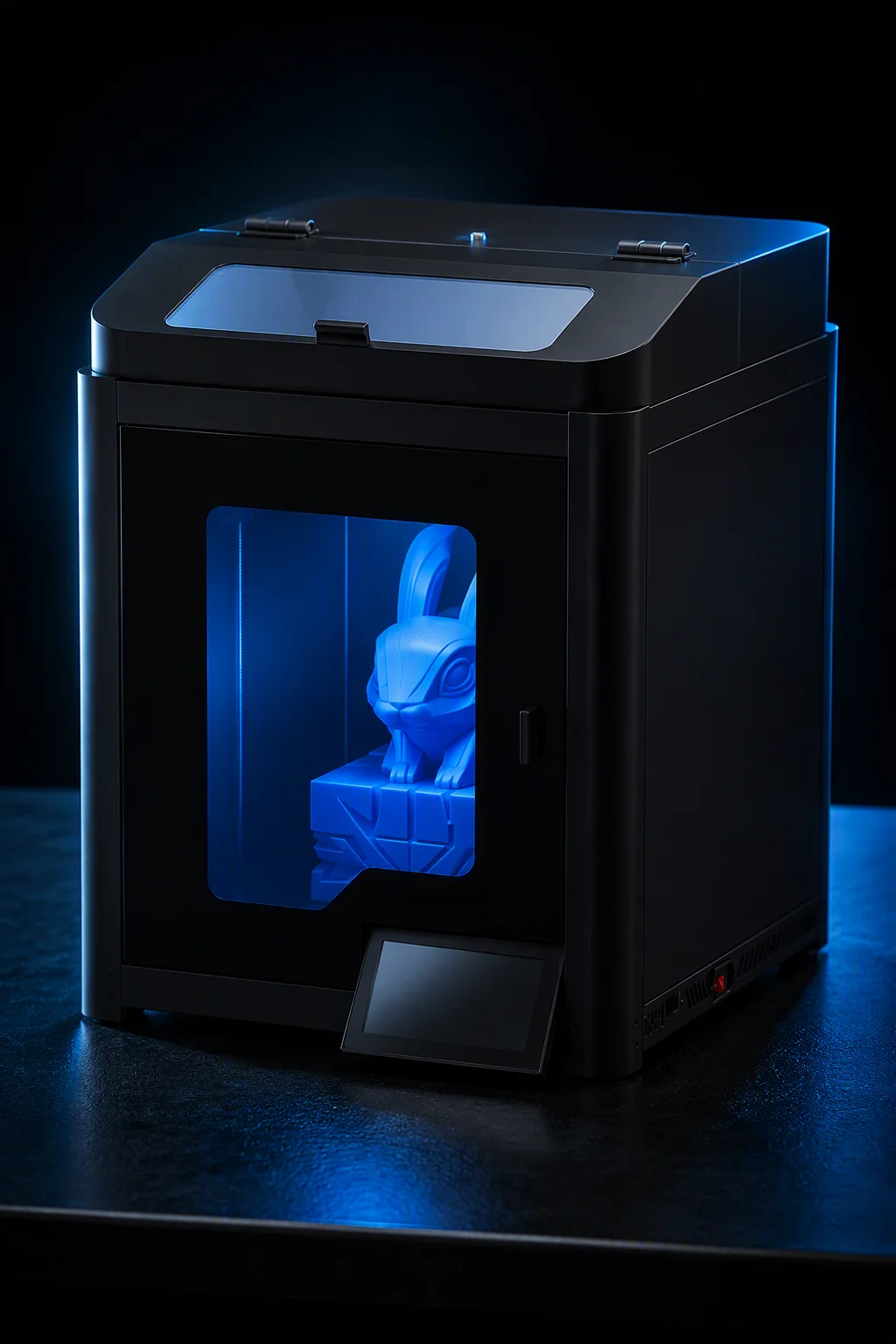
Our enclosed CoreXY printers are the most common first 3D printer purchase for CNC-equipped machine shops because they print engineering materials (CF-PA, PC, ASA) out of the box with ±0.1mm dimensional accuracy. Partner with us and receive the hybrid manufacturing sales playbook, ROI calculator templates, and reference cases from 200+ machine shop deployments.