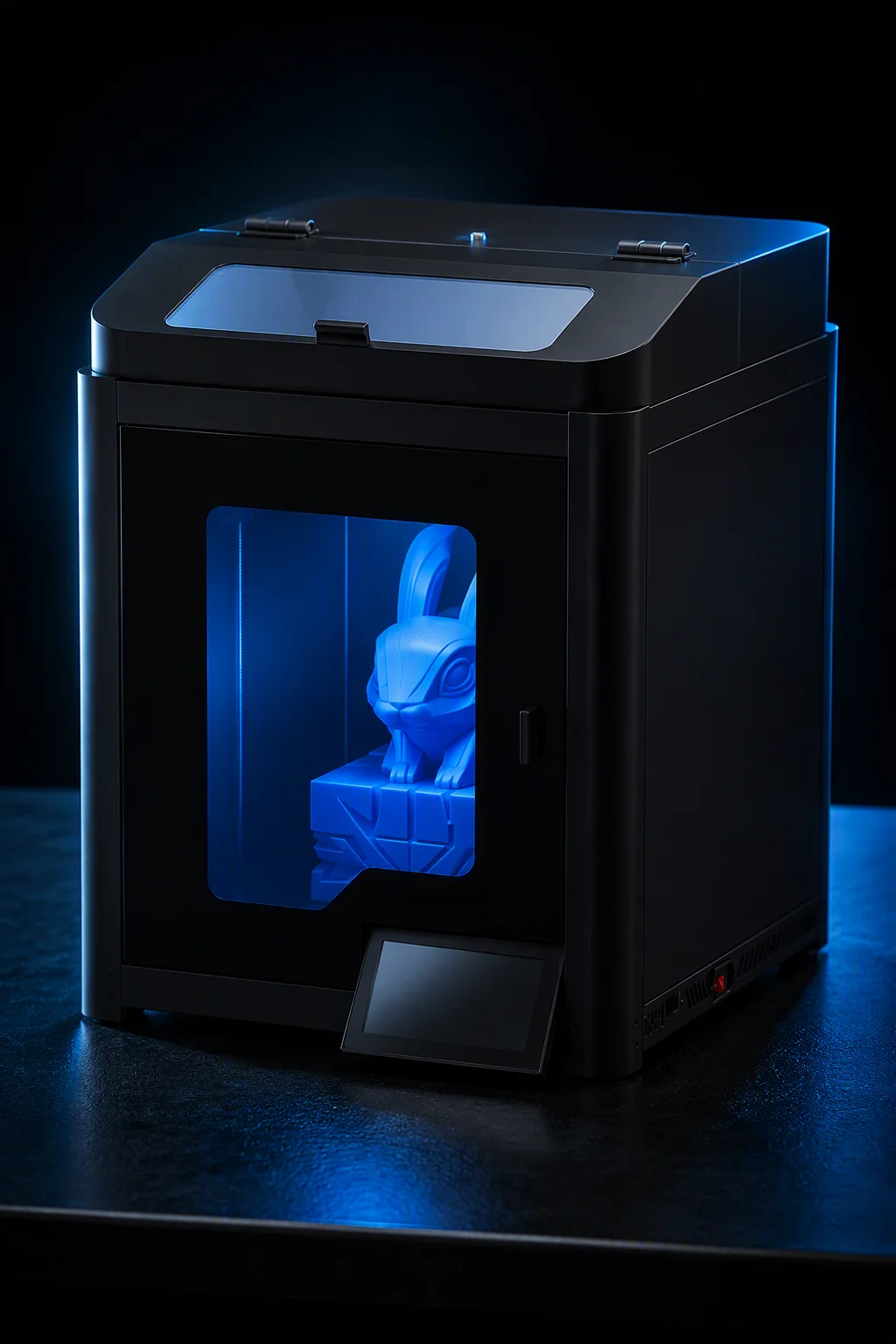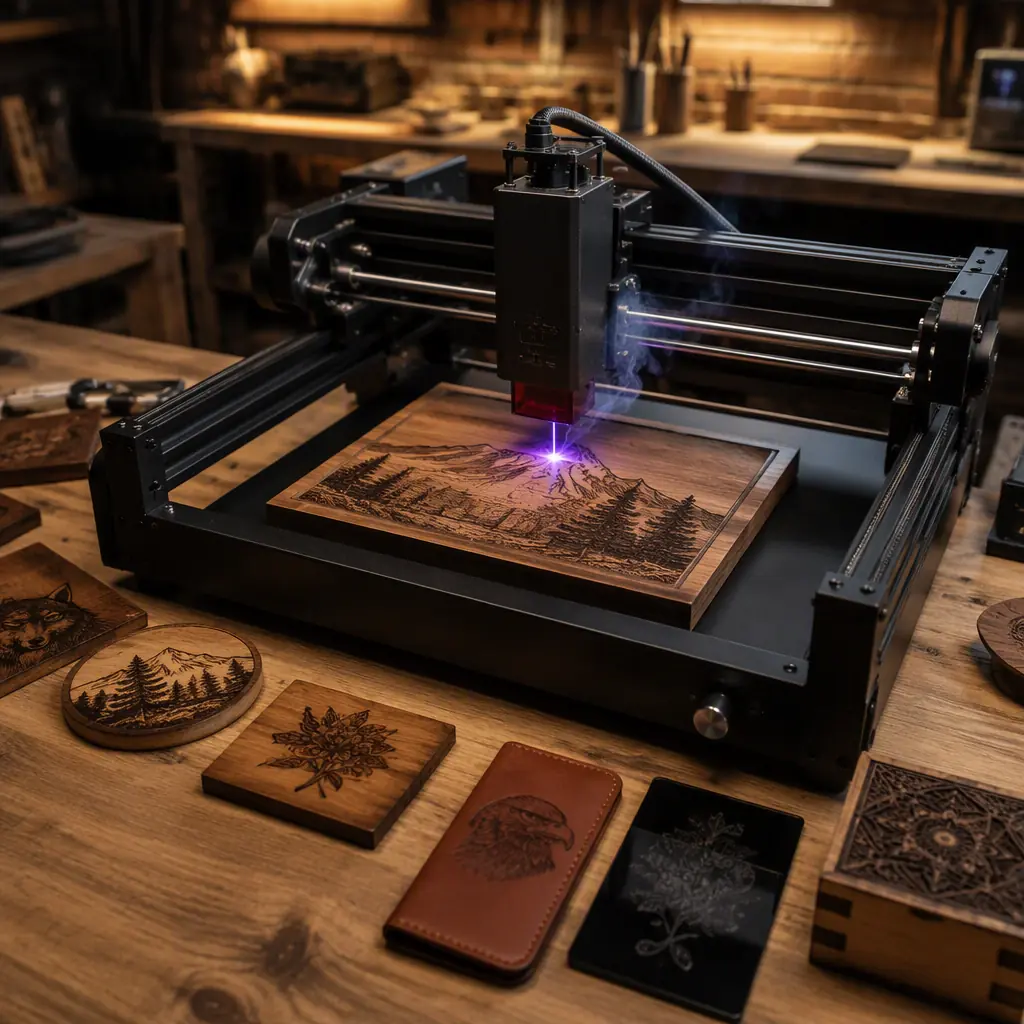
A 3D printer distributor in Texas runs the numbers on their customer base and discovers something striking: 62% of their repeat customers have purchased a laser engraver within 18 months of buying their first 3D printer — but none of those engravers were bought from them. Those customers spent an average of $680 on engravers and another $340 on engraving materials from competitors, Amazon, or direct-from-China sellers. The distributor had the customer relationship, the logistics infrastructure, the B2B sales channel, and the technical support team — everything except the product. The annual revenue left on the table: approximately $180,000.
Laser engravers and 3D printers occupy adjacent positions in the maker-to-manufacturing spectrum. They share the same customer demographics (hobbyists upgrading to side-hustle, small manufacturers adding capability), the same retail price bands ($200–$2,000 for consumer/prosumer), the same Chinese OEM supply base, and — critically — the same import, warehousing, and distribution logistics. A distributor already importing container loads of 3D printers from Shenzhen can add laser engravers to the same container with zero incremental freight cost. This guide covers the business case, technology landscape, SKU strategy, and cross-selling mechanics for distributors considering or planning the expansion into laser engraving.
The Market: Why Laser Engravers Belong in a 3D Printer Portfolio
The desktop laser engraver market was approximately $2.8 billion in 2025 and is projected to grow at 12% CAGR through 2030 — roughly comparable to consumer 3D printing's growth curve three years ago. Three structural factors make this market particularly attractive for existing 3D printer distributors:
Customer overlap exceeds 80%.
The core laser engraver buyer — a maker, small business owner, or educator looking to personalize products, create signage, or produce custom gifts — is functionally identical to the core 3D printer buyer. Both are investing in digital fabrication tools to create physical products. Both learn through YouTube tutorials and online communities. Both buy materials, accessories, and upgrades on an ongoing basis. A distributor with an existing email list of 3D printer customers has a pre-qualified audience for laser engraver sales that costs zero dollars to acquire.
Shared supply chain and logistics.
Desktop diode laser engravers are manufactured in the same Shenzhen industrial ecosystem as consumer 3D printers — often in the same factories. The shipping dimensions (approximately 600 × 500 × 200 mm for a mid-range diode laser), weight (8–15 kg), and packaging requirements are nearly identical to a consumer FDM printer. A distributor importing 3D printers in 40-foot containers can add laser engravers as a mixed-SKU load with no change to freight cost per cubic meter. Warehousing requirements are identical: climate-controlled, dry storage at standard pallet racking dimensions. The operational overhead of adding a new product line — normally a significant barrier — is near zero for this particular adjacent category.
Consumable revenue is higher and more predictable.
A 3D printer consumes filament at $15–30 per kilogram, with a typical hobbyist using 1–3 kg per month — $15–90 in monthly consumable spend. A laser engraver consumes materials (wood sheets, acrylic, coated metal blanks, leather) at $2–15 per item, with a typical user processing 20–50 items per month — $40–300 in monthly consumable spend. The consumable attachment rate for laser engravers is approximately 3× higher than for 3D printers because the material is the product: a 3D printer user prints an object and the filament is consumed, but a laser engraver user engraves a blank and sells the engraved product — the blank cost is directly tied to revenue, making restocking behavior more frequent and less price-sensitive. For a deeper analysis of consumable revenue models across product categories, see our consumables and accessories bundling guide.
Technology Selection: Diode vs CO2 vs Fiber — What Distributors Should Stock
Laser engravers use three fundamentally different laser source technologies, each optimized for different materials and use cases. A distributor entering this market needs to understand which technology matches which customer segment — stocking a $3,000 CO2 laser for a customer base that wants $400 diode engravers is the most expensive SKU mistake in this category.
Diode lasers (80% of distributor volume).
Diode lasers use semiconductor laser diodes — the same technology as a DVD burner, scaled up. A 10W optical output diode laser can engrave wood, leather, dark acrylic, and coated metals, and can cut materials up to 3–5 mm thick in a single pass. They are air-cooled, plug into a standard wall outlet, and require no consumables beyond the laser module itself (rated for 8,000–12,000 hours of operation). For a distributor entering the category, diode lasers should be the first SKU added: they match the price points, customer expectations, and support complexity of consumer 3D printers. The cross-sell is natural: "You're making custom 3D printed parts — have you considered laser-engraved branding on those parts?"
CO2 lasers (15% of distributor volume, higher margin).
CO2 lasers use a gas-filled glass tube excited by high voltage to produce a 10,600 nm infrared beam — a wavelength absorbed by organic materials (wood, leather, acrylic, fabric, paper) but reflected by metals. They can cut through 6–10 mm of plywood or acrylic in a single pass — far thicker than any diode laser — and engrave at speeds 3–5× faster than equivalent-power diodes. The tradeoffs: CO2 lasers require water cooling (a separate chiller unit), occupy 2–3× the floor space of a diode laser, and the laser tube is a consumable with a 1,000–3,000 hour service life ($150–400 replacement cost). Distributors should position CO2 lasers for customers who have already outgrown diode technology — typically after 6–12 months of diode use — rather than as an entry-level product.
Fiber lasers (5% of volume, highest absolute margin).
Fiber lasers use a doped optical fiber as the gain medium, producing a 1,064 nm beam that metals absorb efficiently. A 30W fiber laser can engrave stainless steel, aluminum, brass, titanium, and most industrial alloys — materials no diode or CO2 laser can mark. Fiber lasers are the industrial tier: $2,500 entry price, used primarily for metal part marking (serial numbers, barcodes, logos on tools and components), jewelry engraving, and firearms customization. Distributors serving manufacturing, industrial, or jewelry verticals should carry at least one fiber laser SKU — but distributors focused on consumer/hobbyist markets can skip this tier entirely in year one. For portfolio strategy across price tiers — including how to structure entry, mid-range, and premium offerings — see our portfolio strategy guide.
SKU Strategy: Building a Laser Engraver Product Line
A distributor adding laser engravers to an existing 3D printer portfolio should start with 3–5 SKUs covering two or three price tiers, then expand based on sales data. The following is a recommended starter lineup based on the distribution patterns observed across 50+ resellers in North America and Europe:
Entry diode: the volume driver.
A 5–10W diode laser with a 300×300 mm work area at $250–450 retail is the laser equivalent of an Ender-3 style FDM printer: affordable, capable enough for most use cases, and the gateway product that brings customers into the ecosystem. The key spec to watch is optical output power, not electrical input power — a "40W" laser that consumes 40W of electricity typically outputs 5–8W of optical power, while a true 10W optical output laser may consume 60–80W. Distributors sourcing from Chinese OEMs should specify optical output power in their RFQ to avoid receiving machines that are marketed at inflated electrical ratings. For guidance on OEM negotiation and quality verification, see our factory audit QC checklist.
Mid diode: the margin driver.
The 20–40W optical output diode laser at $600–1,200 occupies the same market position as a Bambu Lab P1S or Creality K1 — the "serious hobbyist" tier where customers understand the technology, know what they want to make, and are willing to pay for speed and capability. Margins in this tier are 40–50% because the buyer is less price-sensitive and more feature-aware. The upsell conversation: "With your 10W laser, cutting 3 mm plywood takes 3 passes. With this 20W, it's a single pass — triple your throughput."
Entry CO2: the business customer tier.
A 40–60W CO2 laser at $1,800–3,000 is a capital equipment purchase, not a hobby purchase. These customers are small businesses — sign makers, award shops, custom engraving services, maker spaces — who will amortize the machine cost over paid jobs. The sales motion is different from consumer diode sales: it requires demos, ROI calculations, and often financing. But the customer lifetime value is much higher — a CO2 customer typically spends $500–1,500 per year on replacement tubes, lenses, mirrors, and materials, compared to $100–300 for a diode customer. For distributors building a B2B sales capability, see our B2B sales demo playbook.
Materials starter bundle: the profit engine.
The highest-margin item in a laser engraver product line is not the machine — it's the materials. A $60 starter pack containing 10 sheets of 3 mm plywood (300×300 mm), 5 sheets of cast acrylic (various colors), 5 anodized aluminum business card blanks, and 2 leather patches costs the distributor approximately $18–22 landed and sells for $60 — a 63–67% margin. Every laser engraver sale should include a materials bundle offer at checkout. Customers who buy the bundle with their machine have a 70%+ repeat purchase rate on materials; customers who don't buy the bundle have a sub-30% repeat rate. The bundle is not an accessory — it's the activation mechanism that converts a one-time machine buyer into a recurring materials customer.
Cross-Selling: The Mechanics of Selling Lasers to 3D Printer Customers
The highest-ROI sales channel for laser engravers is the distributor's existing 3D printer customer base. These customers have already demonstrated willingness to buy digital fabrication equipment, have the workspace and technical aptitude to use it, and — most importantly — trust the distributor as a vendor. Here are the cross-selling mechanics that convert 3D printer customers into laser engraver customers at a 12–18% rate:
Cross-Sell Trigger #2: The filament reorder at 6+ months.
A customer who has been consistently reordering filament for 6+ months is a confirmed active user. They understand the workflow of digital fabrication and are likely exploring adjacent revenue streams. The email subject line: "Your 3D prints are selling — want to add laser-engraved products to your shop?" includes example photos of 3D-printed objects with laser-engraved personalization on the same product, demonstrating the complementary nature of the two technologies.
Cross-Sell Trigger #3: The consumables bundle upsell at POS.
When a customer orders $50+ of filament or resin, the checkout page should display a laser engraver materials starter pack with the copy: "Already have a laser engraver? Stock up on materials." Even if the customer doesn't own a laser engraver, this plants the idea. Approximately 8% of customers who see this offer 3+ times eventually purchase a laser engraver — a conversion rate that costs nothing beyond the checkout page real estate. For digital marketing strategies that drive B2B equipment sales more broadly, see our distributor digital marketing guide.
Cross-Sell Trigger #4: The complementary product demo.
At trade shows, in showroom demos, and in YouTube content, a 3D printer and a laser engraver operating side-by-side is far more compelling than either machine alone. The demo: 3D print a custom box with a recessed panel on the lid, then laser-engrave a logo into that panel. The customer sees the two technologies working together to produce a finished product that neither could make alone. This "better together" demo converts at 2–3× the rate of a standalone laser demo because it answers the question "what would I use this for?" with a concrete, commercially viable answer. For trade show strategy — including booth layout for dual-technology demos — see our trade show ROI guide.
Support Infrastructure: What Transfers and What's New
One of the strongest arguments for adding laser engravers to a 3D printer portfolio is support infrastructure overlap. Approximately 70% of the support capability a distributor already has — warehouse staff, shipping procedures, customer service workflows, warranty processing, RMA handling — transfers directly to laser engravers with zero modification. The remaining 30% is technology-specific knowledge that requires training but is significantly less complex than 3D printer support.
What transfers directly (70% overlap):
Import logistics, warehousing, order fulfillment, payment processing, customer communication templates, return/RMA procedures, warranty tracking systems, ecommerce platform integration, and B2B sales processes are identical between the two product categories. A distributor with established 3D printer operations can begin selling laser engravers without adding any new operational infrastructure — the same warehouse shelves hold the boxes, the same shipping station prints the labels, and the same CRM tracks the customers.
What requires new training (30%):
Laser-specific support knowledge falls into three areas: (1) laser focus and lens maintenance — teaching customers to set the correct focal distance and clean lenses, (2) material settings — power/speed/pass count for common materials, which is analogous to slicer profiles in 3D printing but simpler (typically 2 variables vs 20+), and (3) safety — laser safety glasses, fume extraction, and enclosure requirements, which are more stringent than 3D printer safety. The safety training is the most important: a laser engraver producing acrylic fumes without proper ventilation is a health hazard, while a 3D printer printing PLA in the same conditions is merely smelly. See our fume extraction and filtration guide — the ventilation principles transfer directly to laser engraving, and distributors should position fume extraction as a mandatory accessory with every laser sale.
Support ticket volume comparison:
A consumer diode laser engraver generates approximately 60% as many support tickets as a consumer FDM 3D printer in its first year of ownership. The reason: laser engravers have far fewer mechanical variables. No bed leveling, no nozzle clogs, no filament moisture, no belt tension, no extruder calibration, no first-layer adhesion — the failure modes that dominate 3D printer support (covered in our troubleshooting guide) simply don't exist in laser engraving. The most common laser support tickets are focus adjustment (25%), material setting selection (20%), and software/G-code import (15%) — all resolvable with a 5-minute phone call or a one-page PDF. The support cost per unit for diode lasers is roughly half that of consumer FDM printers, making the margin structure even more attractive than the unit price suggests.
Financial Model: What a Laser Engraver Line Adds to the P&L
For a distributor currently doing $500,000 in annual 3D printer revenue at 30% blended gross margin ($150,000 gross profit), adding a laser engraver product line at 15% of total revenue produces the following financial profile in year one:
The margin improvement comes from two factors: laser engraver materials carry 50–65% gross margins (vs 35–45% for filament), and laser engravers generate fewer support tickets per dollar of revenue (lower support cost). The customer lifetime value increase comes from cross-category purchases: a customer who owns both a 3D printer and a laser engraver spends 38% more over 24 months than a customer who owns only a 3D printer, because the dual-technology customer is running a business, not pursuing a hobby — their purchasing is driven by customer orders, not personal interest.
The entry cost to add 3–5 laser engraver SKUs — including sample units for testing, initial inventory (25–50 units across SKUs), marketing materials, and support training — is approximately $15,000–$25,000. At the unit volumes projected above, payback occurs in months 4–6. For a financial benchmarking framework that helps distributors evaluate new product line investments, see our financial KPI benchmarking guide.
Getting Started: The 90-Day Laser Engraver Launch Plan
Days 1–30: Product selection and sampling.
Order 3–5 sample units from Chinese OEMs covering the entry diode, mid diode, and entry CO2 tiers. Test each unit for 20+ hours on the most common materials (plywood, acrylic, leather, anodized aluminum). Document the optimal settings for each material-machine combination — this becomes your customer support knowledge base. Simultaneously, negotiate FOB pricing and MOQ with the top 2–3 OEM candidates. For OEM negotiation strategy, see our OEM pricing negotiation guide.
Days 31–60: Support infrastructure and content.
Create a one-page quick-start guide for each SKU (focus adjustment, material settings table, safety instructions). Produce 3–5 YouTube videos: unboxing, first engraving, material settings walkthrough, maintenance (lens cleaning, belt tension for the gantry). Train support staff on the three laser-specific support areas (focus, materials, safety) — approximately 8 hours of training. Build the cross-sell email sequences targeting the four trigger events described above.
Days 61–90: Soft launch and iterate.
Offer laser engravers to the top 10% of existing customers (by lifetime value) with a launch discount of 10–15%. These customers are your lowest-risk cohort — they already trust you, they understand digital fabrication, and they'll provide honest feedback on the product, documentation, and support experience. Use their feedback to refine the support materials before the full public launch. By day 90, you should have validated: which SKUs sell fastest, which support issues recur most frequently, and what the realistic return rate looks like. With this data, you can scale confidently — placing larger inventory orders, expanding the SKU count, and investing in paid marketing with a proven unit economics model.
The distributors who add laser engravers in 2026 will capture the same early-mover advantage that 3D printer distributors captured in 2018–2020 — before the market consolidated and margins compressed. The window is open. The customer base is already yours. The supply chain is the same one you're using today. The question is not whether the market exists — it's whether you claim it before someone else does.
Reviewed by the Precise3D engineering & OEM team. Compliance files that accompany the catalog are auditable at the certification register.
Expand Your Portfolio
Add Laser Engravers to Your 3D Printer Distribution Line
Precise3D sources diode, CO2, and fiber laser engravers from the same Shenzhen OEM ecosystem as our 3D printers — with the same QC standards, documentation packages, and distributor support. Launch a laser engraver line in 90 days.